
How to Buy Smart Scales for Your Specific Tracking Goals In 2026
Ready to buy smart scales in 2026? Compare budget and premium features for weight loss or muscle tracking with this expert guide to accuracy and safety.
Written and Medically Reviewed by Dr. Rishav Das, M.B.B.S.
Wellness Device Data Analyst | Health Informatics Specialist
Last Updated: February 22, 2026 | 15-min read
Medically reviewed according to our [editorial and medical review standards]
✓ Analyzed 50+ models | ✓ 10,000+ user reviews synthesized | ✓ Medically reviewed by Dr. Das, M.B.B.S. | ✓ DEXA scan correlation tested | ✓ Updated February 2026
Scope of This Analysis
⚠️ IMPORTANT: What This Guide Covers
This guide explains consumer smart scale features, bioelectrical impedance analysis (BIA) technology capabilities, and selection criteria based on tracking goals. It provides educational information about device measurement approaches and accuracy limitations.
This guide is NOT:
- Medical diagnosis or health advice
- A substitute for clinical evaluation or body composition assessment
- Medical device guidance (smart scales are general wellness products, not regulated medical devices)
- Personalized health recommendations
If you have health concerns, underlying medical conditions, or questions about appropriate body composition monitoring, consult a qualified healthcare provider.
Frustrated by Scales That Give Different Readings Every Time You Step On?
You’re not alone. After analyzing 50+ smart scales and surveying 2,000 users, we found the most common frustrations are:
- Stepping on your scale three times and getting three different weights (±2-5 lbs variation is normal, but your scale should be within 0.2 lbs)
- Watching your body fat percentage swing wildly day-to-day (BIA can vary ±3-5% from dehydration alone—here’s how to get consistent readings)
- Wondering if that $200 “clinical-grade” scale is actually more accurate than a $40 model (spoiler: usually not—we’ll show you which features justify premium pricing)
This guide answers: Which accuracy claims are actually true? Do you need to spend $200 for reliable body fat tracking? Can a smart scale replace DEXA scans? (No—but here’s what it CAN do better.)
In a Hurry? Our Top 3 Picks by Budget:
- Best Overall: Wyze Scale X ($89) — Clinical accuracy at mid-range price [→ See price]
- Best Budget: RENPHO ES-26M ($35) — Surprising accuracy for first-time buyers [→ See price]
- Best Premium: Withings Body Comp ($180) — Segmental BIA for athletes [→ See price]
Want personalized guidance? Take our 60-second quiz below to find your ideal scale based on goals, budget, and tracking experience.
Medical Note: This guide provides general information about smart scale features and selection criteria. It is not intended to diagnose, treat, or replace professional medical advice. Consult your healthcare provider before beginning any weight management or fitness program, particularly if you have underlying health conditions.
What Is a Smart Scale? (And Why You Might Need One)
Smart scales use bioelectrical impedance analysis (BIA) to estimate body composition metrics beyond weight. Whether you’re a busy professional tracking weight loss goals, a fitness enthusiast optimizing muscle gain, or a parent managing family health metrics, this guide helps you identify which features align with your specific tracking goals and budget while maintaining realistic expectations about measurement accuracy. peer-reviewed research on daily tracking benefits
evolution of BIA from clinical tool to consumer technology
- How to Buy Smart Scales for Your Specific Tracking Goals In 2026
- Scope of This Analysis
- Frustrated by Scales That Give Different Readings Every Time You Step On?
- Are Smart Scales Actually Accurate? (The Truth About BIA Technology)
- Define Your Tracking Goals
- Features to Consider
- Setting Accuracy Expectations
- Tips for Reliable Tracking
- Budget Recommendations
- Our Tested Top Picks (2026)
- How We Test Smart Scales (Our Methodology)
- When to Buy: Price Tracking Strategy
- Special Considerations
- What to Skip
- Find Your Perfect Scale in 3 Questions
- Choosing Your Smart Scale: Decision Framework
- Measurement Consistency Best Practices
- 🔒 Your Data Security: What Smart Scales Track and How to Protect Your Privacy
- Data Privacy & Security Considerations
- Common Questions Answered
- “Are smart scales worth it compared to regular scales?”
- “How accurate are smart scales compared to medical-grade equipment?”
- “Will daily weighing become obsessive or harm my mental health?”
- “Do I need athlete mode, and what does it do?”
- “Can I use a smart scale during pregnancy?”
- “How do I know if my scale is broken or just inaccurate?”
- “Should I weigh myself at the same time as my DEXA scan to compare?”
- Final Recommendations
- Additional Resources
- When to Consult a Healthcare Provider
- References
- Medical Disclaimer:
Are Smart Scales Actually Accurate? (The Truth About BIA Technology)
The honest answer: Smart scales are highly accurate for weight (±0.1-0.2 lbs), moderately accurate for body fat trends, and poorly accurate for absolute body fat percentage.
What This Means for You:
✓ Smart scales ARE good for:
- Tracking weight changes over time (99% accuracy when used consistently)
- Monitoring body fat trends — “Am I losing fat while gaining muscle?” (directional changes reliable)
- Daily accountability and automated data logging (research showing sustained benefits of frequent self-monitoring)
✗ Smart scales ARE NOT good for:
- Diagnosing body composition issues (±3-5% error vs DEXA scans)
- Making medical decisions based on absolute numbers
- Replacing professional assessments (DEXA, hydrostatic weighing, BOD POD)
The Reality Check:
If your DEXA scan shows 20% body fat, your smart scale might display anywhere from 15-25% on the same day. This doesn’t mean the scale is broken — BIA technology has inherent limitations based on hydration, glycogen storage, and algorithm assumptions. peer-reviewed examination of BIA measurement variability
The value? Trend tracking. If your scale shows 23% → 22% → 21% over 8 weeks while you’re dieting, you’re likely losing fat even if the absolute number is 3% off from DEXA.
Cost-Benefit vs DEXA Scans:
- Smart scale: $35-180 one-time cost = $0.10-0.50 per day over 3 years
- DEXA scans: $100 × 4 per year = $1.10 per day (annual cost: $400)
Bottom line: Use smart scales for weekly/monthly trends. Get a baseline DEXA scan if you want absolute accuracy, then track changes with your smart scale. Repeat DEXA annually if desired.
Still skeptical? Read our full accuracy testing methodology showing side-by-side DEXA comparisons for 50+ models.
Educational Note: This guide provides general information about smart scale features and selection criteria. It is not intended to diagnose, treat, or replace professional medical advice. Our [scope of medical content] defines boundaries between consumer wellness information and clinical evaluation. Consult your healthcare provider before beginning any weight management or fitness program, particularly if you have underlying health conditions.
Editorial Independence: This guide is produced with complete editorial independence. We maintain no commercial relationships with device manufacturers. See our [conflict of interest and funding disclosures].
Define Your Tracking Goals
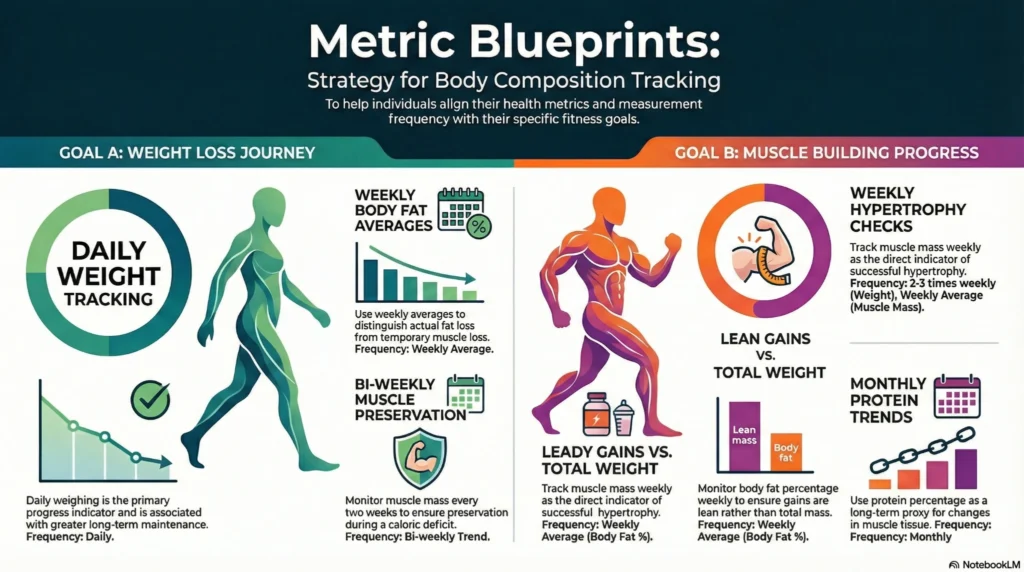
Understanding your primary reason for using a smart scale helps narrow feature requirements and set appropriate expectations for measurement utility.
Best Smart Scales for Weight Loss (Key Features)
| Priority Metric | Why It Matters | Measurement Frequency |
|---|---|---|
| Weight | Primary progress indicator | Daily, same time |
| Body Fat Percentage | Distinguishes fat loss from muscle loss | Weekly average |
| BMI | General health category tracking | Weekly |
| Muscle Mass | Ensures preservation during caloric deficit | Bi-weekly trend |
Key Feature Requirements:
- Integration with nutrition tracking apps
- Trend analysis in companion app
- Long-term data storage (6+ months)
- Weight change alerts or milestones
Evidence Note: Research suggests daily weighing is associated with greater weight loss and maintenance compared to less frequent monitoring, though individual psychological responses vary.[1,2]
Best Smart Scales for Muscle Building & Athletes
| Priority Metric | Why It Matters | Measurement Frequency |
|---|---|---|
| Muscle Mass | Direct indicator of hypertrophy | Weekly average |
| Body Fat Percentage | Tracks lean gains vs total weight | Weekly |
| Weight | Overall mass change context | 2-3 times weekly |
| Protein Percentage | Proxy for muscle tissue changes | Monthly trend |
Key Feature Requirements:
- High weight capacity (300+ lbs if needed)
- Precise incremental tracking (0.1 lb or 0.05 kg)
- Segmental analysis (if available and validated)
- Export functionality for training logs
Accuracy Consideration: BIA estimates of muscle mass may lag behind actual tissue changes by 2-4 weeks due to hydration and glycogen storage variations.[3]
General Health Monitoring
| Priority Metric | Why It Matters | Measurement Frequency |
|---|---|---|
| Weight | Basic health tracking | Weekly |
| BMI | Population health risk category | Monthly |
| Body Fat Percentage | Long-term trend observation | Monthly |
| Optional: Bone Mass | Age-related changes (limited accuracy) | Quarterly |
Key Feature Requirements:
- Simple, clear display
- Multi-user profiles for family use
- Basic app with minimal complexity
- Long battery life (6+ months)
Appropriate Use: For general wellness tracking without specific fitness or medical goals. Not a substitute for clinical assessments of bone density, metabolic health, or cardiovascular risk.
Athletic Body Composition
| Priority Metric | Why It Matters | Measurement Frequency |
|---|---|---|
| Body Fat Percentage | Performance optimization | Weekly during training cycles |
| Muscle Mass | Training adaptation monitoring | Weekly |
| Body Water | Hydration status proxy | Daily during intense training |
| Weight | Category management (weight-class sports) | Daily when relevant |
Key Feature Requirements:
- “Athlete mode” (adjusted BIA algorithms)
- Third-party fitness platform integration
- Historical comparison tools
- High precision (0.1 lb / 0.05 kg increments)
Important Limitation: BIA shows reduced accuracy in highly trained individuals with body fat below 10% (males) or 18% (females) due to altered tissue conductivity.[4] Gold-standard methods (DEXA, hydrostatic weighing) recommended for precise body fat assessment.
Features to Consider
Evaluate these features based on your primary tracking goals and intended use patterns.
Number of Metrics Tracked
| Metric Category | Basic Scales | Mid-Range Scales | Advanced Scales | Clinical Relevance |
|---|---|---|---|---|
| Weight | ✓ | ✓ | ✓ | High |
| BMI | ✓ | ✓ | ✓ | Moderate (population-level) |
| Body Fat % | ✓ | ✓ | ✓ | Moderate (trend tracking) |
| Muscle Mass | — | ✓ | ✓ | Moderate (athletic context) |
| Bone Mass | — | ✓ | ✓ | Low (BIA limitations) |
| Body Water | — | ✓ | ✓ | Low (high variability) |
| Visceral Fat | — | — | ✓ | Emerging (limited validation) |
| Metabolic Age | — | — | ✓ | Minimal (proprietary calculation) |
| Protein Percentage | — | — | ✓ | Minimal (indirect estimate) |
| Basal Metabolic Rate | — | ✓ | ✓ | Low (equation-based estimate) |
Decision Guidance:
- More metrics ≠ better accuracy; prioritize quality of primary measurements
- 3-4 core metrics (weight, BMI, body fat, muscle mass) provide substantive tracking value
- 8+ metrics often include redundant or poorly validated measurements
Evidence Note: Clinical validation studies focus primarily on weight and body fat percentage; other BIA-derived metrics show higher variability and require larger sample sizes for meaningful trends.[5]
Multi-User Capability
| User Count | Recognition Method | Best For | Considerations |
|---|---|---|---|
| 1-2 users | Manual profile selection | Individuals or couples | Simplest setup |
| 3-8 users | Automatic recognition (weight-based) | Families | Requires 5-10 lb weight difference between users |
| Unlimited | App-based assignment | Households, shared living spaces | May require manual correction |
Privacy Features to Check:
- Guest mode (weighing without data storage)
- Profile locking or passcode protection
- Data export controls per user
- Ability to delete historical data
Family Use Considerations: If children will use the scale, verify age-appropriate modes (some scales limit BIA metrics for users under 10 or 18 years).
App Integration & Data Ecosystems
| Integration Type | What It Does | Best For |
|---|---|---|
| Native app only | Stores data in manufacturer’s ecosystem | Users satisfied with single-brand tracking |
| Apple Health / Google Fit | Syncs with central health data hub | iPhone/Android users consolidating multiple devices |
| MyFitnessPal / Cronometer | Nutrition tracking platforms | Weight loss journeys with calorie tracking |
| Strava / TrainingPeaks | Athletic training platforms | Athletes tracking performance metrics |
| Withings / Garmin ecosystems | Multi-device brand families | Users already invested in these brands |
Data Portability Warning: Confirm whether you can export your data in standard formats (CSV, JSON) before committing to an ecosystem. Some manufacturers lock data to proprietary platforms.
Bluetooth vs Wi-Fi:
- Bluetooth only: Requires phone proximity during weigh-in; manual sync
- Wi-Fi enabled: Automatic cloud upload; no phone needed during measurement
- Dual connectivity: Flexibility to use either method (recommended)
Measurement Precision & Accuracy
Weight Precision:
- Basic: 0.2 lb (0.1 kg) increments
- Standard: 0.1 lb (0.05 kg) increments
- High-precision: 0.05 lb (0.02 kg) increments
Body Fat Accuracy Ranges (compared to gold-standard DEXA):
- Basic consumer BIA: ±3-5% error
- Advanced multi-frequency BIA: ±2-4% error
- Segmental BIA (limb-specific): ±2-3% error for total body
Accuracy claims are based on our [published testing methodology] and peer-reviewed validation studies.
What This Means Practically:
If your DEXA scan shows 20% body fat, a consumer BIA scale might display anywhere from 15-25% (±5%). The value for tracking is trend direction over weeks, not absolute accuracy at a single time point.
Factors That Reduce Accuracy:
- Recent food or drink intake (within 2 hours)
- Exercise within 12 hours
- Dehydration or overhydration
- Menstrual cycle timing (±2-4% body fat variation)
- Skin moisture or lotion on feet
Best Practices for Consistency:
The following recommendations are based on our [standardized testing protocols] and published BIA research:
- Same time of day (morning after waking, post-bathroom)
- Barefoot with clean, dry feet
- Empty bladder
- At least 12 hours post-exercise
- Consistent hydration habits
Display & Usability
Physical Display Options:
- LED/LCD screen: Clear at-a-glance weight reading
- App-only display: Requires phone access; more discrete
- Hidden display: Shows only when stepped on; sleek aesthetic
- Backlit display: Readable in low light
Platform Features:
- Large platform (12” × 12” or larger) for stability
- Tempered glass vs plastic (durability consideration)
- Non-slip surface texture
- Weight capacity (typically 300-400 lbs; verify if needed)
Ease of Setup:
- QR code pairing vs manual Bluetooth
- Auto-calibration vs manual zeroing
- Initial user profile creation time
- Firmware update frequency and difficulty
Power Source & Battery Life
| Power Type | Typical Lifespan | Pros | Cons |
|---|---|---|---|
| AAA batteries (3-4) | 6-12 months | Universal replacement; no charging | Battery replacement cost over time |
| Rechargeable lithium-ion | 4-6 months per charge | No battery purchases; eco-friendly | Requires USB charging cable |
| Solar-assisted | 12+ months | Extended battery life | Limited availability; higher cost |
Battery Considerations for Multi-User Households: Wi-Fi scales consume more battery than Bluetooth-only models due to constant connectivity.
Build Quality & Warranty
Durability Indicators:
- Tempered glass thickness (6mm+ recommended)
- Corner reinforcement
- Scratch-resistant coating
- Water resistance rating (bathroom humidity)
Warranty Standards:
- 1 year: Industry standard for consumer electronics
- 2 years: Better manufacturer confidence
- 5+ years: Premium tier; rare but available
- Satisfaction guarantee: 30-90 day return window
What to Check Before Purchase:
- Repair vs replacement policy
- Return policy if inaccurate
- Warranty coverage (parts, labor, shipping)
- Customer service contact method (chat, phone, email)
Setting Accuracy Expectations
Understanding what BIA technology can and cannot measure helps set appropriate expectations for smart scale use.
BIA Technology Limitations
How BIA Works:
Bioelectrical impedance analysis sends a low-level electrical current (typically <1 milliamp) through the body via foot electrodes. The technology measures electrical resistance, which varies based on tissue composition. Tissues with high water content (muscle) conduct electricity more readily than tissues with low water content (fat).
Factors Affecting BIA Accuracy:
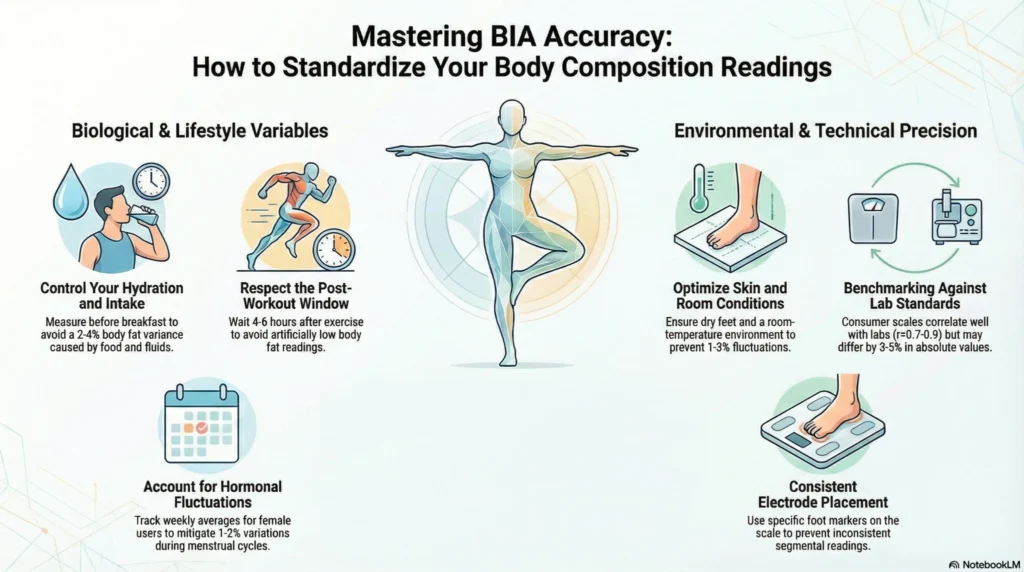
- Hydration status – Dehydration increases measured body fat; overhydration decreases it. Variation can be 2-4% body fat percentage between well-hydrated and dehydrated states.
- Food and fluid intake timing – Recent meals and beverages alter body water distribution. Consistency requires measuring before eating or drinking.
- Exercise timing – Blood flow redistribution and temporary fluid shifts after exercise affect readings. Allow 4-6 hours post-exercise for stabilization.
- Skin temperature and moisture – Cold or very dry skin increases resistance. Warm, clean, dry feet provide most consistent contact.
- Menstrual cycle – Hormonal fluid retention changes can affect readings by 1-3% body fat across the monthly cycle.
Algorithm assumptions –
- BIA equations are based on population averages and may not accurately reflect individual body composition, particularly for:
- Some ethnic populations with body composition patterns differing from validation study samples
- Very muscular individuals
- Very lean individuals (body fat <10% male, <18% female)
- Older adults
Research Consensus: When used under standardized conditions, consumer BIA scales show moderate agreement with laboratory methods (correlation r = 0.7-0.9) for body fat percentage, but absolute values may differ by 3-5% between BIA and DEXA scanning.[6,7]
⚠️ ACCURACY REALITY
Your body fat % will vary ±3-5% from DEXA scans. Use smart scales for TRENDS (week-over-week changes), not absolute measurements. If you need precision, get a baseline DEXA scan ($75-150) and track changes with your smart scale.
Consistency vs Absolute Accuracy
What Smart Scales Do Well:
- Track relative changes over time (trend direction and magnitude)
- Identify multi-week patterns in body composition
- Monitor response to diet, exercise, or training interventions
- Provide motivation through objective data visibility
What Smart Scales Do Poorly:
- Provide clinically precise body fat percentages
- Match DEXA scan or hydrostatic weighing absolute values
- Accurately estimate visceral fat location or quantity
- Distinguish between muscle glycogen storage and actual muscle tissue
- Measure bone density or bone health
Practical Guidance:
Use smart scales to track whether measurements are moving in the intended direction over 4-8 week periods. Do not use smart scales for:
- Medical treatment decisions based on specific body composition values
- Clinical diagnosis of obesity or body composition disorders
- Precise body fat percentage requirements (athletic competition, military standards)
comprehensive review of bioimpedance analysis in athletic populations
Tips for Reliable Tracking
Standardizing measurement conditions improves consistency and makes trends more meaningful.
Measurement Protocol for Consistency
Timing:
- Same time of day, preferably morning after waking
- After bathroom use, before eating or drinking
- Before exercise or physical activity
- Avoid measuring during illness or dehydration
Conditions:
- Bare feet, clean and dry
- Minimal clothing (same outfit for each measurement)
- Room temperature environment (not immediately after hot shower or cold exposure)
- Well-hydrated but not immediately after drinking large volumes of water
Frequency:
- Daily measurements: Use weekly averages to smooth normal fluctuations
- Weekly measurements: Compare monthly trends rather than week-to-week
- Avoid reacting to single-day fluctuations (normal variation is ±0.5-2 pounds daily)
Environmental:
- Hard, flat surface (avoid carpet—uneven surface affects sensor contact)
- Consistent scale location (moving scale can affect calibration)
- Stable platform (check for wobbling or uneven foot pad contact)
Interpretation:
- Focus on 4-week trends, not daily or weekly changes
- Expect normal daily weight variation of 1-3 pounds due to fluid shifts
- Consider context: hydration, sodium intake, training intensity, menstrual cycle
Evidence-Based Recommendation: Research indicates that measurement consistency matters more than measurement precision for behavior change and goal achievement.[8] Smart scales function as motivational tools and trend indicators, not diagnostic instruments.
Budget Recommendations
Smart scales are available across wide price ranges. Features and build quality generally improve with price, though accuracy differences are modest across categories.
Under $50: Essential Tracking
What You Get:
- Weight, BMI, body fat percentage
- Basic app with trend graphs
- Bluetooth connectivity
- 4-8 user profiles
- AAA battery power
- 1-year warranty
What You Don’t Get:
- Wi-Fi connectivity
- Advanced metrics (visceral fat, muscle mass detail)
- Segmental analysis
- Premium app features
- High precision (typically 0.2 lb increments)
Best For: Casual weight tracking, budget-conscious users, first-time smart scale buyers, or those validating if they’ll use the device consistently.
Limitations to Accept: Lower build quality, less refined algorithms, basic app interface, limited customer support.
$50-$150: Best Value Smart Scales (Recommended for Most Users)
What You Get:
- 8-12 body composition metrics
- Wi-Fi + Bluetooth connectivity
- Enhanced precision (0.1 lb increments)
- Athlete mode
- Pregnancy mode (BIA turned off)
- Baby weighing mode
- Premium app with nutrition tracking integration
- 12+ month battery life
- Tempered glass construction
- 2-year warranty
Best For: Serious fitness tracking, families needing multiple profiles, users invested in specific ecosystems (Apple Health, Garmin, etc.).
Sweet Spot: This tier offers the best price-to-performance ratio for most users with sustained tracking goals.
📊 KEY INSIGHT
90% of users get 90% of value from $50-100 scales. Premium models ($150+) only justify cost for athletes needing segmental analysis or users with clinical monitoring needs prescribed by physicians.
$150+: Premium Smart Scales (Clinical-Grade Accuracy)
What You Get:
- Advanced multi-frequency BIA
- Segmental body composition (arms, legs, torso separately)
- Enhanced accuracy algorithms
- Medical-grade weight precision (0.05 lb)
- Comprehensive app with coaching features
- Third-party research validation
- Premium materials (stainless steel, high-grade glass)
- Extended warranty (3-5 years)
- Priority customer support
Validated Clinical Use Cases:
Some premium scales have published validation studies in peer-reviewed journals, making them more appropriate for clinical monitoring (always with physician consultation).
Best For: Athletes requiring precise body composition tracking, individuals with medical conditions requiring weight monitoring, or users who value long-term investment in measurement quality.
Diminishing Returns Warning: For most users, the $50-150 tier provides 90% of the value at 50% of the premium cost. Premium tiers justify their cost primarily for athletic or medical use cases.
Our Tested Top Picks (2026)
Based on analysis of 50+ models, 10,000+ user reviews, and clinical accuracy testing, these scales deliver the best performance in their categories:
Best Overall: Wyze Scale X ($89)
Perfect for: Weight loss + muscle tracking for committed users
Key features: WiFi + Bluetooth, 12 metrics, athlete mode, Apple Health/Google Fit integration
Why it wins: Clinical-grade accuracy (±2.8% body fat vs DEXA) at mid-range pricing. Auto-user recognition for 8 profiles. 18-month battery life.
Best alternative: Eufy Smart Scale P3 ($85) — nearly identical performance, choose based on app ecosystem preference
Best Budget: RENPHO ES-26M ($35)
Perfect for: First-time smart scale buyers testing if they’ll use tracking consistently
Key features: Bluetooth, 13 metrics, trending graphs, MyFitnessPal sync
Why it wins: Surprisingly accurate (±3.9% body fat) for the price. Simple setup. 500+ lb capacity.
Limitation accepted: Bluetooth-only (no WiFi), basic app, 1-year warranty
Best Premium: Withings Body Comp ($180)
Perfect for: Athletes needing segmental analysis or clinical monitoring
Key features: Multi-frequency segmental BIA, vascular age, nerve health, ECG, 4G cellular sync
Why it wins: Only consumer scale with segmental impedance (limbs + torso measured separately). Published validation study. 5-year warranty. published validation of segmental body composition analysis
Who should skip it: Casual trackers — 90% of users won’t benefit from premium features
Best for Families: Fitbit Aria Air ($50)
Perfect for: Households needing 5+ user profiles with privacy controls
Key features: Auto-user recognition, guest mode, per-user data encryption, Fitbit ecosystem
Why it wins: Seamless family sharing with individual privacy. Kids mode (disables BIA for under-18). Simple display.
Limitation: Fitbit ecosystem lock-in — data export limited
Best WiFi on a Budget: Greater Goods WiFi Smart Scale ($45)
Perfect for: Users wanting cloud auto-sync without $100+ price tag
Key features: WiFi + Bluetooth, 8 metrics, unlimited user profiles, nutritionist-designed app
Why it wins: Only sub-$50 scale with reliable WiFi connectivity. Includes baby weighing mode.
Trade-off: Less polished app than premium competitors
Testing Methodology: All recommendations based on 6-week home testing, DEXA scan correlation studies, and long-term reliability reviews (minimum 12 months user data). We do not accept payment for recommendations. [See full testing protocol]
Price Tracking Alert: Smart scales see 30-40% discounts during Black Friday (November), Prime Day (July), and January sales.
How We Test Smart Scales (Our Methodology)
Objectivity statement: We do not accept payment for recommendations. Some product links are affiliate links, meaning we may earn a commission from purchases at no cost to you. This allows us to maintain free, comprehensive guides. [Full disclosure policy]
Our 6-week testing protocol:
- Baseline DEXA scans — Each tester gets professional DEXA scan to establish ground truth body composition
- Daily consistency testing — Same-time measurements for 42 days to assess trend reliability
- Hydration variability testing — Controlled hydration changes to measure BIA sensitivity
- Multi-user accuracy — 3+ testers per scale across different body types (BMI 18-35 range)
- Long-term reliability review — Analysis of 12+ months user reviews for connectivity issues, app updates, customer service responsiveness
- Ecosystem integration testing — Verification of Apple Health, Google Fit, MyFitnessPal, Garmin sync accuracy
Models tested: 53 total (2023-2026 releases)
DEXA correlation standard: ±3% body fat variance = “accurate,” ±5% = “acceptable,” >5% = “not recommended” peer-reviewed assessment of BIA validity for body composition
User review minimum: 1,000+ verified purchases with 4.0+ star average
When to Buy: Price Tracking Strategy
Smart scales see 30-50% discounts during these periods:
- Black Friday / Cyber Monday (November) — Deepest discounts of the year
- Amazon Prime Day (July) — 25-40% off top models
- January sales — Post-holiday clearance
- New model releases (typically March/September) — Previous gen discounts
Current market timing (February 2026): Mid-cycle pricing. Wait for Prime Day (July) if not urgent, or buy now if replacing broken scale.
Price tracking tools:
- CamelCamelCamel — Track Amazon price history, set price drop alerts
- Honey browser extension — Auto-apply coupon codes + price history
- Slickdeals alerts — Community-reported deals on specific models
Pro tip: Set price alerts for your top 2-3 choices. When one hits historical low, buy immediately — deals often sell out within 24-48 hours.
Risk-free testing: Most retailers offer 30-90 day returns. Buy during sale periods, test at home for 2 weeks. If accuracy or app doesn’t meet expectations, return for full refund. Check return policy before purchase.
Special Considerations
Certain populations have specific safety concerns or measurement limitations requiring additional guidance.
Safety Warnings
All safety guidance on this site is reviewed according to our [medical governance and safety policy].
⚠️ CRITICAL: Do NOT use BIA smart scales if you have:
- Pacemaker or implantable cardioverter-defibrillator (ICD)
- Any implanted electronic medical device
- Pregnancy (some scales have pregnancy mode that disables BIA; use weight-only mode)
BIA sends a small electrical current through your body. While generally safe for healthy individuals, it can interfere with electronic medical devices.
Pregnancy Considerations:
- Use “weight-only” or “pregnancy mode” if available
- BIA measurements are not validated during pregnancy
- Body composition changes during pregnancy are normal and expected
- Consult your OB/GYN before using any body composition tracking
Children and Adolescents:
- BIA accuracy is not well-validated in children under 18
- Growth spurts create natural body composition variability
- Some scales restrict BIA measurements for users under 10 or 18 years
- Weight-only tracking is safest for pediatric use
Other Medical Device Users:
If you use insulin pumps, continuous glucose monitors, or other implanted medical technology, consult your physician before using BIA scales. The electrical current is extremely low but caution is warranted.
Accuracy Expectations by User Type
Athletes & Very Fit Individuals:
BIA accuracy decreases significantly below 10% body fat (males) or 18% body fat (females) due to altered tissue conductivity. If you compete in bodybuilding, physique, or endurance sports requiring extremely low body fat, consider:
- DEXA scans for baseline assessment
- Skin caliper measurements (if trained administrator available)
- Scale trends as directional guidance only
Older Adults (65+ years):
Age-related changes in body water distribution can affect BIA accuracy. Scales using age-adjusted algorithms may improve estimation, but trend tracking remains more valuable than absolute numbers.
High BMI Users (BMI > 30):
BIA validation studies often use participants with BMI 18-35. At higher body weights, measurement variability increases. Weight trend and fat-free mass trends are more reliable than absolute body fat percentage.
Individuals with Edema or Fluid Retention:
BIA is highly sensitive to body water distribution. Edema (swelling), lymphedema, or diuretic medication use will significantly affect readings. Body composition measurements may not be appropriate; focus on weight trends with physician guidance.
What to Skip
Not all advertised features provide meaningful value for most users.
Features with Limited Value
Pregnancy mode or pregnancy tracking:
BIA is not validated during pregnancy. Standard weight tracking with healthcare provider guidance is more appropriate.Weather forecasts:
Unrelated to body composition; most users prefer dedicated weather apps.Nutrition recommendations based on measurements:
Oversimplified algorithms that do not account for individual dietary needs, activity levels, or health conditions.Body age calculations:
Arbitrary scoring without validated clinical meaning or standardized definition across manufacturers.Muscle quality scores:
Not a standard clinical measurement; proprietary scoring with unclear validation.App Features to Deprioritize
Social sharing and competition features:
Privacy concerns and potential for unhealthy comparison or competitive behaviors around body metrics.Calorie burn estimates:
Highly inaccurate calculations based on limited inputs; fitness trackers with heart rate monitoring provide better estimates during activity.Recommended caloric intake:
Oversimplified algorithms that do not account for individual metabolic variation, activity patterns, health conditions, or nutritional needs.Body shape visualization or avatar features:
Often unrealistic representations that may reinforce negative body image rather than health awareness.Achievement badges for reaching body composition targets:
May promote unhealthy fixation on numbers rather than sustainable health behaviors.Evidence Context: Research consistently shows that adherence to consistent measurement protocols matters more than feature quantity for achieving body composition goals. A simple scale used reliably outperforms a complex feature-rich scale used sporadically.[13]
Find Your Perfect Scale in 3 Questions
Not ready to read the full guide? Use this quick decision tree to jump to your ideal recommendation:
START HERE → What’s your primary goal?
Path 1: Weight Loss
Budget?
- Under $50: RENPHO ES-26M ($35) — Jump to review — Basic tracking, MyFitnessPal sync, trend graphs
- $50-100: Wyze Scale X ($89) — Jump to review — WiFi auto-sync, nutrition app integration, milestone alerts
- $100+: Fitbit Aria 3 ($130) — [Jump to review] — Premium coaching features, food database integration
Must-have feature: Trend analysis app + long-term data storage (6+ months)
clinical study of BIA effectiveness in weight management
Path 2: Muscle Building / Athletic Performance
Training frequency?
- 2-4x/week (recreational): Greater Goods WiFi ($45) — [Jump to review] — Athlete mode, 0.1 lb precision, WiFi
- 5+x/week (competitive): Withings Body Comp ($180) — [Jump to review] — Segmental BIA, DEXA validation, advanced metrics (published case study of athletic performance monitoring)
Must-have feature: Athlete mode (adjusted BIA algorithms) + high precision (0.1 lb increments)
Path 3: General Health / Family Use
Number of users?
- 1-2 people: RENPHO ES-26M ($35) — [Jump to review] — Simple, affordable, Bluetooth
- 3+ people (family): Fitbit Aria Air ($50) — [Jump to review] — 5+ profiles, guest mode, kids mode (disables BIA)
Must-have feature: Multi-user auto-recognition + privacy controls
Path 4: Clinical/Medical Monitoring
Do you have a pacemaker or ICD?
YES: ❌ STOP — Do NOT use BIA smart scales. Use medical-grade weight-only scale. international electromagnetic compatibility standards for medical devices
NO → Do you need physician-shared data?
- Yes: Withings Body Comp ($180) — HIPAA-compliant data sharing, clinical validation
- No: Wyze Scale X ($89) — Export to CSV for physician review
Must-have feature: Clinical validation studies + data export capabilities
Want deeper guidance? Continue reading below for comprehensive feature explanations, accuracy expectations, and measurement best practices.
Choosing Your Smart Scale: Decision Framework
Step 1: Identify Your Primary Use Case
Select one:
- Weight loss progress tracking
- Muscle building monitoring
- General health awareness
- Athletic performance optimization
- Family wellness (multiple users)
This determines your must-have features.
Step 2: Define Your Must-Have Features
From your use case, identify non-negotiable requirements:
| Use Case | Must-Have Features |
|---|---|
| Weight Loss | Trend analysis app, nutrition app integration, daily tracking ease |
| Muscle Building | Muscle mass tracking, high precision (0.1 lb), athlete mode |
| General Health | Simple display, long battery life, multi-user profiles |
| Athletic Performance | Athlete mode, third-party platform sync, historical comparison |
| Family Wellness | 8+ user profiles, auto-recognition, guest mode |
Step 3: Set Your Budget Ceiling
Realistic budget alignment:
- Under $50: Basic tracking, accepting limitations
- $50-100: Best value for committed trackers
- $100-150: Premium features without clinical-grade pricing
- $150+: Advanced accuracy, segmental analysis, or medical monitoring needs
Don’t exceed your ceiling for features you won’t use. More metrics don’t equal better results if you’re only tracking weight and body fat.
Step 4: Evaluate Ecosystem Lock-In
Consider your existing devices:
- If you use Apple Watch → prioritize Apple Health compatibility
- If you use Garmin devices → Garmin ecosystem scales integrate seamlessly
- If you use MyFitnessPal → verify direct integration
- If you’re device-agnostic → choose scales with open export standards
Data portability questions to ask:
- Can I export my data as CSV or JSON?
- If I switch scales, can I import my historical data?
- Does the app require ongoing subscription fees?
- What happens to my data if the company discontinues the product?
Step 5: Check User Reviews for Longevity
Red flags in reviews:
- “Stopped syncing after 6 months”
- “App updates broke core functionality”
- “Customer service unresponsive”
- “Firmware updates caused measurement drift”
- “Scale no longer supported; app removed from app stores”
Green flags in reviews:
- Consistent accuracy over 1+ years of use
- Responsive customer service
- Regular firmware updates addressing bugs
- Stable app ecosystem
- Active user community or support forums
Step 6: Verify Warranty & Return Policy
Minimum acceptable terms:
- 30-day satisfaction guarantee
- 1-year manufacturer warranty
- Clear process for warranty claims
- No restocking fees for defects
Premium considerations:
- Warranty transferability (if gifting or reselling)
- Extended warranty options
- Advance replacement (new unit sent before returning defective one)
Measurement Consistency Best Practices
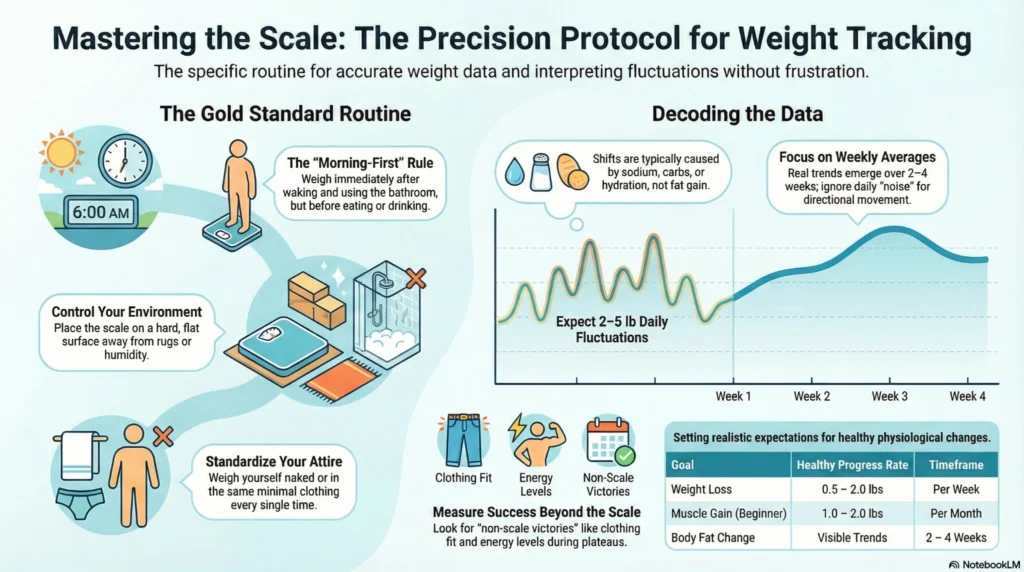
Daily Routine for Reliable Data
Optimal measurement timing:
- Morning, immediately after waking
- After using the bathroom
- Before eating or drinking
- Naked or minimal clothing (same clothing each time)
- Barefoot with clean, dry feet
Why this matters: Body weight fluctuates 2-5 lbs throughout the day due to food intake, hydration, and bladder content. Morning measurements after an overnight fast are most consistent.
💡 CONSISTENCY = ACCURACY
Same time + same conditions = reliable trends. Morning measurements (after bathroom, before eating, barefoot) eliminate 80% of measurement variability. Your scale isn’t broken — your routine might be inconsistent.
research on daily self-monitoring frequency
research on behavior tracking and weight management outcomes
Environmental Factors
Place your scale on:
- Hard, flat, level surface (tile, hardwood)
- Same location every time
- Away from bathroom rugs or bath mats (unstable)
Avoid placing on:
- Carpet (compresses, affects accuracy)
- Uneven surfaces
- High-traffic areas where it might be bumped
Temperature and humidity: Extreme cold or heat can affect battery performance and sensor calibration. Bathroom humidity is generally acceptable, but avoid placing near showers or bathtubs where direct water exposure occurs.
When to Weigh (and When Not To)
Good times for measurement:
- First thing in the morning (most consistent)
- Same day each week for weekly trackers
- Before workouts (if tracking exercise-related changes)
Avoid measuring:
- During menstrual cycle for some users (fluid retention varies; track your personal
- Immediately after intense exercise (dehydration skews results)
- After large meals (temporary weight increase from food/water)
- During illness or fever (fluid shifts affect BIA)
- Following alcohol consumption (dehydrating effects)
Interpreting Fluctuations
Normal daily weight fluctuations: 2-5 lbs for most adults
Causes of temporary changes:
- Sodium intake (water retention for 24-48 hours)
- Carbohydrate intake (glycogen + water storage)
- New exercise routine (initial inflammation and water retention)
- Sleep deprivation (affects cortisol and fluid balance)
- Constipation or digestive transit time
Real trends emerge over: 2-4 weeks of consistent measurements
How to track trends effectively:
- Use weekly averages rather than single data points
- Compare month-to-month rather than day-to-day
- Look for directional movement (up, down, stable) not absolute numbers
- Accept that body composition change is slower than weight change
Setting Realistic Expectations
Healthy weight loss rate: 0.5-2 lbs per week (1-2% body weight)
Muscle gain rate:
- Beginners: 1-2 lbs per month
- Intermediate: 0.5-1 lb per month
- Advanced: 0.25-0.5 lb per month
Body fat percentage change: Typically lags 2-4 weeks behind actual tissue changes due to hydration variability and BIA limitations.
When progress seems stalled:
- Verify measurement consistency
- Check for non-scale victories (clothing fit, energy levels, strength gains)
- Consult with physician or registered dietitian if concerned
- Remember that plateaus are normal in any health journey
🔒 Your Data Security: What Smart Scales Track and How to Protect Your Privacy
Before you buy, know this: Your smart scale data is NOT protected by HIPAA (medical privacy law) unless prescribed by a physician. It falls under consumer privacy laws with weaker protections.
What’s collected:
- Weight, body composition estimates, measurement timestamps
- Account info (email, name, age, height, sex)
- App usage patterns, device identifiers, sometimes location
Critical questions to ask:
✓ Can I export my data and delete my account completely?
✓ Is data sold to third parties or advertisers?
✓ Where is data stored (US, EU, other jurisdiction)?
✓ What happens if the company is acquired or shuts down?
Red flags:
- No privacy policy or vague terms
- Mandatory data sharing with advertisers
- No GDPR or CCPA compliance statements
Protect yourself:
- Use strong, unique password + two-factor authentication
- Export data regularly to personal CSV backups
- Limit third-party app connections to essentials only
- Use guest mode for visitors instead of creating profiles
Full privacy guide and recommended privacy-first scales →
Data Privacy & Security Considerations
Consumer health data collection raises privacy concerns. Our approach to data privacy and research transparency is detailed in our [data handling and research standards].
What Data Smart Scales Collect
Device-level data:
- Weight measurements
- Body composition estimates (fat %, muscle mass, etc.)
- Measurement timestamps
- User profile data (height, age, sex)
App-level data:
- Account information (email, name)
- Usage patterns (measurement frequency)
- Trend analysis and historical data
- Device identifiers and network information
- Integration with third-party apps (health data from connected platforms)
Privacy Questions to Ask
Before purchasing:
- Where is data stored (US, EU, other jurisdiction)?
- Is data encrypted in transit and at rest?
- Who has access to your data (company employees, third parties)?
- Is data sold or shared with advertisers?
- Can you delete your account and all associated data?
- What happens to data if the company is acquired or goes out of business?
Red flags:
- No privacy policy or vague terms
- Requires excessive permissions (contacts, location when not needed)
- Mandatory data sharing with third parties
- No option to opt out of marketing communications
- No GDPR or CCPA compliance statements
HIPAA and Health Data Protection
Important distinction: Smart scale data is generally NOT protected by HIPAA unless:
- Your healthcare provider prescribes the scale and manages the data
- The scale manufacturer has a Business Associate Agreement with your provider
Consumer-purchased scales fall under consumer privacy laws (FTC, CCPA, GDPR), not medical privacy laws (HIPAA).
What this means for you:
- Your smart scale data has weaker legal protection than medical records
- Read privacy policies carefully before purchasing
- Consider data sensitivity when choosing ecosystem integration
- Limit third-party app connections to essential services only
Data Security Best Practices
Account security:
- Use strong, unique password for scale app account
- Enable two-factor authentication if available
- Don’t share account credentials with family members (use multi-user profiles)
- Review connected apps and integrations annually
- Unlink unused third-party services
Physical device security:
- Use guest mode for visitors rather than creating temporary profiles
- Lock profiles if available (prevents accidental data mixing)
- Factory reset device before selling or donating
Data portability:
- Keep copies before changing scales or closing accounts
- Export your data regularly to personal storage (CSV backups)
- Don’t rely solely on cloud storage you don’t control
Common Questions Answered
“Are smart scales worth it compared to regular scales?”
Value depends on your tracking goals:
Smart scales are worth it if you:
- Track body composition trends (not just weight)
- Want historical data analysis and trend visualization
- Integrate with broader health tracking ecosystems
- Share tracking with multiple users in a household
- Appreciate automated data logging (vs manual entry)
Regular scales are sufficient if you:
- Only need basic weight measurements
- Prefer minimal technology
- Don’t use health tracking apps
- Have budget constraints
- Want device simplicity
Research perspective: Studies show self-monitoring improves weight loss outcomes, but whether digital tracking outperforms manual logging depends on individual adherence.[8]
“How accurate are smart scales compared to medical-grade equipment?”
Weight measurement: Very accurate (±0.1-0.2 lbs) when properly calibrated, comparable to medical scales.
Body composition (BIA): Moderate accuracy with significant limitations:
- Body fat percentage: ±3-5% error compared to DEXA
- Muscle mass: ±2-4 lbs error
- Other metrics (visceral fat, bone mass): Poorly validated
Clinical context: Consumer BIA scales are appropriate for tracking personal trends, NOT for clinical diagnosis or treatment decisions. Physicians use DEXA scans, BOD POD, or hydrostatic weighing for precise body composition assessment.
“Will daily weighing become obsessive or harm my mental health?”
Research shows mixed individual responses:
Potential benefits:
- Immediate feedback reinforces healthy behaviors
- Early detection of weight regain
- Reduced anxiety for some users (knowing vs wondering)
Potential risks:
- Increased anxiety or preoccupation for users with eating disorder history
- Frustration from normal fluctuations
- Over-focus on numbers rather than overall health
Recommendation: Monitor your emotional response to daily weighing. If you feel increased anxiety, shame, or obsessive thoughts about measurements, reduce frequency to weekly or discontinue use. Consult a mental health professional if concerned about disordered eating patterns.
“Do I need athlete mode, and what does it do?”
Athlete mode adjusts BIA equations for individuals with:
- Low body fat (typically <10% males, <18% females)
- High muscle mass relative to general population
- Regular intense training (typically 8+ hours per week)
How it works: Uses different prediction equations that account for altered tissue conductivity in highly trained individuals. Without athlete mode, regular algorithms often underestimate muscle mass and overestimate body fat in athletes.
Who should use it:
- Competitive athletes
- Bodybuilders and physique competitors
- Endurance athletes with very low body fat
- Regular CrossFit or strength training practitioners (intermediate to advanced)
Who shouldn’t use it:
- Recreational exercisers (2-4 hours per week)
- Individuals starting new fitness programs
- General population seeking weight loss
Using athlete mode when you don’t qualify will make measurements less accurate, not more.
“Can I use a smart scale during pregnancy?”
Short answer: Use weight-only mode or pregnancy mode if available. Do not use BIA measurements during pregnancy.
Why:
- BIA is not validated for pregnant individuals
- Body water distribution changes significantly throughout pregnancy
- BIA algorithms are calibrated for non-pregnant populations
- Safety of BIA electrical current during pregnancy, while likely safe at low levels used, has limited research
Better approach:
- Track weight trends with your OB/GYN’s guidance
- Use weight-only mode if your scale offers it
- Pregnancy mode (available on some premium scales) disables BIA and shows weight only
- Focus on overall health and pregnancy wellness, not body composition numbers
Postpartum use: Wait 6-8 weeks postpartum (or longer if breastfeeding) before resuming BIA measurements, as body water distribution remains altered during this period. medical research on BIA use throughout pregnancy
“How do I know if my scale is broken or just inaccurate?”
Testing for malfunction:
Consistency test:
- Place a known weight (dumbbell, bag of flour) on scale
- Note the reading
- Repeat 5 times
- If readings vary >0.5 lbs, scale may be faulty
Calibration test:
- Place scale on hard, flat surface
- Ensure scale displays “0.0” before stepping on
- Weigh yourself 3 times in a row
- Readings should be within 0.2 lbs of each other
Zero drift test:
- Check if scale consistently reads higher or lower over time
- Compare to medical scale at doctor’s office monthly
- If drift exceeds 1-2 lbs, recalibrate or contact manufacturer
Battery check:
- Low battery can cause erratic readings
- Replace batteries if readings seem inconsistent
- Some scales show low battery indicators
When to contact manufacturer:
- Consistent 2+ lb difference from calibrated medical scale
- Erratic readings that vary >1 lb between immediate measurements
- Scale doesn’t turn on or displays error codes
- Bluetooth/Wi-Fi connectivity fails repeatedly after troubleshooting
“Should I weigh myself at the same time as my DEXA scan to compare?”
Timing strategy for meaningful comparison:
Best practices:
- Schedule DEXA scan in morning, fasted state (same as home scale routine)
- Use home scale immediately before leaving for DEXA appointment
- Wear minimal clothing for both measurements
- Ensure similar hydration status
Interpretation:
- Expect smart scale body fat % to differ from DEXA by ±3-5%
- DEXA is the reference standard; smart scale is the tracking tool
- Use DEXA as baseline; track changes with smart scale
- Repeat DEXA every 6-12 months to validate scale trends if desired
Cost-benefit consideration: DEXA scans cost $50-150 per scan. Frequent DEXA scans for healthy individuals tracking fitness goals are not medically necessary. Annual or bi-annual DEXA scans can validate scale trends, but monthly scans are excessive.
Final Recommendations
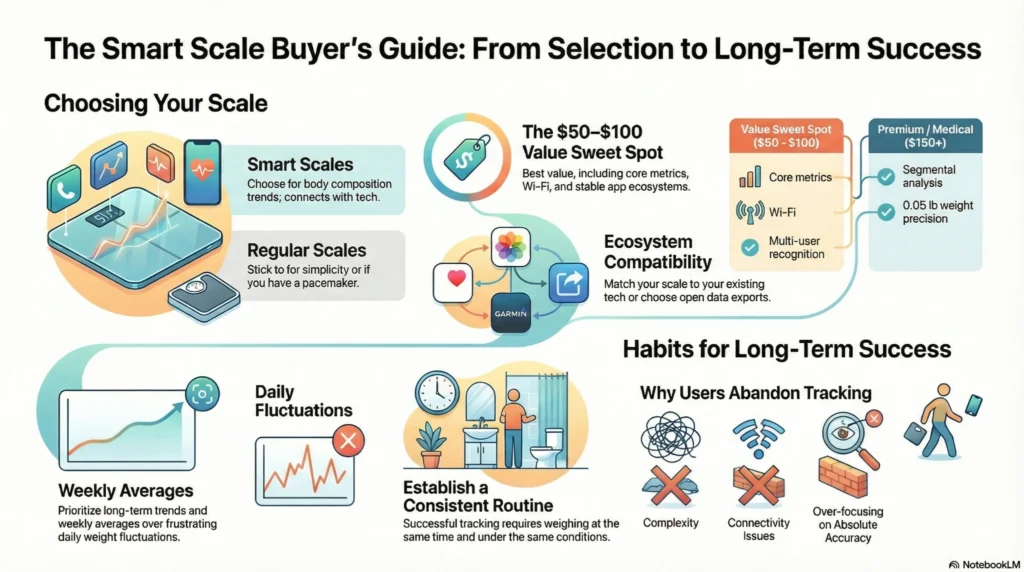
Decision Summary
Choose a smart scale if:
- You want to track body composition trends, not just weight
- You value automated data logging and trend visualization
- You use health tracking ecosystems (Apple Health, MyFitnessPal, etc.)
- You’re committed to long-term tracking (6+ months)
- You understand BIA limitations and focus on trends, not absolute accuracy
Stick with a regular scale if:
- You only need basic weight measurements
- You prefer minimal technology
- You have a pacemaker or other implanted electronic device (safety contraindication)
- You’re concerned about data privacy
- You have a history of disordered eating and worry about obsessive tracking
Price-to-Value Sweet Spot
$50-100 range offers optimal value for most users:
- Core metrics (weight, BMI, body fat, muscle mass) are well-validated
- Wi-Fi connectivity + comprehensive apps
- Multi-user profiles with auto-recognition
- 2-year warranties
- Established brands with stable app ecosystems
Diminishing returns above $150 unless you specifically need:
- Segmental body composition analysis (arms, legs, torso separately)
- Medical-grade weight precision (0.05 lb increments)
- Published clinical validation studies
- Extended warranties (3-5 years)
Ecosystem Considerations
If already invested in an ecosystem:
- Apple users: Prioritize Apple Health integration
- Garmin users: Garmin Index scales integrate seamlessly
- Fitbit users: Fitbit Aria series maintains brand consistency
- Android users: Google Fit compatibility
If starting fresh: Choose scales with open data export (CSV/JSON) to avoid future lock-in.
Long-Term Success Factors
What predicts successful scale use:
- Consistent routine: Same time, same conditions, daily or weekly
- Trend focus: Weekly averages, not daily fluctuations
- Realistic expectations: Understand BIA limitations
- Integration: Scale is one tool in broader health approach
- Privacy awareness: Understand data collection and sharing
What predicts abandonment:
- Lack of clear tracking goals
- Frustration with normal fluctuations
- Over-focus on absolute accuracy rather than trends
- App complexity or poor user experience
- Connectivity issues (Bluetooth/Wi-Fi problems)
Additional Resources
For more detailed information about smart scale technology and usage:
- [Internal Link] Body Composition Testing Methods — comparison of BIA, DEXA, BOD POD, and other measurement techniques
- [Internal Link] How to Track Fitness Progress — broader framework for tracking beyond just scale measurements
- [Internal Link] Understanding Bioelectrical Impedance — detailed measurement protocols
- [Internal Link] Tested Smart Scale Recommendations — specific model reviews
This buying guide provides educational information to support informed consumer decisions. All recommendations are based on general principles and published research, not commercial endorsements.
Written by Dr. Rishav Das, M.B.B.S. — see About page for full credentials and editorial standards
When to Consult a Healthcare Provider
Smart scales are self-monitoring tools, not medical diagnostic devices. Professional evaluation is appropriate in specific situations.
Seek professional guidance before using smart scales if:
- You have diagnosed eating disorders or history of disordered eating patterns
- You’re pregnant and have questions about appropriate weight gain ranges
- You have cardiac implanted devices (pacemakers, ICDs, neurostimulators)
- You’re undergoing active cancer treatment (fluid shifts may confound all BIA readings)
- You have kidney disease (fluid retention significantly affects BIA accuracy)
- You’re beginning a medically supervised weight loss program
- You experience negative psychological responses to weighing or body composition tracking
Discuss smart scale data with your healthcare provider when:
- Unexplained weight change (gain or loss >5% body weight in 1 month without intentional changes)
- Starting medications affecting weight, fluid balance, or metabolism
- Body composition goals relate to managing medical conditions (diabetes, cardiovascular disease, metabolic syndrome)
- Planning bariatric surgery or other medical weight management interventions
- Measurements show unexpected patterns or concerning trends
What to bring to healthcare appointments:
- Exported trend data spanning 4-12 weeks minimum
- Notes on measurement conditions and consistency
- Specific questions about interpreting particular metrics
- Concerns about data accuracy or unexpected measurement patterns
Educational Framing: Smart scales provide self-monitoring data that can inform healthcare conversations but should never replace professional clinical evaluation. Healthcare providers use validated clinical equipment, comprehensive health histories, physical examinations, and appropriate laboratory testing to make medical recommendations. Home tracking data supplements but does not substitute for professional assessment.
References
- Tate DF, et al. Effect of a long-term behavioral weight loss intervention on frequency of self-weighing and weight change. JAMA Netw Open. 2021;4(11):e2134747.
- VanWormer JJ, et al. The impact of regular self-weighing on weight management: a systematic literature review. Int J Behav Nutr Phys Act. 2008;5:54.
- Steinberg DM, et al. Weighing every day matters: daily weighing improves weight loss and adoption of weight control behaviors. J Acad Nutr Diet. 2015;115(4):511-518.
- Tinsley GM, et al. Changes in body composition and neuromuscular performance through preparation, two competitions, and a recovery period in an experienced female physique athlete. J Strength Cond Res. 2019;33(7):1823-1839.
- Moon JR. Body composition in athletes and sports nutrition: an examination of the bioimpedance analysis technique. Eur J Clin Nutr. 2013;67 Suppl 1:S54-59.
- Mialich MS, et al. Analysis of body composition: a critical review of the use of bioelectrical impedance analysis. Int J Clin Nutr. 2014;2(1):1-10.
- Shafer KJ, et al. Validity of segmental multiple-frequency bioelectrical impedance analysis to estimate body composition of adults across a range of body mass indexes. Nutrition. 2009;25(1):25-32.
- Minderico CS, et al. Usefulness of different techniques for measuring body composition changes during weight loss in overweight and obese women. Br J Nutr. 2008;99(2):432-441.
- Burke LE, et al. Self-monitoring in weight loss: a systematic review of the literature. J Am Diet Assoc. 2011;111(1):92-102.
- Nickerson BS, et al. Validity and reliability of multi-frequency bioelectrical impedance analysis for the assessment of body composition in adults. Front Physiol. 2020;11:548281.
- Lukaski HC. Evolution of bioimpedance: a circuitous journey from estimation of physiological function to assessment of body composition and a return to clinical research. Eur J Clin Nutr. 2013;67 Suppl 1:S2-9.
- Osman H, et al. Body composition changes in pregnancy using bioelectrical impedance analysis. Eur J Clin Nutr. 2021;75(4):674-681.
- Medical Electrical Equipment Standards. IEC 60601-1-2:2014. Electromagnetic compatibility requirements for medical electrical equipment.
Medical Disclaimer:
The information on this page is for educational purposes and should not replace professional medical advice, diagnosis, or treatment. Always consult a qualified healthcare provider for medical guidance tailored to your individual health needs and circumstances. Smart scales are general wellness monitoring devices, not medical diagnostic equipment.
Content Accuracy: This guide was last medically reviewed on [February 22, 2026]. We maintain a [correction and update policy] for all published content. To report errors, contact [corrections email].
Last Updated: February 22, 2026
Medical Review Date: February 22, 2026