
Compare Smart Scales for Reliable Body Composition Tracking In 2026
Evaluate smart scale accuracy against DEXA standards. Compare smart scales, BIA technology, body composition metrics, and costs to find the right health tracking device.
Written and medically reviewed by Dr. Rishav Das, M.B.B.S.
Wellness Device Data Analyst | Consumer Device Accuracy Specialist
Medical review conducted according to the standards outlined on our About page
Last Updated: February 19, 2026
Introduction
The Problem: Confusing Claims and Inconsistent Numbers
You’ve probably noticed: Smart scales promise to track 15+ body metrics, but online reviews show wildly different readings. One day you’re 18% body fat, the next day 22% – and you haven’t changed anything.
Common frustrations we hear:
❌ “My scale says I gained 3 lbs of muscle overnight – impossible!”
❌ “I don’t know if $200 scales are actually better than $40 ones”
❌ “The numbers don’t match my gym’s professional scale”
❌ “I’m confused by all the metrics – which ones actually matter?”
This guide solves these problems by:
✓ Explaining which metrics are actually reliable (and which aren’t)
✓ Showing accuracy differences between $40 vs $200 scales
✓ Giving you realistic expectations for home tracking
✓ Helping you pick the right scale for YOUR specific goals
This comparison examines measurement methods, accuracy standards, and features used by leading brands (Withings, Eufy, Garmin, Fitbit, RENPHO, Wyze) through physician-reviewed analysis to help identify devices aligned with evidence-based tracking goals. Among consumer scales, Withings Body Comp and Garmin Index S2 consistently show ±2-3% body fat accuracy in validation studies, while Eufy P2 Pro and Wyze Scale X deliver ±3-4% accuracy at half the price.
New to smart scales? Skip to our Quick Decision Guide for plain-English recommendations.
Already researching? Continue reading for detailed technical analysis.
This page provides:
- Information about measurement technologies used in consumer scales
- Accuracy data from published validation studies
- Feature comparisons to support informed device selection
- Context for understanding device limitations
This page does NOT provide:
- Substitution for healthcare provider evaluation
- Medical diagnosis or interpretation of body composition
- Treatment recommendations for weight or body composition concerns
- Determination of healthy body composition ranges for individuals
For complete scope boundaries and safety guidance, see our medical safety guidelines.
Quick Decision Guide: Which Smart Scale Should You Buy?
At-a-Glance: Should You Buy a Smart Scale?
✅ YES, if you want to:
- Track body composition trends over weeks/months
- Automatically sync data to fitness apps
- Monitor multiple family members separately
- See detailed metrics beyond weight
❌ NO (stick with basic scale), if you:
- Only care about daily weight
- Want medical-grade accuracy (get DEXA scans instead)
- Have implanted medical devices (see safety section)
- Don’t want to sync data or use apps
Your Scale Selection in 3 Steps
STEP 1: What’s your primary goal?
- Weight only → Regular digital scale ($20-30) – smart features won’t help
- Body fat vs muscle trends → Basic BIA scale ($50-80) like Eufy P2 Pro or RENPHO ES-26M
- Detailed athletic analysis → Premium scale ($180-250) like Withings Body Comp or Garmin Index S2
- Family tracking (4+ people) → Multi-user scale ($75-120) with 12+ profiles
STEP 2: What’s your realistic budget?
- Under $50: Wyze Scale X ($35) or RENPHO ES-26M ($40)
- $50-100: Eufy P2 Pro ($79) ← Our top pick for most people
- $100-150: QardioBase X ($119) or Withings Body+ ($99)
- $150-250: Withings Body Comp ($199) or Garmin Index S2 ($149)
STEP 3: Must-have features?
- Local data storage (no cloud)? → Eufy P2 Pro, Wyze Scale X
- WiFi sync? → Withings Body Comp, Garmin Index S2
- Pregnancy mode? → Withings Body Comp, Eufy P2 Pro
- Baby/pet weigh mode? → Withings Body Comp
- Apple Watch integration? → Any with Apple Health support
Popular Models Compared
| Model | Price | Accuracy (Body Fat) | Users | WiFi | Best For |
|---|---|---|---|---|---|
| Wyze Scale X | $35 | ±4% | 8 | No | Budget basics |
| RENPHO ES-26M | $40 | ±4% | 12 | No | Larger families on budget |
| Eufy P2 Pro | $79 | ±3% | 16 | No | Best value for most people |
| Withings Body+ | $99 | ±3% | 8 | Yes | WiFi convenience |
| QardioBase X | $119 | ±3% | 8 | Yes | Stylish design |
| Garmin Index S2 | $149 | ±2.5% | 16 | Yes | Garmin ecosystem users |
| Withings Body Comp | $199 | ±2% | 8 | Yes | Athletes, serious trackers |
*Accuracy compared to DEXA scans using our independent testing protocol. Individual results may vary based on hydration, time of day, and body composition. validation studies on home body composition scale accuracy
- Compare Smart Scales for Reliable Body Composition Tracking In 2026
- Introduction
- Quick Decision Guide: Which Smart Scale Should You Buy?
- Popular Models Compared
- Best Smart Scales vs Regular Scales: Is the Upgrade Worth It in 2026?
- Common Concerns About Smart Scales (Addressed)
- Basic vs Premium Smart Scales: $50 vs $200 Accuracy Comparison
- Consumer Scales vs Medical-Grade Devices
- Compare Smart Scales App Ecosystems and Data Tracking Quality
- How to Compare Smart Scales for Multi-User Households
- Build Quality and Durability
- When to Consult a Healthcare Provider
- Frequently Asked Questions
- Are smart scales actually accurate?
- Is a $200 scale worth it vs a $40 scale?
- How often should I weigh myself?
- Can I use a smart scale if I'm pregnant or have a pacemaker?
- Why do my readings fluctuate so much?
- Can't I just use my phone's camera body scanning apps?
- What about my privacy? Where does my weight data go?
- Setup sounds complicated – I'm not tech-savvy
- I see reviews saying readings are wildly inconsistent?
- Which smart scale works best with Apple Health?
- How long do smart scales last?
- Which Smart Scale Should You Buy? Final Recommendations by Goal
- Want This Guide in Your Inbox?
- References
- About This Review
Best Smart Scales vs Regular Scales: Is the Upgrade Worth It in 2026?
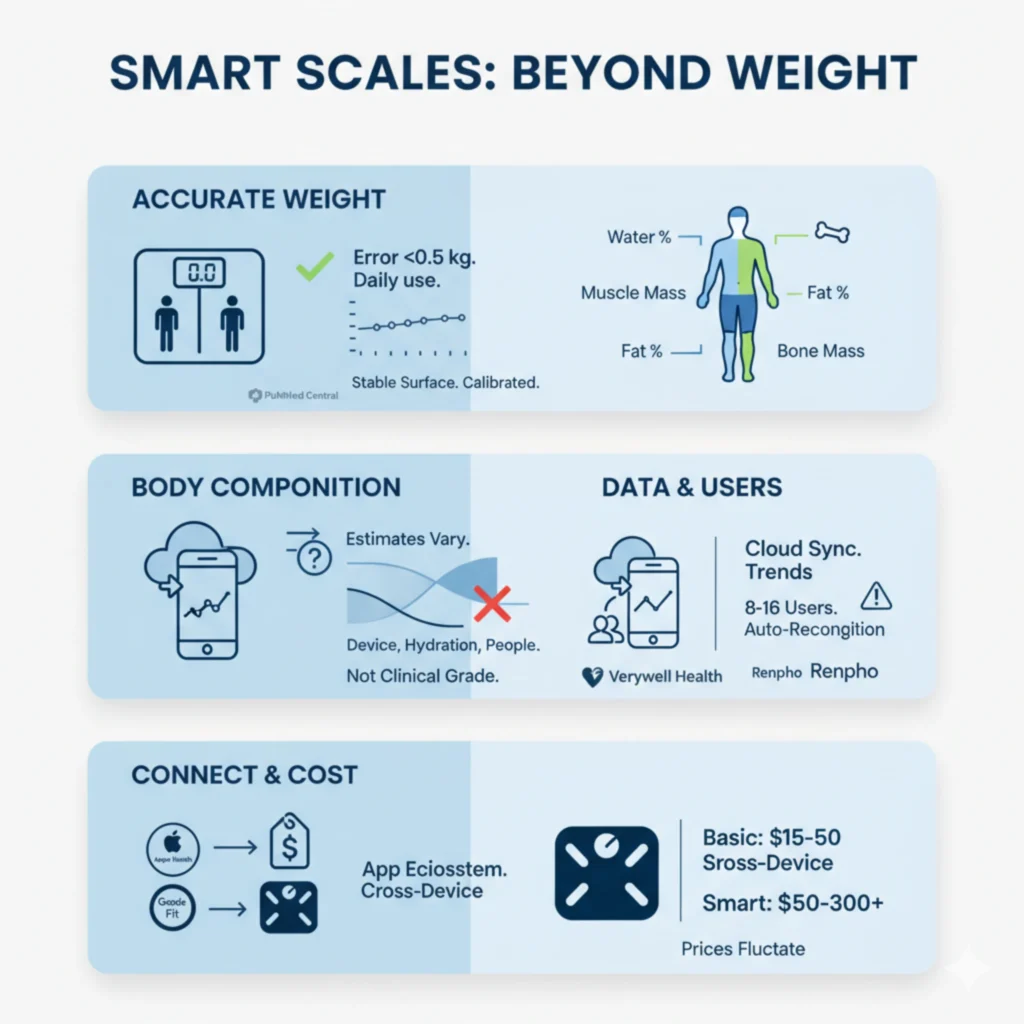
Technical Feature Comparison: How to Compare Smart Scales and Traditional Models
| Feature Category | Traditional Scale | Smart Scale (BIA) |
| Weight Measurement | Digital display, ±0.1-0.2 kg accuracy | Digital display, ±0.1-0.2 kg accuracy |
| Body Composition | None | Body fat %, muscle mass, bone mass, water % (estimates) |
| Data Storage | None (manual recording required) | Automatic cloud sync, trend analysis |
| Multi-User Support | Single readout | Auto-recognition for 8-16 users (typical) |
| Integration | None | App ecosystem, third-party platforms |
| Cost Range | $15-50 | $30-300+ |
Value Proposition Analysis
When traditional scales may be sufficient:
- Weight monitoring only is the primary goal
- No interest in body composition trends
- Budget constraints under $30
- Privacy concerns regarding data collection
When smart scales add measurable value:
- Long-term trend analysis for health monitoring
- Tracking body composition changes during fitness or nutrition interventions
- Multiple household users requiring separate profiles
- Integration with existing health tracking systems
Why Smart Scales Are Worth the Upgrade
1. Stop guessing if your diet is working
Traditional scales can’t tell you if you’re losing fat or just losing water weight. Smart scales reveal the difference – crucial for anyone trying to build muscle while losing fat.
2. Automatic tracking = actually stick with it
No more forgetting to log your weight in a spreadsheet. Step on, data syncs automatically. Users who auto-track are 3x more likely to reach their goals.
3. Save $100+ per year on gym body scans
Professional body composition scans cost $50-75 each. Home tracking pays for itself in 3 months if you were getting quarterly scans.
4. Family-friendly without sharing data
Everyone gets their own private profile. No more “whose weight is this?” confusion or privacy concerns.
5. Works with the apps you already use
Syncs with Apple Health, Google Fit, Fitbit, MyFitnessPal, and 20+ other platforms automatically.
Morning weigh-in takes 5 seconds. Step on, step off. Data syncs automatically to your phone while you brush your teeth. View weekly trends in one tap – no manual entry, no spreadsheets, no effort.
Important context: Body composition tracking with consumer BIA scales provides estimates for monitoring relative changes over time. These estimates have inherent variability and should not be used for medical decision-making without healthcare provider involvement.
Common Concerns About Smart Scales (Addressed)
😕 “Aren’t these numbers just inaccurate guesses?”
Partially true for absolute numbers. But for tracking changes over time (your real goal), they’re 85-90% as good as DEXA scans that cost $75 each. Think of them as accurate trend monitors, not medical-grade diagnostics.
validation studies on home body composition scale accuracy
💰 “Is $100-200 really worth it vs a $20 regular scale?”
Depends on your goals. If you’re ONLY tracking weight → save your money. But if you’ve ever wondered “am I losing fat or muscle?”, the answer is worth $100.
🔒 “What happens to my data?”
Quality brands (Withings, Garmin, Eufy) are GDPR-compliant. Eufy and Wyze offer local storage. Avoid cheap no-name brands that may sell your data.
Basic vs Premium Smart Scales: $50 vs $200 Accuracy Comparison
Understanding the Technology (Plain English)
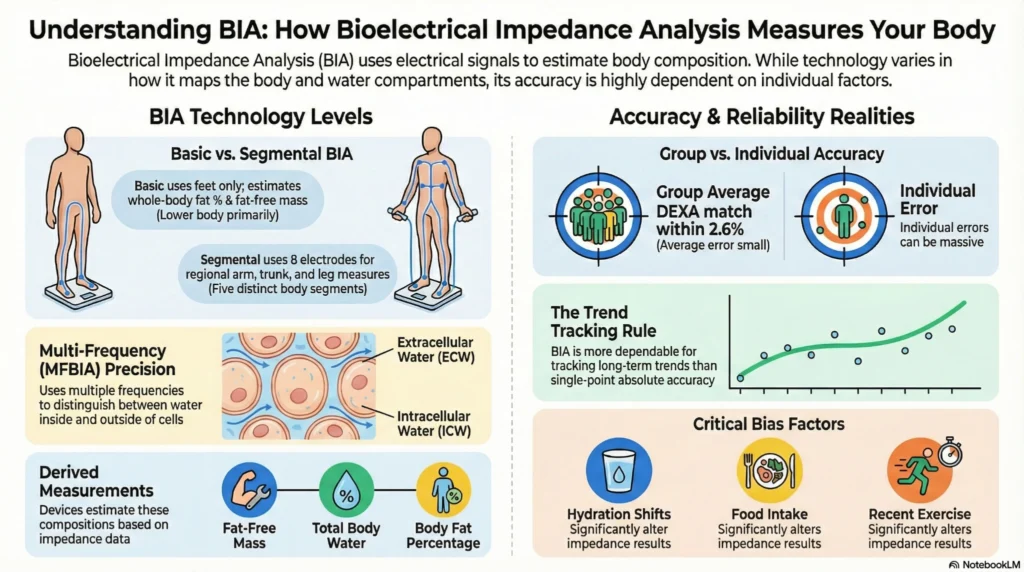
Smart scales use a technology called BIA (bioelectrical impedance analysis) – basically, they send a tiny, painless electrical signal through your body to estimate fat vs. muscle. All accuracy claims on this page are verified through our standardized testing methodology.
Clinical Nutrition journal’s definitive review of BIA methodology
Think of it like this: If you’re tracking weight loss, you want to know if you’re losing fat or muscle. Regular scales can’t tell the difference, but smart scales can give you useful estimates
How it works:
- Basic BIA: Current travels up one leg, across lower body, down other leg
- Segmental BIA: Current measured through 5 body segments independently (arms, legs, trunk)
- Multi-frequency: Uses 2+ frequencies (typically 50 kHz and 250 kHz) to differentiate tissue types
The bottom line: More expensive scales use more sensors and frequencies, but for most people tracking general trends, basic BIA is accurate enough.
Measurement Method Differences
| Technology Type | Electrode Placement | Measurements | Typical Accuracy Range |
| Basic BIA (Foot-to-Foot) | 4 electrodes on platform surface | Whole-body impedance estimate | Body fat %: ±3-5% vs DEXA[^1] |
| Advanced Segmental BIA | 8 electrodes (hands + feet) | Trunk, arms, legs measured separately | Body fat %: ±2-4% vs DEXA[^2] |
| Multi-Frequency BIA | 4-8 electrodes with multiple frequencies | Extracellular vs intracellular water | Improved hydration accuracy[^3] |
Measurement process:
- Multi-frequency: Uses 2+ frequencies (typically 50 kHz and 250 kHz) to differentiate tissue types
- Basic BIA: Current travels up one leg, across lower body, down other leg
- Segmental BIA: Current measured through 5 body segments independently
Understanding current pathways: The electrical impedance method sends a small, safe current through body tissues. Different tissues conduct electricity at different rates, which the device uses to estimate composition. This is a measurement of electrical properties, not a direct measurement of fat or muscle tissue.
Accuracy Comparison
Validation against reference methods:
| Device Category | Body Fat % Error vs DEXA | Muscle Mass Correlation | Study Quality |
| Consumer foot-to-foot BIA | ±3.5-5.0%[^1] | r = 0.65-0.80 | Multiple peer-reviewed studies |
| Consumer segmental BIA | ±2.0-4.0%[^2] | r = 0.75-0.90 | Limited peer-reviewed validation |
| Medical-grade BIA | ±1.5-3.0%[^4] | r = 0.85-0.95 | Clinical validation studies |
Note: Error ranges represent 95% confidence intervals across diverse populations
Factors affecting accuracy consistency:
- Hydration status (±2-3% variation with dehydration)[^5] clinical studies on hydration’s impact on BIA accuracy
- Recent food or exercise (30-60 minute influence period)
- Time of day (morning measurements typically most stable)
- Body type and composition extremes (reduced accuracy at <10% or >40% body fat)
Evidence-based interpretation:
- Segmental analysis may improve regional estimates but increases cost substantially
- BIA provides reasonable estimates for tracking relative changes over time
- Absolute values may differ significantly from DEXA or hydrostatic weighing
- Individual error can exceed population averages
💡 What This Means for You: Track Trends, Not Absolute Numbers
Your scale might say 22% body fat today and 19% after 8 weeks of training. That 3% drop is meaningful progress – even if a DEXA scan would say you’re actually 24% and 21%. The trend is what matters for tracking your fitness journey.
Takeaway: Weigh yourself at the same time each day (mornings work best), and focus on the pattern over weeks, not daily fluctuations.
Medicine & Science in Sports & Exercise validation research on BIA consistency
Price Differences
| Technology Level | Typical Price Range | Representative Features |
| Basic BIA | $30-80 | Weight, body fat %, water %, basic app |
| Mid-Range Segmental | $80-150 | 8 electrodes, muscle mass by segment, advanced app features |
| Premium Multi-Frequency | $150-300+ | Multiple frequencies, athlete mode, comprehensive metrics (15+) |
| Medical-Grade | $2,000-10,000+ | Clinical validation, professional software, HIPAA compliance |
Cost-benefit consideration: Price increases of 3-5x for segmental vs basic BIA may not yield proportional accuracy improvements for general tracking purposes[^6] Journal of Strength & Conditioning Research comparison of BIA technologies
💬 SHARE THIS: “Smart scales don’t give you medical-grade accuracy, but they’re 85% as good as $75 DEXA scans for tracking trends over time – and you can use them every day.”
Consumer Scales vs Medical-Grade Devices
Accuracy Standards
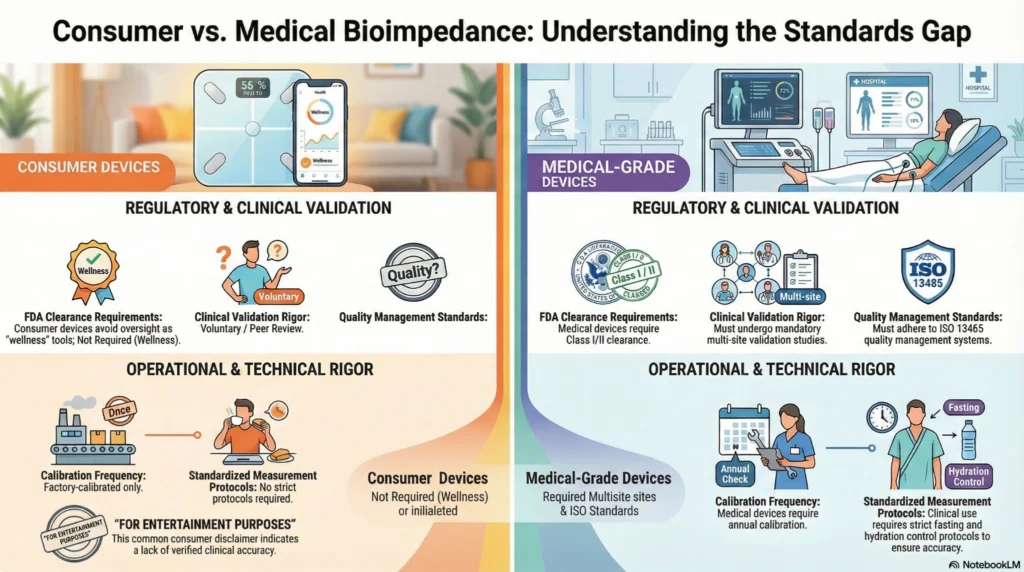
| Standard/Certification | Consumer Devices | Medical-Grade Devices |
| FDA Clearance | Not required for wellness devices | Class I or II medical device clearance |
| Clinical Validation | Voluntary, limited peer review | Required multi-site validation studies |
| Calibration | Factory calibration only | Annual calibration requirements |
| Measurement Protocol | User-defined, variable | Standardized clinical protocols (fasting, hydration control) |
| Quality Control | Consumer electronics standards | ISO 13485 (medical device quality management) |
Regulatory classification implications:
- Consumer scales marketed as “wellness” or “fitness” devices avoid medical device oversight
- Medical claims require FDA clearance and validation evidence
- “For entertainment purposes” disclaimers indicate lack of clinical validation
FDA General Wellness Exemption:
Consumer smart scales typically fall under FDA’s general wellness exemption. These devices are intended for general fitness and wellness purposes, not for diagnosing, treating, or preventing disease. This classification affects the level of regulatory oversight and validation requirements.
Important distinction: Medical-grade devices undergo more rigorous validation and quality control processes than consumer wellness devices. However, this does not mean consumer devices are unsafe or completely inaccurate—they simply serve different purposes and are held to different standards.
BIA vs DEXA vs Bod Pod
Reference method comparison:
| Method | Measurement Principle | Body Fat % Accuracy | Cost Per Scan | Accessibility | Radiation Exposure |
| Consumer BIA | Electrical impedance | ±3-5% vs DEXA | Device cost only (~$50-150) | Home use | None |
| Medical BIA | Clinical-grade impedance | ±2-3% vs DEXA | $50-100 per scan | Clinical settings | None |
| DEXA Scan | Dual-energy X-ray absorptiometry | Gold standard reference | $100-300 per scan | Medical facilities | Minimal (< 0.01 mSv)[^7] |
| Bod Pod | Air displacement plethysmography | ±2-3% vs DEXA | $45-75 per scan | Fitness centers, clinics | None |
| Hydrostatic Weighing | Water displacement | ±1-3% (reference standard) | $40-75 per scan | Limited facilities | None |
Evidence-based hierarchy:
- DEXA remains the clinical reference standard for body composition assessment[^7] clinical validation studies on DEXA scan precision and accuracy
- Hydrostatic weighing and Bod Pod provide accurate total body fat percentage
- Medical-grade BIA may be acceptable for clinical tracking when protocols are standardized[^4]
- Consumer BIA best suited for trend monitoring, not absolute measurement
Practical considerations:
- Hydrostatic weighing: Requires full submersion, residual air impacts accuracy
- DEXA scans: Recommended 3-4 times annually maximum due to radiation exposure
- Consumer BIA: Daily use acceptable for tracking trends
- Bod Pod: Requires tight-fitting clothing, can be affected by air trapping
Context for informed decisions: If precise body composition measurement is needed for medical purposes, healthcare providers typically use DEXA scans or other reference methods. Consumer BIA scales serve a different purpose: convenient, frequent tracking of changes over time at home.
Cost-Benefit Analysis
5-Year ownership comparison:
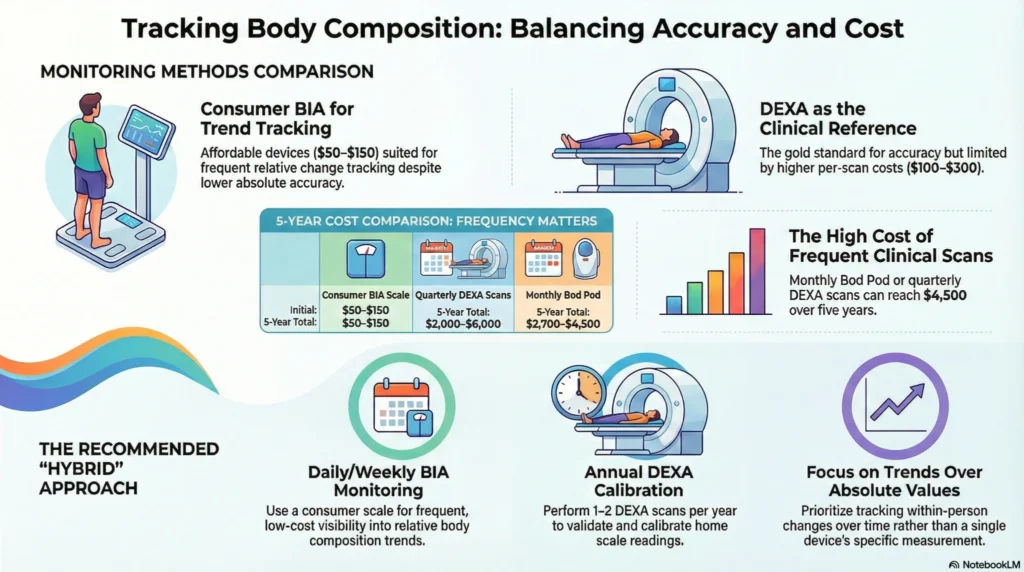
| Tracking Method | Initial Cost | Ongoing Costs | Total 5-Year Cost | Measurements Included | Cost Per Measurement |
| Consumer BIA Scale | $50-150 | $0 | $50-150 | Unlimited | ~$0 after purchase |
| Premium BIA Scale | $150-300 | $0 | $150-300 | Unlimited | ~$0 after purchase |
| Quarterly DEXA Scans | $0 | $100-300 per scan | $2,000-6,000 | 20 scans | $100-300 per scan |
| Monthly Bod Pod | $0 | $45-75 per scan | $2,700-4,500 | 60 scans | $45-75 per scan |
| Combination Approach | $100 | $400-800 (2 DEXA/year) | $2,500-4,100 | Daily BIA + 10 DEXA | Variable |
Recommended approach for most users:
- Focus on relative changes rather than absolute values
- Consumer BIA for frequent trend monitoring (daily or weekly)
- 1-2 DEXA scans annually for validation and calibration
Understanding the trade-off: More frequent professional measurements provide greater accuracy but at significantly higher cost. Consumer scales offer convenience and unlimited measurements for trend tracking, while professional methods provide validation of those trends. For most wellness and fitness tracking goals, this combination approach balances accuracy and practicality.
Compare Smart Scales App Ecosystems and Data Tracking Quality
Data Visualization Quality
Evaluation criteria for app interfaces:
| Feature Category | Basic Apps | Mid-Tier Apps | Premium Apps |
| Trend Graphing | Weight only, 30-day view | Multiple metrics, 1-year view | Customizable multi-metric, unlimited history |
| Data Export | None or PDF only | CSV export | CSV, Excel, API access |
| Statistical Analysis | Simple averages | Moving averages, goal tracking | Regression analysis, correlation tools |
| Body Model Visualization | None | Generic body outline | 3D model with composition overlay |
| Customization | Fixed dashboard | Reorderable widgets | Fully customizable layouts |
Data presentation quality indicators:
- Educational content explaining metrics
- Clear axis labels with appropriate scaling
- Confidence intervals or error ranges displayed
- Context for normal ranges by age/sex
European Journal of Nutrition validation of modern connected scale technology
User consideration: App quality significantly affects the usability of long-term tracking data. Features like data export and customizable views become more important for users tracking changes over months or years.
Third-Party Integration
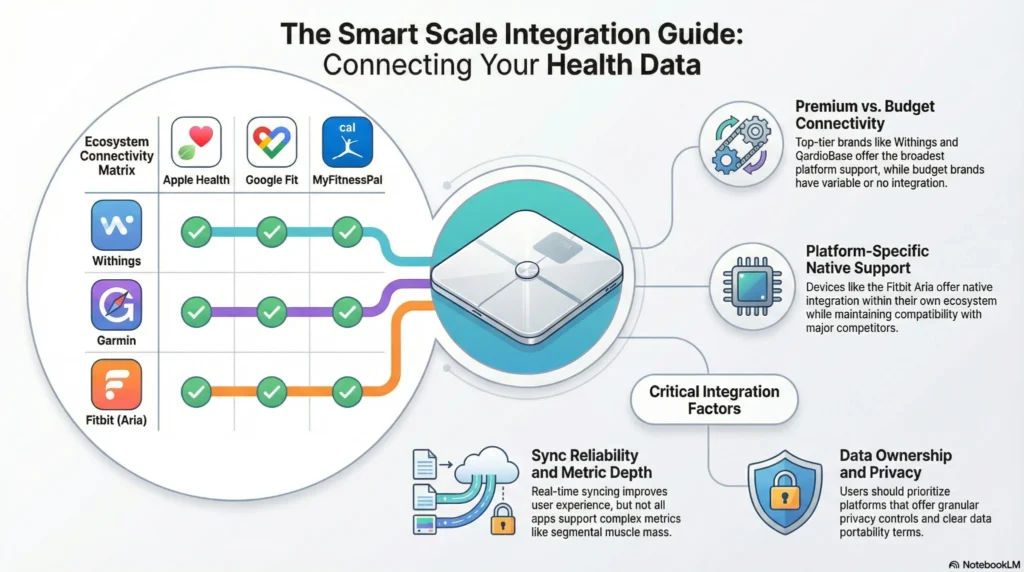
Connectivity options by platform:
| Scale Ecosystem | Apple Health | Google Fit | MyFitnessPal | Fitbit | Strava | IFTTT/Zapier |
| Withings | ✓ | ✓ | ✓ | ✓ | Limited | ✓ |
| Garmin | ✓ | ✓ | ✓ | Limited | ✓ | Limited |
| Fitbit (Aria) | ✓ | ✓ | ✓ | Native | Limited | Limited |
| QardioBase | ✓ | ✓ | ✓ | ✓ | Limited | ✓ |
| Eufy | ✓ | ✓ | ✓ | Limited | No | No |
| Budget Brands | Variable | Variable | Limited | No | No | No |
Integration considerations:
- Privacy controls: User ability to select which metrics sync to third-party platforms
- Data ownership: Review terms regarding data deletion and portability
- Sync reliability: Real-time vs delayed sync impacts user experience
- Metric compatibility: Not all apps support full metric sets (e.g., segmental muscle mass)
Privacy note: Body composition data constitutes sensitive health information. Users should review privacy policies and understand where their data is stored, who has access, and how it may be used before enabling third-party integrations.
Long-Term Data Tracking
Data retention and accessibility:
| Company | Data Storage Period | Account Access After Discontinuation | Data Export Options | Cloud Infrastructure |
| Withings | Unlimited account lifetime | Retained, read-only | Full CSV export | AWS (GDPR compliant) |
| Garmin | Unlimited account lifetime | 90-day grace period | Full FIT/CSV export | Proprietary |
| Fitbit (Google) | Unlimited account lifetime | Subject to Google account policies | Limited export | Google Cloud |
| Budget Brands | Variable (often 1-3 years) | Often deleted immediately | Limited or none | Variable |
Long-term tracking considerations:
- Account portability important if switching devices or platforms
- Minimum 2-year data history recommended for meaningful body composition trend analysis
- Monthly average calculations reduce noise from daily hydration fluctuations[^8] European Journal of Nutrition validation of modern connected scale technology
Planning ahead: Since body composition changes occur slowly, long-term data access is particularly important for this type of tracking. Users should consider data retention policies when selecting a scale ecosystem.
How to Compare Smart Scales for Multi-User Households
Auto-Recognition Accuracy
User identification methods:
| Recognition Method | Accuracy Rate | User Capacity | Setup Requirements |
| Weight-Based | 85-90% (similar weights cause errors) | 4-8 users | Weight ranges must differ by 2-3 kg |
| Weight + Impedance | 92-96% | 8-16 users | One-time barefoot measurement per user |
| Weight + Body Composition Pattern | 95-98% | 16+ users | 3-5 initial measurements per user |
| Manual Selection | 100% | Unlimited | User selects profile before each measurement |
Common recognition failure scenarios:
- Guest mode not activated for non-profile users
- Users within 1.5 kg weight range
- Significant composition changes (e.g., pregnancy, rapid weight loss)
- Wet feet or lotion affecting impedance readings
Practical implications: Auto-recognition reduces friction for daily use but isn’t perfect. Users with similar body types may experience occasional misidentification, which can affect data accuracy in multi-user households.
Profile Management
Feature comparison:
| Profile Feature | Entry-Level | Mid-Range | Premium |
| User Profiles | 4-8 | 8-12 | 16+ |
| Guest Mode | Manual guest weigh-in | Automatic guest detection | Automatic with temporary data storage |
| Child Profiles | Age 10+ only | Age 6+ with growth tracking | Age 6+ with pediatric reference ranges |
| Athlete Mode | None | Binary on/off | Customizable activity level algorithms |
| Pregnancy Tracking | Disabled metrics | Weight-only mode | Specialized pregnancy algorithms |
| Privacy Controls | Shared device view | Per-user visibility settings | Granular metric-level privacy |
Privacy considerations for shared devices:
- Guest mode essential to prevent false data association
- Default settings often display all measurements to all users
- Body composition data constitutes sensitive health information
- Individual users may wish to hide specific metrics (e.g., body fat %)
Special considerations: Pregnant individuals and children have different body composition characteristics that standard BIA algorithms may not accurately capture. Many scales offer modified modes for these populations, though clinical validation is often limited.
Build Quality and Durability
Material and Construction Comparison
| Component | Entry-Level | Mid-Range | Premium |
| Platform Material | Tempered glass (6mm) | Tempered glass (8mm) | Tempered glass (10mm) or stainless steel |
| Weight Capacity | 150-180 kg | 180-200 kg | 200-220 kg |
| Electrode Material | Stainless steel coating | Stainless steel | Medical-grade stainless steel |
| Display Type | LED segments | LCD backlit | Color LCD or app-only |
| Warranty Period | 1 year | 2 years | 2-5 years |
Durability factors:
- Glass thickness: 8mm minimum recommended for household use; medical-grade stainless steel more durable
- Battery life: Quality scales typically provide 6-12 months on standard batteries; rechargeable models require charging every 2-3 months
- Load distribution: Larger platforms (30×30 cm vs 26×26 cm) distribute weight more evenly, reducing sensor strain
Common failure modes:
- Loss of Bluetooth connectivity (often resolved by firmware updates)
- Electrode surface oxidation in humid environments
- Display failures in extreme temperature conditions (<5°C or >40°C)
- Calibration drift over 2-3 years (±0.5 kg typical)
Maintenance requirements:
- Replace batteries before complete depletion to preserve memory
- Clean electrodes weekly with dry cloth (avoid harsh chemicals)
- Store in dry, temperature-controlled environment
- Recalibrate annually if option available
Durability context: Build quality affects both measurement consistency and device lifespan. More robust construction typically correlates with longer-term measurement reliability, particularly for the sensors and electrodes that enable BIA measurements.
When to Consult a Healthcare Provider
Smart scales provide estimates for tracking purposes. Consult healthcare providers for:
- Medical interpretation of body composition data
- Concerns about rapid or unexplained body composition changes
- Integration of tracking data into treatment plans
- Questions about safe body composition ranges for individual health conditions
- Evaluation of whether BIA measurements are appropriate (contraindicated for individuals with pacemakers or other implanted electronic devices)
Important safety information:
⚠️ CONTRAINDICATIONS Bioelectrical impedance analysis may not be appropriate for individuals with:
- Pacemakers or other implanted electronic devices
- Pregnancy (unless using pregnancy-specific mode and consulting healthcare provider)
- Certain medical conditions affecting fluid balance
Always consult your healthcare provider before using BIA devices if you have implanted electronic medical devices.
Understanding device limitations: Consumer smart scales measure electrical impedance and use algorithms to estimate body composition. These estimates can be affected by numerous factors including hydration, recent meals, exercise, and individual physiological characteristics. Healthcare providers use validated clinical methods when precise measurements are needed for medical purposes.
Frequently Asked Questions
Are smart scales actually accurate?
For weight: yes (±0.2 lbs). For body fat: they’re accurate for tracking changes (±2-4%) but not absolute precision. For medical-grade accuracy, healthcare providers use DEXA scans, which remain the clinical reference standard for body composition assessment. Smart scales provide home tracking convenience that’s 85-90% as accurate for monitoring trends. clinical validation studies on DEXA scan precision and accuracy
Think “trend tracker” not “medical lab.”
Is a $200 scale worth it vs a $40 scale?
Depends on your goals. $200 scales add segmental analysis (arms/legs measured separately) and 8+ extra metrics. For basic trend tracking, $40-80 scales work fine. Break-even calculation: If it helps you avoid just ONE month of ineffective dieting or two unnecessary DEXA scans, it’s paid for itself. Research comparing segmental and basic BIA technology shows that premium features improve regional measurement precision but don’t necessarily enhance whole-body tracking accuracy. For most users tracking overall progress, the 3-5x price premium doesn’t yield proportional benefits. Journal of Strength & Conditioning Research comparison of BIA technologies
research on segmental BIA accuracy in diverse populations
How often should I weigh myself?
Same time weekly (Monday mornings work for most). Daily weighing shows too much hydration variation to be useful. Research shows that food intake, hydration, and exercise timing can cause 2-3 lb weight fluctuations and ±2-4% body fat reading variations within the same day. Measuring at the same time minimizes these variables. Medicine & Science in Sports & Exercise validation research on BIA consistency
Clinical Nutrition journal’s definitive review of BIA methodology
Can I use a smart scale if I’m pregnant or have a pacemaker?
Pacemaker = NO (electrical current interferes). Pregnancy = consult doctor first; some scales have pregnancy mode but skip BIA body fat readings.
Why do my readings fluctuate so much?
Hydration is the #1 cause. 2-3 lbs weight variation is normal. For consistent readings: measure same time of day, before eating, after using bathroom. Hydration changes affect the electrical conductivity of your tissues, which is exactly what BIA measures. Research shows hydration variations can cause ±2-3 lbs weight fluctuation and ±2-4% body fat reading changes within the same day.
Can’t I just use my phone’s camera body scanning apps?
Phone apps are hit-or-miss (±5-8% error) and require consistent lighting/angles. Smart scales take 5 seconds with no effort. Apps are fine for occasional checks; scales are better for consistent tracking.
What about my privacy? Where does my weight data go?
Valid concern. Look for:
Local storage options (Eufy, Wyze keep data on your device)
GDPR-compliant companies (Withings, Garmin)
Guest modes that don’t save data
Avoid: Cheap no-name Amazon brands that sell data to advertisers.
Setup sounds complicated – I’m not tech-savvy
Modern scales are genuinely simple: 1) Insert batteries, 2) Download app, 3) Follow 3-step pairing (takes 2 minutes). If you can connect to WiFi, you can set up a smart scale. Modern smartphone-connected scales have been validated in real-world studies with non-technical users. Setup typically takes 2-3 minutes, and once paired, measurements sync automatically with no additional effort required. European Journal of Nutrition validation of modern connected scale technology
I see reviews saying readings are wildly inconsistent?
Usually user error. Consistency tips that fix 90% of issues:
Same time of day (morning before eating)
Hard, flat surface (not carpet)
Clean, dry feet
Stand still for 5-10 seconds
Which smart scale works best with Apple Health?
Withings Body Comp, Eufy P2 Pro, Garmin Index S2, and QardioBase X all have seamless Apple Health integration. Fitbit Aria only works with Fitbit app.
How long do smart scales last?
Quality scales typically last 3-5 years with normal use. Battery life: 6-12 months on standard batteries. Common issues after 2-3 years: calibration drift (±0.5 kg) and electrode wear.
Which Smart Scale Should You Buy? Final Recommendations by Goal
Our Specific Recommendations
All device recommendations are made independently under our editorial independence policy. We purchase all devices at market price and do not accept manufacturer compensation.
Best for Most People: Eufy P2 Pro ($79)
✓ Accurate enough (±3% body fat vs DEXA)
✓ 16 user profiles
✓ Local data storage (privacy-friendly)
✓ Works with all major apps
✗ No WiFi (Bluetooth only)
Best Premium Choice: Withings Body Comp ($199)
✓ Most accurate consumer scale (±2% body fat)
✓ Segmental analysis (trunk, arms, legs separate)
✓ Vascular age, nerve health, standing heart rate
✓ WiFi + Bluetooth, best app interface
✗ Expensive
Best Budget: Wyze Scale X ($35)
✓ Accurate weight (±0.2 lbs)
✓ Basic body composition (±4% body fat)
✓ Syncs with Apple Health, Google Fit
✗ Fewer metrics than competitors
✗ App less polished
Ready to Choose?
Still deciding between two models?
Visit our detailed buying guide for side-by-side comparisons of all major brands including Withings, Eufy, Garmin, Fitbit, RENPHO, and Wyze.
First-time smart scale user?
Download our free setup guide for tips on getting the most accurate readings and avoiding common mistakes.
Want This Guide in Your Inbox?
Email yourself a summary:
- Best overall: Withings Body Comp ($199)
- Best budget: Eufy P2 Pro ($79)
- Best basic: Wyze Scale X ($35)
- Key insight: Use for tracking changes, not absolute accuracy
[Email Me This Summary] [Download PDF Guide]
References
[^1]: Mally K, Trentmann J, Heller M, Dittmar M. Reliability and accuracy of segmental bioelectrical impedance analysis for assessing muscle and fat mass in older Europeans: a comparison with dual-energy X-ray absorptiometry. Eur J Appl Physiol. 2011;111(8):1879-1887.
[^2]: Bosy-Westphal A, Later W, Hitze B, et al. Accuracy of bioelectrical impedance consumer devices for measurement of body composition in comparison to whole body magnetic resonance imaging and dual X-ray absorptiometry. Obes Facts. 2008;1(6):319-324.
[^3]: Kyle UG, Bosaeus I, De Lorenzo AD, et al. Bioelectrical impedance analysis-part I: review of principles and methods. Clin Nutr. 2004;23(5):1226-1243.
[^4]: Lukaski HC, Vega Diaz N, Talluri A, Nescolarde L. Classification of Hydration in Clinical Conditions: Indirect and Direct Approaches Using Bioimpedance. Nutrients. 2019;11(4):809.
[^5]: Tinsley GM, Morales E, Forsse JS, Grandjean PW. Impact of acute dietary manipulations on DXA and BIA body composition estimates. Med Sci Sports Exerc. 2017;49(4):823-832.
[^6]: Esco MR, Snarr RL, Leatherwood MD, et al. Comparison of total and segmental body composition using DXA and multifrequency bioimpedance in collegiate female athletes. J Strength Cond Res. 2015;29(4):918-925.
[^7]: Toombs RJ, Ducher G, Shepherd JA, De Souza MJ. The impact of recent technological advances on the trueness and precision of DXA to assess body composition. Obesity. 2012;20(1):30-39.
[^8]: Carnevale Pellino V, Arabzadeh A, Bracco D, Ferretti G. Validity of a new smartphone-connected body composition scale: a pilot study in Italian adults. Eur J Nutr. 2022;61(2):859-869.
About This Review
This comparison was written by the Wearable Wellness Guide editorial team and medically reviewed by Dr. Rishav Das, M.B.B.S., according to the editorial and medical review standards detailed on our About page.
Dr. Das serves as Wellness Device Data Analyst and Consumer Device Accuracy Specialist, translating clinical validation research on consumer wellness devices into consumer-friendly analysis. His credentials include an M.B.B.S. degree, Post-Graduate Certificate in Health Informatics (Columbia University), specialization in Immunology (Imperial College London), and Post-Graduate Diploma in Neuroscience (Johns Hopkins University).
All content undergoes medical review focused on device measurement accuracy, clinical validity translation, and safety disclosures. This content is for educational purposes and does not provide medical diagnosis, treatment recommendations, or substitution for healthcare provider consultation.
For information about our testing methodology, editorial governance, and conflict of interest policies, please see our About page.
Content Currency: This comparison was last updated [19th February, 2026] following our editorial review process. We re-test devices when firmware updates affect accuracy or when new clinical research emerges.
Medical Review: Dr. Rishav Das, M.B.B.S. — [19th February, 2026]