Monitor Your Respiratory Health and Oxygen Levels
Learn the clinical foundations of respiratory health, how monitoring technologies work, and how to safely interpret your readings.
Written by Dr. Rishav Das, M.B.B.S. | Wellness Device Data Analyst — See full credentials and scope of authority on our About page
Medically reviewed under the standards described on our About page | Updated: May 2026
Introduction
Respiratory monitoring provides measurable data on how effectively your body is exchanging oxygen and carbon dioxide. This page explains the clinical foundations of respiratory health, how monitoring technologies work, who may benefit from monitoring, and how to interpret readings safely.
Educational content only. This page supplements — and does not replace — professional medical care. Always consult a licensed healthcare provider for diagnosis, treatment, or changes to your care plan. See our About page for full medical oversight standards.
⚠️ EMERGENCY: When to Call 911 Immediately
If SpO₂ falls below 90% and is accompanied by difficulty breathing, confusion, chest pain, or blue-tinged lips or fingertips (cyanosis), seek emergency care without delay. Do not wait for a follow-up appointment. These may indicate a life-threatening respiratory emergency.
📖 Who This Page Is For
This guide is written for:
- Adults managing COPD, asthma, sleep apnea, or recovering from a respiratory illness
- Caregivers supporting a family member with a chronic respiratory condition
- Anyone who wants to understand what their pulse oximeter readings actually mean If you have a specific condition, your doctor may have set a personal SpO₂ target that differs from the general ranges shown here. Always follow your individualized care plan.
💬 Common Concerns This Page Answers
- “My oxygen reading just showed 93% — should I call my doctor?”
- “How often should I check my SpO₂ if I have COPD?”
- “Is my $25 pulse oximeter actually accurate?”
- “My skin tone is darker — can I trust these readings?”
- “At what number do I go to the ER?” This page gives you the specific numbers, conditions, and action steps — so you always know what to do next.
- Monitor Your Respiratory Health and Oxygen Levels
- Introduction
- 📖 Who This Page Is For
- 💬 Common Concerns This Page Answers
- Understanding Respiratory Health
- Oxygen Saturation (SpO₂) Basics
- Who Needs a Pulse Oximeter at Home? (Conditions, Use Cases, and When It Matters)
- How Pulse Oximeters Work — and Which Type Is Most Accurate for Home Use
- Which Device Is Right for You?
- 💬 What People Are Saying
- Interpreting Oxygen Measurements
- Respiratory Monitoring for Specific Conditions
- Medical Safety and Emergency Guidance
- Explore Respiratory Monitoring Topics
- References
- 📥 Free Download: Daily Oxygen Monitoring Log
- 📲 Know Someone Who Could Use This Guide?
Understanding Respiratory Health
How Your Respiratory System Works
The respiratory system delivers oxygen (O₂) to the bloodstream and removes carbon dioxide (CO₂). This process depends on the coordinated function of multiple structures.
| Structure | Primary Function | Clinical Relevance to Monitoring |
| Airways (trachea, bronchi) | Conduct air into the lungs | Obstruction reduces airflow; detected via respiratory rate changes |
| Alveoli | Gas exchange surface between air and blood | Damaged alveoli reduce O₂ transfer (COPD, pneumonia) |
| Hemoglobin (red blood cells) | Bind and transport O₂ through the bloodstream | SpO₂ measures hemoglobin oxygen saturation |
| Diaphragm & intercostal muscles | Drive breathing mechanics | Muscle fatigue may appear as elevated respiratory rate |
| Chemoreceptors (brainstem) | Regulate breathing based on CO₂/O₂ levels | Blunted response in some COPD patients — target SpO₂ may differ |
Oxygen Saturation and Why It Matters
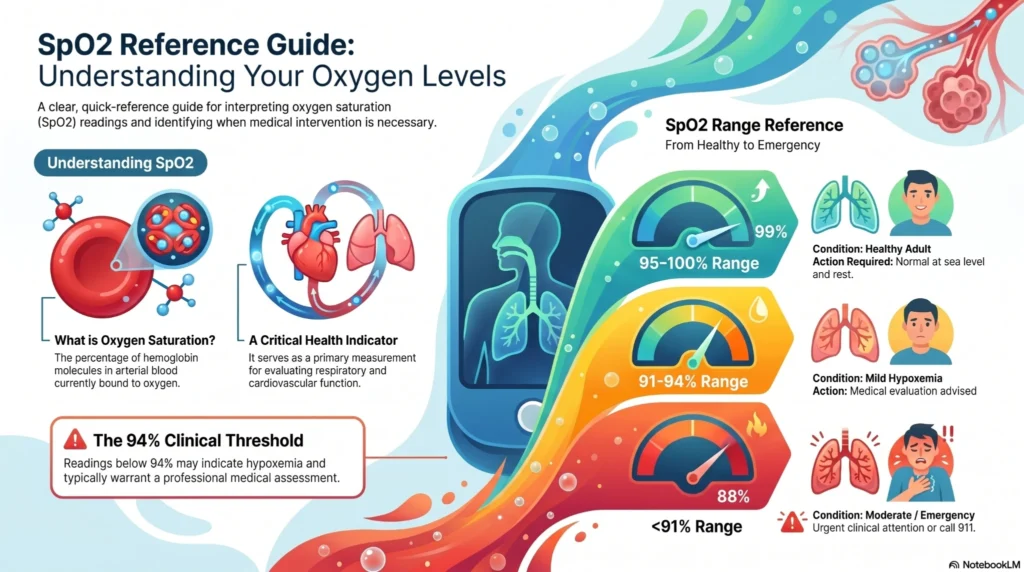
Oxygen saturation (SpO₂) reflects the percentage of hemoglobin molecules in arterial blood that are bound to oxygen. It is a critical indicator of respiratory and cardiovascular function. Evidence from multiple clinical sources, including guidelines from the British Thoracic Society, indicates that SpO₂ below 94% may indicate hypoxemia and warrant clinical assessment.[1][2]
| Category | SpO₂ Range | Context |
| Healthy adult | 95–100% | At sea level, at rest |
| Mild hypoxemia | 91–94% | Medical evaluation advised |
| Moderate hypoxemia | <91% | Urgent clinical attention |
| Emergency threshold | <90% | Call 911 immediately |
SpO₂ Range Reference:
80%─────85%─────90%─────95%────100%
◄─EMERGENCY─►◄─MODERATE CONCERN─►◄─NORMAL─►
(<90%) (90–94%) (95–100%)
Respiratory Rate and Breathing Patterns
| Population Group | Normal Respiratory Rate | Clinical Significance |
| Adults (18+) | 12–20 breaths/minute | Baseline for comparison; deviation may signal distress or disease |
| Children (6–12 years) | 18–30 breaths/minute | Higher baseline; pediatric ranges differ significantly from adults |
| Infants (<1 year) | 30–60 breaths/minute | Requires pediatric assessment; consumer devices not validated |
| Older adults (65+) | 12–20 breaths/minute | Tachypnea (>20/min) may indicate early deterioration[3] |
Abnormal breathing patterns include tachypnea (>20/min), bradypnea (<12/min), Cheyne-Stokes respiration (cyclic pattern associated with heart failure or CNS disorders), and Kussmaul breathing (deep, labored breathing associated with metabolic acidosis). These patterns are clinical findings and require provider interpretation.[4]
Common Respiratory Conditions
- COPD — Chronic obstructive disease reducing airflow; monitoring supports exacerbation detection and O₂ therapy titration.
- Asthma — Reversible airway inflammation and bronchoconstriction; SpO₂ monitoring may help assess attack severity.
- Sleep Apnea — Intermittent upper airway obstruction during sleep; nocturnal SpO₂ drops are a key diagnostic indicator.
- COVID-19 / Respiratory Infections — Silent hypoxia — low SpO₂ without perceived breathlessness — has been observed in some COVID-19 cases.[5]
- High-Altitude Exposure — Reduced ambient O₂ may lower SpO₂; altitude sickness risk increases above 2,500 m (8,200 ft).
- Heart Failure — Reduced cardiac output may impair oxygen delivery; respiratory rate and SpO₂ are often monitored together.
Oxygen Saturation (SpO₂) Basics
What SpO₂ Measures
SpO₂ (peripheral oxygen saturation) is a non-invasive estimate of arterial oxygen saturation (SaO₂) measured using light sensor technology (PPG — photoplethysmography). A pulse oximeter shines a small light through your fingertip to detect how much oxygen your red blood cells are carrying. A pulse oximeter emits light at two wavelengths (typically 660 nm red and 940 nm infrared) through a capillary bed; oxygenated and deoxygenated hemoglobin absorb light differently, allowing a ratio to be calculated.[6]
Clinical note: SpO₂ is an estimate, not a direct measurement of blood oxygen. Invasive arterial blood gas (ABG) analysis provides SaO₂ and PaO₂ with higher precision. In clinical settings, SpO₂ is used for trending and screening; ABG is used for definitive assessment.
Normal Oxygen Saturation Ranges
What is a normal oxygen level at home? For most healthy adults at rest and at sea level, a reading between 95% and 100% is normal. See the condition-specific ranges in the table below.
| Clinical Scenario | Target SpO₂ | Source Guideline | Status |
| Healthy adult (sea level, rest) | 95–100% | General clinical consensus[1] | Normal |
| Older adult (>70 years) | 94–98% | Age-related physiological variation[3] | Normal (adjusted) |
| COPD (stable, provider-specified) | 88–92% | BTS/GOLD guidelines — higher O₂ may suppress drive[7] | Condition-specific |
| High altitude (>2,500 m) | 90–95% (adjusted) | Lower ambient PO₂ reduces baseline SpO₂[8] | Context-specific |
| During intense exercise (healthy) | ≥95% | Transient drops <90% may warrant evaluation[9] | Variable |
| Mild hypoxemia | 91–94% | Medical evaluation recommended | Abnormal |
| Moderate–severe hypoxemia | <91% | Emergency threshold; seek care immediately | Emergency |
Factors That Affect Readings
| Factor | Effect on Reading | Clinical Recommendation |
| Poor peripheral circulation (cold, shock) | May produce inaccurate or no reading | Warm the digit; reposition sensor; use earlobe probe |
| Nail polish (dark colors, especially blue/green) | May underestimate SpO₂[10] | Remove polish or rotate probe 90° |
| Skin pigmentation | May overestimate SpO₂ in individuals with darker skin tones[11] | FDA has issued advisories on bias; results should be interpreted with clinical context |
| Motion artifact | Produces false readings during movement | Remain still during spot-check readings; wearables use algorithmic filtering |
| Carboxyhemoglobin (CO poisoning) | Falsely elevated SpO₂ (CO-Hb reads as oxy-Hb) | Standard pulse oximeters cannot detect CO poisoning; ABG required |
| Methemoglobinemia | SpO₂ erroneously reads ~85% regardless of true saturation | Rare but clinically significant; co-oximetry required |
| Anemia (severe) | SpO₂ may appear normal despite low absolute O₂ content | SpO₂ reflects % saturation, not total O₂; clinical context required |
⚠️ If You Have Darker Skin: What You Need to Know About Pulse Oximeter Accuracy
The FDA has confirmed that standard pulse oximeters may read 2–4% higher than your actual oxygen level if you have darker skin. This is due to how these devices were calibrated — using data primarily from lighter-skinned individuals.
What this means for you:
• Your displayed SpO₂ may appear normal even when your true level is lower.
• Do not rely solely on a single SpO₂ reading to assess your status.
• Ask your healthcare provider about periodic verification through arterial blood gas (ABG) testing to establish your accurate personal baseline.
• When in doubt, act on symptoms — not just the number on the device. The FDA is actively reviewing device standards. Until updated devices are widely certified, clinical correlation is especially important for this group.
When Low Oxygen Is Dangerous
⚠️ Critical thresholds — do not delay emergency care
SpO₂ <90% is generally regarded as a medical emergency threshold, particularly when accompanied by dyspnea, altered mental status, or cyanosis. Silent hypoxia — reduced oxygen without subjective breathlessness — was observed in some COVID-19 patients and may delay recognition of a critical state.[5]
Who Needs a Pulse Oximeter at Home? (Conditions, Use Cases, and When It Matters)
COPD and Chronic Respiratory Disease
For people living with COPD
A silent drop in oxygen levels can precede a serious flare-up by hours — before you feel noticeably worse. Daily monitoring gives you and your care team an early warning system, so a bad day doesn’t become a hospital admission.
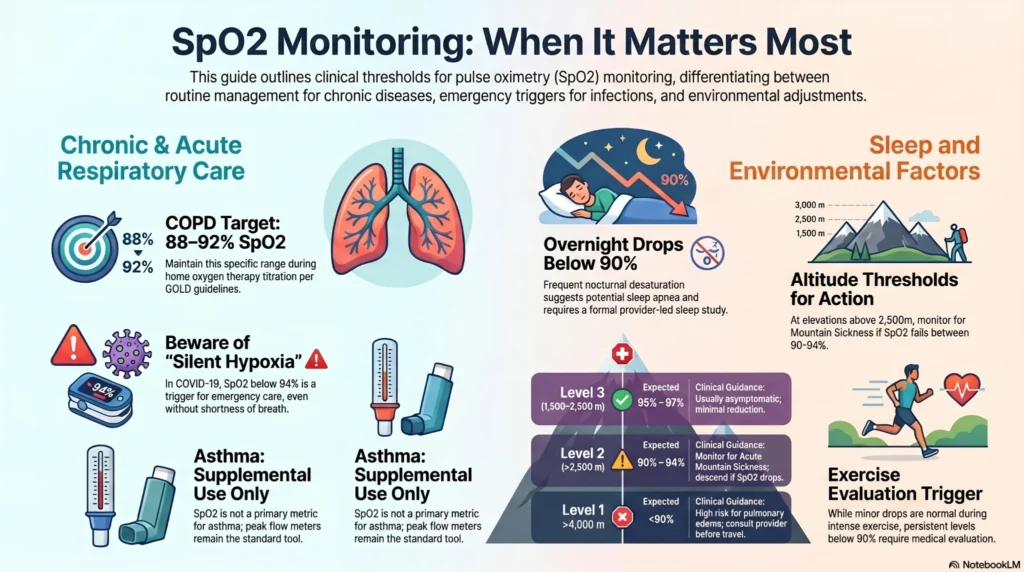
How often should I check SpO₂ with COPD? Most providers recommend a morning spot-check at rest, taken at the same time each day. More frequent checks are appropriate during exacerbations or when following a written action plan.
| Monitoring Use Case | Clinical Purpose | Evidence Level |
| Daily SpO₂ spot-check | Detect early exacerbations before symptom onset | Supported — clinical guidelines recommend home monitoring[7] |
| O₂ therapy titration at home | Maintain SpO₂ within provider-prescribed range (often 88–92%) | Evidence-based — GOLD guidelines[7] |
| Activity-related monitoring | Assess desaturation during exertion | Used in clinical practice; device accuracy varies |
| Nocturnal monitoring | Identify overnight desaturation | May be ordered by provider for specific clinical scenarios |
→ See the best FDA-cleared pulse oximeters for COPD home monitoring [link to COPD device review page]
Asthma Management
For people managing asthma
During a flare-up, your lungs can be working much harder than you realize. SpO₂ monitoring gives you an objective data point beyond how you ‘feel’ — so you know when to use your rescue inhaler, when to call your doctor, and when to go to the ER
- SpO₂ is not a primary asthma management metric but may provide supplemental data during acute episodes.
- During a severe asthma attack, SpO₂ <95% in children or <92% in adults may indicate moderate-to-severe obstruction requiring urgent care.[12]
- Routine SpO₂ monitoring in well-controlled asthma has limited evidence of clinical benefit outside provider-directed plans.
- Peak flow meters and symptom diaries remain primary asthma self-management tools per GINA guidelines.[12]
→ See pulse oximeters recommended for asthma management [link to asthma device page]
Sleep Apnea Screening and Management
For people concerned about sleep apnea
If you wake up exhausted despite sleeping 8 hours, or your partner notices you stopping breathing at night, overnight oxygen tracking can provide objective data to bring to your doctor — cutting through months of uncertainty about whether to get tested.
| Indicator | What It May Suggest | Next Step |
| Nocturnal SpO₂ drops <90% | Possible obstructive sleep apnea (OSA) | Consult provider; formal sleep study (polysomnography) required for diagnosis |
| Oxygen Desaturation Index (ODI) >5/hour | Associated with moderate sleep-disordered breathing[13] | Provider evaluation required; not a standalone diagnostic |
| Persistent morning headaches + low nocturnal SpO₂ | May suggest nocturnal hypoxemia | Medical review; provider may order overnight oximetry study |
| CPAP therapy monitoring | Assess treatment effectiveness | Wearable SpO₂ may be used adjunctively with provider guidance |
Important: Consumer wearables are not FDA-cleared diagnostic devices for sleep apnea. A formal sleep study performed or ordered by a licensed provider is required for diagnosis. See our Sleep & Recovery pillar for additional context.
→ Compare overnight SpO₂ tracking devices for sleep apnea screening [link to sleep monitoring review page]
COVID-19 and Respiratory Infections
⚠️ Silent hypoxia awareness
- Evidence from the COVID-19 pandemic documented cases of “silent hypoxia” — SpO₂ <94% without prominent dyspnea.[5]
- Home pulse oximetry was recommended by some health authorities for high-risk COVID-19 patients to detect deterioration early.
- A threshold of SpO₂ <94% (or <92% per some guidelines) was used as a trigger for seeking emergency care during acute COVID-19 infection.[14]
- These thresholds should be individualized based on provider guidance, particularly for patients with chronic respiratory conditions.
High Altitude and Exercise Monitoring
| Context | Expected SpO₂ Change | Clinical Guidance |
| Altitude 1,500–2,500 m (4,900–8,200 ft) | Minimal reduction (1–3%) | Usually asymptomatic; monitoring may be useful for those with pre-existing conditions |
| Altitude >2,500 m (8,200 ft) | May fall to 90–94% | Monitor for acute mountain sickness (AMS) symptoms; descend if SpO₂ drops significantly |
| Altitude >4,000 m (13,100 ft) | SpO₂ may fall below 90% | High-altitude pulmonary edema (HAPE) risk; medical consultation before travel |
| Intense aerobic exercise (healthy adults) | Transient minor drop (<2–3%) | Persistent drops <90% during exercise warrant provider evaluation[9] |
How Pulse Oximeters Work — and Which Type Is Most Accurate for Home Use
How Pulse Oximeters Work
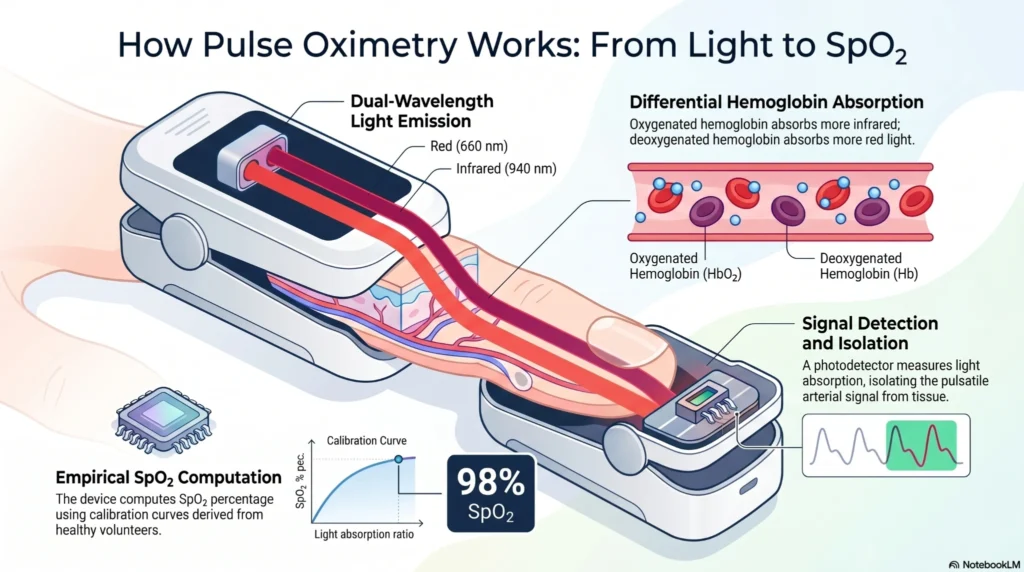
- SpO₂ percentage is computed from empirical calibration curves derived from healthy volunteer studies. This calibration data influences accuracy at low saturation levels.
- A light-emitting diode (LED) shines red (660 nm) and infrared (940 nm) light through the tissue (typically a fingertip or earlobe).
- A photodetector on the opposite side measures light absorption. Oxygenated hemoglobin absorbs more infrared; deoxygenated hemoglobin absorbs more red light.
- The device calculates the ratio of pulsatile (arterial) to non-pulsatile (venous and tissue) absorption — isolating the arterial signal.
Finger Clip vs. Wearable Sensors
| Device Type | Mode | Accuracy | Price Range | Best Use Case | Best For | Limitations |
| Finger clip oximeter | Spot-check | ±2% (FDA Class II) | $15–$40 | COPD daily check-in; COVID-19 home monitoring | COPD, asthma, post-illness recovery | Not for continuous use; motion-sensitive |
| Wrist wearable (smartwatch) | Spot/continuous estimate | ±3–4% (varies) | $150–$400 | Wellness trends; overnight SpO₂ estimate | General wellness; tech-comfortable users | Lower accuracy; not FDA-cleared for diagnosis |
| Ring wearable | Continuous estimate (PPG) | ±2–3% (varies) | $200–$500 | Sleep monitoring; activity tracking | Sleep apnea screening; active users | Limited clinical validation; motion-affected |
| Medical-grade continuous oximeter | Continuous (hospital) | ±2% (FDA cleared) | Rx / clinical only | ICU, surgery, formal sleep studies | Clinical settings only | Requires clinical supervision |
→ Ready to choose a device? See our Buying Guide — matched to your condition and budget. [link to Buying Guide page]
Do I Need a Pulse Oximeter at Home?
For most healthy adults without a chronic condition, a pulse oximeter is optional. For the groups below, the answer is a clear yes.
| Who should have one | Why it matters | What you need |
| COPD patients | Early exacerbation detection; O₂ therapy titration | Finger clip, FDA-cleared, ±2% accuracy |
| Asthma (moderate–severe) | Objective severity check during flare-ups | Finger clip — low cost, reliable |
| Post-COVID recovery | Silent hypoxia detection; peace of mind | Finger clip — basic model sufficient |
| Sleep apnea concern | Overnight SpO₂ trend data for provider review | Ring or wrist wearable with overnight mode |
| Caregiver for above groups | Monitoring support between appointments | Finger clip with memory log or large display |
For under $30–$35, an FDA-cleared finger clip oximeter gives you reliable daily readings. See our top picks → [link to Top Devices page]
✅ 4 Things to Look for When Buying a Pulse Oximeter
1. FDA 510(k) clearance — Means the device has been reviewed for medical accuracy. Look for this label on the box or product listing.
2. ±2% accuracy — The clinical standard. Avoid devices that don’t publish this spec.
3. Large, easy-read display — Especially important for older adults or those monitoring at night.
4. Battery life of 20+ hours — Continuous overnight monitoring requires a device that won’t die mid-reading.
Continuous vs. Spot-Check Monitoring
| Monitoring Approach | Clinical Use Cases | Appropriate For |
| Spot-check (single reading) | Daily COPD check-in, COVID-19 home monitoring, post-exertion check | Stable chronic disease management with provider guidance |
| Intermittent scheduled readings | Multiple daily readings at set intervals | Exacerbation monitoring; provider-directed protocols |
| Nocturnal continuous monitoring | Sleep apnea screening, nocturnal desaturation detection | Provider-ordered; results reviewed clinically |
| Activity-linked monitoring | Exertional desaturation in COPD, pulmonary rehabilitation | Used in clinical pulmonary rehabilitation settings |
Accuracy and Reliability Considerations
⚠️ Known accuracy limitations — critical for interpretation
- The FDA has identified that pulse oximeters may be less accurate in individuals with darker skin tones due to calibration methodology; ongoing regulatory review is in progress.[11]
- Devices cleared by the FDA under 510(k) for medical use carry greater accuracy evidence than wellness-grade consumer wearables. (see our testing and evaluation methodology).
- A single reading should not be used to make clinical decisions; trending over time and clinical correlation are essential.
- No consumer pulse oximeter replaces clinical assessment or arterial blood gas (ABG) analysis.
Can I trust a wearable SpO₂ reading? Wearables (watches and rings) are useful for identifying trends over time but typically have higher margin of error (±3–4%) than FDA-cleared finger clip devices. Use them for patterns, not clinical decisions.
| 💰 Is it worth buying? For anyone with COPD, asthma, sleep apnea, or who is recovering from COVID-19: yes. A basic FDA-cleared finger clip oximeter costs $20–$35 and provides medically meaningful daily readings. That’s under $1 per month over three years of daily use. | ⏱️ Is it complicated to use? No. Using a pulse oximeter takes about 10 seconds: clip it to your fingertip, stay still for one reading cycle, and read the two numbers on the display. No app required for basic models. No calibration needed. |
Which Device Is Right for You?
Find your situation below for a direct recommendation:
| Your situation | Recommended device type | Next step |
| 👤 Managing COPD at home | Finger clip oximeter — FDA-cleared, ±2% accuracy, under $35 | → See our Top Devices for COPD |
| 😴 Monitoring sleep apnea concerns | Ring or wrist wearable with overnight SpO₂ tracking | → See our Sleep Monitoring options |
| 🏃 Active lifestyle / exercise tracking | Wrist wearable with continuous SpO₂ + heart rate | → See Activity Monitor reviews |
| 👩👴 Caregiver for an older adult with COPD / asthma | Finger clip oximeter with large display + memory log | → See our Caregiver-Friendly picks |
Not sure? Our Device Comparison page walks through every option side by side. [link to Device Comparisons page]
💬 What People Are Saying
“I check my SpO2 every morning with COPD. This $28 oximeter gives me peace of mind between doctor visits — and I’ve caught two early flare-ups before they got serious.”
— Verified Amazon reviewer, COPD patient, 67
“My mother has asthma and we got her a finger oximeter after her last hospital scare. Now we know the exact number at which to call her doctor vs. wait. It changed how we manage her care.”
— Caregiver reviewer, daughter of 74-year-old asthma patient
“I was skeptical a $30 device could be accurate. After comparing it to the hospital monitor during a check-up, it was within 1%. Sold.”
— Verified reviewer, post-COVID recovery monitoring
Interpreting Oxygen Measurements
Target SpO₂ Ranges for Different Conditions
| Condition | Target SpO₂ Range | Source Guideline | Notes |
| Healthy adult (at rest) | 95–100% | General clinical consensus | Lower end of normal for older adults |
| COPD (stable) | 88–92% | BTS/GOLD guidelines[7] | Provider must specify individual target; higher O₂ may suppress respiratory drive |
| Asthma (during attack) | ≥94% (adults); ≥95% (children) | BTS/SIGN Asthma Guidelines[12] | Values below thresholds indicate need for urgent care |
| Acute COVID-19 (at-risk) | ≥94% | WHO COVID-19 guidelines[14] | Seek care if below threshold; individual protocols vary |
| High altitude (acclimatized) | 90–95% (context-dependent) | Altitude medicine consensus[8] | Reassess if symptomatic (headache, confusion, dyspnea) |
| Sleep (healthy adults) | ≥95% (most of sleep period) | Sleep medicine literature[13] | Sustained drops <90% may indicate sleep-disordered breathing |
Respiratory Rate Normal Ranges
| Age Group | Normal Range (breaths/min) | Tachypnea Threshold | Bradypnea Threshold |
| Adults (18–65) | 12–20 | >20/min | <12/min |
| Older adults (65+) | 12–20 | >20/min (clinical concern at >25) | <12/min |
| Children (6–12 years) | 18–30 | >30/min | <18/min |
| Toddlers (1–5 years) | 22–40 | >40/min | <22/min |
| Infants (<1 year) | 30–60 | >60/min | <30/min |
Understanding Reading Variability
- SpO₂ readings naturally fluctuate by 1–2% even in healthy individuals due to respiratory cycle variation and sensor motion.[6]
- A single low reading should be repeated after the user is still, warm, and positioned correctly before acting on the result.
- Trending (comparing readings over time under similar conditions) is more clinically meaningful than any single data point.
- Respiratory rate measured by consumer wearables may have higher variability than hospital-grade monitoring equipment.
- Readings taken immediately after exercise, during fever, or with cold extremities may not reflect resting baseline values.
When Readings Require Medical Attention
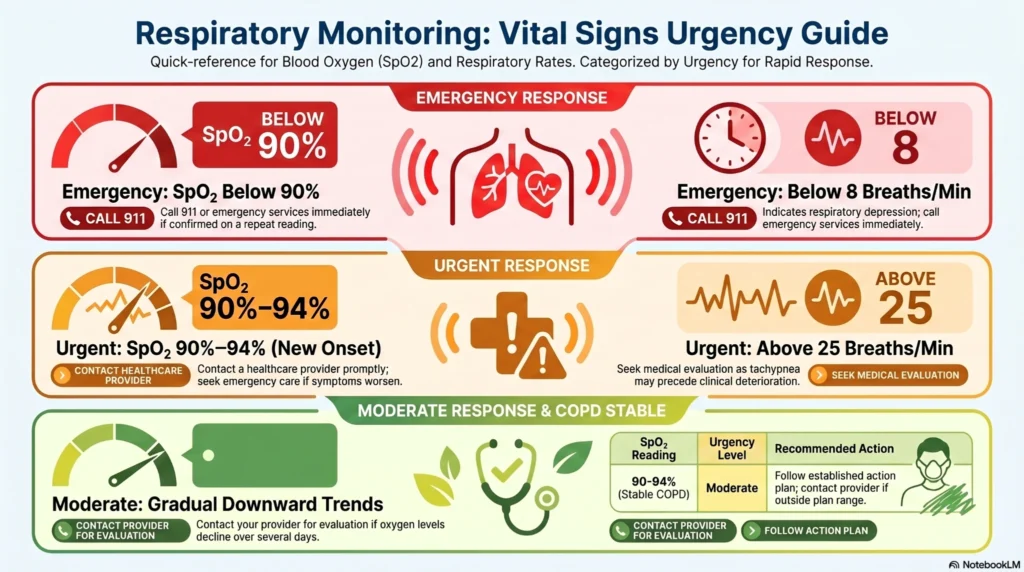
| Reading / Finding | Urgency Level | Recommended Action |
| SpO₂ <90% (confirmed on repeat) | Emergency | Call 911 / Emergency services immediately |
| SpO₂ 90–94% (new onset, no known cause) | Urgent | Contact healthcare provider promptly; proceed to emergency if worsening |
| SpO₂ 90–94% (stable, known COPD — below prescribed target) | Moderate | Follow provider-established action plan; contact provider if outside plan range |
| Respiratory rate >25/min (adult, at rest) | Urgent | Seek medical evaluation; tachypnea may precede clinical deterioration |
| Respiratory rate <8/min (adult) | Emergency | May indicate respiratory depression; call emergency services |
| Gradual downward SpO₂ trend over days | Moderate | Contact provider for evaluation; may indicate disease progression |
Respiratory Monitoring for Specific Conditions
COPD Home Monitoring
| Monitoring Element | Recommended Practice | Evidence / Guideline |
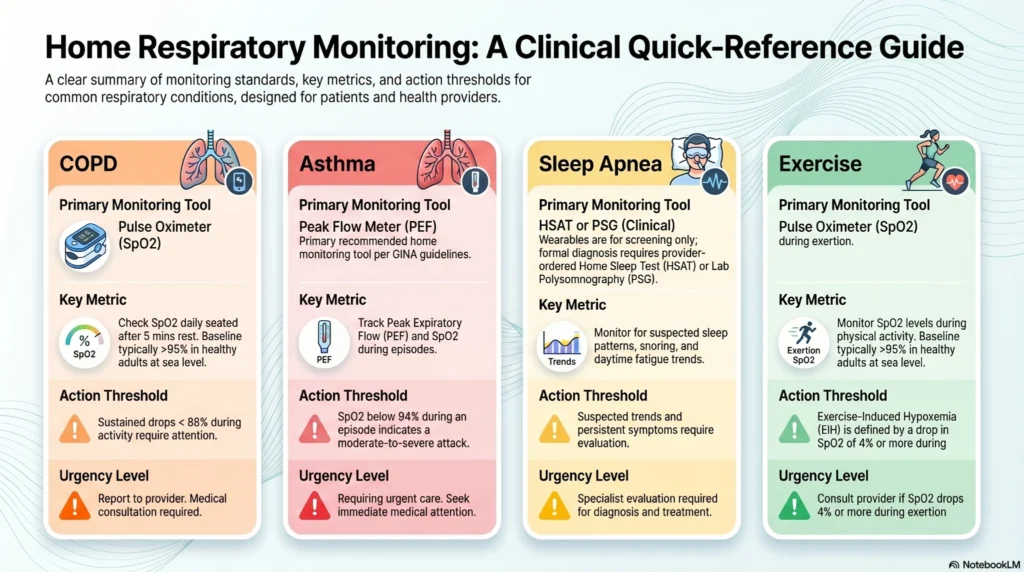
| Daily SpO₂ check | Same time daily (morning recommended); resting, seated, after 5+ minutes of inactivity | GOLD 2024 guidelines recommend regular self-monitoring[7] |
| Exacerbation action plan | Provider-defined SpO₂ thresholds that trigger specific responses (e.g., adjust O₂, call provider, seek ER) | A written action plan can help you avoid emergency room visits — ask your provider for one.[7] |
| Activity monitoring | Note desaturation during ADLs; report sustained drops <88% during activity to provider | Used in clinical practice; device-specific accuracy varies |
| Supplemental O₂ monitoring | If on long-term O₂ therapy (LTOT), monitor SpO₂ while using O₂ per provider plan | GOLD / BTS recommend SpO₂ ≥90% during O₂ use for most COPD patients[7] |
Asthma Symptom Tracking
- Peak expiratory flow (PEF) measurement is the primary recommended home monitoring tool for asthma per GINA guidelines.[12]
- SpO₂ monitoring may be used as an adjunct, particularly in moderate-to-severe asthma or when symptom perception is unreliable.
- Symptom diaries tracking triggers, frequency, and rescue inhaler use remain central to asthma self-management.
- SpO₂ <94% during an asthma episode suggests moderate-to-severe attack and warrants urgent care.
Sleep Apnea Detection
| Monitoring Approach | What It Detects | Diagnostic Value |
| Consumer wearable nocturnal SpO₂ | Overnight SpO₂ trends; estimated ODI | Screening indicator only; not diagnostic |
| Home sleep apnea test (HSAT) | Airflow, SpO₂, respiratory effort, heart rate | FDA-cleared; provider-ordered; diagnostic for uncomplicated OSA |
| In-lab polysomnography (PSG) | Comprehensive sleep architecture + respiratory data | Gold standard for sleep apnea diagnosis |
Suspected sleep apnea requires formal diagnosis by a qualified sleep medicine or respiratory specialist. Consumer devices may support awareness but do not replace clinical evaluation. See our Sleep & Recovery pillar for related content.
Exercise-Induced Respiratory Changes
- In healthy adults, SpO₂ typically remains ≥95% during moderate-to-intense exercise at sea level.[9]
- Exercise-induced hypoxemia (EIH) — defined as a drop in SpO₂ ≥4% during exertion — may be observed in some athletes and individuals with underlying pulmonary disease.
- Consumer wearable accuracy is reduced during high-intensity exercise due to motion artifact; clinical-grade devices or post-exercise spot-checks may be more reliable.
- SpO₂ drops during exercise in individuals with known COPD or interstitial lung disease should be discussed with a provider, as they may affect activity prescriptions.
Medical Safety and Emergency Guidance
Recognizing Respiratory Distress
| Sign / Symptom | What It May Indicate | Urgency |
| Labored breathing, accessory muscle use | Increased work of breathing; possible obstruction or failure | Emergency |
| Cyanosis (blue lips, fingertips) | Severe hypoxemia; inadequate oxygenation of peripheral tissues | Emergency |
| Altered mental status, confusion | Hypoxic encephalopathy or hypercapnia | Emergency |
| Respiratory rate >30/min (adult) | Severe respiratory distress or systemic illness | Emergency |
| SpO₂ <90% (confirmed) | Significant hypoxemia | Emergency |
| Rapid breathing + fever + productive cough | Possible pneumonia or lower respiratory infection | Urgent — seek care same day |
| Persistent wheeze not responsive to rescue inhaler | Possible severe asthma exacerbation | Emergency |
When Low Oxygen Requires Emergency Care
🚨 Call 911 / Emergency Services immediately if any of the following occur:
- SpO₂ <90% confirmed on repeat reading
- Severe shortness of breath at rest or unable to complete a sentence
- Blue coloring of lips, fingernails, or skin (cyanosis)
- Loss of consciousness or confusion associated with breathing difficulty
- Chest pain with respiratory symptoms
- Rapid deterioration from a known respiratory baseline
Do not drive yourself to the emergency room if experiencing severe respiratory distress. Call emergency services or have someone else drive.
Warning Signs in Respiratory Infections
| Warning Sign | Possible Significance | Action |
| SpO₂ <94% during respiratory illness | May indicate lower respiratory involvement (pneumonia, viral pneumonitis) | Contact provider immediately; proceed to ER if worsening or <90% |
| Breathlessness at rest or with minimal activity | Significant respiratory compromise | Seek emergency evaluation |
| Feeling unwell but SpO₂ normal (possible silent hypoxia) | SpO₂ alone may not capture early deterioration[5] | Monitor closely; act on symptoms, not readings alone |
| Symptoms rapidly worsening within 24–48 hours | Acute progression of infection | Seek urgent evaluation; do not wait for scheduled appointment |
All content has been produced under the medical oversight standards and conflict of interest and funding disclosure detailed on our About page.





Explore Respiratory Monitoring Topics
| Topic | Description |
| Device Guide | Pulse oximeters, wearable sensors, and breathing monitors reviewed with medical context. |
| Metrics Explained | Deep dive into SpO₂, respiratory rate, and breathing pattern interpretation. |
| Device Comparisons | Side-by-side comparison of pulse oximeter types, accuracy, and FDA status. |
| Buying Guide | Selection framework based on medical need, condition, and monitoring frequency. |
| Top Devices | Recommended devices with FDA clearance status, accuracy data, and use-case fit. |
References
- O’Driscoll BR, et al. BTS guideline for oxygen use in adults in healthcare and emergency settings. Thorax. 2017;72(Suppl 1):ii1–ii90.
- Jubran A. Pulse oximetry. Crit Care. 2015;19:272. doi:10.1186/s13054-015-0984-8
- Sharma G, Goodwin J. Effect of aging on respiratory system physiology and immunology. Clin Interv Aging. 2006;1(3):253–260.
- Cretikos MA, et al. Respiratory rate: the neglected vital sign. Med J Aust. 2008;188(11):657–659.
- Tobin MJ, Laghi F, Jubran A. Why COVID-19 silent hypoxemia is baffling to physicians. Am J Respir Crit Care Med. 2020;202(3):356–360.
- Nitzan M, Romem A, Koppel R. Pulse oximetry: fundamentals and technology update. Med Devices (Auckl). 2014;7:231–239.
- Global Initiative for Chronic Obstructive Lung Disease (GOLD). Global Strategy for Prevention, Diagnosis and Management of COPD: 2024 Report. goldcopd.org
- Luks AM, Swenson ER. Pulse oximetry at high altitude. High Alt Med Biol. 2011;12(2):109–119.
- Dempsey JA, Wagner PD. Exercise-induced arterial hypoxemia. J Appl Physiol. 1999;87(6):1997–2006.
- Cote CJ, et al. The effect of nail polish on pulse oximetry. Anesth Analg. 1988;67(7):683–686.
- U.S. Food and Drug Administration. Pulse Oximeter Accuracy and Limitations: FDA Safety Communication. February 2021. fda.gov
- Global Initiative for Asthma (GINA). Global Strategy for Asthma Management and Prevention. 2023 Update. ginasthma.org
- Lévy P, et al. Obstructive sleep apnoea syndrome. Nat Rev Dis Primers. 2015;1:15015.
- World Health Organization. Clinical Management of COVID-19: Living Guideline. who.int
📥 Free Download: Daily Oxygen Monitoring Log
Track your SpO₂ and respiratory rate readings in one place — with columns for time of day, reading, symptoms, and notes for your doctor.
✓ Printable PDF format | ✓ Designed for COPD and asthma daily check-ins | ✓ Includes SpO₂ reference ranges and action thresholds
[Enter your email to download the free monitoring log] You’ll also receive our monthly respiratory health digest — practical tips for managing COPD, asthma, and sleep apnea at home. Unsubscribe anytime.
📲 Know Someone Who Could Use This Guide?
If you’re caring for a family member with COPD, asthma, or sleep apnea — or if you’re a patient yourself — this free guide explains exactly what oxygen readings mean and when to act.
Pre-written caption for Facebook / health groups:
“Free guide for anyone managing COPD or asthma at home. Explains exactly what SpO₂ readings mean, when to call your doctor vs. go to the ER, and which pulse oximeter is worth buying. No sign-up needed. → ”
Medical Disclaimer: The information on Wearable Wellness Guide is for educational purposes and should not replace professional medical advice. Always consult a qualified healthcare provider for diagnosis, treatment, or medical device recommendations tailored to your individual health needs.
Page last updated: May 2026
Medical review: Dr. Rishav Das, M.B.B.S. — May 2026
Medical reviewer role: Wellness Device Data Analyst | Consumer Device Accuracy Specialist
Reviewer credentials and scope of authority: See About page