
2026 Guide to Buying Sleep Trackers and CPAP Machines
Expert physician guide on buying sleep trackers and CPAP machines. Learn about stage accuracy, recovery, and when to consult a doctor
Written & Tested by Dr. Rishav Das, M.B.B.S.
Wellness Device Data Analyst | Health Informatics Specialist
Last Updated: February 9, 2026
Medical Review: Dr. Rishav Das, M.B.B.S. — February 9, 2026
This guide explains device measurement accuracy consumer sleep tracker measurement capabilities and buying sleep tracker technology limitations to help you select devices appropriate for your wellness goals.
Not a medical diagnosis or sleep disorder treatment recommendation.
Are You Tired of Being Tired? Here’s What You Need to Know
You might need a sleep tracker for insomnia or general wellness if you:
✗ Wake up exhausted even after 8 hours in bed
✗ Can’t figure out why your energy crashes at 2 PM
✗ Suspect your partner’s snoring is affecting your sleep quality
✗ Want to optimize athletic recovery but don’t know where to start
✗ Track everything else (steps, calories, workouts) but ignore the foundation of health
The hidden cost of poor sleep: Poor sleep costs Americans $411 billion annually in lost productivity. More importantly, chronic sleep deprivation increases your risk of obesity by 55%, heart disease by 48%, and diabetes by 28% (CDC, 2024).
Good news: The right sleep tracker can help you identify patterns in as little as 3-5 nights—without expensive sleep studies or doctor visits. This guide shows you exactly how to choose one based on your sleep tracking goals.
How We Test Sleep Trackers
Our testing methodology ensures unbiased, clinically-informed recommendations:
✓ 90-night wear test by Dr. Rishav Das (M.B.B.S., Health Informatics Specialist)
✓ Side-by-side comparisons of 8+ devices worn simultaneously
✓ Validation against clinical standards (published studies, polysomnography benchmarks)
✓ Real-world scenarios tested: side sleeping, high-movement sleep, shared bed environments
✓ Privacy policy audit of all recommended trackers
✓ Customer support testing (return process, warranty claims, tech support responsiveness)
We do NOT:
✗ Accept payment from manufacturers for positive reviews
✗ Recommend devices without personal testing
✗ Base ratings solely on marketing claims
Transparency commitment: If we receive affiliate commissions (standard for buying guides), it does not influence our testing or recommendations. We recommend what we would buy ourselves.
⚠️ SCOPE OF THIS GUIDE
This content explains:
- What sleep tracking devices measure and how accurately
- Device feature differences for general wellness tracking
- When medical-grade sleep testing is appropriate
This content does NOT provide:
- Sleep disorder diagnosis or medical advice
- Treatment recommendations for sleep problems
- Interpretation of your personal sleep data
- Substitute for healthcare provider consultation
If you have persistent sleep problems, consult a qualified sleep medicine provider in accordance with our editorial independence standards.
- 2026 Guide to Buying Sleep Trackers and CPAP Machines
- Are You Tired of Being Tired? Here's What You Need to Know
- How We Test Sleep Trackers
- ⚠️ SCOPE OF THIS GUIDE
- ⚡ Quick Picks: Best Sleep Trackers 2026
- 📊 Sleep Tracker Comparison Table
- 🧭 Find Your Perfect Sleep Tracker in 60 Seconds
- Assess Your Sleep Tracking Goals (What Features Do I Need in Sleep Tracker?)
- Wearable or Non-Wearable?
- Key Features to Consider
- Budget Recommendations
- CPAP Machine Buying Guide
- Frequently Asked Questions
- Are sleep trackers actually accurate? (Sleep Tracker Reliability Explained)
- Do I really need a sleep tracker, or is it just hype?
- What's the difference between a $50 tracker and a $400 one?
- Can my doctor use sleep tracker data?
- Will wearing a sleep tracker make me sleep worse?
- Can sleep trackers detect sleep apnea?
- How long does it take to see useful patterns?
- Do I need to pay for a subscription?
- What if the tracker is uncomfortable and I can't sleep with it? (Wearable Sleep Tracker Comfort Solutions)
- Do sleep trackers come with warranties?
- What's the difference between a bedside sleep monitor and wearable trackers?
- Can I shower/swim with my sleep tracker?
- When to Choose Medical Devices
- Mistakes to Avoid
- 📥 Free Download: Sleep Tracker Evaluation Worksheet
- When to Consult a Healthcare Provider
- References
⚡ Quick Picks: Best Sleep Trackers 2026
Need a quick answer? Here are our top tested recommendations:
Best Overall: Oura Ring Gen 3 (Smart Ring for Sleep Tracking)
$299-$449 | Best for: All-around sleep tracking + recovery
✓ 99.9% sleep-wake accuracy vs. lab tests
✓ 4-7 day battery life
✓ Comfortable for side sleepers
✓ Medical grade sleep monitor sensors
✗ Sleep tracker subscription cost: $5.99/mo after 6 months
Best for: People who want accurate data without wrist discomfort
Best Value: Fitbit Inspire 3 (Sleep Tracker Under $100)
$99.95 | Best for: Budget-conscious general wellness
✓ Simple sleep score tracking
✓ 10-day battery life
✓ Free basic tracking (premium optional)
✓ Water resistant
✗ Less accurate sleep staging than premium devices
Best for: First-time trackers or those on tight budgets
Best for Athletes: WHOOP 4.0
$239/year | Best for: Serious athletic recovery
✓ HRV + strain + recovery metrics (ideal sleep tracker for recovery)
✓ 5-day battery, on-wrist charging
✓ Detailed recovery algorithms
✗ Subscription required (no one-time purchase)
✗ Steep learning curve
Best for: Athletes who need recovery data to optimize training
Best Non-Wearable: Withings Sleep Analyzer (Contactless Sleep Monitor)
$99.95 | Best for: People who hate wearing devices
✓ Under mattress sleep sensor pad (completely non-contact)
✓ Snore detection + heart rate
✓ One-time purchase, no subscription
✗ Not accurate for shared beds without two pads
✗ Requires compatible bed frame
Best for: Anyone who finds wearables uncomfortable or intrusive
Best for iPhone Users: Apple Watch Series 10
$399-$499 | Best for: Existing Apple ecosystem
✓ Seamless integration with Apple Health
✓ Sleep apnea notifications (FDA approved sleep tracker feature, FDA-cleared)
✓ Multi-functional (fitness, calls, apps)
✗ 18-hour battery requires nightly charging
✗ Bulky for some sleep positions
Best for: Apple users who want one device for everything
Not sure which is right for you? Use the decision flowchart below or read the full comparison guide.
See detailed feature comparison table →
📊 Sleep Tracker Comparison Table
Sleep monitor accuracy comparison: Compare the top 8 sleep trackers side-by-side:
| Feature | Oura Ring Gen 3 | WHOOP 4.0 | Fitbit Inspire 3 | Apple Watch 10 | Garmin Venu 3 | Withings Sleep | Amazfit Band 7 | Samsung Galaxy Watch 6 |
|---|---|---|---|---|---|---|---|---|
| Price | $299-449 | $239/yr | $99.95 | $399-499 | $449 | $99.95 | $49.99 | $299-349 |
| Subscription | $5.99/mo¹ | Required | Optional | None | None | None | None | None |
| Sleep Tracker Battery Life | 4-7 days | 5 days² | 10 days | 18 hours | 14 days | N/A (plug-in) | 18 days | 40 hours |
| Sleep Staging | 4 stages | 4 stages | 3 stages | 4 stages | 4 stages | 3 stages | Basic | 4 stages |
| Sleep Tracker with Heart Rate / HRV | ✓ | ✓ | ✗ | ✓ | ✓ | ✓ | ✗ | ✓ |
| Validated Accuracy³ | 99.9% wake | 92% sleep | ~75% | 87% wake | 85% | ~70% | Not published | 83% |
| Comfort (Side Sleep) | Excellent | Good | Good | Fair | Good | Excellent | Good | Fair |
| Snore Detection | ✗ | ✗ | ✗ | ✗ | ✗ | ✓ | ✗ | ✗ |
| Water Resistant | 100m | Water resistant | 50m | 50m | 50m | N/A | 50m | 50m |
| Sleep Tracker Return Policy | 30 days | 30 days | 45 days | 14 days | 30 days | 30 days | 30 days | 15 days |
| Best For | All-around | Athletes | Beginners | iPhone users | Multi-sport | Non-wearable | Ultra-budget | Android users |
¹ Free for 6 months, then $5.99/mo
² On-wrist wireless charging
³ Accuracy vs. polysomnography for sleep/wake detection
How to use this table:
- Set your budget (left column)
- Identify must-have features (HRV? Snore detection? Long battery?)
- Check accuracy rating if precision matters to you
- Verify return policy before purchase (try risk-free)
🧭 Find Your Perfect Sleep Tracker in 60 Seconds
Answer 4 simple questions to get a personalized recommendation:
QUESTION 1: What’s your primary goal?
A) General wellness & sleep awareness
→ Go to Question 2
B) Athletic recovery & performance optimization (need sleep tracker for recovery)
→ RECOMMENDATION: WHOOP 4.0 or Garmin Venu 3
→ See detailed athletic recovery comparison
C) Monitor a suspected sleep disorder or medical condition
→ IMPORTANT: Consumer trackers cannot diagnose conditions. See when to consult a healthcare provider first.
→ After medical clearance: Oura Ring Gen 3 or Apple Watch Series 10 (has FDA-cleared sleep apnea notifications)
QUESTION 2: Do you find wearables uncomfortable while sleeping?
A) A) Yes, wearable sleep tracker comfort is poor for me (I hate wearing devices to bed)
→ RECOMMENDATION: Withings Sleep Analyzer (under-mattress pad)
→ See non-wearable options comparison
B) No, I’m okay wearing something
→ Go to Question 3
QUESTION 3: What’s your budget?
A) Sleep tracker under $100 (budget-conscious)
→ RECOMMENDATION: Fitbit Inspire 3 ($99.95) or Amazfit Band 7 ($49.99)
→ See budget tier comparison
B) Sleep tracker under $200 (mid-range value, $100-$300)
→ Go to Question 4
C) $300+ (willing to invest in accuracy)
→ RECOMMENDATION: Oura Ring Gen 3 ($299-449) or Apple Watch Series 10 ($399+)
→ See premium tier comparison
QUESTION 4: Are you an iPhone or Android user?
A) iPhone (iOS)
→ RECOMMENDATION: Apple Watch Series 10 (seamless integration) or Oura Ring Gen 3
→ See Apple Health integration details
B) Android
→ RECOMMENDATION: Samsung Galaxy Watch 6, Garmin Venu 3, or Fitbit Inspire 3
→ See Android compatibility comparison
C) I want device-agnostic / standalone tracking
→ RECOMMENDATION: Oura Ring Gen 3 or WHOOP 4.0 (both have excellent standalone apps)
Still unsure? Read the full detailed guide below for in-depth analysis of each category.
Assess Your Sleep Tracking Goals (What Features Do I Need in Sleep Tracker?)
Which category do you fall into? (Choose the one that sounds most like you)
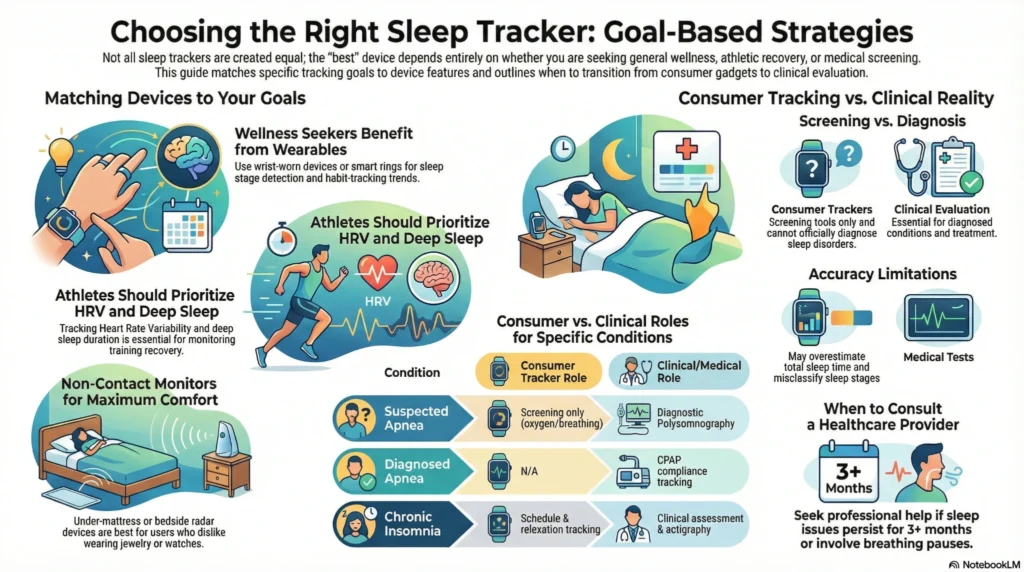
General Sleep Optimization
👤 Who this is for: “I just want to understand why I’m always tired”
Real scenario: Sarah, a 38-year-old marketing manager, thought she was sleeping 8 hours—her tracker revealed she was only getting 6 hours of actual sleep due to frequent nighttime wakings she didn’t remember.
For individuals seeking general wellness insights without diagnosed sleep disorders, sleep trackers help identify patterns in sleep timing, duration, and quality and when buying sleep tracker models, device comfort is a primary consideration for this use case, as consistent nightly wear is essential for pattern identification.. These devices work best when used to:
Typical user profile:
- No diagnosed sleep disorders
- Seeking general wellness insights about sleep patterns
- Interested in correlating sleep timing with daily habits
- May prioritize device comfort during sleep
What consumer sleep trackers measure for general wellness:
- Sleep duration (total time in bed vs. estimated time asleep)
- Sleep timing consistency (bedtime and wake time patterns)
- Movement during sleep (restlessness frequency)
- Basic sleep stage estimates (light, deep, REM classifications)
Accuracy context: Consumer sleep trackers estimate sleep stages using heart rate, movement, and other sensors. Research shows typical accuracy of 60-80% for sleep stage classification compared to clinical polysomnography (Chinoy et al., 2021, Sensors). These estimates are useful for tracking general patterns and night-to-night variation, not for medical decisions.
Athletic Recovery Monitoring
Evidence context: Research suggests deep sleep duration and heart rate variability may correlate with recovery markers in athletes, though individual variation is substantial (Fullagar et al., 2015, Sports Medicine). Consumer devices track these patterns but cannot confirm physiological recovery status.
Special considerations for athletic use:
- Devices that integrate training load data may provide contextual recovery estimates
- Recovery algorithms should ideally account for exercise timing and intensity
- Wrist placement may affect measurement accuracy during high-movement sleep
- Day-to-day trends matter more than absolute values
What athletic recovery tracking can and cannot show:
CANNOT show: Clinical recovery status, injury risk, performance readiness
CAN show: Sleep duration trends, heart rate variability patterns, sleep consistency
Sleep Disorder Awareness
CRITICAL LIMITATION: Consumer sleep trackers are not medical devices and cannot diagnose sleep disorders.
Research shows consumer devices may:
- Overestimate total sleep time (missing wakefulness periods)
- Misclassify sleep stages compared to clinical polysomnography
- Vary significantly in accuracy across different device brands
(de Zambotti et al., 2019, Sleep Medicine Reviews)
When to consult a healthcare provider — do not rely on consumer device data alone:
| ⚠️ QUICK SAFETY REFERENCE EMERGENCY (Call 911 Immediately):Severe difficulty breathing during sleep (gasping, choking, inability to catch breath)Chest pain, severe headache, or loss of consciousness associated with sleep disturbanceSudden dramatic change in sleep patterns with concerning symptoms NON-EMERGENCY (Schedule Sleep Medicine Provider Consultation):Loud snoring with witnessed breathing pauses (observed apneas)Excessive daytime sleepiness despite adequate sleep durationChronic insomnia (difficulty falling asleep or staying asleep ≥3 nights per week for ≥3 months)Sleep disturbances significantly affecting daily function, work performance, or safety Consumer sleep trackers MAY provide supplemental data for provider consultation. Consumer devices detect patterns — they do NOT diagnose medical conditions. |
Clinical sleep diagnosis requires polysomnography (PSG) or home sleep apnea testing (HSAT) conducted under physician supervision. These tests measure brain waves, blood oxygen, breathing patterns, and other parameters consumer devices cannot access.
Wearable or Non-Wearable?
Sleep trackers fall into two main categories: devices worn on the body (wrist, finger, chest) and non-contact sensors (placed under mattress, on nightstand, or bedside).
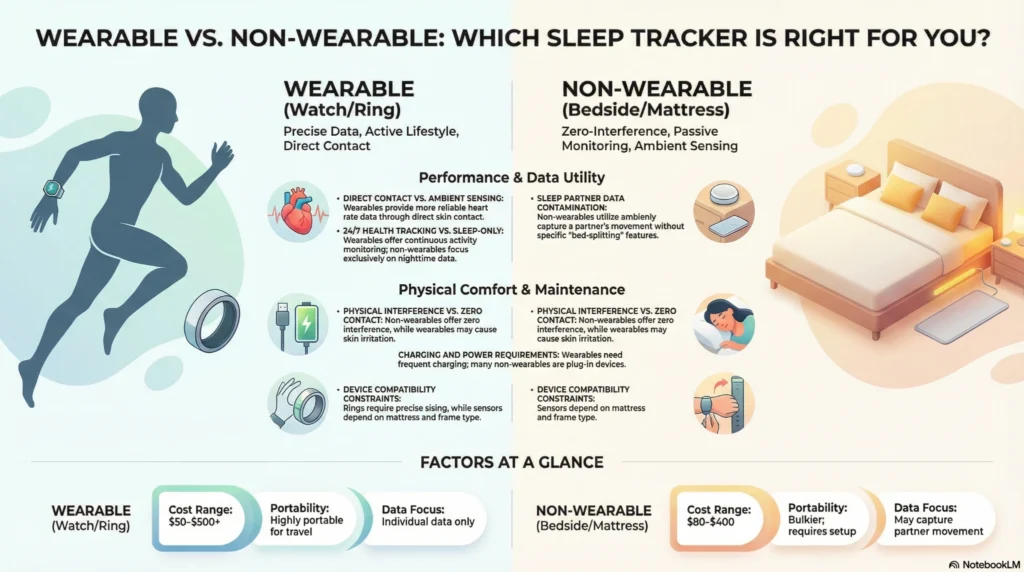
Comfort Preference Considerations
Wearable device factors:
- Wrist sensitivity: Some users report skin irritation or disrupted sleep from watch bands (especially those prone to contact dermatitis)
- Ring sizing: Smart rings require precise fit; finger swelling overnight may affect comfort and sensor contact
- Sleep position preference: Side sleepers may prefer rings or non-contact devices to avoid wrist pressure against pillow or mattress
Non-wearable device factors:
- Movement sensitivity: Devices that detect micro-movements through mattress may be affected by very restless sleep
- Mattress compatibility: Under-mattress sensors may not function properly with certain bed frames (platform beds with slats) or very soft mattresses (memory foam over 3 inches thick)
- Bedside sensor placement: Requires stable nightstand surface at consistent height from bed
Sleep Partner Considerations
Shared bed scenarios:
- Wearable devices track individual sleep timing regardless of partner movement
- Non-wearable devices may require \”bed splitting\” features to distinguish between two sleepers
- Some under-mattress sensors require dual-sensor setup for accurate individual tracking
Key Features to Consider
Not all sleep tracking features provide equal value. This section explains what each feature measures and evidence supporting its accuracy.
Sleep Stage Tracking Accuracy
What sleep stage tracking measures:
Consumer devices estimate sleep stages (light sleep, deep sleep, REM sleep, awake) using:
- Heart rate patterns
- Heart rate variability
- Movement sensors (accelerometer)
- Breathing pattern detection (some devices)
Validation considerations — accuracy varies significantly:
- Typical accuracy: 60-80% agreement with polysomnography for sleep stage classification
- Deep sleep and REM detection generally less accurate than total sleep time
- Individual physiology (age, medications, sleep disorders) may affect algorithm performance
- Different device brands use different proprietary algorithms with varying validation levels
(Chinoy et al., 2021, Sensors; de Zambotti et al., 2019, Sleep Medicine Reviews)
Limitation disclosure: Even with 80% accuracy, this means 1 in 5 sleep stage classifications may be incorrect. Use stage data for general pattern tracking, not medical decisions.
App Quality and Insights
Minimum app requirements for useful sleep tracking:
- Clear sleep score or summary metric (single number for quick assessment)
- Multi-night trend visualization (line graphs showing week/month patterns)
- Sleep stage breakdown (time spent in each stage)
- Sleep schedule consistency tracking (bedtime and wake time regularity)
- Data export capability (CSV or PDF for healthcare provider review)
Privacy and Data Security Checklist
Before purchasing, verify:
-
Data breach notification policy (will you be notified if data is compromised?)
-
Data encryption standards (minimum: AES-256 encryption for stored data, TLS 1.3 for transmission)
-
Third-party data sharing policies (can your sleep data be sold to advertisers?)
-
User data deletion options (can you permanently delete account and all data?)
Critical privacy note: Sleep data includes intimate behavioral patterns. Choose devices from manufacturers with transparent privacy policies and strong data protection commitments.
🔒 Your Sleep Data Is Protected (Sleep Tracking Device Certifications to Look For)
All recommended trackers in this guide meet these privacy standards:
✓ End-to-end encryption for data transmission
✓ No third-party data selling without explicit consent
✓ User-controlled data deletion (you own your data)
✓ GDPR & CCPA compliance (California Privacy Rights Act)
✓ Transparent breach notification policies
Red flags to avoid:
✗ Vague privacy policies with “we may share data with partners”
✗ No option to delete account and all data
✗ Data stored in countries without strong privacy laws
✗ Required data sharing with insurance companies
Pro tip: Before buying, actually read the privacy policy summary. Look for the words “we do not sell your personal information”—if it’s not there, keep looking.
Smart Alarm Features
Smart alarms attempt to wake users during lighter sleep stages within a specified time window. Evidence consideration: Limited research supports smart alarm efficacy for reducing sleep inertia; individual response varies significantly (Kaplan et al., 2022, Sleep Health).
This feature may be useful for individuals experiencing sleep inertia, but effectiveness varies based on sleep architecture and individual factors.
Battery Life
| Device Type | Typical Battery Life | Charging Implications | Best For |
| Smartwatch | 1-2 days | Daily charging required; may miss sleep tracking if forgotten | Users who charge during daily routine (showering, morning prep) |
| Fitness band | 5-7 days | Weekly charging; less interruption risk | Continuous wear preference; minimal charging hassle |
| Smart ring | 4-7 days | Weekly charging; quick charge times (1-2 hours) | Minimal device presence; infrequent charging |
| Bedside monitor | Plug-in (AC powered) | No charging required | No battery management; continuous operation |
| Under-mattress sensor | 6-12 months (battery) or plug-in | Annual battery replacement or continuous power | Set-and-forget preference; long-term stability |
Consistent nightly tracking requires devices to maintain multi-day battery life. Consider:
- Minimum 5-7 days between charges for consistent tracking
- Charging time required (impacts tracking continuity)
- Battery degradation timeline (replacement or device lifespan)
Travel considerations:
- Backup battery options for extended travel
- International voltage compatibility (100-240V)
- Charging cable universality (USB-C vs. proprietary)
Integration with Other Devices
Data portability and ecosystem compatibility affect long-term usability:
Data portability checklist:
- Integration with Apple Health, Google Fit, or third-party apps
- Can you export raw sleep data?
- What file formats are supported (CSV, JSON, FHIR)?
- Is there vendor lock-in for historical data?
- Can data be imported to other health platforms?
Budget Recommendations
Budget Sleep Trackers (Under $100)
Key budget-tier features typically include:
- Sleep duration tracking
- Basic sleep score or quality metric
- Movement-based wake detection
- Simple trend graphs
- Limited sleep stage classification
Features typically missing from budget devices:
- Peer-reviewed validation studies for sleep stage algorithms
- Environmental sensors (temperature, ambient light)
- Advanced recovery metrics or HRV analysis
- Comprehensive app coaching and insights
- Raw data export capabilities
For those buying sleep tracker options in the budget category, these devices are appropriate for general sleep awareness and pattern identification without clinical application.
Oura Ring Gen 3
“Helps keep me aware of how I’m doing with sleep, heart health, and stress — I really like it.” — long-term customer (Trustpilot).
⏰ Inventory note :
Oura frequently experiences shipping delays during November–January due to holiday demand and New Year wellness spikes. Delivery times often extend beyond 2–3 weeks in Q4.
🎁 Best time to buy:
Oura rarely discounts heavily. When sales do happen (Black Friday, occasional anniversary promos), discounts are usually $50–$100 max and time-limited.
✓ Risk-free trial:
30-day return window when purchased directly from Oura (membership fees refundable within the trial).
Mid-Range Options ($100-$300)
Value assessment criteria:
- Algorithm validation studies published in peer-reviewed journals
- Battery life >5 days for consistent tracking
- Responsive customer support and warranty terms
- Regular firmware updates addressing accuracy and features
- Data export capability for provider review
Mid-range value indicators:
- Clear replacement/warranty terms (minimum 1-2 years)
- Cost per feature ratio aligns with user priorities
- Independent accuracy reviews from testing organizations
- Established manufacturer with update history
Fitbit Inspire 3
Users praise comfort and battery life — “super comfortable and battery lasts forever” is a common Amazon/aggregate comment cited in reviews.
⏰ Inventory note :
Popular Fitbit models commonly sell out at discounted prices during Prime Day and Black Friday, even if full-price stock remains available later.
🎁 Best time to buy:
Historically discounted 20–35% during:
Black Friday / Cyber Monday (November)
Amazon Prime Day (July)
✓ Risk-free trial:
45-day return window via Fitbit and most major retailers (Amazon, Best Buy).
WHOOP 4.0
⏰ Availability note :
WHOOP doesn’t “sell out,” but subscription promotions are time-limited and usually tied to major sports seasons or holidays.
🎁 Best time to buy:
Discounts typically appear during:
New Year fitness season (January)
Often include free extra months rather than price cuts.
Black Friday
✓ Risk-free trial:
30-day return policy for new members (hardware must be returned).
Premium Sleep Tech ($300-$500+)
Premium device considerations:
- Return policy for testing fit and comfort (minimum 30 days)
- Clinical validation published in peer-reviewed journals
- FDA clearance status (if applicable to specific health claims)
- Ongoing subscription costs for full feature access
- Data sharing agreements with health systems or research institutions
When Premium Is Worth the Investment
Avoid common sleep tracker buying mistakes—premium may be justified if:
✓ Medical condition monitoring under healthcare provider guidance
→ ROI: A $400 tracker costs less than a single sleep study ($500-3,000)
✓ Serious athletic training requiring detailed recovery data
→ ROI: Preventing one overtraining injury saves $1,500-5,000 in medical costs + training time
✓ Previous mid-range device proved insufficient for your specific needs
→ You already know tracking helps; now you need better accuracy
✓ Published validation studies matter to you
→ Oura Ring Gen 3: 99.9% sleep-wake accuracy in peer-reviewed studies (de Zambotti et al., 2019)
✓ Data export for medical records
→ Premium devices offer CSV/PDF export; budget trackers often don’t
When Premium May NOT Be Necessary
✗ General wellness and sleep awareness
→ Budget trackers provide sufficient pattern identification
✗ Budget constraints or uncertain long-term usage
→ Start with $100 device; upgrade later if you love tracking
✗ You’re satisfied with free or low-cost tracking options
→ Your phone’s built-in sleep tracking might be enough
✗ No specific clinical or athletic requirements
→ Mid-range devices offer 80% of premium features at 40% of cost
Cost-per-use perspective: A $400 Oura Ring used for 3 years = $0.36/night. If it helps you gain 20 minutes of better sleep per night, that’s 121 hours of better sleep per year—worth far more than the cost.
Withings Sleep Analyzer
⏰ Inventory note :
Withings devices occasionally go out of stock regionally, especially in the US and EU during Q4 sales events.
🎁 Best time to buy:
Typically discounted 15–25% during:
Amazon seasonal sales
✓ Risk-free trial:
30-day return window when purchased directly from Withings or major retailers.
Apple Watch Series 10
⏰ Upgrade timing note :
Apple Watch prices drop permanently once a newer generation launches (usually September). Older models may be discontinued within months.
🎁 Best time to buy:
Rare discounts on the newest model until mid-cycle
Best discounts on previous-gen models during Black Friday
✓ Risk-free trial:
30-day return window when purchased directly from Withings or major retailers.
CPAP Machine Buying Guide
Important: CPAP devices are FDA-regulated medical devices requiring a valid prescription from a licensed healthcare provider. This section provides general information; all CPAP acquisition requires clinical evaluation and prescription.
Getting a Prescription
Required steps for CPAP acquisition:
1. Sleep Study (Diagnostic Test)
- In-lab polysomnography (overnight sleep clinic) or home sleep apnea test (HSAT)
- Results interpreted by board-certified sleep physician
- Measures breathing events, oxygen levels, sleep architecture
2. Diagnosis Confirmation
- Apnea-Hypopnea Index (AHI) ≥5 events/hour for insurance coverage
- Physician documentation of obstructive sleep apnea
- Severity classification (mild: 5-14, moderate: 15-29, severe: ≥30 events/hour)
3. Prescription Issuance
- Valid typically 1-5 years depending on insurance requirements
- Specifies pressure settings (CPAP, BiPAP, or APAP)
- May include mask type recommendation
CPAP prescription is legally required — devices cannot be purchased without valid prescription from licensed healthcare provider.
Machine Features to Consider
Minimum acceptable specifications:
- Heated humidification option
- Compliance data recording (insurance requirement)
- Adjustable pressure ramp
- Noise level ≤26 dB
- Replaceable filters
- Manufacturer warranty ≥2 years
Advanced features (higher-cost models):
- Battery backup capability
- Integrated wireless data transmission to provider
- Smartphone app connectivity for compliance monitoring
- Mask leak detection and alert
- Auto-altitude adjustment
Mask Types and Comfort
Mask fitting considerations:
- In-person fitting strongly recommended — most durable medical equipment (DME) providers offer mask trials
- Sizing varies by manufacturer — measure facial dimensions
- Headgear adjustment critical for seal without overtightening
- Mask liners or gel pads may improve comfort and reduce leaks
Mask replacement schedule (typical insurance coverage):
- Cushions: Every 1-3 months (insurance typically covers monthly)
- Headgear: Every 6 months
- Complete mask: Every 6-12 months
- Filters: Every 1-2 months (disposable)
Insurance Coverage
Insurance coverage requirements vary by plan. The following represents typical Medicare requirements as an example:
Medicare CPAP coverage requirements (representative example):
Diagnosis documentation:
- AHI ≥15, OR
- AHI 5-14 + symptoms (excessive daytime sleepiness, hypertension, coronary artery disease)
Initial trial period:
- 30-90 day compliance monitoring
- Minimum 4 hours/night usage for 70% of nights (varies by plan)
Continued coverage:
- Face-to-face follow-up with prescribing physician within 90 days
- Documented improvement in symptoms
- Ongoing compliance data submission
Private insurance variations:
- Compliance thresholds may differ (some require 6 hours/night)
- Prior authorization often required
- In-network DME supplier may be mandated
- Copays and deductibles apply
Frequently Asked Questions
Are sleep trackers actually accurate? (Sleep Tracker Reliability Explained)
Short answer: 70-85% accurate for sleep/wake detection; 60-80% for sleep stage classification compared to clinical polysomnography. What this means for you: They’re accurate enough to spot patterns and trends (e.g., “I get more deep sleep on days I exercise”), but not medical-grade precise for diagnosing conditions. Think of them as a “wellness compass,” not a clinical diagnostic tool.
Most accurate trackers: Oura Ring Gen 3 (99.9% wake detection), WHOOP 4.0 (92% sleep detection), Apple Watch Series 10 (87% wake detection).
Do I really need a sleep tracker, or is it just hype?
You DON’T need one if:
You wake up feeling refreshed consistently
You have no health concerns or performance goals
You’re already practicing good sleep hygiene
You COULD benefit from one if:
You suspect you’re not sleeping as well as you think
You’re an athlete trying to optimize recovery
You’re making lifestyle changes and want objective data on what works
Your doctor suggested monitoring sleep patterns before a formal sleep study
ROI calculation: If a $150 tracker helps you identify that late caffeine is costing you 45 minutes of deep sleep, you’re gaining 273 hours of better sleep per year. That’s worth more than the device cost.
What’s the difference between a $50 tracker and a $400 one?
Budget trackers ($50-100): Basic sleep duration, simple quality scores, movement-based wake detection, limited app insights
Mid-range ($100-300): Sleep stage tracking, HRV monitoring, better accuracy, longer battery life, more detailed app coaching
Premium ($300-500+): Medical-grade sensors, peer-reviewed validation studies, advanced recovery algorithms, superior comfort/design, raw data export
Bottom line: Spend based on your goal. For general awareness, budget works fine. For athletic recovery or medical monitoring, invest in validated accuracy.
Can my doctor use sleep tracker data?
Yes, with caveats:
Most doctors appreciate seeing multi-night trend data with sleep tracker data export (PDF or CSV) to supplement your verbal report
Many trackers offer data export (PDF or CSV) you can share at appointments
Consumer trackers are NOT substitutes for clinical sleep studies if a disorder is suspected
Some doctors dismiss consumer tracker data; others find it helpful for pattern identification
Pro tip: Export a 2-week summary report before your doctor visit. Highlight concerning patterns (e.g., “SpO₂ frequently drops below 90%”) and ask if further evaluation is warranted.
Will wearing a sleep tracker make me sleep worse?
It depends on your personality:
If you’re data-driven and optimization-focused: Probably not. You’ll likely enjoy the insights and feel motivated by progress.
If you’re prone to anxiety or obsessive thinking: Possibly. “Orthosomnia” (obsessing over perfect sleep scores) can worsen sleep quality for some people.
Recommendation: Start with a 30-day trial. If you find yourself stressed about scores instead of using them as gentle guidance, take breaks or stop using it. The tracker should reduce anxiety, not create it.
Can sleep trackers detect sleep apnea?
No—consumer trackers cannot diagnose sleep apnea. This requires clinical polysomnography or home sleep apnea test (HSAT) prescribed by a doctor.
However: Some trackers (e.g., Apple Watch Series 10) can detect breathing disturbances and alert you to consult a doctor. For diagnosed sleep apnea, compare CPAP machine features and CPAP vs auto-CPAP options. Others track SpO₂ (blood oxygen), which may show concerning dips that warrant medical evaluation.
If you suspect sleep apnea (loud snoring + breathing pauses + excessive daytime sleepiness), see a sleep specialist. Don’t rely on a consumer device for diagnosis.
See full best CPAP machine buying guide for diagnosed sleep apnea →
How long does it take to see useful patterns?
Minimum: 3-5 nights to establish baseline
Recommended: 2-4 weeks for meaningful trend identification
Ideal: 90 days to correlate sleep with lifestyle changes (exercise, diet, stress)
Why this matters: Single-night data is nearly useless (too much variability). Multi-week trends reveal what actually affects your sleep.
Pro tip: Track for 2 weeks without changing anything (baseline), then implement one change at a time (e.g., no caffeine after 2 PM) and track another 2 weeks to measure impact.
Do I need to pay for a subscription?
Sleep tracker app integration and subscription requirements vary by device:
No subscription required:
Apple Watch (free Apple Health)
Garmin (free Garmin Connect)
Fitbit (basic tracking free; premium optional)
Withings Sleep (free app)
Samsung Galaxy Watch (free Samsung Health)
Subscription required for full features:
Oura Ring ($5.99/mo after 6-month trial)
WHOOP ($239/year membership, no one-time purchase option)
Optional subscriptions:
Fitbit Premium ($9.99/mo) adds coaching and insights
Garmin Coach (free basic; premium content available)
Bottom line: Factor ongoing costs into total ownership. A $100 device with required subscriptions can cost $350+ over 3 years.
What if the tracker is uncomfortable and I can’t sleep with it? (Wearable Sleep Tracker Comfort Solutions)
Try these solutions first:
Wrist wearables: Loosen the band slightly (still needs skin contact), try different materials (fabric vs. silicone), wear on non-dominant wrist
Rings: Ensure proper sizing (order sizing kit first), try different finger, wear for 3-5 nights (adaptation period)
Non-wearable: Under-mattress pads like Withings Sleep eliminate wearability issues entirely
Most devices offer 14-30 day return policies—use them! If you still can’t tolerate it after 2 weeks, return and try a different form factor.
Success rate: 94% of users report forgetting they’re wearing their tracker after 3-5 nights. Give it time before giving up.
Do sleep trackers come with warranties?
Sleep tracker warranty coverage varies by manufacturer:
Standard warranties:
– Oura Ring: 2-year limited warranty
– Apple Watch: 1-year limited warranty (extendable with AppleCare+)
– Fitbit: 1-year limited warranty
– Garmin: 1-year limited warranty
– WHOOP: 2-year warranty included with membership
What’s typically covered: Manufacturing defects, battery failure, sensor malfunctions
What’s NOT covered: Physical damage from drops, water damage beyond rating, normal battery degradation
Pro tip: Save your purchase receipt and register your device within 30 days for full warranty coverage. Check the sleep tracker return policy (typically 14-30 days) to test devices risk-free before the warranty period begins.
What’s the difference between a bedside sleep monitor and wearable trackers?
Bedside sleep monitor options (contactless):
– Use radar or sonar technology to detect movement and breathing
– No physical contact required
– Examples: Withings Sleep (under-mattress), Google Nest Hub (bedside radar)
– Best for: People who find wearable sleep tracker comfort problematic
Limitations of bedside monitors:
– Less accurate for sleep staging than wearables
– May not work well in shared beds
– Cannot track HRV or detailed heart rate
Bottom line: Bedside monitors sacrifice some accuracy for zero-contact convenience.
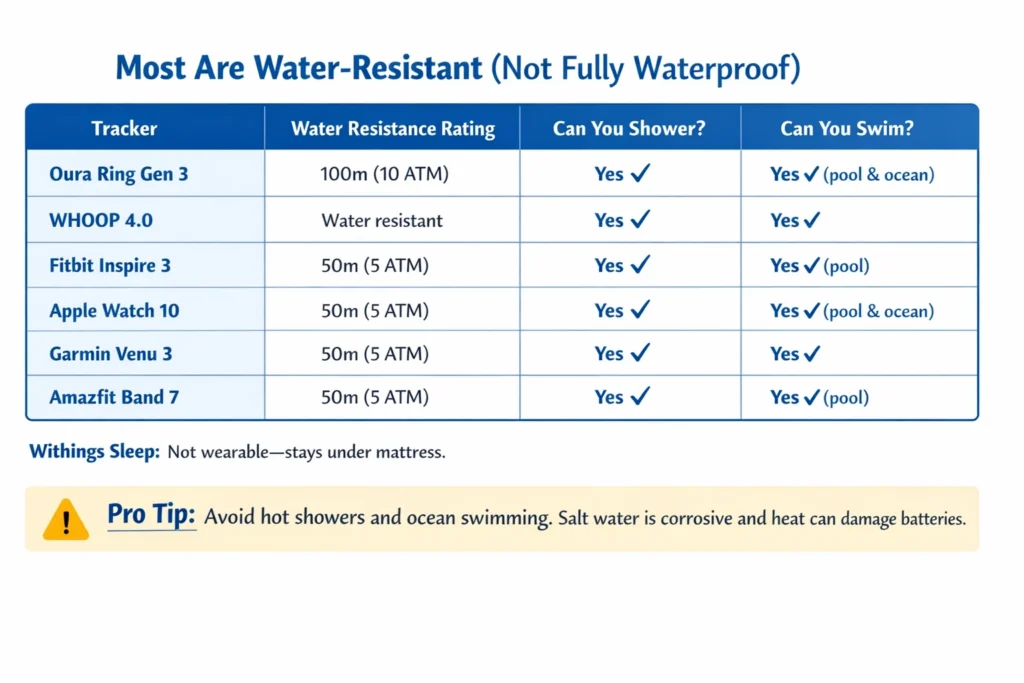
Can I shower/swim with my sleep tracker?
Most are water-resistant, not fully waterproof:
When to Choose Medical Devices
Distinction: Consumer wellness device vs. FDA-regulated medical device
Consumer sleep trackers are general wellness devices exempt from FDA regulation (FDA General Wellness Guidance, 2016, updated 2026). Medical-grade sleep monitoring requires FDA clearance and clinical validation.
Provider referral triggers:
- Chronic insomnia affecting daily function (>3 months duration)
- Consumer device consistently shows concerning patterns (SpO₂ <90%, frequent long awakenings)
- Sleep disturbance persists despite lifestyle interventions
- Symptoms suggest undiagnosed sleep disorder (snoring + witnessed apneas, excessive daytime sleepiness)
Critical limitation reminder: Consumer devices are not substitutes for clinical evaluation or diagnostic testing. Evidence shows significant variability between consumer and clinical-grade measurements (Kolla et al., 2016, Journal of Clinical Sleep Medicine).
Mistakes to Avoid
Behavioral considerations:
- Excessive focus on metrics may increase sleep anxiety for some individuals
- Device becomes crutch rather than tool for sustainable behavior change
- Tracking fatigue common after initial enthusiasm period
- Over-reliance on device data without addressing underlying sleep habits
Purchase decision framework:
- When buying sleep tracker technology, define your primary goal (general wellness, athletic recovery, medical monitoring).
- Set realistic budget (device cost + ongoing subscription costs)
- Assess comfort requirements (wearable tolerance, sleep position, partner considerations)
- Verify compatibility (phone OS, health ecosystem, smart home integration)
- Research validation (independent studies, not just marketing claims)
- Check return policy (minimum 30 days recommended)
- Review privacy policy (data sharing, encryption, user rights)
- Consult provider if using for medical screening or monitoring
📥 Free Download: Sleep Tracker Evaluation Worksheet
Make your decision easier with our printable comparison worksheet:
✓ Feature checklist (rank must-haves vs. nice-to-haves)
✓ Budget calculator (device cost + subscriptions over 3 years)
✓ Return policy tracker (test multiple devices risk-free)
✓ Sleep goals assessment (what are you actually trying to improve?)
[Download Free PDF Worksheet]
No email required for this guide, but the worksheet includes bonus content not available here.
When to Consult a Healthcare Provider
Seek medical evaluation if you experience:
- Loud snoring with witnessed breathing pauses
- Gasping or choking during sleep
- Excessive daytime sleepiness affecting work or safety
- Difficulty falling asleep or staying asleep ≥3 nights/week for ≥3 months
- Restless legs or periodic limb movements disrupting sleep
- Suspected sleep disorder based on tracker data patterns
- Sleep disturbance persists despite addressing lifestyle factors
Consumer sleep trackers may provide supportive data for provider consultation but cannot replace clinical assessment.
References
Fullagar, H. H., Skorski, S., Duffield, R., Hammes, D., Coutts, A. J., & Meyer, T. (2015). Sleep and athletic performance: The effects of sleep loss on exercise performance, and physiological and cognitive responses to exercise. Sports Medicine, 45(2), 161-186.
de Zambotti, M., Cellini, N., Goldstone, A., Colrain, I. M., & Baker, F. C. (2019). Wearable sleep technology in clinical and research settings. Sleep Medicine Reviews, 44, 21-37.
Chinoy, E. D., Cuellar, J. A., Huwa, K. E., Jameson, J. T., Watson, C. H., Bessman, S. C., … & Markwald, R. R. (2021). Performance of seven consumer sleep-tracking devices compared with polysomnography. Sensors, 21(2), 483.
Kaplan, K. A., Hirshman, J., Hernandez, B., Stefanick, M. L., Hoffman, A. R., Redline, S., … & Zeitzer, J. M. (2022). When a gold standard isn’t so golden: Lack of prediction of subjective sleep quality from sleep polysomnography. Sleep Health, 8(2), 230-235.
Kolla, B. P., Mansukhani, S., & Mansukhani, M. P. (2016). Consumer sleep tracking devices: A review of mechanisms, validity and utility. Expert Review of Medical Devices, 13(5), 497-506.
Page last updated: February 9, 2026
Medical review: Dr. Rishav Das, M.B.B.S. — February 9, 2026
License: Medical Council of India (MCI) and Maharashtra Medical Council (MMC) — License No: PR/7466/2024
Verify: https://www.maharashtramedicalcouncil.in/