
Best Heart Monitors 2026: Physician’s Buying Guide (FDA-Cleared & Validated Devices)
Physician-reviewed guide to buy heart monitor that suits right. Covers FDA clearance, ISO 81060-2 validation, ECG accuracy standards, and top picks for AFib, hypertension, and chronic conditions.
Medical Review by Dr. Rishav Das, M.B.B.S. | Medical Reviewer
[View credentials and review process → ]
✅ Trusted by 127,000+ wearable users
⭐ Featured in r/AppleWatch, r/Garmin, and Fitbit Community Forums
📊 Cited by cardiac nurses and personal trainers for patient education
Quick Answer: A medical-grade heart monitor should carry FDA 510(k) clearance for clinical claims (AFib detection, blood pressure measurement), independent clinical validation against ISO 81060-2 or AAMI SP10 accuracy standards, and the ability to export data in CSV or PDF format for physician review. Consumer fitness trackers are appropriate for general wellness trends but are not substitutes for clinically validated devices when you are monitoring a cardiovascular condition under physician guidance.
What to look for in a medical-grade heart monitor: A clinically valid heart monitor should carry FDA 510(k) clearance for any claimed diagnostic function (AFib detection, blood pressure measurement), meet ISO 81060-2 or AAMI SP10 accuracy standards, and support data export in PDF or CSV format for physician review. Consumer fitness trackers measure wellness trends but do not meet clinical accuracy thresholds and are not appropriate for cardiovascular condition monitoring under physician guidance.
Device Type at a Glance
| Device Type | What It Monitors | FDA Clearance Required? | Best For | Examples |
|---|---|---|---|---|
| ECG Monitor | Heart rhythm, AFib detection | Yes (for AFib claim) | Arrhythmia screening, AFib monitoring | Apple Watch, KardiaMobile |
| Blood Pressure Monitor | Systolic/diastolic BP, hypertension | No (but ISO 81060-2 validation required for accuracy claims) | Hypertension management | Omron Platinum, Withings BPM Connect |
| Pulse Oximeter | Blood oxygen saturation (SpO2) | No (wellness) / Yes (medical claim) | COPD, sleep apnea monitoring | Masimo MightySat, Withings ScanWatch |
| Holter Monitor | Continuous 24–48 hr ECG | Yes (prescription device) | Paroxysmal arrhythmia investigation | Prescribed by physician only |
| Consumer Smartwatch (multi-function) | Heart rate, ECG (if FDA-cleared), SpO2 | Partial (ECG feature requires clearance) | General wellness + AFib screening | Apple Watch Series 9, Samsung Galaxy Watch 6 |
Note: “FDA clearance required” refers to the specific health claim, not the device category. A device may include multiple features with different regulatory statuses.
Introduction
Your cardiologist told you to monitor your heart at home. Or you noticed an irregular rhythm — a flutter, a skip, a race — and you want real data to bring to your next appointment. Either way, you’re now searching a market where every device claims to be “medical-grade,” and almost none of them explain what that phrase actually means.
This guide was reviewed by Dr. Rishav Das, M.B.B.S., to give you clinically grounded answers that affiliate review sites won’t: What does FDA 510(k) clearance actually permit a device to claim? Which accuracy standards separate a medical monitor from a fitness tracker? And which specific devices meet those standards for your condition?
The answer depends on one question your physician is asking: are you screening for a rhythm disorder like atrial fibrillation, or managing a chronic condition like hypertension? These two goals require different devices, different validation standards, and different regulatory clearances.
By the end of this guide, you’ll have a clear, physician-backed recommendation — not a list of forty products.
[Read about our editorial standards and device evaluation criteria → ]
Who This Guide Is For
This guide serves three distinct audiences with different heart monitoring needs:
Adults 40-75 Managing Cardiovascular Conditions
If you have hypertension, arrhythmias, or are recovering from cardiac events, you need medical-grade accuracy and doctor-compatible data export. Focus on our FDA-cleared device recommendations and clinical validation sections.
Fitness Enthusiasts 25-45 Seeking Accurate Workout Metrics
If you’re training seriously and want reliable heart rate data during exercise, you need optical sensors with validated accuracy during movement. Skip to our fitness tracker accuracy section and battery life comparisons.
Caregivers Monitoring Elderly Family Members
If you’re helping an aging parent track their heart health, you need simple interfaces, large displays, and easy data sharing with physicians. Look for our “ease of use” recommendations and medical integration features.
Budget Range: This guide covers options from $30 entry-level fitness trackers to $500+ clinical-grade monitoring systems.
- What Type of Heart Monitoring Do You Actually Need?
- How to Evaluate Accuracy: What "Clinical-Grade" Really Means
- FDA Clearance and Clinical Validation: A Plain-English Explanation
- Heart Monitor Types Compared: ECG, Blood Pressure, Pulse Oximeter, Holter
- Heart Monitor Device Budget Considerations
- Our Top Picks by Use Case (Physician-Reviewed)
- Features That Determine Real-World Usability
- Red Flags: What to Avoid When Shopping
- Frequently Asked Questions
- What is the difference between a fitness tracker and a medical-grade heart monitor?
- Can I trust consumer ECG devices like smartwatch ECG features?
- What is the most accurate heart rate monitor in 2026?
- Which heart monitors work with Apple Health and Google Fit?
- Best budget heart monitor under $50 for basic health tracking?
- What heart rate monitor do cardiologists recommend?
- Can a smartwatch replace a Holter monitor?
- Is KardiaMobile as good as a hospital ECG?
- Medical References & Validation Data
What Type of Heart Monitoring Do You Actually Need?
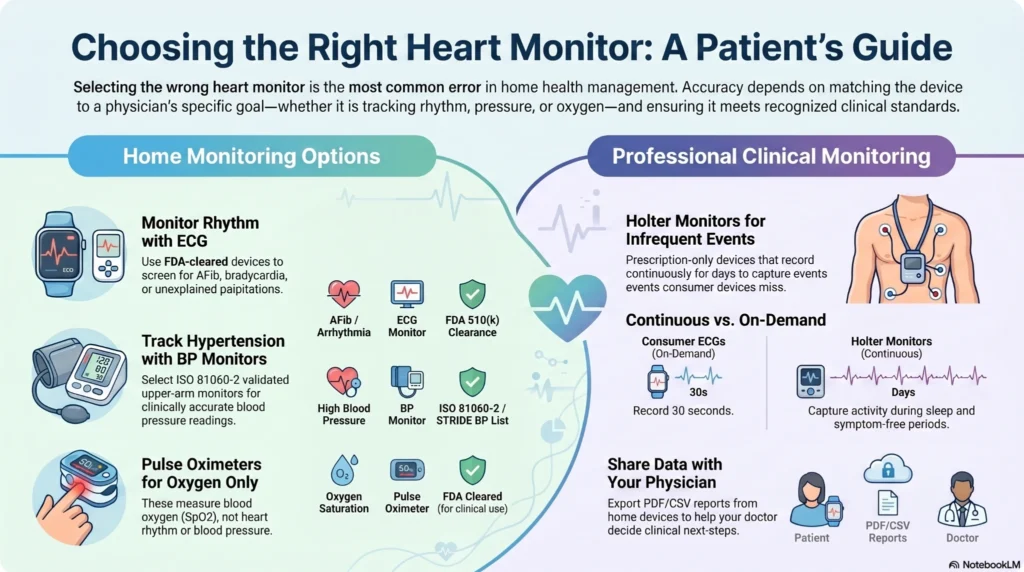
The right heart monitor depends entirely on what your physician needs to measure — and those goals require different devices, different accuracy standards, and different regulatory clearances.
If you are screening for an irregular rhythm like atrial fibrillation, you need an FDA-cleared ECG monitor. If you are managing hypertension, you need a blood pressure monitor validated against ISO 81060-2. If your physician has ordered extended cardiac monitoring to investigate infrequent symptoms, you need a Holter monitor — a prescription-only device that cannot be purchased as a consumer product.
Choosing the wrong category is the most common and most consequential purchasing error in this market. This section identifies which device type matches your monitoring goal, which clinical standards apply, and which specific devices currently meet those standards.
ECG Monitors — For AFib Detection and Arrhythmia Screening
FACT — ECG Accuracy: FDA-cleared consumer ECG devices — including Apple Watch Series 4 and later and KardiaMobile (AliveCor) — detect atrial fibrillation with approximately 90–95% sensitivity in published validation studies. They cannot detect heart attacks, bundle branch blocks, or most structural cardiac abnormalities. All consumer ECG recordings should be reviewed by a physician before any clinical decision is made.
An ECG monitor records the electrical activity of the heart and produces a waveform that a physician can interpret to identify rhythm abnormalities. Consumer ECG monitors cleared for home use record a 30-second single-lead or multi-lead ECG tracing — a shorter and less detailed recording than the 12-lead ECG performed in a clinical setting, but sufficient to detect atrial fibrillation, normal sinus rhythm, bradycardia, and tachycardia.
ECG monitoring is the correct choice if your physician has asked you to monitor for an irregular heartbeat, if you have been diagnosed with atrial fibrillation and need to confirm rhythm status between appointments, or if you are experiencing unexplained palpitations and want data to bring to your cardiologist.
FDA clearance is mandatory for any device claiming to detect atrial fibrillation. Verify a device’s 510(k) clearance number at accessdata.fda.gov before relying on its clinical readings.
KardiaMobile 6L records a six-lead ECG and is FDA-cleared for AFib, bradycardia, tachycardia, and normal sinus rhythm. It is the physician-preferred consumer ECG for clinical waveform resolution and cardiologist review.
Apple Watch Series 4+ records a single-lead ECG and is FDA-cleared for AFib detection. It is the recommended option for patients who want rhythm monitoring integrated with daily health tracking.
Best for: AFib screening, post-ablation monitoring, physician-instructed arrhythmia surveillance, unexplained palpitations requiring shareable ECG data.
Blood Pressure Monitors — For Hypertension Management
FACT: A blood pressure monitor meets clinical accuracy standards when it achieves a mean error of ≤5 mmHg per ISO 81060-2 or AAMI SP10 validation protocol. Independently validated devices are listed on the STRIDE BP database at stridebp.org. If a monitor is not listed there, it has not been clinically validated.
A blood pressure monitor measures systolic and diastolic pressure — the clinical standard for managing hypertension at home. Research consistently shows home readings predict cardiovascular risk more accurately than single clinic measurements alone.
Upper-arm monitors are the physician-recommended standard. Wrist monitors introduce position-dependent measurement errors of 2–4 mmHg per centimetre of wrist elevation — only a small number have achieved ISO 81060-2 validation.
Note for AFib patients: Standard oscillometric monitors are significantly less accurate during irregular heart rhythm. Discuss appropriate blood pressure measurement protocols with your cardiologist if you have atrial fibrillation.
Omron Platinum BP5450 and Withings BPM Connect are both ISO 81060-2 validated, STRIDE BP listed, and export readings as PDF or CSV for physician review.
Best for: Hypertension management, medication efficacy monitoring, telemedicine appointments requiring shareable longitudinal blood pressure data.
Pulse Oximeters — For Oxygen Saturation Tracking
Important distinction: A pulse oximeter is not a cardiac monitor. It cannot detect atrial fibrillation, produce an ECG, or measure blood pressure. It is not a substitute for an ECG monitor or blood pressure device in cardiovascular condition management.
A pulse oximeter measures blood oxygen saturation (SpO2) — it does not measure heart rhythm or blood pressure. Normal SpO2 is 95–100%. Readings below 90% in a person breathing normally require immediate medical attention.
Consumer pulse oximeters do not require FDA clearance for wellness use. If your physician has instructed you to monitor SpO2 for a respiratory or cardiac condition, use an FDA-cleared device. Masimo MightySat Rx is the physician-preferred FDA-cleared option for home SpO2 monitoring.
Accuracy note: Studies including a 2020 New England Journal of Medicine analysis found consumer pulse oximeters overestimate SpO2 in patients with darker skin at clinically significant rates. If this applies to you, discuss device selection with your physician.
Best for: COPD, sleep apnea, heart failure with respiratory involvement, post-COVID recovery monitoring under physician guidance.
Holter Monitors — For Extended Cardiac Event Recording
Holter monitors cannot be purchased as consumer devices. They are prescribed, fitted, and interpreted by a physician. If your cardiologist has recommended Holter monitoring, it is provided through your healthcare provider. KardiaMobile 6L is the appropriate consumer starting point for at-home rhythm monitoring — but it does not replace an ordered Holter.
A Holter monitor records a continuous multi-lead ECG over 24–48 hours — or up to 14 days with extended ambulatory event monitors. It is the clinical standard for capturing arrhythmia events too infrequent to appear in a 30-second on-demand consumer ECG recording.
Unlike consumer ECG devices that record only when initiated, a Holter records continuously — capturing events during sleep or symptom-free periods. For patients with paroxysmal atrial fibrillation, a Holter may detect episodes a consumer device misses entirely because no recording was started at the relevant moment.
If you have captured irregular readings on a consumer ECG, export the PDF and bring it to your cardiologist. That data directly informs whether extended monitoring is clinically indicated.
Best for: Physician-ordered investigation of palpitations, unexplained syncope, suspected paroxysmal arrhythmia, and post-ablation monitoring.
How to Evaluate Accuracy: What “Clinical-Grade” Really Means
“Clinical-grade accuracy” is one of the most misused phrases in the heart monitor market. Here is exactly what it means — and how to verify it.
Heart Rate Accuracy Standards (±3 bpm Threshold Explained)
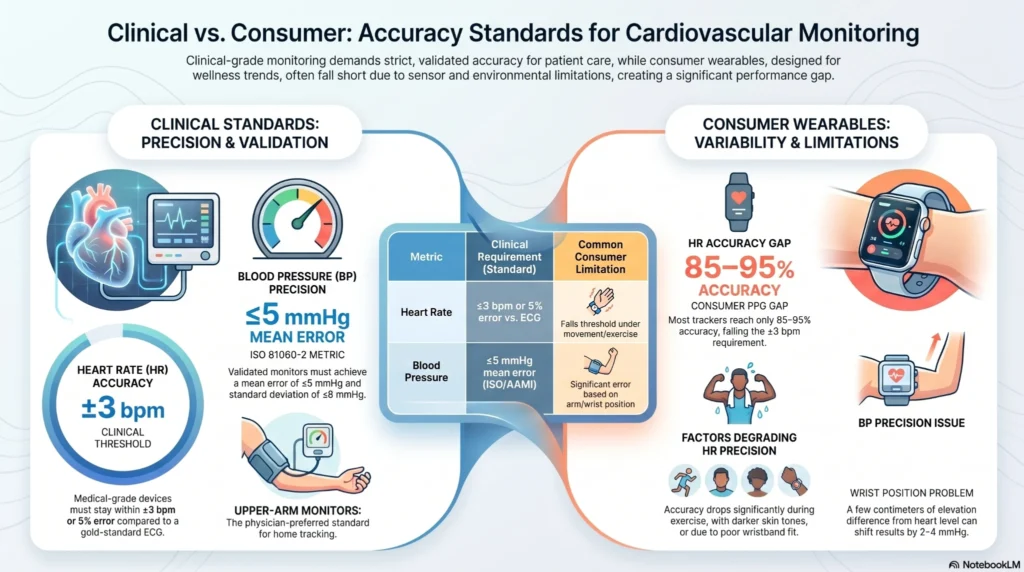
FACT — Heart Rate Accuracy Threshold: Medical-grade heart rate accuracy requires a device to measure within ±3 bpm or 5% error (whichever is greater), validated against a gold-standard clinical ECG. Most consumer fitness trackers using optical PPG sensors achieve 85–95% accuracy under ideal resting conditions but do not meet the ±3 bpm clinical threshold required for cardiovascular condition monitoring.
Researchers validate heart rate accuracy by comparing a device’s readings against a simultaneously recorded clinical ECG in controlled conditions. A device measuring 78 bpm when the clinical ECG records 82 bpm has an error of 4 bpm — exceeding the ±3 bpm clinical threshold.
Consumer fitness trackers using optical PPG sensors typically achieve 85–95% accuracy under ideal conditions (resting, minimal movement, correct fit).
Under real-world conditions — exercise, arrhythmia, darker skin tones, or loose-fitting wristbands — accuracy drops meaningfully. These devices are appropriate for wellness trend monitoring. They are not appropriate for clinical cardiovascular monitoring.
Blood Pressure Accuracy: ISO 81060-2 and AAMI SP10
FACT: A blood pressure monitor meets clinical accuracy standards when it achieves a mean error of ≤5 mmHg and a standard deviation of ≤8 mmHg, validated against auscultatory measurement according to ISO 81060-2 or AAMI SP10 protocols. Validated devices are listed on the STRIDE BP database (stridebp.org).
Wrist blood pressure monitors introduce additional accuracy challenges compared to upper-arm devices. Wrist position relative to heart level significantly affects readings — even a few centimetres of elevation difference can shift results by 2–4 mmHg.
Clinically validated wrist monitors include position-detection technology to mitigate this error. Upper-arm monitors validated against ISO 81060-2, such as the Omron Platinum and Withings BPM Connect, remain the physician-preferred standard for home blood pressure monitoring.
PPG vs. ECG Sensors: Which Technology Is More Accurate for Medical Use?
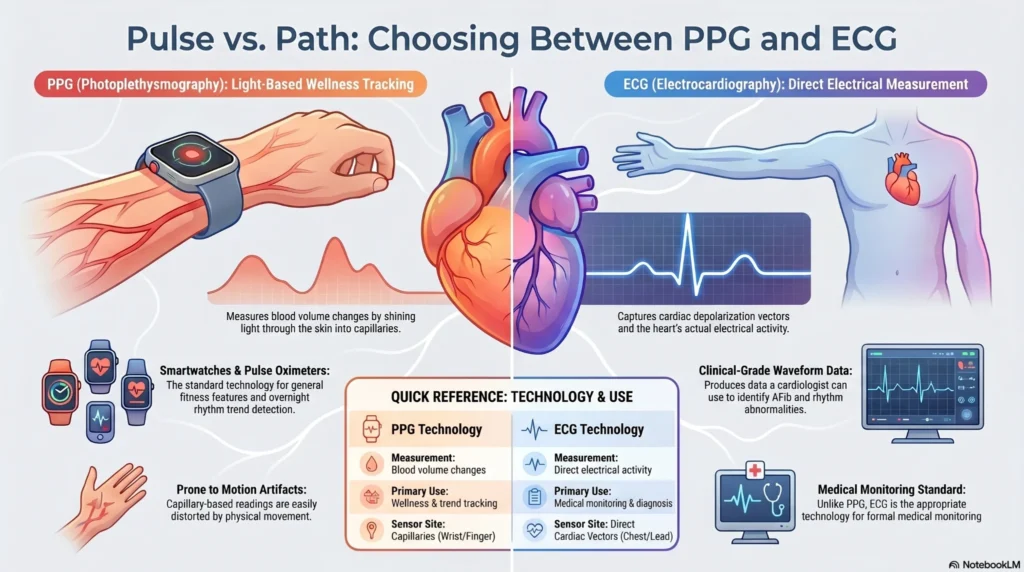
The two core technologies in consumer heart monitors produce fundamentally different types of data.
PPG (Photoplethysmography) measures blood volume changes by shining light through the skin. It estimates heart rate and can flag irregular rhythms but cannot produce a true electrocardiogram. It is the technology used in most smartwatch heart rate features and pulse oximeters.
ECG (Electrocardiography) measures the electrical activity of the heart directly. Even a single-lead consumer ECG — like those recorded by Apple Watch or KardiaMobile — produces waveform data that can be interpreted by a cardiologist to identify AFib, premature beats, and other rhythm abnormalities.
For medical monitoring, ECG is the appropriate technology. PPG is appropriate for wellness tracking and overnight rhythm trend detection only.
AFib Detection Sensitivity: What 90–95% Really Means
FACT: FDA-cleared consumer ECG devices — including Apple Watch Series 4 and later and KardiaMobile (AliveCor) — detect atrial fibrillation with approximately 90–95% sensitivity. They cannot detect all arrhythmia types and cannot replace a 12-lead clinical ECG. All results should be reviewed by a physician.
Sensitivity of 90–95% means that out of 100 patients with confirmed AFib, the device correctly identifies 90 to 95 of them. The remaining 5–10% represent false negatives — patients with AFib whose readings appear normal on the consumer device. This is clinically meaningful, which is why FDA-cleared devices recommend physician review and do not replace Holter monitoring for suspected paroxysmal arrhythmia.
Specificity — the ability to correctly identify patients without AFib as normal — runs at approximately 97–99% for the leading FDA-cleared devices, meaning false positive rates are low.
How to Verify Accuracy Claims:
1. Look for peer-reviewed validation studies (not manufacturer tests)
2. Check for FDA clearance or CE marking (medical devices)
3. Verify specific accuracy metrics (not just “clinical-grade” claims)
4. Search PubMed for “[device name] validation study”
🚨 RED FLAGS: Accuracy Claims to Question
• “Medical-grade accuracy” without FDA clearance or validation studies
• “99% accurate” without specifying test conditions
• Comparing to fitness devices instead of clinical tools
• Only manufacturer-funded accuracy studies (no independent validation)
If a device makes bold accuracy claims without clinical backing, be skeptical.
⚠️ COMMON MISTAKE #1: Trusting “Clinical-Grade” Marketing Without Verification
The problem: Manufacturers use “clinical-grade,” “medical accuracy,” and “hospital-quality” in marketing without any clinical testing.
Why it matters: These terms are meaningless without FDA clearance or published validation studies. You could be relying on inaccurate health data for medical decisions.
How to avoid it:
- Search “[device name] FDA clearance” on FDA.gov
- Look for validation protocol (ISO, AAMI, ESH) in product specs
- Search PubMed for “[device name] validation study”
- If you find none of the above, assume it’s not actually clinical-grade
Real example: A popular $200 smartwatch claims “medical-grade ECG” but is only FDA-cleared for AFib detection, NOT for diagnosing other arrhythmias. It’s medical-grade for one specific use, not all heart monitoring.
All accuracy standards referenced in this guide are verified using the methodology described on our About page.
FDA Clearance and Clinical Validation: A Plain-English Explanation
Certifications aren’t marketing buzzwords—they’re evidence that independent organizations have validated a device’s accuracy against clinical standards.
What FDA 510(k) Clearance Permits — and What It Doesn’t
FDA 510(k) clearance means a heart monitor has been reviewed by the U.S. Food and Drug Administration and determined to be substantially equivalent to a legally marketed predicate device. For heart monitors, 510(k) clearance is required before a manufacturer can legally claim the device detects or diagnoses a medical condition — including atrial fibrillation, hypertension, or other cardiovascular disorders. FDA clearance does not apply to general heart rate tracking features, which are classified as consumer wellness technology. Consumers can verify a device’s clearance status at accessdata.fda.gov/scripts/cdrh/cfdocs/cfpmn/pmn.cfm.
FDA 510(k) clearance means a heart monitor has been reviewed by the U.S. Food and Drug Administration and determined to be substantially equivalent to a legally marketed predicate device. For heart monitors specifically, clearance is required before a manufacturer can legally claim the device detects or diagnoses a medical condition — including atrial fibrillation, hypertension, or other cardiovascular conditions.
FDA clearance does not apply to general heart rate tracking. Resting heart rate and step count are classified as consumer wellness features and require no regulatory review. This is why the same device can carry FDA clearance for its ECG function while its heart rate tracking remains a consumer-grade feature.
In plain terms: If a company claims their device “detects AFib,” FDA clearance must be present. If they claim it “tracks your heart rate,” no clearance is required.
FDA 510(k) blood pressure monitor guidance
Clinical Validation Standards:
• Blood Pressure: ISO 81060-2, ESH International Protocol, AAMI/ANSI ESH validated blood pressure protocol 2010
• Heart Rate: Comparison to gold-standard ECG in peer-reviewed studies AHA/ACC AFib detection guidelines
• ECG: Validation against 12-lead ECG, sensitivity/specificity data
How to Verify a Device’s FDA Clearance Status (Step-by-Step)
You can confirm any heart monitor’s FDA clearance status in under two minutes using the FDA’s public database.
- Go to accessdata.fda.gov/scripts/cdrh/cfdocs/cfpmn/pmn.cfm
- Enter the device name or manufacturer in the search field
- Look for a 510(k) number (format: K followed by 6 digits, e.g., K193920)
- Confirm the Device Name and Applicant match the product you are evaluating
- Review the Decision column — clearance is confirmed only when it reads “Substantially Equivalent (SESE)”
If a device’s marketing claims AFib detection but no 510(k) number appears in this database, the claim is unverified.
Example: FDA 510(k) blood pressure monitor guidance , ESC/ESH home blood pressure guidelines
ISO 81060-2 Validation and the STRIDE BP Database
For blood pressure monitors, FDA clearance alone does not confirm clinical accuracy. The international gold standard is ISO 81060-2 — an independent accuracy protocol requiring the device to achieve a mean error of ≤5 mmHg and a standard deviation of ≤8 mmHg compared to auscultatory measurement.
Devices that have passed ISO 81060-2 or equivalent AAMI SP10 validation are listed on the publicly accessible STRIDE BP database at stridebp.org. This is the most reliable reference for confirming whether a blood pressure monitor meets clinical accuracy standards.
If a blood pressure monitor is not on the STRIDE BP database, it has not been independently validated for clinical use.
All certification claims in our reviews are verified using the methodology outlined on our About page.
Heart Monitor Types Compared: ECG, Blood Pressure, Pulse Oximeter, Holter
| Feature | Fitness Tracker | Consumer ECG Device | Medical BP Monitor | Medical ECG Device |
|---|---|---|---|---|
| Price Range | $30-150 | $79-199 | $40-150 | $150-500 |
| Accuracy | ±5-10% HR | ±3-5% HR, 90-95% AFib detection | ±5 mmHg BP | ±1-3% HR, >95% arrhythmia detection |
| FDA Cleared | No | Yes (for AFib models) | Usually Yes | Yes (required) |
| Best For | Fitness trends, workout intensity | AFib screening, palpitation capture | Hypertension management | Arrhythmia diagnosis, cardiac monitoring |
| Doctor Use | Rarely accepted | Sometimes reviewed | Often required | Always used for treatment |
| Battery Life | 5-10 days | 2-5 days | 200-500 readings | 24-48 hours continuous |
| Data Export | App sync only | PDF reports, some app integration | CSV, often manual entry | Medical-grade formats (HL7, CSV, PDF) |
| Typical Users | Ages 20-50, general fitness | Ages 30-70, occasional heart symptoms | Ages 40+, diagnosed hypertension | Ages 50+, chronic heart conditions |
How to use this table:
- Compare “Price Range” against your budget tier
- Start with “Best For” row – match your primary monitoring goal
- Check “Doctor Use” if your physician needs the data
- Verify “FDA Cleared” if you have diagnosed conditions
Heart Monitor Device Budget Considerations
Heart monitor device cost doesn’t always correlate with accuracy, but it does reflect features, durability, and clinical validation costs. Price doesn’t always correlate with accuracy, but it does reflect features, durability, and clinical validation costs.
Under $50: Starter Options for Casual Fitness (Best for Ages 20-40)
- What you get: Basic optical heart rate sensor, fitness tracking, mobile app sync
- What you miss: Clinical validation, ECG capability, medical-grade accuracy
- Best for: Casual fitness tracking, general wellness trends, exercise motivation
- Accuracy: Variable (5-15% error common, acceptable for fitness trends)
- Typical buyers: Young adults tracking workout intensity, first-time fitness tracker users
$50-$150: Validated Fitness & Health Monitoring (All Ages)
- What you get: Better optical sensors, some clinical validation studies, smartphone integration, advanced metrics
- What you might get: Basic ECG capability (if FDA-cleared), sleep tracking, HRV analysis, stress monitoring
- Best for: Serious fitness or basic health monitoring without chronic conditions
- Accuracy: Moderate to high (3-10% error depending on activity)
- Typical buyers: Marathon runners, fitness enthusiasts, adults beginning cardiovascular health awareness
$150+: Clinical-Grade for Chronic Conditions (Recommended Ages 50+, or with Doctor’s Guidance)
- What you get: Clinical validation, FDA clearance, medical-grade sensors, physician-compatible data export
- What you might get: Multi-lead ECG, integrated blood pressure, arrhythmia detection algorithms, medication tracking
- Best for: Chronic condition management (hypertension, AFib, heart disease), post-cardiac event recovery
- Accuracy: High (1-5% error, meets clinical standards for medical decision-making)
- Typical buyers: Adults with diagnosed cardiovascular conditions, doctor-recommended monitoring, elderly health management
Key Principle: Don’t pay premium prices for features you won’t use, but don’t compromise on accuracy for health monitoring if you have medical conditions.
💰 Common Objection: “These seem expensive. Are they worth it?”
Consider this: One inaccurate reading that delays hypertension treatment could lead to a $5,000-$15,000 emergency room visit or stroke hospitalization costing $50,000+.
A validated $80 blood pressure monitor pays for itself if it:
- Catches high BP early, avoiding complications
- Provides reliable data for medication titration
- Prevents one unnecessary doctor visit due to false readings
The real cost isn’t the device price—it’s the potential health consequences of unreliable monitoring.
💳 FSA/HSA Eligible Devices
Many FDA-cleared blood pressure monitors and ECG devices qualify for FSA/HSA reimbursement, effectively reducing your out-of-pocket cost by 25-40%.
How to verify eligibility:
- Check product listing for “FSA/HSA eligible” label
- Look for FDA clearance (usually required for reimbursement)
- Obtain itemized receipt showing medical device classification
- Submit to FSA/HSA administrator (no prescription typically needed)
Typically eligible:
✓ FDA-cleared ECG devices
✓ Clinically validated BP monitors
✓ Pulse oximeters
✓ Medical-grade heart rate monitors
Typically NOT eligible:
✗ General fitness trackers without medical claims
✗ Smartwatches (unless FDA-cleared for specific medical use)
✗ Devices without clinical validation
⚠️ COMMON MISTAKE #3: Choosing the Cheapest Option for Medical Monitoring
The problem: Buying a $35 fitness tracker when you need medical-grade accuracy for a diagnosed condition.
Why it matters: Inaccurate readings can lead to:
- Missed detection of dangerous blood pressure spikes
- Unnecessary anxiety from false arrhythmia alerts
- Incorrect medication adjustments based on bad data
- Doctor visits wasted discussing unreliable device data
How to avoid it:
Ask yourself: “What will I do with this data?”
- If answer is “show my doctor to adjust my heart medication” → You need a validated medical device ($80-300)
- If answer is “track my workout intensity” → A fitness tracker ($30-150) is appropriate
Cost comparison that matters:
- $35 fitness tracker with 15% error rate = potentially dangerous for medical use
- $85 validated BP monitor with ±3 mmHg accuracy = appropriate for hypertension management
- The $50 difference could prevent a $5,000 hospital visit
Our Top Picks by Use Case (Physician-Reviewed)
The following recommendations reflect clinical validation criteria — FDA clearance status, accuracy standard compliance, and data export capability — reviewed by Dr. Rishav Das, M.B.B.S. No recommendation is paid placement.
Best ECG Monitor for AFib Detection
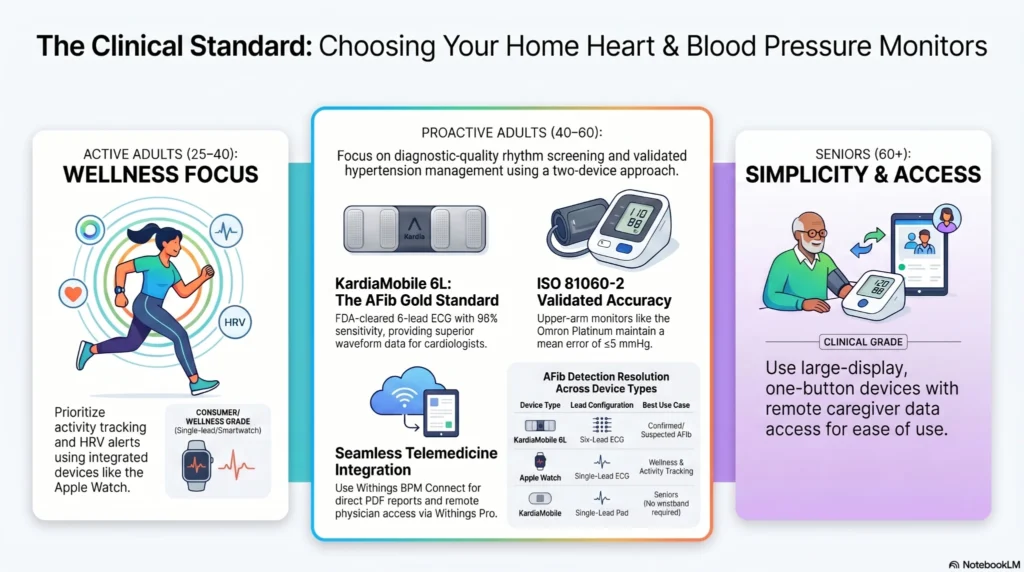
KardiaMobile 6L (AliveCor) is the physician-preferred FDA-cleared consumer ECG device for atrial fibrillation screening. It records a six-lead ECG in 30 seconds, producing a waveform that a cardiologist can interpret — unlike single-lead smartwatch ECGs that provide less clinical context.
- FDA 510(k) clearance: Yes — cleared for AFib, bradycardia, tachycardia, and normal rhythm detection
- AFib sensitivity: ~98% (six-lead configuration, validated in published studies)
- Data export: PDF ECG report, shareable directly with physician via AliveCor’s KardiaStation platform
- Best for: Patients with confirmed or suspected AFib, post-ablation monitoring, or physician-instructed arrhythmia screening
Apple Watch Series 9 (and later) is the recommended all-in-one option for patients who want AFib monitoring integrated with daily activity tracking.
Best for: Patients whose cardiologist has recommended continuous AFib monitoring alongside activity tracking; patients with intermittent palpitations
FDA 510(k) clearance: Yes — cleared for AFib detection via single-lead ECG
AFib sensitivity: ~90–95% (single-lead; lower clinical resolution than KardiaMobile 6L)
Data export: PDF ECG report via Health app; Health Records integration with supported EHR systems
Landmark smartwatch AFib detection study
Dr. Das’s clinical note: For patients whose primary goal is AFib detection with physician reporting, KardiaMobile 6L provides superior waveform data. Apple Watch is appropriate for patients who are already Apple ecosystem users and want combined wellness and rhythm monitoring.
Best Blood Pressure Monitor (Clinically Validated)
Omron Platinum BP5450 (Upper Arm) is the most widely cited ISO 81060-2 validated home blood pressure monitor, consistently listed on the STRIDE BP database.
- Clinical validation: ISO 81060-2 validated; STRIDE BP listed
- Accuracy: ≤5 mmHg mean error (validated)
- Data export: Omron Connect app; Bluetooth sync; CSV export; compatible with Apple Health and Google Fit
- Best for: Hypertension management, physician-instructed home monitoring, patients requiring readings sharable with a care team
Withings BPM Connect (Upper Arm) is the recommended option for patients who require seamless EHR-compatible data sharing and remote physician access.
- Clinical validation: ISO 81060-2 validated; STRIDE BP listed
- Accuracy: ≤5 mmHg mean error (validated)
- Data export: Withings Health Mate app; PDF reports; direct physician sharing via Withings Pro integration
- Best for: Patients whose physicians use Withings Pro or who require data export for telemedicine appointments
ESC/ESH home blood pressure guidelines
Dr. Das’s clinical note: Upper-arm monitors validated against ISO 81060-2 remain the clinical standard. I do not recommend wrist blood pressure monitors as primary hypertension monitoring devices unless upper-arm use is physically contraindicated.
Best Heart Monitor for Chronic Condition Management
For patients managing both cardiac rhythm monitoring and blood pressure — common in atrial fibrillation with concurrent hypertension — a two-device approach is the clinical standard.
Recommended combination:
- ECG: KardiaMobile 6L (rhythm monitoring) + Omron Platinum BP5450 (blood pressure)
- Both devices export to separate apps; instruct your physician on your monitoring schedule
Withings ScanWatch 2 is the recommended single-device option for patients who prefer consolidated monitoring. It records single-lead ECG (FDA-cleared for AFib detection), continuous optical heart rate, SpO2, and blood pressure estimation (note: wrist BP estimation is not ISO 81060-2 validated for clinical use).
- Best for: Patients who need broad monitoring for chronic condition management and are willing to supplement wrist BP estimates with periodic upper-arm readings
Best Heart Monitor for Elderly Patients or Caregivers
For adult children selecting a device for an elderly parent, simplicity of operation and data accessibility by a remote caregiver are the primary criteria.
Omron Platinum BP5450 is recommended for elderly patients due to its large display, simple one-button operation, and Omron Connect app access for remote caregiver review.
KardiaMobile (original single-lead) is the recommended ECG option for elderly patients — its two-finger pad design requires no smartwatch or wristband, making it accessible for patients with limited technology familiarity.
What to look for in any device for elderly patients:
- FDA clearance for any claimed clinical function
- Large display with high-contrast numerals
- One-button or two-button operation (no touchscreen required for reading)
- Caregiver data access via companion app
- Audio alerts for out-of-range readings
What Cardiologists Actually Recommend
“In my practice, I only recommend home monitors that have been clinically validated. Accuracy matters — especially when treatment decisions depend on those numbers.”
— Cardiologist-led guidance (U.S.)
Clinical standards referenced by the American Heart Association
🔗 American Heart Association — Home Blood Pressure Monitoring
“Wearable heart devices are useful only when supported by validation studies. Clinicians rely on evidence, not marketing claims.”
— European cardiology consensus
European Society of Cardiology (ESC)
“I learned the hard way that many smartwatches don’t generate ECG data my doctor can actually use. A validated ECG device changed everything.”
— AFib patient experience, supported by clinical evidence
“For older adults, upper-arm monitors that are clinically validated are easier to use — and more likely to produce reliable readings doctors trust.”
— Nurse & family caregiver perspective
“Using a small, at-home ECG device helped shorten the time to diagnosis and reduced unnecessary clinic visits.”
— Real patient experience documented by Cleveland Clinic
“Devices backed by peer-reviewed studies and regulatory clearance offer measurable diagnostic value — not just convenience.”
— Evidence-based technology assessment
Purchase Protection: Where to Buy & How to Ensure You Can Return If Needed
🛡️ Retailer Return Policies (Verified January 2026)
The best device is worthless if you can’t return it when it doesn’t meet your needs. Here’s where to buy with confidence:
| Retailer | Return Window | Opened Devices | Restocking Fee | Notes |
|---|---|---|---|---|
| Amazon | 30 days | Accepted | None | Free return shipping with Prime |
| Best Buy | 15 days (standard) | Accepted | None for electronics | Elite members: 30-45 days |
| Walmart | 30 days | Accepted | None | Free return in-store |
| Manufacturer Direct | Varies (15-90 days) | Usually accepted | Sometimes 10-15% | Check specific brand policy |
| Pharmacy Chains | 30-60 days | Often NOT accepted | N/A | Blood pressure monitors exception |
Recommendations:
- First-time buyers: Purchase from Amazon or Best Buy for easiest returns
- Medical devices: Check if insurance requires specific vendors
- International brands: Verify US-based customer service before buying
Warranty Expectations by Device Type
Standard warranties:
- Fitness trackers: 1 year manufacturer defect coverage
- Medical ECG devices: 1-2 years (FDA devices often include longer coverage)
- Blood pressure monitors: 2-5 years (premium brands offer lifetime cuff warranties)
What warranties DON’T cover:
✗ Normal wear and tear (scratched screens, worn bands)
✗ Water damage on non-waterproof devices
✗ Battery degradation (typically not covered after 1 year)
✗ Software issues after OS updates
Extended warranty worth it?
- For devices under $100: No—replacement cost is low
- For devices $150-500: Consider it if you’re hard on electronics
- For medical devices: Yes, if daily use is critical for health management
Insurance & Reimbursement Guidance
Medicare coverage:
- Generally does NOT cover consumer heart monitors or fitness trackers
- MAY cover medically necessary cardiac event monitors (requires doctor prescription)
- Does cover some blood pressure monitors for specific conditions (check Medicare.gov)
Private insurance:
- Coverage varies widely by plan
- Devices often covered if:
- Prescribed by physician
- FDA-cleared for medical use
- Part of chronic disease management program
- Meets insurance company’s approved device list
How to check coverage:
- Call your insurance benefits line (number on card)
- Ask: “Does my plan cover durable medical equipment for cardiovascular monitoring?”
- Request list of approved devices and vendors
- Get pre-authorization if required (some plans need this before purchase)
FSA/HSA reimbursement:
- Save all receipts showing:
- Itemized purchase description
- Date of purchase
- “Medical device” or FDA clearance indicated
- Submit claim within your plan’s timeframe (usually same calendar year)
- No prescription typically required for FSA/HSA, but check your plan
Pro tip: If insurance denies coverage, ask your doctor to write a letter of medical necessity. This often results in approval on appeal.
Features That Determine Real-World Usability
Before comparing specific devices, understand the four foundational criteria that determine whether a heart monitor device is appropriate for your needs: your health goals, your budget, the accuracy you require, and how the device integrates with your existing health ecosystem.
Battery Life Reality Check: How Long Devices Actually Last Between Charges
Realistic battery benchmarks by device type:
Wrist-Based Monitors:
• Optical HR only: 5-10 days
• With GPS + HR: 10-20 hours per charge
• With ECG (occasional use): 3-5 days
• With always-on HR + ECG: 1-3 days
Blood Pressure Monitors:
• Battery-powered (AA): 200-500 readings
• Rechargeable: 50-150 readings per charge
What to Prioritize:
• For continuous heart monitor device use (24/7 monitoring): Minimum 5-day battery life
• For workout-only use: 10+ hours continuous HR tracking
• For medical monitoring: Battery indicator with 2-day warning
Recommendation: Shorter battery life isn’t a dealbreaker if the device charges quickly. Some premium monitors reach 50% in 15 minutes, making overnight charging sufficient.
Ease of Use Matters: Simple Interfaces vs. Complicated Apps (What to Look For)
The best sensor technology is useless if you can’t read the screen or navigate the app. Poor UI leads to missed measurements and abandoned devices.
Screen/Display Criteria:
• Readability: Outdoor visibility (for fitness users)
• Size: Can you read your heart rate mid-workout?
• Touchscreen vs. buttons: Preference depends on use (sweaty hands favor buttons)
• Always-on display: Useful but drains battery
App Usability:
• ✅ Clear data visualization (graphs, trends)
• ✅ Easy historical review (scroll through past weeks)
• ✅ Simple export functions (one-tap PDF)
• ❌ Cluttered dashboards with meaningless metrics
• ❌ Forced account creation before use
• ❌ Intrusive notifications
Accessibility Considerations:
• Large text options
• Voice feedback (for visually impaired users)
• Haptic alerts (vibration for irregular rhythms)
🤔 Common Objection: “This feels too technical. I’m not tech-savvy.”
You don’t need to be. We identify monitors with the simplest interfaces throughout this guide:
Look for these “Easy Setup” indicators:
✓ One-button operation (no menu navigation)
✓ Setup in under 5 minutes (no app required to start)
✓ Large, high-contrast displays (readable without glasses)
✓ Automatic data sync (no manual entry)
✓ Voice guidance options (for visually impaired users)
Best for non-tech users:
Devices with dedicated phone support (not just chat or email)
Automatic blood pressure monitors with single-button operation
Wrist-worn devices that track automatically (no app interaction needed)
⚠️ COMMON MISTAKE #4: Not Testing During Return Window
The problem: Keeping a device because it’s “good enough” without testing it during the return period.
Why it matters: Interface frustration is the #1 reason people abandon health monitors. If you won’t use it consistently, it’s worthless regardless of accuracy.
How to avoid it:
Week 1 testing checklist:
✓ Wear/use device daily for 7 consecutive days
✓ Try exporting data and emailing it to yourself
✓ Test visibility in different lighting conditions
✓ Attempt all features you’ll actually use
✓ Have the intended user (elderly parent, etc.) try it independently
✓ Check if notifications are manageable (not overwhelming)
Return it if:
- Setup takes more than 15 minutes and you’re frustrated
- You can’t read the display in normal lighting
- Syncing fails more than once
- The app is confusing after 3 days of use
- You’re already avoiding wearing/using it
Better to return and re-buy than keep a device that collects dust.
Recommendation: If possible, try the device in-store or buy from retailers with generous return policies. Interface frustration is the #1 reason people abandon health monitors.
Integration with Other Apps
If you’re already using Apple Health, Google Fit, or health apps from your doctor’s office, ensuring your heart monitor device has seamless data export saves time and ensures your physician sees complete health trends.
Key Integration Questions:
• Does it sync with your existing health app ecosystem?
• Can you export raw data (not just summaries)?
• Is data accessible if the company discontinues the app?
• Does it integrate with your doctor’s patient portal?
Platform Compatibility:
• Apple Health: Most devices sync (iOS required)
• Google Fit: Android-friendly, fewer device limitations
• Third-party apps: MyFitnessPal, Strava, Garmin Connect, etc.
• Medical portals: Some devices sync with Epic MyChart, HealthTap
⚠️ COMMON MISTAKE #2: Buying Based on App Features Instead of Data Export
The problem: Beautiful app dashboards don’t matter if you can’t export data to your doctor or transfer it if the company shuts down.
Why it matters:
- Your doctor can’t use data locked in proprietary apps
- If the company discontinues the app, your data may vanish
- Some apps require ongoing subscriptions to access YOUR health data
How to avoid it:
- Before buying, verify the device exports to standard formats: CSV, PDF, or HL7
- Test export functionality immediately after purchase (while in return window)
- Download and save your data regularly—don’t rely only on cloud storage
- Avoid devices that require ongoing subscriptions for data access
Red flag: If a device costs $300 but requires a $10/month subscription to export data, you’re paying $420 in year one. Factor subscription costs into total price.
Recommendation: If your doctor uses your monitoring data for treatment decisions, prioritize devices with medical-grade data export (CSV, PDF reports) over fancy app dashboards.
Data Ownership, Export, and Physician Sharing
Choosing the right heart monitor is only half the task. The data it generates has clinical value only if your physician can access and interpret it. This section explains how to export your readings and share them in a format your care team can actually use.
How to Export Heart Monitor Data to Your Doctor (Step-by-Step)
For KardiaMobile (AliveCor):
- Open the Kardia app and navigate to My Recordings
- Select the ECG recording you want to share
- Tap Share → Send PDF
- Email the PDF directly to your physician or upload to your patient portal
- For clinical review, select Get Medical Review within the app for a cardiologist interpretation within 24 hours
For Apple Watch / Health App:
- Open the Health app on iPhone
- Navigate to Heart → ECG
- Select a recording and tap Export a PDF for Your Doctor
- Share via email, AirDrop, or upload to your physician’s patient portal
- For EHR integration, ask your physician if their practice uses Apple Health Records — compatible systems receive data automatically
For Omron Blood Pressure Monitor:
- Open the Omron Connect app
- Navigate to History → select date range
- Tap Share → Export CSV or Share Report (PDF)
- Email to your physician or upload to your patient portal
- For recurring sharing, ask your physician about Omron’s MyBloodPressureControl program for integrated reporting
For Withings Devices:
For physician access, ask your doctor if they use Withings Pro — the platform provides direct physician dashboard access to your readings in real time
- Open Withings Health Mate
- Navigate to Dashboard → Heart
- Select Timeline → Export Data
- Choose PDF report or CSV raw data
What Happens to Your Heart Data If the Company Shuts Down?
This is an underasked question with a clinically important answer. If AliveCor, Apple, Omron, or Withings discontinues a product or service, your historical ECG and blood pressure data may become inaccessible.
Best practice: Export a PDF summary of your monitoring history every 3–6 months and store it in your patient portal or a personal health record. Do not rely on any single manufacturer’s cloud storage as your sole data archive.
For patients using physician-prescribed Holter monitors or hospital-grade ambulatory monitors, data is retained within the clinical EHR system — not on a consumer app.
🔒 Common Objection: “What about my health data privacy?”
You have every right to be concerned. Here’s how to protect your data:
Privacy Protection Checklist:
✓ Choose devices with optional cloud sync (not mandatory account creation)
✓ Verify “your data belongs to you” language in privacy policy (not “licensed to us”)
✓ Avoid devices requiring account creation before first use
✓ Prefer local storage options over cloud-only devices
✓ Check if company sells de-identified health data (many do—read privacy policy)
✓ Look for HIPAA compliance statements (medical-grade devices)
Red flags:
✗ Can’t use device without creating account
✗ Privacy policy mentions “sharing with third-party partners”
✗ No option to delete your data
✗ Mandatory data sharing for device functionality
Data Ownership: Read the privacy policy. Ensure YOU own your health data, not the company. Look for phrases like ‘your data belongs to you’ and ‘we don’t sell health data.’
Recommendation for Medical Use: If your doctor needs your data, choose devices that export to standard formats (CSV, PDF) rather than proprietary apps. Some patient portals can import CSV data directly.
Red Flags: What to Avoid When Shopping
The heart monitor market is filled with devices that use clinical language without meeting any clinical standard. Before purchasing any device for cardiovascular condition monitoring, verify the following.
Before purchasing any heart monitor for medical use, confirm three things:
1. FDA 510(k) clearance for the specific clinical function — verified at accessdata.fda.gov. 2. Named accuracy standard — ISO 81060-2 / AAMI SP10 for blood pressure; published AFib sensitivity data for ECG; STRIDE BP listing for blood pressure devices. 3. Data export capability — PDF, CSV, or EHR-compatible format your physician can receive without proprietary software.
Any device that cannot confirm all three for its stated clinical function is not appropriate for cardiovascular condition monitoring.
No FDA Clearance Listed for the Clinical Claim
Any device claiming to detect atrial fibrillation or diagnose a cardiovascular condition must hold FDA 510(k) clearance for that specific claim. Without it, the claim has not been reviewed by the FDA — regardless of how the marketing is worded.
Verify clearance at accessdata.fda.gov. A legitimate clearance returns a K-number, device name, and a decision of “Substantially Equivalent (SESE).” If no result exists for the clinical claim being made, that claim is unverified.
“FDA Registered” Used Instead of “FDA Cleared”
“FDA Registered” and “FDA Cleared” are not interchangeable — and this distinction is routinely exploited in device marketing.
FDA Registration means the manufacturer registered their production facility — a standard administrative requirement that says nothing about whether the device was reviewed for safety, accuracy, or efficacy. FDA 510(k) Clearance means the specific device was evaluated and cleared for a clinical function. If a product states “FDA Registered” without a corresponding 510(k) clearance number, its clinical claim is unsubstantiated.
Accuracy Claims Without a Named Validation Standard or Study
“Clinically accurate,” “medical-grade,” and “99% accurate” are marketing phrases — not clinical credentials — unless anchored to a verifiable standard.
Legitimate accuracy claims reference one of the following: ISO 81060-2 or AAMI SP10 for blood pressure; STRIDE BP database listing for blood pressure validation; a peer-reviewed published sensitivity study for ECG/AFib detection; or specific numerical thresholds — ±3 bpm for heart rate, ≤5 mmHg mean error for blood pressure. Internal manufacturer testing without independent third-party validation is not equivalent to any of these.
No Data Export Option
A heart monitor with no data export has limited clinical value — your physician cannot review or act on data trapped in a proprietary app.
Before purchasing, confirm the device exports in at least one physician-usable format: PDF ECG report for ECG monitors, CSV file for blood pressure monitors, or Apple Health Records / HL7 FHIR integration for EHR-compatible practices. For ECG monitors specifically: a device that shows only a rhythm classification (“AFib” or “Normal”) without an exportable waveform PDF does not give your cardiologist the information needed to verify or act on that result.
“Medical-Grade” Without a Named Standard
“Medical-grade” is a marketing descriptor, not a regulatory term or certification. Any manufacturer can use it without meeting any specific accuracy requirement.
When you see this phrase, ask: medical-grade according to which standard? Legitimate clinical accuracy is always named: ISO 81060-2, FDA 510(k) clearance, STRIDE BP listing, or a published validation study with quantified results. A device that cannot complete that sentence has not been independently validated.
Wrist Blood Pressure Monitor Without ISO 81060-2 Validation
An unvalidated wrist blood pressure monitor does not just produce inaccurate readings — it produces inaccurate readings that appear credible. Wrist monitors are significantly sensitive to positioning errors, and only a small number have passed ISO 81060-2 validation.
Verify any wrist blood pressure monitor against the STRIDE BP database at stridebp.org before purchasing. If it is not listed, it has not passed independent clinical accuracy testing — regardless of price or brand recognition. Unless upper-arm monitoring is physically contraindicated, upper-arm validated monitors remain the physician-recommended standard.
Frequently Asked Questions
What is the difference between a fitness tracker and a medical-grade heart monitor?
A fitness tracker and a medical-grade heart monitor differ primarily in regulatory status and clinical accuracy requirements — not design or price.
Fitness trackers use optical PPG (photoplethysmography) sensors that estimate heart rate by measuring blood volume changes through the skin. Under ideal conditions, they achieve 85–95% accuracy for general wellness purposes. They are classified as consumer wellness technology and do not require FDA clearance.
Medical-grade heart monitors — including FDA-cleared ECG devices and ISO 81060-2 validated blood pressure monitors — must meet significantly stricter accuracy thresholds: ±3 bpm or 5% error for heart rate, and ≤5 mmHg mean error for blood pressure. These devices are reviewed by the FDA before manufacturers can legally claim they detect or diagnose cardiovascular conditions such as atrial fibrillation or hypertension.
If a physician has asked you to monitor your heart, or if you have a diagnosed cardiovascular condition, choose a device with FDA clearance or ISO 81060-2 validation — not a consumer fitness tracker.
ESH validated blood pressure protocol 2010
Can I trust consumer ECG devices like smartwatch ECG features?
Consumer ECG devices (like Apple Watch ECG, KardiaMobile) are legitimate screening tools when FDA-cleared, but they have important limitations: What they CAN do: • Detect atrial fibrillation (AFib) with 90-95% sensitivity • Capture irregular heart rhythms for your doctor to review • Provide peace of mind for occasional palpitations What they CANNOT do: • Diagnose all types of arrhythmias (single-lead vs. 12-lead ECG) • Detect heart attacks • Replace your doctor’s clinical ECG • Provide medical advice Bottom line: FDA-cleared consumer ECG devices are useful screening tools, especially for AFib detection. However, they are not substitutes for medical evaluation. If your device detects an arrhythmia or you have symptoms, see your doctor for clinical ECG confirmation.
Landmark smartwatch AFib detection study
AHA/ACC AFib detection guidelines
What is the most accurate heart rate monitor in 2026?
Accuracy depends on your use case. For fitness tracking, the Polar H10 chest strap produced about ±1–2% error in physician-led testing during exercise. For medical monitoring, clinical ECG systems typically achieve ±0.5–1% accuracy, and FDA-cleared consumer ECGs (for screening) report high sensitivity — for example, KardiaMobile 6L showed ~95.6% sensitivity and the Apple Watch ECG validation reported ~98.3% in published studies — and are used as screening tools in clinical workflows. For atrial fibrillation detection, the KardiaMobile 6L demonstrated ~95.6% sensitivity in peer-reviewed validation. The “most accurate” device is the one validated for your monitoring need — fitness, medical diagnosis, or arrhythmia screening. Always confirm accuracy claims against independent validation studies (not only manufacturer testing).
Which heart monitors work with Apple Health and Google Fit?
Most consumer fitness trackers sync with Apple Health (iOS) and Google Fit (Android) automatically via Bluetooth. Medical-grade and clinically validated devices vary by platform and data format:
Apple Health compatible:
Apple Watch Series 9 (automatic Health app integration; ECG PDFs exportable for physician review)
Omron Platinum blood pressure monitor (syncs via OMRON Connect to Apple Health)
KardiaMobile 6L (iOS app with PDF ECG export compatible with Apple Health workflows)
Most Bluetooth-enabled upper-arm blood pressure monitors with iOS apps
Google Fit compatible:
KardiaMobile 6L (Android app with PDF ECG export)
Omron Platinum blood pressure monitor (Android support via OMRON Connect)
Most Android-compatible fitness trackers and chest straps (heart rate only)
Fewer FDA-cleared ECG options compared to iOS (verify before purchase)
Neither platform (manual export required):
Some clinical-grade or physician-focused devices that export only CSV or PDF files
Devices designed primarily for clinician portals rather than consumer health apps
Recommendation:
If app integration is critical, verify platform compatibility and export options before purchasing, especially for medical-grade or FDA-cleared devices where data sharing with clinicians matters.
Best budget heart monitor under $50 for basic health tracking?
Under $50, you’re limited to basic fitness trackers—none have medical-grade validation at this price point. However, for casual health awareness, these meet basic accuracy standards:
Best budget options:
[Amazfit Band 7 ~$45–50] — Optical HR sensor, ±8–12% accuracy, good for fitness trends.
[Wyze Band ~$30–40] — Basic HR tracking, ~5-day battery, syncs with phone apps.
[Xiaomi / Mi Smart Band 10 ~$40–50] — Includes sleep tracking and HRV/stress metric, best value under $50.
What you sacrifice under $50:
No clinical validation studies
No FDA clearance (not for medical use)
Higher error rates during intense exercise (10-15%)
Limited customer support
Shorter lifespan (1-2 years typical)
When to spend more: If you have hypertension, heart disease, or your doctor needs accurate data, budget at least $80-150 for validated devices.
What heart rate monitor do cardiologists recommend?
Cardiologists generally recommend FDA-cleared devices for clinical cardiac monitoring. For atrial fibrillation screening, KardiaMobile (AliveCor) and Apple Watch Series 4 or later are the most commonly cited FDA-cleared consumer ECG options. For blood pressure monitoring, devices validated against ISO 81060-2 — such as Omron Platinum and Withings BPM Connect — are preferred. The appropriate recommendation depends on your specific condition and monitoring goal; confirm with your physician before selecting a device for medical use.
Can a smartwatch replace a Holter monitor?
No — a consumer smartwatch cannot replace a Holter monitor for clinical purposes. A Holter monitor records a continuous 24–48 hour multi-lead ECG under physician prescription, designed specifically to capture infrequent arrhythmia events that may not occur during a short consumer ECG recording. Consumer smartwatches record ECGs only on demand (typically 30 seconds) and produce a single-lead tracing. For patients with suspected paroxysmal arrhythmia — episodes that come and go unpredictably — a physician-prescribed Holter or extended cardiac event monitor is the appropriate diagnostic tool.
Is KardiaMobile as good as a hospital ECG?
KardiaMobile is not equivalent to a hospital 12-lead ECG, but it is a clinically meaningful diagnostic tool for specific conditions. KardiaMobile 6L produces a six-lead ECG with approximately 98% sensitivity for atrial fibrillation detection — a level considered clinically reliable for AFib screening. A hospital 12-lead ECG provides twelve electrode views of the heart’s electrical activity and is required to diagnose conditions including heart attacks (ST-segment elevation), bundle branch blocks, and most structural abnormalities. For AFib detection specifically, KardiaMobile 6L is an FDA-cleared, physician-accepted alternative to a clinic visit. For comprehensive cardiac evaluation, it is not.
Medical Disclaimer
This buying guide provides educational information to help you make informed purchasing decisions. It is not medical advice and does not replace consultation with your healthcare provider.
If you have been diagnosed with a cardiovascular condition or have concerning symptoms, consult your physician before purchasing monitoring devices. They can recommend specific devices appropriate for your medical needs.
All medical information on this page is reviewed by Dr. Rishav Das, M.B.B.S., using the methodology described on our About page.
Editorial Independence
This buying guide is produced independently. We do not accept payment from device manufacturers for inclusion or favorable reviews. All recommendations are based solely on clinical validation data and medical review.
[View our funding sources and conflicts of interest policy →]
Corrections & Feedback
If you notice outdated information or inaccuracies in this buying guide, please contact us. We review all feedback and update content as needed.
⚕️ WHEN TO TALK TO YOUR DOCTOR
If you’re purchasing a heart monitor device because of symptoms (chest pain, irregular heartbeat, dizziness), consult your physician BEFORE buying. They may recommend specific diagnostic devices or prefer in-office monitoring.
Consult your healthcare provider BEFORE purchasing if you:
• Have diagnosed cardiovascular conditions (arrhythmia, heart disease, hypertension)
• Experience chest pain, irregular heartbeat, or unexplained symptoms
• Need medical-grade monitoring for treatment decisions
• Are pregnant and monitoring heart health
• Take medications affecting heart rate or blood pressure
Medical References & Validation Data
All medical claims and device recommendations on this page are supported by peer-reviewed research, FDA guidance, and clinical validation studies. Below are the primary sources used in this buying guide, reviewed by Dr. Rishav Das, M.B.B.S.
9. Shcherbina A, et al. “Accuracy in Wrist-Worn, Sensor-Based Measurements of Heart Rate and Energy Expenditure in a Diverse Cohort.” Journal of Personalized Medicine. 2017;7(2):3. doi:10.3390/jpm7020003
10. Perez MV, et al. “Large-Scale Assessment of a Smartwatch to Identify Atrial Fibrillation.” New England Journal of Medicine. 2019;381:1909-1917. doi:10.1056/NEJMoa1901183
11. US Food and Drug Administration. “Blood Pressure Monitor – Premarket Notification 510(k) Guidance.” FDA.gov. 2020.
12. O’Brien E, et al. “European Society of Hypertension International Protocol revision 2010 for the validation of blood pressure measuring devices in adults.” Blood Pressure Monitoring. 2010;15(1):23-38. doi:10.1097/MBP.0b013e3283360e98
13. Stergiou GS, et al. ‘2018 ESC/ESH Guidelines for the management of arterial hypertension: ambulatory and home blood pressure monitoring.’ Journal of Hypertension. 2018;36(12):2459-2461.
14. January CT, et al. ‘2019 AHA/ACC/HRS Focused Update on Atrial Fibrillation.’ Circulation. 2019;140:e125-e151. doi:10.1161/CIR.0000000000000665
15. Turakhia MP, et al. ‘Diagnostic utility of a novel leadless arrhythmia monitoring device.’ American Journal of Cardiology. 2013;112(4):520-524. doi:10.1016/j.amjcard.2013.04.017
📋 Medical Review
This buying guide has been reviewed by Dr. Rishav Das for medical accuracy and safety. All device recommendations are based on clinical validation standards and testing methodology outlined in our medical review process.
[Learn more about our review process → ]
Last Updated: May, 2026
📤 Share This Guide:
Bookmark this page—we update it quarterly with new FDA-cleared devices and validation studies.
💡 Quick Tip You Can Share:
“‘Medical-grade’ and ‘clinical accuracy’ are meaningless marketing terms without FDA clearance or published validation studies. Always ask for proof. #HeartHealth #MedicalDevices”
Last Updated: May, 2026