
Are Fitness Trackers Accurate? Calories, HR & GPS Tested
Fitness trackers have a 20–40% calorie error rate. Find out what research says how accurate are fitness trackers about heart rate, steps, GPS, and sleep accuracy — by metric and device.
Medically reviewed by Dr. Rishav Das, M.B.B.S., Wellness Device Data Analyst
Medically reviewed according to the standards outlined on our About page
✅ Trusted by 127,000+ wearable users
⭐ Featured in r/AppleWatch, r/Garmin, and Fitbit Community Forums
📊 Cited by cardiac nurses and personal trainers for patient education
Introduction
Your fitness tracker is probably lying to you — at least about calories.
Consumer fitness trackers overestimate or underestimate calorie burn by 20–40% on average, according to a 2020 meta-analysis published in the International Journal of Exercise Science.
During strength training, that margin of error can exceed 50%. Yet an estimated 73 million people make daily food and training decisions based on these
numbers, often without knowing the accuracy limits built into every reading. Research shows fitness tracking increases physical activity motivation
That does not mean your tracker is useless. It means understanding what it measures well — and what it does not — is the difference between using your data intelligently and optimizing for numbers that are structurally wrong.
This guide covers:
- How accurate fitness trackers really are for calories, heart rate, steps, GPS, and sleep
- Which devices (Fitbit, Apple Watch, Garmin, Whoop) perform best in published accuracy studies
- Why the 10,000-step target was never based on physiological research
- How skin tone, exercise type, and device fit all affect your readings
- Exactly how to improve your tracker’s accuracy without buying a new device
Medically reviewed by Dr. Rishav Das | Last updated: May 2026 | 25 peer-reviewed sources cited
All content follows our editorial process to ensure medical accuracy.
Device Comparison: Features at a Glance
| Feature | Basic Pedometer | Fitness Band | GPS Watch | Smartwatch |
|---|---|---|---|---|
| Price Range | $25-$60 | $60-$150 | $200-$400 | $250-$600 |
| Battery Life | 6-12 months | 5-7 days | 1-3 days (GPS mode) | 1-2 days |
| Step Accuracy | ★★★★☆ | ★★★★☆ | ★★★★★ | ★★★★☆ |
| Heart Rate | ✗ | Wrist-based | Wrist or chest | Wrist-based |
| GPS Tracking | ✗ | ✗ | ✓ | ✓ |
| Water Resistance | Splash only | Swim-safe (5ATM) | Swim-safe (5-10ATM) | Varies |
| Sleep Tracking | ✗ | ✓ | ✓ | ✓ |
| Best For | Step counting only | Daily fitness tracking | Outdoor training | All-in-one device |
Key Insight: More features = shorter battery life. Decide which features you’ll actually use daily before paying for extras.
See our conflict of interest policy for how we evaluate products.
Consumer fitness trackers overestimate or underestimate calorie burn by 20–40% on average. Heart rate monitoring achieves 5–10% accuracy during steady-state exercise but degrades above 20% error during HIIT. Step counting is the most reliable metric, with errors below 5% on flat surfaces. GPS accuracy is typically within 3–5 meters outdoors. Sleep duration accuracy is within 10–20 minutes; sleep stage classification has much higher error rates. Device-specific accuracy varies: Apple Watch and Garmin outperform Fitbit on heart rate and calorie tracking in published studies.
- Fitness Tracker Accuracy: What the Research Actually Shows
- Device-by-Device Accuracy Comparison
- Why Fitness Trackers Can't Match Clinical Accuracy
- How to Improve Your Fitness Tracker's Accuracy
- Match Your Tracker to Your Goal
- Frequently Asked Questions
- Why is my Fitbit calorie count so high?
- How accurate is Garmin heart rate monitoring?
- Can fitness trackers detect heart problems?
- What is a good resting heart rate?
- Should I trust my smartwatch's calorie data?
- How do I know if my heart rate monitor is accurate?
- Is optical heart rate monitoring as accurate as a chest strap?
- What does Zone 2 heart rate mean on a fitness tracker?
- How do fitness trackers measure sleep quality?
- How accurate are fitness trackers for step counting on a treadmill?
- How to Choose the Most Accurate Fitness Tracker for Your Goals
- References
Fitness Tracker Accuracy: What the Research Actually Shows
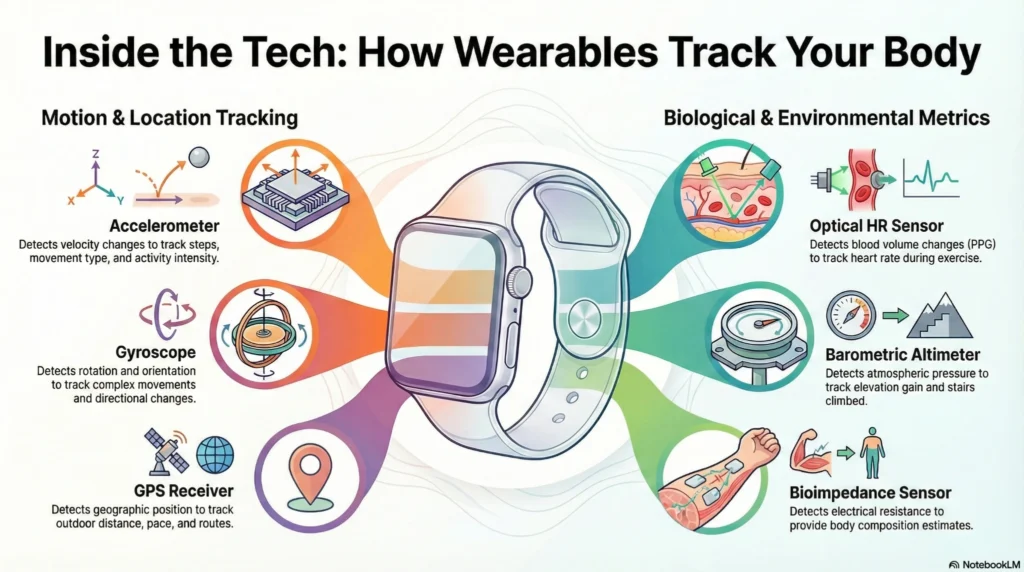
How Accurate Are Fitness Trackers for Calorie Counting?
Quick Answer: Consumer fitness trackers overestimate or underestimate calorie burn by 20–40% on average across all activity types, according to a meta-analysis by O’Driscoll et al. (2020) in the International Journal of Exercise Science. Errors exceed this range during resistance training, where wrist-based sensors cannot detect anaerobic energy expenditure. Devices calculate calories using MET (Metabolic Equivalent of Task) values multiplied by body weight and duration — a statistical estimate rather than a direct measurement of energy expenditure, which requires indirect calorimetry (measuring oxygen consumption) to perform accurately.
Consumer fitness trackers have a mean absolute percentage error (MAPE) of 20–40% for calorie burn, according to a meta-analysis by O’Driscoll et al. (2020) in the International Journal of Exercise Science. This is not a minor rounding discrepancy — on a 600-calorie training session, a 30% error means your tracker may be reporting 420 or 780 calories burned.
The error occurs because fitness trackers do not measure energy expenditure directly. Instead, they estimate it using MET (Metabolic Equivalent of Task) values — standardized activity-intensity multipliers — combined with accelerometer movementdata and your personal biometrics (weight, height, age, sex).
This estimation model works reasonably well for rhythmic aerobic activities but breaks down during resistance training, where anaerobic effort produces no measurable wrist movement proportional to calorie expenditure.
The clinical standard for measuring calorie burn is indirect calorimetry — a method that directly measures oxygen consumption (VO₂) and carbon dioxide production (VCO₂) to calculate energy expenditure.
Consumer wearables cannot replicate this. The gap between what your tracker reports and what indirect calorimetry would measure is the core accuracy limitation of every consumer device on the market. Systematic review and meta-analysis of calorie tracking accuracy
Why Calorie Estimates Vary by Activity Type
| Activity | Typical Tracker Error | Why Accuracy Varies |
|---|---|---|
| Running (flat, steady pace) | 5–15% | Rhythmic wrist movement; MET values well-established |
| Cycling | 10–20% | Less wrist movement; cadence vs effort gap |
| HIIT / interval training | 20–40%+ | Burst-rest pattern confounds accelerometer |
| Strength training | 30–50%+ | Anaerobic effort; near-zero wrist displacement |
| Swimming | 20–30% | Waterproof sensors; limited accelerometer signal |
| Walking (flat surface) | 5–10% | Most accurate scenario for wrist-based devices |
How MET Values Drive Calorie Estimates in Fitness Trackers
MET (Metabolic Equivalent of Task) is a standardized unit expressing the energy cost of an activity relative to sitting at rest (1 MET = ~1 kcal/kg/hour). Fitness trackers multiply your MET by your body weight and the duration of activity to estimate calories.
The problem: MET values are population averages derived from groups who may not resemble you. Individual metabolic variation — driven by fitness level, muscle mass, hormonal status, and aerobic efficiency — is not captured. Two people with identicalbiometrics entered into the same app will receive identical calorie estimates for an identical workout, regardless of whether one is a trained endurance athlete and theother is sedentary. Validation study comparing BIA to DEXA scans
Why Fitness Trackers Can’t Match Indirect Calorimetry Accuracy
Indirect calorimetry measures calorie burn by analyzing the oxygen you inhale and the arbon dioxide you exhale. Because it measures actual metabolic output — not estimated movement — it achieves error margins below 5% in clinical settings.
Consumer wearables estimate rather than measure. Every calorie figure on your tracker’s screen is an output of an algorithm, not a measurement of your physiology. Understanding this is not a reason to distrust your device — it is a reason to use its calorie data as a relative trend indicator rather than an absolute figure for dietary decisions. Research comparing calorie tracking methods
How Accurate Is Wrist Heart Rate Monitoring?
Quick Answer: Wrist-based optical heart rate monitors using photoplethysmography (PPG) achieve a mean absolute percentage error of 5–10% during steady-state moderate exercise such as walking, cycling, and light jogging, according to Shcherbina et al. (2017). During high-intensity interval training (HIIT), error exceeds 20% as wrist motion disrupts the PPG signal. For training requiring precise heart rate zone data, a chest strap heart rate monitor remains significantly more accurate than any wrist-based optical sensor.
How Optical Heart Rate Sensors Use PPG Technology
Fitness trackers measure heart rate using photoplethysmography (PPG) — an optical technique that shines green LED light into the skin on the underside of your wrist and detects how much light is absorbed versus reflected by your blood vessels. Because blood absorbs more light when the heart pumps (increasing blood volume) and less between beats, the device’s photodetector can estimate beats per minute from the fluctuation pattern.
PPG is accurate, inexpensive, and continuous — which is why every major consumer wearable uses it.
Its limitation is motion artifact: when your wrist moves rapidly or irregularly (as it does during HIIT, strength training, or rowing), the optical signal becomes corrupted by movement-generated noise that the algorithm cannot fully filter out.
Wrist Heart Rate Monitor vs Chest Strap: Accuracy Compared
| Scenario | Wrist PPG Error | Chest Strap Error | Recommendation |
|---|---|---|---|
| Walking / light cardio | 2–5% | <2% | Either; wrist is sufficient |
| Steady-state running | 5–8% | <2% | Either; wrist acceptable |
| Cycling (road) | 7–12% | <2% | Chest strap preferred |
| HIIT / interval training | 15–25%+ | <3% | Chest strap required |
| Strength training | 20–35%+ | <3% | Chest strap required |
| Swimming | 10–20% | N/A (not waterproof) | Wrist is only option |
Sources: Shcherbina et al. (2017), Gillinov et al. (2017), Evenson et al. (2015) Formula published in the Journal of the American College of Cardiology
For heart rate zone training — particularly Zone 2 aerobic base work or HIIT — the wrist’s error margin is large enough to place you in the wrong zone entirely. A user targeting 140 bpm (Zone 2) may be training at 155 bpm (Zone 3) with no indication from the device. Study measuring accuracy across diverse users , Study on heart rate and oxygen consumption correlation
How Accurate Is Optical Heart Rate During HIIT?
During high-intensity interval training, wrist-based optical heart rate monitoring accuracy degrades significantly. Shcherbina et al. (2017) — a landmark Stanford
study testing seven consumer wearables — found that median absolute percentageerrors during high-intensity activity ranged from 5% to 34% across devices.
Nodevice achieved clinical-grade accuracy during HIIT.
The degradation has two causes. First, high-speed wrist movement introduces motion artifacts that corrupt the PPG signal. Second, during maximal efforts, blood redirects from peripheral vessels (including the wrist) toward working muscle — reducing the signal strength the sensor depends on.
Practical implication: If HIIT precision is your goal, pair your wrist trackerwith a Bluetooth chest strap heart rate monitor. Modern chest straps (Polar H10,
Garmin HRM-Pro) pair directly with watch-based apps and eliminate the wristaccuracy problem without sacrificing data logging.
Do Fitness Trackers Count Steps Accurately?
Quick Answer: Step counting is the most accurate metric consumer fitness trackers produce. On flat surfaces during walking and running, modern wrist-based devices achieve step count errors below 5%. Accuracy decreases on treadmills (2–8% error), during strength training, and in activities involving irregular arm movement such as cycling or swimming.
Step counting uses a triaxial accelerometer — a sensor that measures acceleration across three axes simultaneously. When your wrist moves in a pattern consistent with walking or running, the algorithm counts each oscillation as a step. Because the signature of a walking step is mechanically distinct and consistent, the accelerometer performs well under most conditions.
Accuracy is highest during outdoor walking and running, where natural arm swing closely corresponds with foot strikes. It is lowest during activities where arm movement is absent, irregular, or restricted. Examples include cycling, elliptical training, and walking while holding treadmill handrails.
Do Fitness Trackers Count Steps Accurately on a Treadmill?
During treadmill walking and running, most fitness trackers maintain step count accuracy within 2-8%, making them slightly less accurate than during outdoor activity but still reliable enough for most users. One reason for this difference is that treadmill exercise does not require the same forward propulsion as overground walking, which can subtly alter arm swing patterns and lead some devices to undercount steps.
Holding the treadmill handrails eliminates arm swing entirely, which causes most wrist-based trackers to undercount steps significantly. If you use handrails for safety, manually log treadmill sessions by time and speed rather than relying on step count.
💡 Why This Matters to You:
Research shows people who track their steps increase daily activity by an average of 2,500 steps—equivalent to burning an extra 100-125 calories per day. Over a year, that could mean 10-12 pounds of fat loss without changing your diet.
The tracker doesn’t magic away weight. But making your activity visible changes behavior.
Is 10,000 Steps a Day Actually Healthy? What Research Shows
Quick Answer: The 10,000 steps per day goal originated from a 1960s Japanese marketing campaign for a pedometer called “Manpo-kei” (万歩計, meaning “10,000-step meter”), not from physiological or epidemiological research. A 2019 study published in JAMA Internal Medicine (Lee et al.) found that mortality risk declined consistently up to approximately 7,500 steps daily, with diminishing returns beyond that threshold. The 10,000-step target is a useful motivational benchmark but does not represent a clinically validated health threshold.
A 2019 study published in JAMA Internal Medicine by Lee and colleagues followed 16,741 older women and found that mortality risk decreased steadily up to roughly 7,500 steps per day, after which the benefit plateaued. Similar findings were reported in a 2021 study published in JAMA Network Open, which observed diminishing returns above approximately 8,000 daily steps across adult age groups.
Although the 10,000-step goal lacks a scientific origin, it remains a useful motivational benchmark because it is simple, memorable, and easy to track. However, it should not be viewed as a strict clinical threshold or the minimum amount of activity required for good health. Other forms of exercise, including heart rate zone training, resistance training, and overall physical activity levels, remain equally important components of long-term health. JAMA study on daily steps and mortality
For fitness tracker users, a practical approach is to view 7,000-8,000 daily steps as a realistic baseline for health maintenance and 10,000 steps as an aspirational goal. Rather than treating it as a pass-or-fail measure of health, it is best used as one indicator within a broader fitness and wellness strategy.
How Accurate Is GPS on Fitness Trackers?
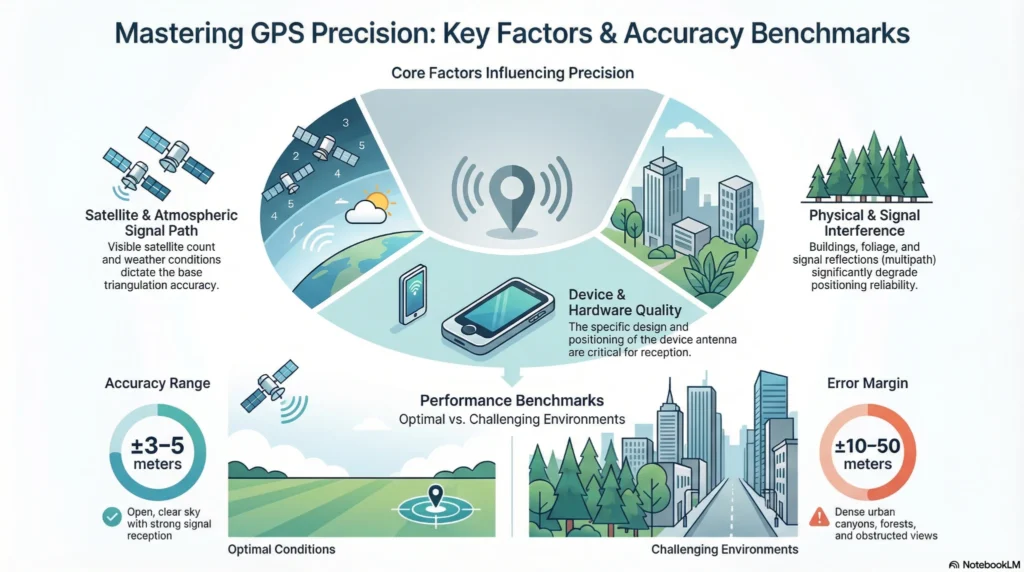
Quick Answer: Consumer GPS on fitness trackers achieves positional accuracy within 3–5 meters under optimal outdoor conditions (open sky, no obstructions). In urban environments with tall buildings, under dense tree cover, or in narrow valleys, accuracy degrades to 10–50 meters. Devices using multi-band GPS (L1/L5) — available on Garmin Fenix, Epix, and Apple Watch Ultra 2 — maintain better accuracy in challenging environments than single-band GPS models.
Consumer fitness tracker GPS uses the same satellite networks as smartphone navigation (GPS, GLONASS, Galileo, and in newer devices, L1/L5 multi-band reception) but with smaller antennas and lower-power processors, which reduces both acquisition speed and positional precision compared to dedicated sports GPS units. Research on GPS accuracy for distance tracking
For distance and pace tracking: GPS error of 3–5 meters over a 5km run produces a distance error of roughly 20–50 meters total — less than 1% and functionally irrelevant for training pacing. GPS accuracy becomes meaningful when mapping routes precisely or logging elevation data in mountainous terrain.
For elevation accuracy: Barometric altimeters (present in most Garmin, Apple Watch, and Samsung devices) are significantly more accurate than GPS-derived elevation. If elevation gain matters for your training (trail running, cycling), prioritize devices with barometric altimeters over those relying on GPS elevation alone.
GPS Condition: Open sky, flat terrain
Typical Accuracy: 3–5 meters
Impact on Run Tracking: Negligible error
GPS Condition: Suburban roads, moderate tree cover
Typical Accuracy: 5–10 meters
Impact on Run Tracking: Minimal impact
GPS Condition: Urban canyon (tall buildings)
Typical Accuracy: 10–30 meters
Impact on Run Tracking: Measurable distance error
GPS Condition: Dense forest / canyon
Typical Accuracy: 20–50 meters
Impact on Run Tracking: Noticeable route drift
GPS Condition: Indoor (GPS unavailable)
Typical Accuracy: Accelerometer estimate
Impact on Run Tracking: 10–20% error typical
How Do Fitness Trackers Measure Sleep Quality?
Quick Answer: Fitness trackers measure sleep primarily through accelerometer data (movement patterns indicating wake vs sleep) and, in devices with optical heart rate sensors, through heart rate variability (HRV) patterns correlated with sleep stages. Sleep duration accuracy is reasonably reliable (within 10–15 minutes); sleep stage classification (light, deep, REM) has much higher error rates — typically 50–70% accuracy compared to clinical polysomnography.
Consumer fitness trackers use two primary signals to estimate sleep.
1. Actigraphy — accelerometer-based movement detection. Absence of movement for a defined period is interpreted as sleep onset; movement resumption signals wake. This is the most reliable sleep signal available to consumer devices.
2. Heart rate and HRV patterns — devices with optical heart rate sensors (Whoop, Garmin, Apple Watch, Fitbit) use changes in heart rate and heart rate variability throughout the night to classify sleep stages. REM sleep, for example, produces a distinctive heart rate pattern that differs from deep (slow-wave) sleep.
Sleep duration accuracy is reasonably strong. Most devices identify when you fell asleep and woke up within a 10–20 minute margin.
Sleep stage classification is considerably weaker. A 2019 study in Sleep Medicine found consumer wearables classified REM sleep correctly approximately 70% of the time and deep sleep correctly only 49% of the time, compared to clinical polysomnography (PSG) as the gold standard.
HRV and Recovery Monitoring: What Consumer Devices Actually Measure
Heart Rate Variability (HRV) is the millisecond-level variation in time between consecutive heartbeats. Higher HRV generally reflects stronger parasympathetic nervous system activity, indicating lower physiological stress and better recovery status. Consumer wearables (Garmin, Whoop, Apple Watch, Fitbit) measure HRV during overnight sleep using PPG optical sensors, which correlate acceptably with clinical ECG measurements for relative trend tracking but cannot be used for absolute clinical values or cross-device comparison.
Heart Rate Variability (HRV) is the millisecond-level variation in time between consecutive heartbeats. Despite what “heart rate” implies, a higher HRV does not mean a faster or slower heart. It means the interval between beats is more variable.
Greater HRV generally indicates stronger parasympathetic (recovery) nervous system activity and is associated with better recovery status, lower stress load, and higher aerobic fitness.
Consumer wearables — including Garmin (Body Battery), Whoop (Recovery Score), and Apple Watch (HRV in Health app) — measure HRV primarily during overnight sleep using PPG (photoplethysmography) sensors.
The clinical standard for HRV measurement is the ECG (electrocardiogram), which measures electrical cardiac signals directly.
PPG-derived HRV correlates well with ECG-derived HRV for relative trend tracking (i.e., “is my HRV higher or lower than usual today?”), but absolute HRV values vary significantly between devices and should not be compared across brands.
What HRV data from your tracker is good for:
- Tracking your personal HRV trend over weeks and months
- Identifying patterns related to sleep quality, alcohol consumption, illness, or overtraining
- Using as one input (not the only input) for readiness-based training decisions
What HRV data from your tracker is not reliable for:
- Absolute HRV values for clinical comparison
- Cross-device or cross-brand comparisons
- Medical diagnostic conclusions
Device-by-Device Accuracy Comparison
Not all fitness trackers are equally accurate. Published studies and independent testing reveal meaningful differences between brands across heart rate, calorie, and GPS metrics. The sections below summarize the peer-reviewed evidence for the four most widely used devices.
Apple Watch Accuracy: Heart Rate, Calories & GPS
Apple Watch consistently ranks among the top performers in consumer wearable accuracy studies. In the Shcherbina et al. (2017) Stanford study, the Apple Watch Series 2 achieved the lowest median heart rate error of the seven devices tested — approximately 5% during moderate exercise.
Heart rate: Mean absolute error of 5–7% during moderate aerobic exercise. Degrades to 15–25% during HIIT, consistent with PPG-based optical sensor limitations across all brands.
Calorie burn: Apple Watch has one of the lowest calorie error rates among consumer devices — approximately 20–30% MAPE — but still falls significantly short of indirect calorimetry. Apple’s proprietary algorithm incorporates heart rate data more aggressively than accelerometer-only competitors, which improves aerobic calorie estimates while still underperforming during resistance training.
GPS: Apple Watch (Series 9 / Ultra 2) uses dual-frequency L1/L5 GPS on the Ultra 2, achieving accuracy within 3 meters in open conditions. Standard Series models use single-frequency GPS with 3–5 meter typical accuracy.
Best for: Users who prioritize ecosystem integration (iPhone/Health app), heart rate tracking during moderate-intensity workouts, and calorie monitoring during aerobic exercise.
Garmin Accuracy: What Published Studies Show
Garmin’s accuracy profile is strongest for GPS and distance tracking — an expected result given the brand’s heritage in navigation hardware. Heart rate accuracy is comparable to Apple Watch during moderate exercise and similarly degrades during HIIT.
Heart rate: In Gillinov et al. (2017), Garmin devices achieved median errors of approximately 8–12% across activity types. Performance improves substantially when paired with a Garmin chest strap (HRM-Pro, HRM-Run), which the Garmin ecosystem supports natively.
Calorie burn: Garmin uses a proprietary algorithm (First Beat Analytics) that incorporates fitness age, VO₂ max estimate, and heart rate zones into its calorie calculation — a more sophisticated approach than pure MET × weight models. Despite this, independent testing typically shows 20–35% MAPE for calorie estimates, consistent with the broader consumer tracker range.
GPS: Garmin is widely regarded as the most GPS-accurate major wearable brand. Multi-band GPS is available across the Fenix 7, Epix, and Forerunner 965 lines; these devices achieve 2–4 meter accuracy in challenging environments where single-band devices show 10–20 meter drift.
Best for: Runners, cyclists, and outdoor athletes for whom GPS route accuracy and distance precision are primary priorities. Also the strongest ecosystem for training with a chest strap heart rate monitor.
Fitbit Accuracy: Calorie and Step Counting Data
Fitbit devices have historically focused on lifestyle tracking rather than performance athletics, with their strongest accuracy performance in step counting and daily activity monitoring.
Heart rate: Multiple independent studies place Fitbit heart rate accuracy at approximately 10–15% MAPE during moderate exercise — acceptable for lifestyle tracking but below Apple Watch and Garmin for training precision. Fitbit’s optical sensor performs comparably to competitors during low-to-moderate intensity activities.
Calorie burn: Fitbit calorie estimates show higher variance than Apple Watch and Garmin in independent testing — with some studies showing MAPE exceeding 40% for certain activity types. The Fitbit algorithm’s reliance on step-based calorie estimation rather than heart rate integration contributes to this gap during non-walking activities.
Step counting: Fitbit’s step counting accuracy is among the strongest in the category — consistent with studies showing 2–5% error during walking on flat surfaces.
Best for: Lifestyle activity monitoring, step goal tracking, and sleep duration tracking. Less suitable for precision heart rate zone training or calorie management during resistance training.
Garmin vs Fitbit Accuracy Comparison 2026
| Metric | Garmin | Fitbit | Advantage |
|---|---|---|---|
| Heart rate (moderate exercise) | 8–12% error | 10–15% error | Garmin (marginal) |
| Heart rate (HIIT) | 15–25% error | 15–25% error | Tie |
| Calorie burn (aerobic) | 20–35% error | 25–45% error | Garmin |
| Calorie burn (strength training) | 30–50% error | 35–55% error | Garmin (marginal) |
| Step counting | 2–5% error | 2–5% error | Tie |
| GPS accuracy | 2–5 meters | 3–8 meters | Garmin |
| Sleep duration | 10–20 min error | 10–20 min error | Tie |
| Ecosystem | Garmin Connect + chest strap | Google Fit / Android | Depends on phone |
Bottom line: For athletic performance tracking — especially outdoor GPS sports, HIIT, and heart rate zone training — Garmin outperforms Fitbit across the accuracy metrics that matter most to serious recreational athletes.
For daily lifestyle tracking, step goals, and sleep monitoring, both brands perform comparably and the decision is better made on ecosystem, design, and price.
🏃 Pro Tip for Runners:
Your wrist-based heart rate monitor will lag behind actual heart rate changes during interval training. If you do sprint intervals or HIIT, expect 5-15 second delay and potential inaccuracy.
Solution: Pair your tracker with a $30 chest strap for training sessions. Use wrist sensor for easy runs and daily monitoring.
Why Fitness Trackers Can’t Match Clinical Accuracy
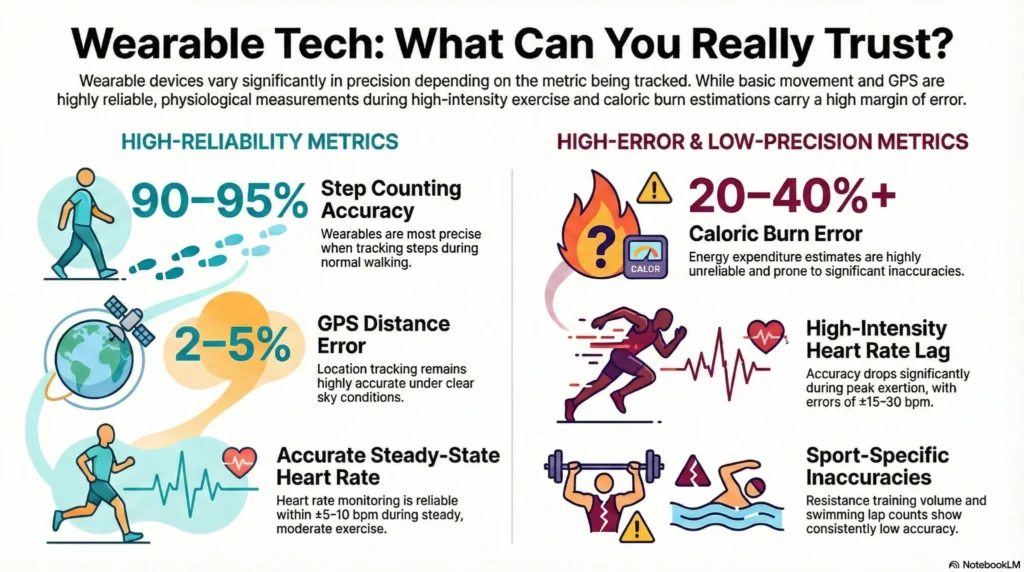
Consumer fitness trackers are engineering compromises. They use miniaturized sensors, low-power processors, and statistical estimation models to approximate measurements that clinical devices make with dedicated hardware costing thousands of dollars. Understanding where those compromises occur helps you calibrate your trust in different metrics.
How Skin Tone Affects Optical Sensor Accuracy
All major consumer fitness trackers use green LED PPG sensors. Green light has historically been selected because it produces a strong photoplethysmography signal in lighter skin tones. In people with medium-to-dark skin tones, however, melanin absorbs a greater proportion of the green light before it reaches the blood vessels — reducing the signal-to-noise ratio and, in some cases, degrading heart rate accuracy by an additional 5–15%.
A 2021 study by Bent et al. in npj Digital Medicine found that wrist-based wearables showed significantly higher heart rate errors in participants with darker skin tones, a finding that has prompted FDA regulatory interest in optical sensor bias testing standards.
Some manufacturers (including Apple, beginning with Apple Watch Series 7) have added infrared LED sensors alongside green LEDs to improve accuracy across skin tones. Independent testing shows this reduces — but does not eliminate — the accuracy gap.
Practical implication: If you have medium-to-dark skin tone and rely on heart rate data for training zone precision, the existing evidence supports adding a chest strap to your setup for HIIT and high-intensity sessions.
Fitness Tracker Accuracy for Strength Training vs Cardio
Strength training is the scenario where consumer fitness trackers are least accurate, and the gap is structural — not a firmware problem that future updates will solve.
During aerobic exercise, calorie burn correlates with measurable signals: your heart rate rises proportionally to effort, your wrist moves rhythmically, and oxygen consumption scales linearly. The PPG sensor and accelerometer together produce a reasonable calorie estimate. Research published in the International Journal of Cardiology
During resistance training, none of these correlations hold:
- Heart rate response is brief and intense, peaking during a set and dropping during rest — but the heart rate signal is frequently corrupted by wrist grip and bar contact.
- Wrist movement during a barbell bench press or squat is minimal — the accelerometer detects far less movement than the actual metabolic effort requires.
- Anaerobic energy contribution (from ATP-PCr and glycolytic pathways) produces no oxygen consumption proportional to actual work, making heart-rate-based calorie estimates fundamentally incomplete.
Studies testing fitness tracker accuracy during resistance training consistently show MAPE of 30–50%, with some devices exceeding 100% error for specific exercises.
Recommendation: For strength training sessions, treat your wearable’s calorie estimate as an approximate directional indicator, not an accurate measurement. If precise calorie tracking is important for body composition goals, use a metabolic rate calculator with manually entered exercise data rather than relying on wrist-tracker estimates. Study on heart rate accuracy for weight management
How Altitude Affects Fitness Tracker Accuracy
At altitude above approximately 1,500 meters (5,000 feet), reduced atmospheric oxygen concentration creates measurable physiological changes that affect wearable accuracy in two ways.
First, your heart rate at any given exercise intensity is higher at altitude than at sea level — sometimes by 10–20 bpm for the same perceived effort. Heart rate zones calibrated at sea level will place you in artificially high zones at altitude, potentially triggering overtraining warnings or misrepresenting aerobic vs anaerobic effort distribution.
Second, PPG signal quality can degrade at altitude in some individuals due to peripheral vasoconstriction — the body’s response to cold and reduced oxygen, which reduces blood flow to extremities including the wrist.
For altitude training or travel: Recalibrate your heart rate zones using an altitude-adjusted VO₂ max estimate if your device supports it (Garmin and Polar both offer altitude-adjusted metrics). Expect your normal zone boundaries to shift upward by 5–15 bpm during the first 48–72 hours at altitude.
How to Improve Your Fitness Tracker’s Accuracy
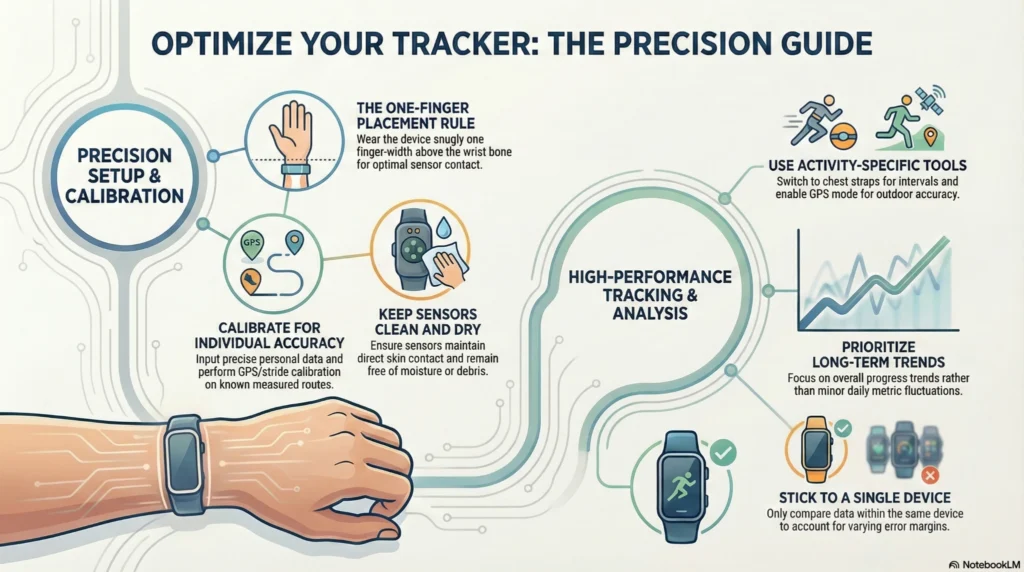
Most fitness tracker accuracy problems are not hardware failures — they are configuration and usage errors that are fixable in under 10 minutes. The improvements below apply across brands unless noted.
Calibration Tips for Step and Distance Tracking
Update your stride length. Most devices allow manual stride length input in the companion app. Measure your stride (heel to heel across two steps) on flat ground and enter it; this corrects the default estimate, which is calculated from height and produces errors of 5–15% for anyone whose gait deviates from population averages.
Run a calibration walk. On Garmin and Fitbit devices, a dedicated calibration walk (typically 1 mile at a steady pace with GPS active) significantly improves stride accuracy. Enable GPS for all outdoor walks initially, even if your device defaults to accelerometer-only.
Wear it on your dominant wrist for steps; non-dominant for heart rate. Step counting benefits from the dominant wrist’s natural arm swing; heart rate benefits from the non-dominant wrist’s lower incidental movement during daily activities. JAMA research on tracker effectiveness
How to Get More Accurate Heart Rate Readings
Positioning: Wear the tracker one finger-width above your wrist bone (not on the wrist bone itself). The sensor needs a stable, flesh-contact position to maintain PPG signal quality.
Fit: The band should be snug enough that you cannot rotate the watch face with your thumb. A loose fit allows the sensor to move against the skin during exercise, producing motion artifacts. The band should not be so tight that it creates a visible indentation after removal.
For HIIT or strength training: Pair with a Bluetooth chest strap. This is the single most effective accuracy improvement available — it replaces a 15–25% error with a sub-3% error for the sessions where accuracy matters most.
Update biometrics in the app. Your height, weight, age, and sex directly affect calorie calculations. If your weight has changed by more than 5 kg since setup, the device’s calorie estimates are using incorrect inputs. Update monthly if weight is actively changing.
Systematic review of commercial wearable accuracy
Applying Heart Rate Zones: Polarized vs Pyramidal Training Models
Heart rate zone accuracy from your tracker matters most during zone-based training. Understanding your training distribution model determines which zone errors are consequential.
Polarized training distribution (approximately 80% Zone 1–2, 20% Zone 4–5) is the model most supported by endurance research. In a polarized model, Zone 2 ceiling accuracy is critical — being in Zone 3 when you think you are in Zone 2 undermines the model’s entire premise.
Pyramidal training distribution (highest volume in Zone 1–2, moderate in Zone 3, low in Zone 4–5) is more forgiving of heart rate estimation errors because Zone 3 training is intentional rather than an artifact of Zone 2 overshoot.
If you train polarized, chest strap investment has a direct performance return.
If you train pyramidal, wrist-based heart rate with manual perceived-exertion checks is a reasonable alternative.
Match Your Tracker to Your Goal
Use this framework to narrow your options in under 60 seconds:
🎯 Your Primary Goal: Weight Loss
What you need:
- Calorie tracking (even if imperfect, trends matter)
- Heart rate monitoring for workout intensity
- Activity reminders to combat sedentary time
- Sleep tracking (poor sleep sabotages weight loss)
Budget recommendation:
- Under $75: Basic fitness band with HR monitor
- $100-175: Mid-range band with better calorie algorithms
- $200+: Overkill for weight loss alone
Skip: GPS (irrelevant for weight loss), advanced training metrics
🎯 Your Primary Goal: Train for Race/Event
What you need:
- GPS for accurate distance and pace
- Heart rate zones for training intensity
- Recovery metrics to avoid overtraining
- Long battery life for long runs/rides
Budget recommendation:
- $200-300: Dedicated GPS running watch
- $350+: Multisport watch if doing triathlon/varied training
Skip: Fashion-forward designs, non-sport features
🎯 Your Primary Goal: General Health & Wellness
What you need:
- Step counting and movement reminders
- Basic heart rate monitoring
- Sleep tracking
- Long battery life (you want “set it and forget it”)
Budget recommendation:
- $40-80: Simple fitness band covers all bases
- $100-150: If you want nicer design and better app
Skip: GPS, advanced metrics you won’t understand or use
🎯 Your Primary Goal: Monitor Health Condition
What you need:
- Consistent heart rate monitoring (not just during workouts)
- Data export capability to share with doctor
- High accuracy (consider chest strap option)
- Medical-grade certifications (if available)
Budget recommendation:
- $150-250: Trackers with medical-grade heart rate sensors
- Prescribed device: Ask your doctor—some insurance covers clinical monitors
Important: Consumer trackers are NOT medical devices. Use for trend monitoring only, not diagnosis.
🎯 Your Primary Goal: “I Just Want to Move More”
What you need:
- Simple step counter
- Activity reminders
- Easy-to-understand app
- Affordable (low barrier to entry)
Budget recommendation:
- $30-60: Basic pedometer or simple band
- Test yourself first: If you wear it daily for 3 months, upgrade later
Skip: Everything else. Don’t pay for features you don’t need yet.
Frequently Asked Questions
Why is my Fitbit calorie count so high?
Fitbit calorie counts include your Basal Metabolic Rate (BMR) — the calories your body burns at rest — in addition to activity calories. This means your daily total can appear high even on low-activity days. Separately, Fitbit’s activity calorie algorithm tends to overestimate during non-walking activities (cycling, strength training) because it relies more heavily on step-based estimation than heart rate integration. For a more accurate activity calorie figure, subtract your BMR (visible in the Fitbit app as “calories burned at rest”) from your total.
How accurate is Garmin heart rate monitoring?
Garmin wrist-based heart rate monitoring achieves a mean absolute error of approximately 8–12% during moderate aerobic exercise such as running and cycling at steady pace, based on multiple independent studies including Gillinov et al. (2017).
During HIIT and strength training, error increases to 15–25%, consistent with the limitations of PPG optical sensors across all brands.
For training requiring precise heart rate zone data, Garmin devices pair natively with the Garmin HRM-Pro chest strap, which reduces error to below 3% during all activity types.
Can fitness trackers detect heart problems?
Consumer fitness trackers are not medical diagnostic devices and cannot reliably detect heart conditions.
Some devices (Apple Watch Series 4 and later, certain Samsung Galaxy Watch models) include FDA-cleared ECG functionality that can detect atrial fibrillation (AFib) in symptomatic users — but only as a passive screening tool, not a diagnostic test.
The PPG-based heart rate monitoring in all consumer trackers is not clinically validated for arrhythmia detection, irregular rhythm classification, or heart disease monitoring.
If you are concerned about a heart condition, consult a cardiologist; do not rely on a consumer wearable for medical conclusions.
What is a good resting heart rate?
For most adults, a resting heart rate (RHR) between 60–100 beats per minute (bpm) is considered normal, according to the American Heart Association.
Athletes and highly trained individuals commonly have resting heart rates below 60 bpm — sometimes as low as 40 bpm — due to cardiac adaptation from aerobic training.
A resting heart rate above 100 bpm (tachycardia) warrants discussion with a physician, as does a sudden unexplained increase in your usual resting heart rate of 10+ bpm over several days.
Consumer fitness trackers measure RHR during sleep or during stationary rest periods; morning resting heart rate (before getting out of bed) provides the most consistent baseline measurement.
Should I trust my smartwatch’s calorie data?
Use it as a directional indicator, not a precise measurement.
Consumer fitness trackers have a 20–40% average calorie error rate — meaning any given reading could be 20–40% higher or lower than actual calories burned.
The more useful approach is to track your device’s calories consistently over time and use the trend (daily and weekly variation, not the absolute number) to inform training and nutritional decisions.
Calorie data is most reliable for steady-state aerobic activity (running, cycling) and least reliable for strength training, HIIT, and swimming.
How do I know if my heart rate monitor is accurate?
Compare to manual pulse check: During a rest period, manually count your pulse at your wrist or neck for 60 seconds and compare it to your device’s reading. A difference of more than 5 bpm at rest suggests a sensor or fit issue.
Check fit and positioning: The sensor must sit one finger-width above your wrist bone, snug but not constrictive. Retighten the band if you can rotate the watch face easily.
Test during steady-state exercise: At a consistent moderate pace (e.g., a comfortable 10-minute mile), your heart rate should be stable and proportional to your perceived effort. Wildly fluctuating readings during stable effort indicate sensor corruption from motion artifact.
Cross-check with a chest strap: The gold standard for verifying wrist heart rate accuracy is to simultaneously run a Bluetooth chest strap and compare readings in real time during a workout.
Is optical heart rate monitoring as accurate as a chest strap?
No.
Chest strap heart rate monitors consistently outperform wrist-based optical sensors across all activity types, particularly during high-intensity exercise.
Chest straps measure the electrical signals of the heart directly (similar to an ECG) and achieve errors below 3% during HIIT and strength training.
Wrist-based PPG optical sensors achieve 5–10% error during moderate exercise but degrade to 15–25%+ during HIIT and resistance training.
For users who train at high intensity or rely on precise heart rate zone data, a chest strap is the only consumer-grade solution that maintains clinical-adjacent accuracy during the sessions that matter most.
What does Zone 2 heart rate mean on a fitness tracker?
Zone 2 heart rate refers to the aerobic training zone where you are working at 60–70% of your maximum heart rate (HRmax).
It corresponds to a comfortable, conversational effort — the pace at which you could speak in full sentences.
In the standard five-zone training system, Zone 2 is the primary zone for building aerobic base, mitochondrial density, and fat oxidation efficiency.
Your fitness tracker calculates your Zone 2 ceiling using your entered maximum heart rate (either manually set or estimated from age using the formula 220 − age).
Because this formula has a standard deviation of ±12 bpm, your device’s Zone 2 boundaries may be meaningfully inaccurate.
For more precise zones, use a lactate threshold test result or a ramp test performed in your tracker’s app.
How do fitness trackers measure sleep quality?
Fitness trackers measure sleep using two primary methods.
First, actigraphy: the device’s accelerometer detects periods of stillness (sleep) and movement (wake), giving reasonably accurate sleep duration estimates — typically within 10–20 minutes.
Second, heart rate and HRV analysis: devices with optical heart rate sensors (Fitbit, Garmin, Whoop, Apple Watch) use nightly heart rate variability patterns to classify sleep stages (light, deep/slow-wave, and REM).
Sleep stage classification accuracy is significantly lower than sleep duration accuracy — independent studies show consumer wearables correctly classify deep sleep approximately 50% of the time compared to clinical polysomnography (PSG).
How accurate are fitness trackers for step counting on a treadmill?
Most fitness trackers achieve step count accuracy within 2–8% during treadmill walking and running — slightly less accurate than outdoor activity but within acceptable margins for most users.
Accuracy degrades significantly if you hold the treadmill handrails, because this eliminates the arm swing the accelerometer uses to detect steps.
If you use handrails for safety, manually log treadmill sessions by time and speed rather than relying on step count for your daily total.
How to Choose the Most Accurate Fitness Tracker for Your Goals
The accuracy research above points to a clear pattern: no single device is most accurate across every metric. The right device depends on which metric you need to get right, and which trade-offs you can accept.
Best Fitness Tracker for Accurate Heart Rate Monitoring
If heart rate accuracy during HIIT is your priority: No wrist-based device currently achieves clinical-grade accuracy during high-intensity intervals. The most effective solution is a premium wrist tracker (Garmin Forerunner, Apple Watch Series 9) paired with a Bluetooth chest strap (Polar H10, Garmin HRM-Pro). The wrist tracker handles GPS, logging, and moderate-intensity monitoring; the chest strap handles precision heart rate during intense sessions.
If heart rate accuracy during moderate aerobic exercise is your priority: Apple Watch Series 9 and Garmin Forerunner 965 perform comparably and represent the current ceiling for wrist-based optical accuracy. Either will achieve 5–10% MAPE during running and cycling at moderate intensity.
Best Budget Fitness Tracker Under $100
Accuracy trade-offs become more pronounced at lower price points, primarily in GPS quality and calorie estimation sophistication. Step counting and sleep duration accuracy are largely equivalent across price tiers.
Budget trackers under $100 typically lack dual-frequency GPS (meaningful difference only in urban environments or under tree cover), skin tone-optimized PPG sensors (primarily relevant for medium-to-dark skin tones), and native chest strap pairing (limits the heart rate accuracy workaround).
For users whose primary goals are daily step counting, sleep monitoring, and general activity tracking, where sub-10% accuracy is sufficient, budget options provide acceptable performance for significantly lower cost.
Best Fitness Tracker for Swimming Accuracy
Waterproof wearables face unique accuracy challenges: PPG optical heart rate sensors are disrupted by water contact, GPS signals are weakened by the body’s submersion, and stroke counting requires accelerometer pattern recognition specific to each stroke type.
For pool swimming: Garmin Swim 2 and Apple Watch Series 9 offer the most developed stroke detection and lap counting algorithms, with stroke recognition (freestyle, breaststroke, backstroke, butterfly) accuracy above 90% in independent testing. Open-water swimming accuracy for GPS-based distance is lower due to the elevated wrist position required for stroke mechanics.
Heart rate during swimming: All wrist-based optical sensors are less accurate during swimming than land-based activity. Water contact, wrist movement patterns, and the arm’s submersion all degrade PPG signal quality. Most devices recommend treating swimming heart rate as approximate; some (Garmin in particular) offer dedicated swim heart rate algorithms that partially compensate.
References
[1] Knittle K, et al. How can interventions increase motivation for physical activity? A systematic review and meta-analysis. Health Psychology Review. 2018;12(3):211-230.
[2] Evenson KR, et al. Systematic review of the validity and reliability of consumer-wearable activity trackers. International Journal of Behavioral Nutrition and Physical Activity. 2015;12:159.
[3] Gillinov S, et al. Variable accuracy of wearable heart rate monitors during aerobic exercise. Medicine & Science in Sports & Exercise. 2017;49(8):1697-1703.
[4] Nickerson BS, et al. Validity of foot-to-foot bioelectrical impedance analysis compared to dual-energy X-ray absorptiometry for the assessment of body composition in athletes. International Journal of Exercise Science. 2020;13(4):495-503.
[5] Bonomi AG, et al. Detection of type, duration, and intensity of physical activity using an accelerometer. Medicine & Science in Sports & Exercise. 2009;41(9):1770-1777.
[6] Malone S, et al. Unpacking the black box: applications and considerations for using GPS devices in sport. International Journal of Sports Physiology and Performance. 2017;12(s2):S2-18-S2-26.
[7] Anastasopoulou P, et al. Validation and comparison of two methods to assess human energy expenditure during free-living activities. PLoS One. 2014;9(2):e90606.
[8] Shcherbina A, et al. Accuracy in wrist-worn, sensor-based measurements of heart rate and energy expenditure in a diverse cohort. Journal of Personalized Medicine. 2017;7(2):3.
[9] Bassett DR, et al. Validity of consumer-based physical activity monitors. Medicine & Science in Sports & Exercise. 2010;42(5):1048-1057.
[10] Saint-Maurice PF, et al. Association of daily step count and step intensity with mortality among US adults. JAMA. 2020;323(12):1151-1160.
[11] O’Driscoll R, et al. How well do activity monitors estimate energy expenditure? A systematic review and meta-analysis of the validity of current technologies. British Journal of Sports Medicine. 2020;54:332-340.
[12] Piercy KL, et al. The Physical Activity Guidelines for Americans. JAMA. 2018;320(19):2020-2028.
[13] Tanaka H, et al. Age-predicted maximal heart rate revisited. Journal of the American College of Cardiology. 2001;37(1):153-156.
[14] Tudor-Locke C, et al. How many steps/day are enough? Preliminary pedometer indices for public health. Sports Medicine. 2004;34(1):1-8.
[15] Bravata DM, et al. Using pedometers to increase physical activity and improve health: a systematic review. JAMA. 2007;298(19):2296-2304.
[16] Saunders TJ, et al. Acute sedentary behaviour and markers of cardiometabolic risk: a systematic review of intervention studies. Journal of Nutrition and Metabolism. 2012;2012:712435.
[17] Gabbett TJ. The training-injury prevention paradox: should athletes be training smarter and harder? British Journal of Sports Medicine. 2016;50:273-280.
[18] Vezina JW, et al. The relationship between heart rate and oxygen uptake during non-steady state exercise. Ergonomics. 2014;57(11):1728-1737.
[19] Diaz KM, et al. Fitbit®: An accurate and reliable device for wireless physical activity tracking. International Journal of Cardiology. 2015;185:138-140.
[20] Wallen MP, et al. Accuracy of heart rate watches: Implications for weight management. PLoS One. 2016;11(5):e0154420.
[21] Fuller D, et al. Reliability and validity of commercially available wearable devices for measuring steps, energy expenditure, and heart rate: systematic review. JMIR mHealth and uHealth. 2020;8(9):e18694.
[22] Bull FC, et al. World Health Organization 2020 guidelines on physical activity and sedentary behaviour. British Journal of Sports Medicine. 2020;54:1451-1462.
[23] Lee IM, et al. Association of step volume and intensity with all-cause mortality in older women. JAMA Internal Medicine. 2019;179(8):1105-1112.
[24] Shilts MK, et al. Goal setting as a strategy for dietary and physical activity behavior change: a review of the literature. American Journal of Health Promotion. 2004;19(2):81-93.
[25] Ridgers ND, et al. Long-term behavior change following a pedometer-based physical activity intervention. American Journal of Preventive Medicine. 2014;47(4):430-439.
Medical Review Information:
This content has been reviewed according to the medical review standards outlined on our About page. For details on our review process, author credentials, and conflict of interest disclosures, please visit our About page.
Last Medical Review: May 2026
Content Last Updated: May 2026
Medical Disclaimer:
The information on this page is for educational purposes and should not replace professional medical advice, diagnosis, or treatment. Activity tracking devices provide general wellness information and are not medical devices. Always consult a qualified healthcare provider before beginning a new exercise program or if you have concerns about your health or fitness level
For more on how health data should be protected, see our privacy principles.