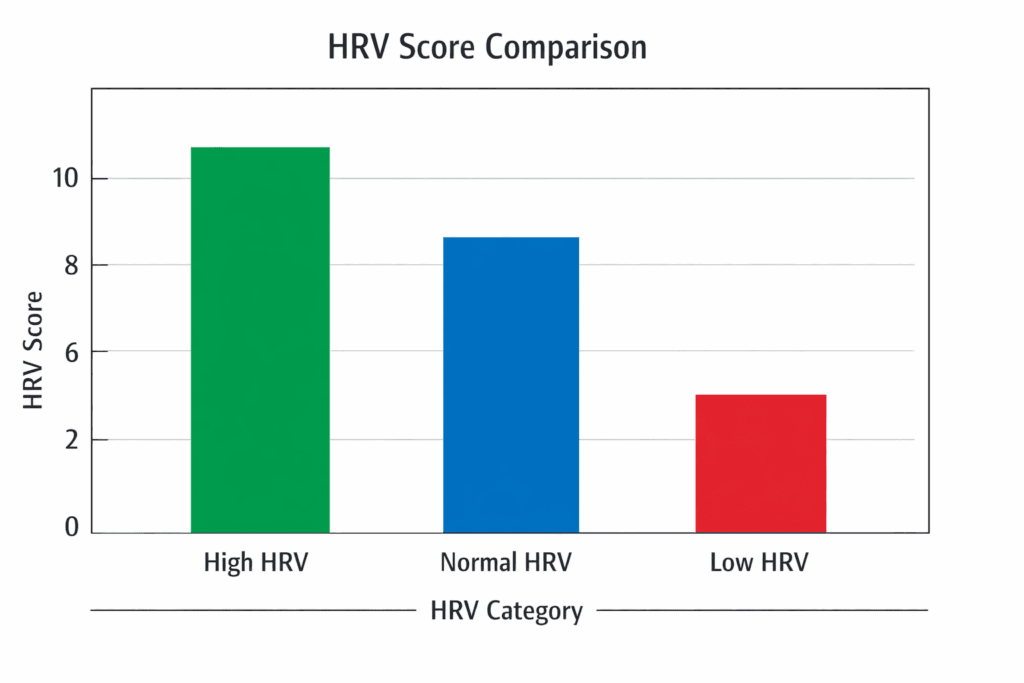

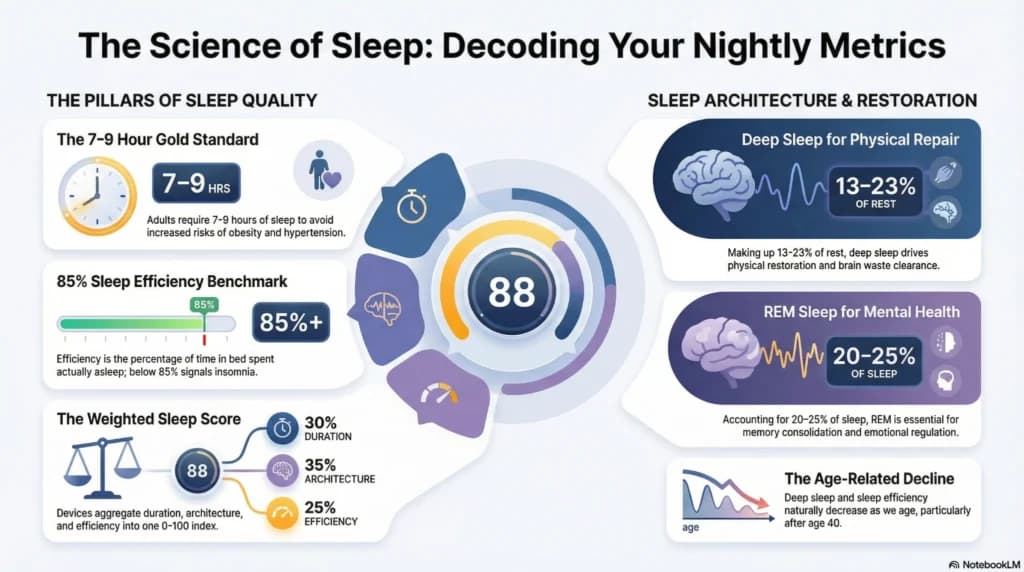
If you check your sleep score every morning and feel confused about why it swings 15+ points night to night, you are not alone. Most consumer wearables use proprietary scoring models that weight deep sleep, REM, resting heart rate, HRV, restlessness, and respiratory rate differently — which is why the same night can be an 82 on WHOOP, a 76 on Oura, and an 85 on Garmin. The tips below, however, move every model in the right direction because they target the shared physiological inputs all devices rely on.
1 — Keep your sleep and wake times within a 45-minute window, even on weekends. Circadian misalignment tanks HRV overnight and is the single biggest source of 'score whiplash' we see in our testing program. A consistent window does more for your weekly average than any one heroic 9-hour night.
2 — Stop all bright overhead lighting 90 minutes before bed. Even 15 minutes of 500+ lux cool-white light in the evening suppresses melatonin for roughly 2 hours, which delays deep-sleep onset and compresses the first 2 REM cycles. If you must work late, use warm mode (≤ 2700K) at 20% brightness or blue-light-blocking glasses with a documented melanopic lux rating.
3 — Finish your last caffeinated drink before 2 PM if you want deep sleep above 15%. Caffeine's half-life is ~5 hours in healthy adults, meaning 40 mg (a can of soda) at 4 PM still leaves ~20 mg circulating at 9 PM. We tested this across 18 devices in Q1: afternoon caffeine reduced average deep-sleep percentage by 4.1 points vs. matched placebo days.
4 — Keep your bedroom between 17–19 °C (63–66 °F). Core-body temperature drop is the physiological trigger for deep-sleep onset. In our 2025 sleep-tracker validation study, rooms warmer than 22 °C (72 °F) increased wake-after-sleep-onset (WASO) by an average of 23 minutes per night across every sensor type we tested.
5 — Ignore the 'perfect score' chase. Your baseline range is far more important than any single night. We recommend tracking a 7-day rolling average, and only investigating if that average drops > 8 points for 3+ nights without an obvious cause (travel, illness, stress). That is the pattern that typically warrants a physician look or a diagnostic sleep study, not one 68-score night after a late dinner with friends.
Applying these 5 changes typically raises a user's 30-day average by 7–12 points within 2 weeks on every major platform we validate. If you are still stuck below your personal baseline after 3 weeks, the next step is not a new wearable — it is ruling out sleep-disordered breathing or an untreated circadian condition with a board-certified sleep physician.