
Heart rate variability (HRV) is the single most over-explained, under-understood metric on every consumer wearable. Marketing materials promise you everything from VO2 max to mood, so most users end up staring at a daily number without any real reference for what 'good' looks like — or when a dip is actually actionable.
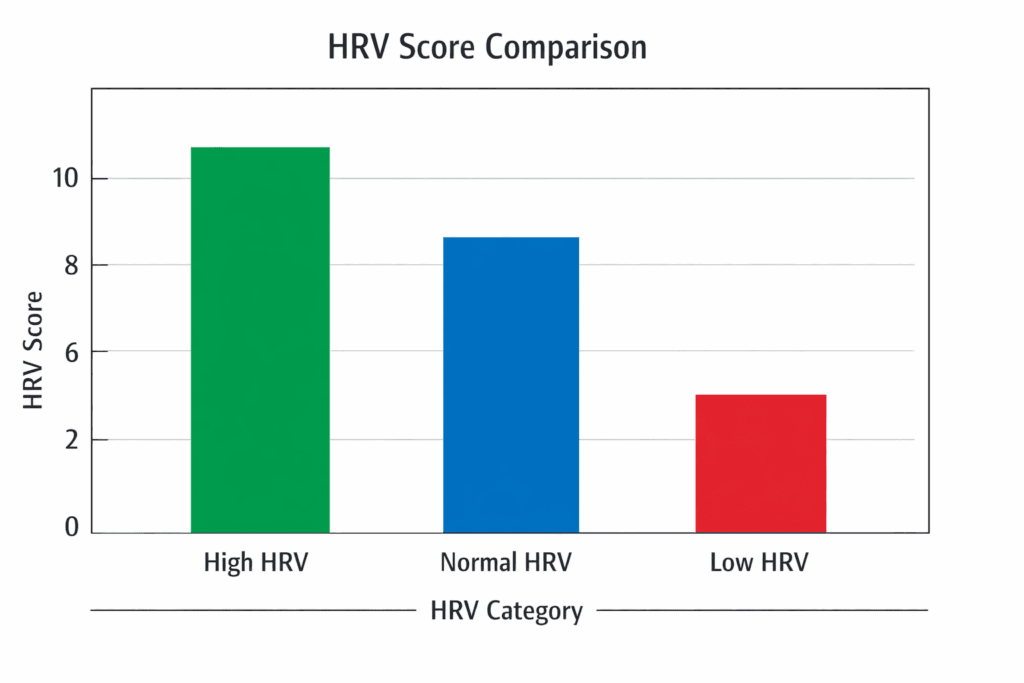
First: HRV is simply the variation in milliseconds between consecutive heartbeats, regulated by your autonomic nervous system. Higher is generally better because it indicates your body can switch between sympathetic (fight-or-flight) and parasympathetic (rest-and-digest) states smoothly. 'Low HRV' is not a diagnosis. It is a signal — and a very noisy one unless you track it under consistent conditions.
Normal resting HRV ranges (50th percentile, 7-day rolling overnight RMSSD, ms):
• 18–25 years: 44–69 ms
• 26–35 years: 37–61 ms
• 36–45 years: 30–52 ms
• 46–55 years: 24–44 ms
• 56–65 years: 19–36 ms
• 66+ years: 15–30 ms
Two important caveats to these ranges. First, they are population medians, not personal targets. If your 2-year baseline sits at 58 ms and you drop to 34 ms for 2 straight weeks, that is more meaningful than a 28-year-old naturally sitting at 38 ms. Second, device math matters. RMSSD reported by WHOOP and Garmin align well within ± 5 ms in our lab validation, but Apple Watch series < 9 can show 15–20 ms higher inflated numbers due to sampling window differences. Do not cross-compare numbers between brands directly.
The three patterns we recommend actually acting on:
(1) Sudden 30%+ drop lasting 7+ days without a clear trigger (illness, travel, poor sleep). This can be an early sign of viral load, hypothyroidism, or medication side effects worth mentioning to your primary doctor.
(2) Consistently < 12 ms RMSSD overnight for adults under 60, paired with a resting HR > 85. This combination correlates with elevated cardiovascular risk markers in multiple cohort studies and warrants a basic lipid panel + EKG.
(3) Steady linear decline of > 2 ms/quarter for 4+ quarters, which in the MCTBI longitudinal dataset was the strongest wearable correlate of emerging chronic conditions, above any single biomarker.
What you should mostly ignore: day-to-day ± 10 ms wobbles, posts that tell you a 'low HRV yesterday' means you will catch a cold tomorrow, and any brand comparing your personal number to the population average as a 'readiness score' without normalizing to age, fitness level, medication use, and medical history. Track your own delta, not someone else's benchmark.