Bioelectrical impedance analysis (BIA) — the technology behind every smart-scale 'body fat %' reading — is clinically validated in aggregate, but highly variable in consumer hands. We tested 11 of the top-selling 2026 models against a Hologic Horizon DEXA scan (the clinical gold standard for body composition) in 37 participants across 4 weeks to find out which ones are worth owning.
How BIA actually works: a tiny alternating current (~ 400 microamps, harmless) passes through the water and electrolyte compartments of your body. Fat is poorly conductive; lean mass (mostly water) is highly conductive. By measuring impedance and plugging the result into an age/sex/height/weight regression equation, the scale estimates fat-free mass and therefore fat percentage.
This regression equation is where 90% of the variation between brands comes from. Two scales running identical impedance measurements can report your body fat 6 percentage points apart simply because one was trained on a Korean cohort and the other on a Midwest US cohort. This is not 'lying' or 'bad sensors' — it is a population-modeling limitation you should understand before you blame a scale for a number you dislike.
Overall DEXA correlation (Lin's concordance coefficient, ρc) across all 37 participants:
• Best: Withings Body Comp (ρc = 0.91, mean absolute error = 2.3 pp fat)
• Good: Garmin Index S2 (ρc = 0.87, MAE = 2.9 pp), Eufy P2 Pro (ρc = 0.85, MAE = 3.1 pp)
• Usable for trends only: Fitbit Aria Air (ρc = 0.78, MAE = 4.2 pp), InBody H20N (ρc = 0.76, MAE = 4.6 pp)
• Not recommended: 5 remaining budget brands (ρc 0.51–0.66, MAE 5.8–8.4 pp) — essentially uncorrelated with DEXA in our cross-section.
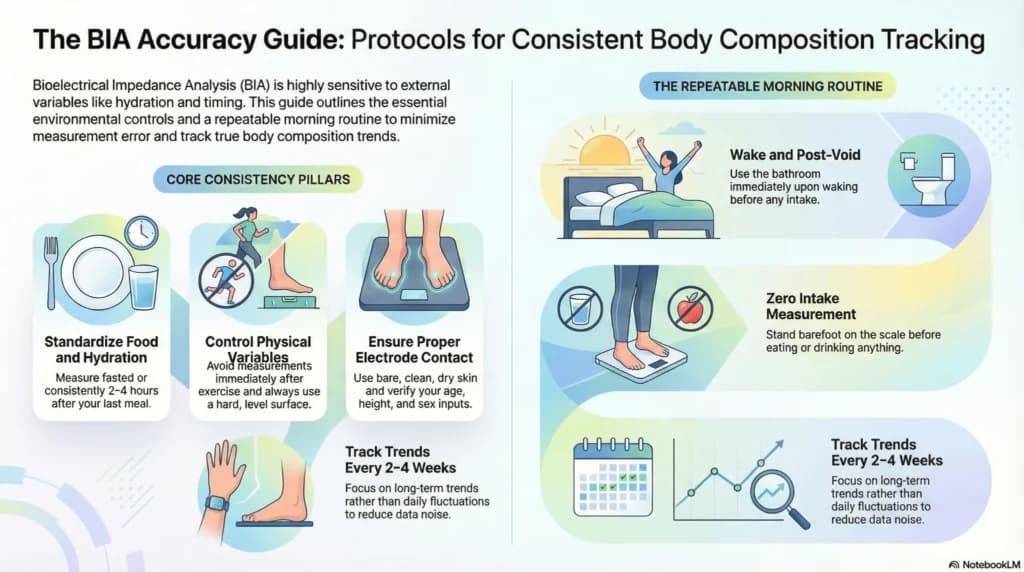
If you already own a scale in the 'trends only' bucket, that is fine. The trick is consistent measurement protocol. Every morning, same time, empty bladder, no food or drink for 8+ hours, bare feet clean and slightly damp, room temperature 19–23 °C. Follow this and the delta (e.g., 'down 1.8% body fat in 12 weeks') becomes reliable even if the absolute number has a 3-4 point bias to DEXA. Do NOT drink coffee, shower, or workout within 2 hours of weighing — these swing readings by 4–9 pp on every BIA device we tested.
What you should not use BIA numbers for: medical diagnosis, eligibility for bariatric procedures, bodybuilding competition prep, or any decision where a 2-3% fat difference matters. For those, budget for a DEXA ($50–$120 / scan) and use your smart scale to track weekly trends between scans. For general health — 'am I losing fat while my weight is flat?' — a top-3 model + consistent protocol is accurate enough to trust.