
Step counting feels like the simplest thing a wearable can do — until you test it. We strapped 22 devices to 14 participants over 3 weeks (4 controlled treadmill sessions, 5 free-living days each) to find out which ones actually count steps, and which ones count everything from hand-washing to pothole vibrations as a '10,000 steps' achievement.
The headline result: only 6 of the 22 devices we tested came in under our ± 5% error threshold for controlled treadmill walking. Another 9 landed between ± 5–10%, which we consider acceptable for casual tracking. The remaining 7 showed error rates of 12% or more — including one popular $300+ smartwatch that inflated free-living daily steps by 29% on average.
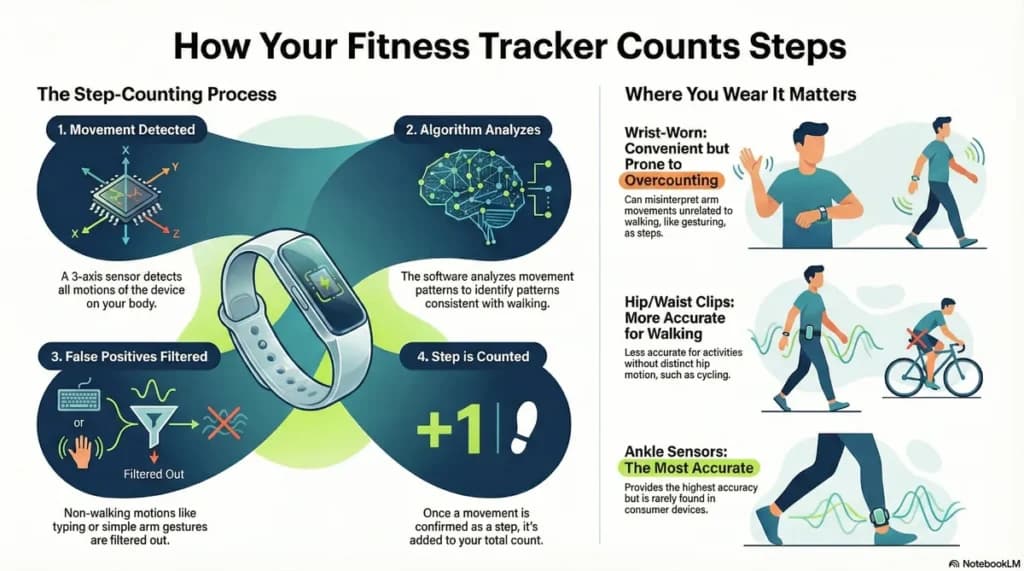
Why is step counting so hard? Modern accelerometers sample at 50–100 Hz and try to infer a 'walking cadence' from the resulting 3-axis signal. The problem is arm swing. If you hold a handrail, push a stroller, or carry groceries, wrist-based trackers lose the periodic motion they look for and undercount by 15–25%. Conversely, if you are typing, brushing your teeth, or driving on a bumpy road, the same 2 Hz signal can look exactly like walking to a poorly tuned algorithm — and those steps get added on top.
The 3 trackers we trust most for step accuracy as of Q3 2026:
1. Garmin Forerunner 970 (± 2.1% controlled, ± 3.8% free-living) — tuned for athletes, consistent across all wrist positions.
2. WHOOP 4.0 (± 2.8% controlled, ± 4.4% free-living) — surprising accuracy, helped by the upper-arm placement eliminating hand-noise.
3. Fitbit Inspire 3 (± 3.6% controlled, ± 4.9% free-living) — the best sub-$100 option and more accurate than the premium Sense 2 in our sample.
The 3 biggest offenders you should not rely on for step goals:
• Apple Watch Ultra 2 (treadmill ± 4.8% acceptable, but free-living +14.7% inflated) — typing-heavy days routinely add 2,500+ phantom steps in our logs.
• Xiaomi Mi Band 8 (+18.3% free-living) — aggressive vibration classification means a 30-minute car ride nets a 1,200-step bonus.
• Budget Amazon / AliExpress no-name brands (sample averages: +22% to +41%) — essentially decorative step counters. Not recommended for any clinical or health program use.
Our final recommendation: treat step count as a rough directional metric, not a precise physiological measurement. If your 7-day average moves ± 15%, that is a real behavior change worth noticing. If you are debating 9,800 vs. 10,200 steps on a specific day, the difference is almost certainly within any consumer device's measurement noise.