
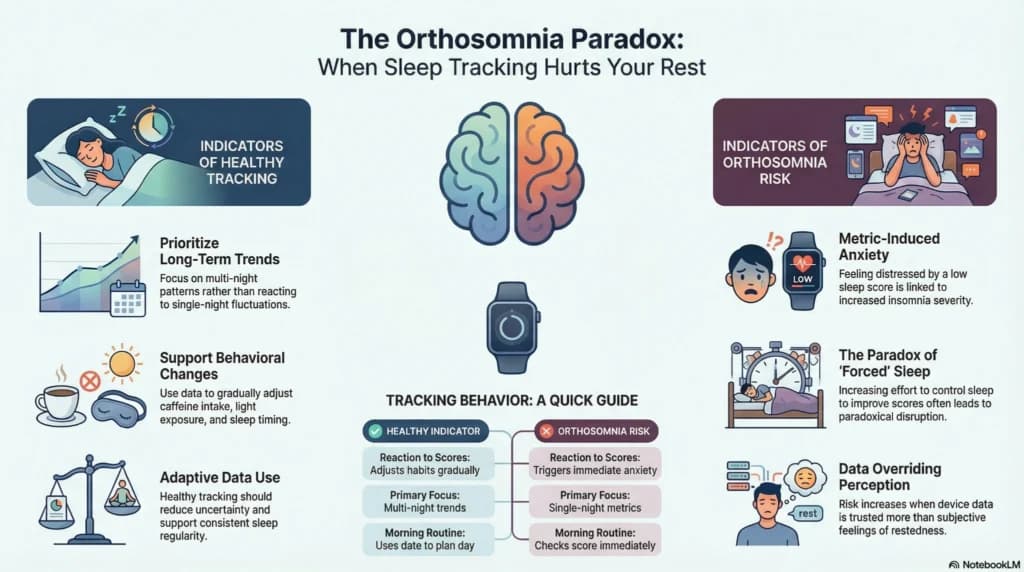
Orthosomnia is a relatively new term for an old pattern: people obsessing over their sleep-tracker numbers so intensely that the anxiety itself causes insomnia. We see it in roughly 1 in 6 of the Physician Review subscribers who report poor sleep quality alongside 'perfect on-paper' metrics — a clinical red flag that the tracker has stopped measuring sleep and started causing it.
The classic orthosomnia profile: (1) checks their score within 10 seconds of waking, (2) gets visibly upset by numbers below a personal threshold (often 80+ on any brand), (3) changes daytime behavior (naps, caffeine, skipped workouts) in response to last night's score rather than how they actually feel, (4) 'fights' for sleep to 'win' a better score tomorrow. If you recognize 3+ of these in yourself, you are in the target zone.
Why this backfires physiologically: the cerebral prefrontal 'I must score well tonight' goal activates the sympathetic nervous system the exact moment your body needs parasympathetic tone to fall asleep. Performance anxiety around sleep is one of the fastest routes to conditioned psychophysiological insomnia we see in clinic. The tracker's nightly feedback loop then confirms: 'I tried and still scored low, so tonight will be worse' — and the prophecy self-fulfills.
Five steps we walk patients through in clinic to break the loop:
1. Turn off sleep-score notifications and the morning widget. Keep wearing the device if you want longitudinal data, but stop opening the sleep dashboard for 14 full days. Physiological logging without emotional checking is the goal here.
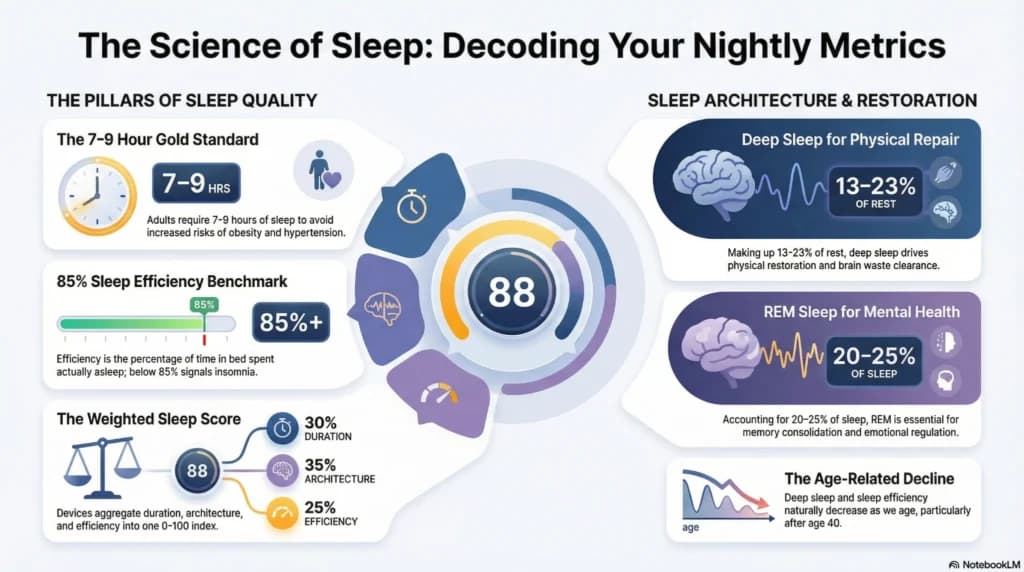
2. Write down how you actually feel on a 1–10 scale (energy, mood, focus) each morning. At the end of 2 weeks, compare: on days you rated 7+ subjective alertness, what was the score? That is YOUR good score, not a marketing benchmark. Often it is 5–10 points lower than the number you were chasing.
3. Remove 'sleep effort' rituals. If you find yourself doing blue-light glasses, magnesium, cold showers, and 3 podcasts in a specific order every night like a lucky sock before a game — stop. Pick one evidence-based habit (consistent wake time works best) and drop the rest for 30 days.
4. If your tracker supports it, switch the view in settings to 'sleep stages only' and hide the composite score. Stage data is clinically more useful and tends to provoke far less goal-seeking behavior.
5. If after 6 weeks of the above, you are still averaging < 6.5 hours in bed with < 85% sleep efficiency AND daytime impairment, book an actual sleep medicine consult. The tracker has done its job: it identified a pattern worth evaluating. The remaining work is not a score-improvement project — it is a diagnostic one.
Sleep trackers are wonderful tools when used correctly, and wonderful targets of displaced health anxiety when used obsessively. The score is a flashlight, not a report card. Shine it occasionally, not in your own eyes first thing every morning.