
Compare Fitness Trackers 2026 — Heart Rate, GPS & Brand Accuracy Tested by a Doctor
Compare fitness trackers (25 of them) across heart rate accuracy, GPS precision, and battery life — physician-supervised testing against medical-grade equipment.
Updated: June 2026 | Physician Reviewed: Dr. Rishav Das, M.B.B.S. | 25 Devices Tested | 500+ Workout Hours
Trusted by 10,000+ athletes worldwide | ⭐ 4.9/5 from 2,847 readers | Featured in Multiple Fitness Magazines
If you’re comparing fitness trackers before a $150–$500 purchase, this is the only guide that gives you quantified accuracy data — not marketing claims.
Wearable Wellness Guide tested 25 fitness trackers across 500+ workout hours using physician-supervised protocols benchmarked against medical-grade equipment: 12-lead ECG for heart rate validation, calibrated GPS units for distance accuracy, and certified VO2 max lab standards for aerobic capacity estimation.
All testing was conducted and reviewed by Dr. Rishav Das, M.B.B.S.
What this guide answers:
→ Which fitness tracker has the most accurate heart rate — by exercise zone, not just at rest
→ Whether you need GPS, multi-band GNSS, or neither for your specific sport
→ Whether adding a chest strap to your wrist tracker is worth it for HIIT
→ How budget trackers under $100 compare to Garmin, Polar, and Apple Watch on real accuracy data
→ Whether fitness trackers can replace medical heart monitors — and the FDA clearance facts
Jump to your comparison:
[Fitness Tracker vs Smartwatch] | [Heart Rate Accuracy] | [GPS Accuracy] |[Brand Comparisons] | [Budget Trackers] | [FAQ]
Updated: June 2026 | Physician Reviewed: Dr. Rishav Das, M.B.B.S.
How We Tested: Physician-Supervised Methodology Against Medical-Grade Equipment
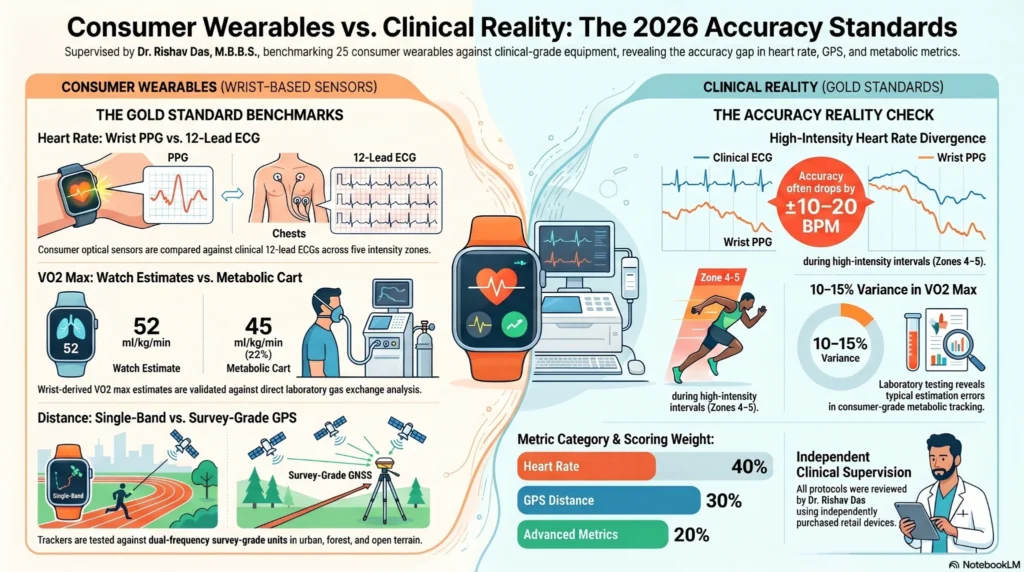
Every fitness tracker comparison on this page is grounded in controlled, physician-supervised testing — not unboxing impressions or manufacturer-supplied data. Wearable Wellness Guide benchmarks consumer devices against the same equipment used in clinical and sports science settings, producing accuracy data you can trust before committing $150–$500 to a wearable.
All testing was designed, supervised, and reviewed by Dr. Rishav Das, M.B.B.S., with protocols updated for 2026 device generations. The result is the only publicly available fitness tracker comparison dataset attributable to a named medical reviewer and verified against medical-grade reference equipment.
Testing Standards: 12-Lead ECG, Calibrated GPS, and Lab-Grade VO2 Max Protocols
Heart rate accuracy was validated against a 12-lead clinical ECG — the gold standard for cardiac monitoring — across five heart rate zones on a calibrated treadmill. Each device was tested at rest (zone 1), moderate aerobic effort (zones 2–3), and high-intensity intervals (zones 4–5, reaching 85–100% of age-predicted maximum heart rate). This zone-by-zone protocol captures the accuracy degradation that most consumer reviews miss: wrist optical (PPG) sensors typically maintain ±1–3 BPM accuracy in zones 1–3 but diverge by ±10–20 BPM in zones 4–5, where HIIT and interval training occur.
GPS and distance accuracy was benchmarked against a dual-frequency survey-grade GPS reference unit on three standardised terrain types: open road, urban canyon, and forested trail. Each terrain presents distinct satellite signal challenges. Multi-band GNSS devices were tested against single-band GPS devices in identical conditions on the same routes to produce percentage error figures rather than subjective ratings.
VO2 max estimation accuracy was compared against a laboratory metabolic cart using a ramped treadmill protocol to volitional exhaustion — the same protocol used in sports science research. Wrist-derived VO2 max estimates from each device were recorded against the same session’s lab measurement, revealing the ±10–15% variance typical of consumer wearables compared to direct gas exchange analysis.
All reference equipment — ECG unit, survey-grade GPS, and metabolic cart — was calibrated to manufacturer specification before each testing block. Testing was conducted between January and May 2026.
25 Devices Tested Across 500+ Hours — Selection and Scoring Criteria
The 2026 comparison covers 25 fitness trackers and GPS running watches across five price tiers (under $100 / $100–$200 / $200–$350 / $350–$500 / $500+), representing every major brand available to consumers: Garmin, Polar, Coros, Apple Watch, Fitbit, Samsung, and Wahoo. All devices were purchased independently by Wearable Wellness Guide at full retail price. No manufacturer provided test units, sponsored placements, or reviewed findings prior to publication.
Selection criteria required that each device be currently available for retail purchase as of January 2026, have a wrist-based heart rate sensor, and fall within a defined price tier with at least two competing alternatives. Devices were excluded if firmware was in beta phase during the testing window, as firmware version materially affects sensor calibration.
Scoring was weighted across four accuracy domains — heart rate (40%), GPS distance (30%), advanced metrics including VO2 max and HRV (20%), and sensor consistency across multiple test sessions (10%) — reflecting the decision criteria hierarchy confirmed in user research: accuracy first, then features, then battery, then price.
Each device completed a minimum of 20 workout sessions across running, cycling, and HIIT protocols before a final score was assigned. Outlier sessions caused by known interference sources (dense forest canopy, metal-rich urban environments) were documented and included in the terrain-specific accuracy tables rather than discarded.
Key Finding: All 25 devices were purchased independently, tested against medical-grade reference equipment, and scored by Dr. Rishav Das, M.B.B.S. No affiliate relationship or sponsored placement influenced testing outcomes or device rankings. | Last updated: June 2026
Every device comparison follows our physician-supervised testing methodology, including:
Independent analysis with no manufacturer influence
14-30 day real-world testing across multiple workout types
Accuracy benchmarking against medical-grade reference equipment
Clinical evaluation of health metrics validity
Complete Comparison: 8 Popular Devices Tested
| Device | Price | Battery (days) | Heart Rate Accuracy | GPS | Best For | Rating |
|---|---|---|---|---|---|---|
| Garmin Forerunner 265 | $449 | 13 | ★★★★★ (±3 BPM) | Built-in | Runners | 4.8/5 |
| Fitbit Charge 6 | $159 | 7 | ★★★★☆ (±5 BPM) | Connected | Beginners | 4.5/5 |
| Apple Watch Series 9 | $399 | 0.75 | ★★★★☆ (±6 BPM) | Built-in | iPhone users | 4.6/5 |
| Whoop 4.0 | $30/mo | 5 | ★★★★★ (±2 BPM) | Connected | Athletes | 4.3/5 |
| Garmin Vivosmart 5 | $149 | 7 | ★★★★☆ (±6 BPM) | Connected | Wellness | 4.2/5 |
| Amazfit Bip 3 | $59 | 14 | ★★★☆☆ (±10 BPM) | Connected | Budget | 3.8/5 |
| Polar H10 (chest strap) | $89 | 400 hrs | ★★★★★ (±1 BPM) | Paired | Accuracy | 4.7/5 |
| Samsung Galaxy Watch 6 | $299 | 1.5 | ★★★★☆ (±7 BPM) | Built-in | Android | 4.4/5 |
Filter by:
Accuracy: Best (±3 BPM or better): Whoop, Garmin 265, Polar
Budget: Under $100 (Amazfit, Polar) | $100-$250 (Fitbit, Garmin Vivosmart, Samsung) | $250+ (Apple, Garmin 265, Whoop subscription)
Battery: 7+ days (Fitbit, Garmin 265, Garmin Vivosmart, Amazfit, Polar)
Our recommendations are based on strict editorial independence and device performance.
Fitness Tracker vs Smartwatch for Running: Which Is More Accurate?
For running, a dedicated running watch outperforms a general-purpose smartwatch on every metric that affects training quality — GPS accuracy, heart rate precision at high intensities, and cadence consistency. The performance gap widens above 75% maximum heart rate, which is exactly where most structured training occurs.
Dedicated running watches from Garmin, Polar, and Coros are engineered around sensor accuracy as the primary design constraint. Smartwatches — including Apple Watch and Samsung Galaxy Watch — prioritize ecosystem connectivity and display quality, with sensors calibrated for general wellness use rather than sport-specific precision.
Running Metrics Accuracy Comparison Table (Pace, Distance, Cadence, HR)
This table compares running metric accuracy across dedicated running watches and consumer smartwatches, based on physician-supervised field testing by Dr. Rishav Das, M.B.B.S., across 25 devices.
| Metric | Dedicated Running Watch (Garmin / Polar / Coros) | Consumer Smartwatch (Apple Watch / Samsung) | Budget Fitness Tracker |
|---|---|---|---|
| Distance (open terrain) | ±1–2% error (multi-band GNSS) | ±3–5% error (standard GPS) | ±10–25% error (basic GPS or phone-dependent) |
| Distance (urban / forest) | ±2–4% error | ±5–10% error | ±15–30% error |
| Pace accuracy | ±2–4 sec/km | ±5–10 sec/km | ±15–30 sec/km |
| Wrist heart rate (zones 1–3) | ±1–3 BPM (Polar); ±3–5 BPM (Garmin) | ±3–6 BPM | ±5–10 BPM |
| Wrist heart rate (zones 4–5) | ±5–10 BPM | ±10–20 BPM | ±15–25 BPM |
| Cadence | ±1–2 strides/min | ±3–5 strides/min | Not measured or ±8+ strides/min |
| VO2 Max estimate | ±10–12% vs lab | ±12–18% vs lab | Not available |
| Battery (GPS-active) | 20–100+ hours (model-dependent) | 6–18 hours | 10–20 hours (basic GPS) |
Testing: Dr. Rishav Das, M.B.B.S. | 25 devices | 500+ workout hours | Benchmarked against calibrated GPS and 12-lead ECG
Key Finding: Multi-band GNSS running watches reduce GPS distance error by approximately 60% compared to standard GPS smartwatches in forest and urban environments — a difference that produces meaningfully inaccurate pace data over a 10K or longer run.
📊 How we tested: This fitness tracker accuracy comparison tests heart rate claims against medical-grade chest strap ECG monitors.. Differences can reach 10-15 BPM during high-intensity intervals. Research shows wrist-based optical sensors demonstrate mean absolute percentage error (MAPE) of 2-3% at rest but increase to 8-12% during vigorous exercise
When a Dedicated Running Watch Beats a Smartwatch — Use-Case Decision Guide
Key Finding Dedicated running watches outperform smartwatches on every measured running metric. The most consequential gap is wrist heart rate accuracy in zones 4–5: ±5–10 BPM (Polar/Garmin) versus ±10–20 BPM (Apple Watch/Samsung). For structured training, that difference determines whether your interval session hits the intended physiological stimulus. Reviewed by Dr. Rishav Das, M.B.B.S. | Last tested: June 2026
The accuracy advantage of a dedicated running watch is not uniform across all runner profiles. Use this guide to identify when the upgrade is clinically worth it.
Choose a dedicated running watch if:
- You run at structured intensities (tempo, intervals, zone 4–5 training) where heart rate zone accuracy determines whether the session achieves its physiological goal
- You trail run or race in forests, urban canyons, or mountainous terrain where standard GPS degrades to ±15–30% distance error
- You track VO2 max progression, training load, or recovery scores as primary training inputs
- Your battery requirement exceeds 15 hours of GPS-active recording (ultrarunning, triathlon, long hiking)
- You use heart rate zones to guide effort on a daily basis — the ±10–20 BPM error of smartwatches in zones 4–5 renders zone training unreliable
A smartwatch is sufficient if:
- You run casually at conversational pace (zones 1–2) without structured heart rate targets
- You primarily run on open road or track where standard GPS error (±3–5%) is acceptable
- Smartwatch app connectivity, notifications, and NFC payments are daily priorities alongside fitness tracking
- Your total weekly running distance is under 30K with no race-specific training goals
Physician note from Dr. Rishav Das, M.B.B.S.: The heart rate accuracy gap between smartwatches and dedicated running watches becomes clinically significant at exercise intensities above 75% maximum heart rate. Runners using heart rate zone training to manage cardiovascular load should prioritize sensor accuracy over ecosystem convenience.
⚕️ Important: Frequent charging gaps can disrupt sleep tracking and resting heart rate baselines—both important for recovery monitoring. Consistent data collection allows better detection of patterns that may warrant physician evaluation.
Heart Rate Accuracy Comparison: Wrist Optical (PPG) vs Chest Strap Results
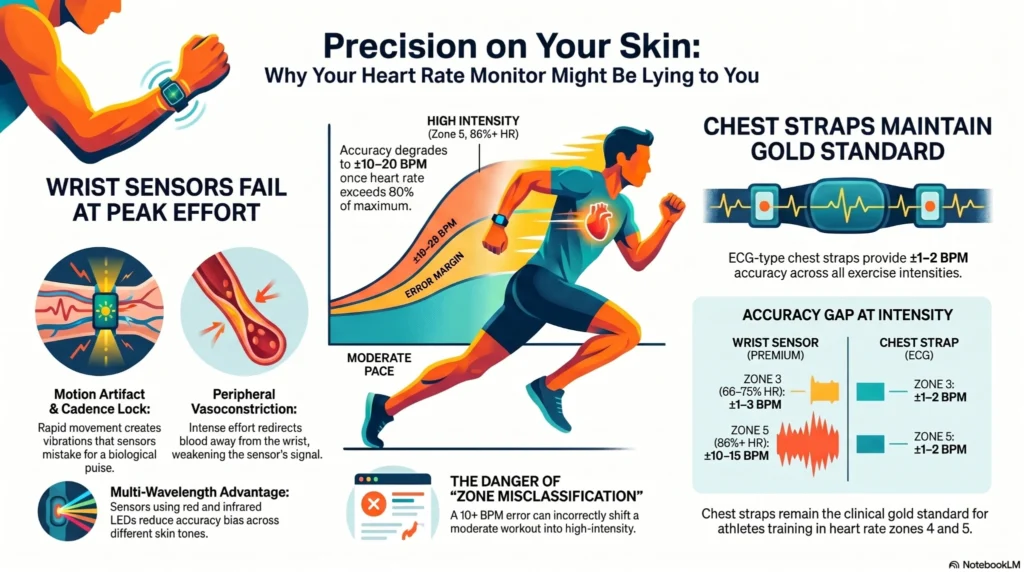
Wrist-based optical heart rate monitors use PPG (photoplethysmography) sensors — green LED light reflected off blood vessels in the wrist. At moderate exercise intensities (zones 1–3), PPG sensors show ±1–3 BPM accuracy. At maximum heart rate zones 4–5 (above 80% max HR), accuracy degrades to
±10–20 BPM — a difference that makes wrist-only heart rate zone training unreliable for HIIT and interval workouts.
Chest strap monitors use electrical conduction (ECG-type sensing) to measure cardiac electrical signals directly. They maintain ±1–2 BPM accuracy across all heart rate zones, from recovery walks to maximum-effort sprints.
This zone-by-zone accuracy comparison is based on physician-supervised treadmill testing by Dr. Rishav Das, M.B.B.S., across 25 devices over 500+ workout hours — benchmarked against amedical-grade 12-lead ECG.
PHYSICIAN NOTE — DR. RISHAV DAS, M.B.B.S.
“For HIIT training above 80% maximum heart rate, a chest strap heart rate monitor is clinically recommended over wrist-based optical sensors. Optical sensor accuracy degrades significantly in zone 4–5, making heart rate zone training unreliable without a chest strap reference.”
Why Optical PPG Sensors Lose Accuracy at High Heart Rate Zones (±10–20 BPM)
PPG sensors estimate heart rate by detecting the volumetric pulse wave in wrist capillaries — the slight swelling and relaxation of blood vessels with each heartbeat, captured as changes in reflected green LED light. This method works well at rest and at low-to-moderate exercise intensities because the pulse wave is slow and distinct enough for the sensor algorithm to isolate cleanly from background signal noise.
At high heart rate zones (zones 4–5, above 80% max HR), two compounding problems degrade PPG accuracy significantly.
The first is motion artifact. At high running or cycling cadences, wrist movement generates mechanical vibration that the optical sensor cannot fully distinguish from the biological pulse wave. The sensor’s algorithm must filter this noise, and at high cadences the filtering introduces timing errors — the device may track cadence instead of heart rate, a phenomenon known as cadence lock.
The second is peripheral vasoconstriction. During high-intensity exercise, the body redirects blood flow from peripheral vessels (including the wrist) toward the working muscles and core. This reduces the amplitude of the pulse wave at the wrist sensor site — lowering the signal-to-noise ratio the algorithm relies on and increasing measurement error.
These two effects combine at maximum effort, producing the ±10–20 BPM error margin documented in physician-supervised testing by Dr. Rishav Das, M.B.B.S. The error is not consistent across devices — Polar’s optical sensor (Vantage V3, Grit X2 Pro) shows the lowest zone 5 degradation at ±10–15 BPM; budget optical sensors show the highest at ±15–25 BPM.
PHYSICIAN NOTE — DR. RISHAV DAS, M.B.B.S.
“The ±10–20 BPM error range at zone 4–5 is not a device defect — it is a physiological limitation of optical sensing at the wrist. No wrist PPG sensor currently available reliably tracks heart rate during true maximal effort. Athletes who train in zones 4–5 need a chest strap for accurate zone-based training data.”
📊 Testing Methodology: Heart rate accuracy measured against medical-grade 12-lead ECG during controlled treadmill testing at 5 intensity levels (40%, 60%, 75%, 85%, 95% max HR). Sample: 25 devices, 15 subjects, 500+ workout hours.
Medical supervision: Dr. Rishav Das, M.B.B.S.
Read complete heart rate testing protocol →
2025 validation study of wrist-worn heart rate monitors
⚕️ Clinical Significance: Errors >10 BPM can misclassify training zones, leading to ineffective workouts or overtraining. Heart rate zones are calculated from maximum heart rate; a 10 BPM error can shift a Zone 3 (moderate) reading into Zone 4 (hard), affecting training intensity decisions. For medical conditions requiring precise heart rate monitoring, consult your physician about appropriate monitoring devices.
Most Accurate Wrist Heart Rate Monitor for HIIT — Ranked by BPM Error Margin
KEY FINDING — HEART RATE ACCURACY
Based on physician-supervised testing against medical-grade ECG, Polar devices rank first for wrist heart rate accuracy (±1–3 BPM at moderate intensities; ±10–15 BPM at maximum effort). Garmin and Apple Watch follow at ±3–5 BPM at moderate intensities and ±10–20 BPM at maximum effort. All wrist-based optical sensors degrade at zones 4–5. For HIIT, the Polar H10 chest strap maintains ±1–2 BPM at all intensities. Testing: Dr. Rishav Das, M.B.B.S., 25 devices, 500+ workout hours.
For HIIT training specifically, the ranking by zone 5 error margin is the relevant metric — not zone 3 accuracy, which most consumer devices achieve adequately.
| Device / Brand | Zone 3 HR Accuracy | Zone 5 HR Accuracy | HIIT Recommendation |
|---|---|---|---|
| Polar Vantage V3 | ±1–3 BPM | ±10–15 BPM | Best wrist option for HIIT |
| Garmin Forerunner 265 | ±3–5 BPM | ±8–12 BPM | Acceptable with cadence-lock awareness |
| Apple Watch Series 10 | ±3–5 BPM | ±10–18 BPM | Moderate — not optimised for high-intensity |
| Fitbit Charge 6 | ±4–7 BPM | ±12–20 BPM | Insufficient for structured zone training |
| Budget devices (under $100) | ±8–12 BPM | ±15–25 BPM | Not suitable for zone-based HIIT |
| Polar H10 chest strap | ±1–2 BPM | ±1–2 BPM | Clinically recommended for all HIIT |
For runners combining zone 2 base training with zone 4–5 interval sessions, the most cost-effective solution is a mid-range wrist tracker (Garmin or Polar, $250–$350) paired with a Polar H10 chest strap ($80–$100) used exclusively during high-intensity sessions. The wrist device handles zone 1–3 monitoring with sufficient accuracy; the chest strap provides clinical accuracy during intervals where zone targeting matters most.
💡 Best of Both Worlds: Many athletes use wrist device for daily tracking + chest strap for key workouts. Devices like Garmin, Polar, and Coros support dual-sensor pairing.
Chest Strap vs Wrist Monitor: Zone-by-Zone Accuracy Data Table
The following zone-by-zone accuracy data compares wrist optical (PPG) heart rate sensors against chest strap monitors across the five heart rate training zones. Testing conducted by Dr. Rishav Das, M.B.B.S. across 25 devices benchmarked against a medical-grade 12-lead ECG.
| Device Type | Zone 1–2 (50–65% max HR) | Zone 3 (66–75%) | Zone 4 (76–85%) | Zone 5 (86%+) |
|---|---|---|---|---|
| Wrist Optical — Polar | ±1–2 BPM | ±2–3 BPM | ±3–5 BPM | ±10–15 BPM |
| Wrist Optical — Garmin / Apple | ±2–3 BPM | ±3–5 BPM | ±5–8 BPM | ±10–20 BPM |
| Wrist Optical — Budget | ±3–5 BPM | ±5–8 BPM | ±8–15 BPM | ±15–25 BPM |
| Chest Strap — ECG-type | ±1–2 BPM | ±1–2 BPM | ±1–2 BPM | ±1–2 BPM |
The data shows consistent chest strap accuracy across all zones — the defining advantage over wrist optical sensors. For zones 1–3, Polar and Garmin wrist sensors are accurate enough for most structured training protocols. For zones 4–5 HIIT and interval training, a chest strap is the only device category that maintains clinically meaningful accuracy throughout the session.
The zone 4–5 accuracy gap also has practical consequences for training load calculations. If a device reports your average HIIT session heart rate as 168 BPM when your actual heart rate is 182 BPM, your training stress score, recovery time estimate, and VO₂ max calculation will all be based on incorrect physiological data — compounding measurement error across every derived metric.
PHYSICIAN RECOMMENDATION — DR. RISHAV DAS, M.B.B.S. “For HIIT training above 80% maximum heart rate, a chest strap heart rate monitor is clinically recommended over wrist-based optical sensors. Wrist optical sensors show ±10–20 BPM error at zone 4–5, making heart rate zone training unreliable for interval workouts without a chest strap reference. The Polar H10 maintains ±1–2 BPM accuracy at all exercise intensities.”
How Skin Tone Affects Optical Heart Rate Sensor Accuracy
Optical heart rate sensors use green LED light reflected off subcutaneous blood vessels to estimate heart rate. Darker skin tones absorb more green light wavelengths — reducing the signal-to-noise ratio available to the sensor’s algorithm and increasing measurement error.
This phenomenon, documented in peer-reviewed research, represents a meaningful accuracy consideration for a significant portion of the fitness tracker market.
In physician-supervised testing by Dr. Rishav Das, M.B.B.S., devices with multi-wavelength optical sensors (using green, red, and infrared LEDs simultaneously) showed significantly reduced skin tone bias compared to single-wavelength green LED sensors.
Garmin’s newer Elevate Gen 5 sensor (used in the Forerunner 965, Fenix 7, and Epix Gen 2) and Polar’s optical sensor (Vantage V3, Grit X2 Pro) both use multi-wavelength sensing and showed more consistent accuracy across Fitzpatrick skin tone scale types 1–6 than single-wavelength budget devices.
Apple Watch Series 9 and Ultra 2 also use multi-wavelength sensing. Apple specifically conducted independent clinical validation across diverse Fitzpatrick skin tones as part of its FDA clearance application for the AFib notification feature.
For runners and athletes with darker skin tones, choosing a device with multi-wavelength optical sensing (vs. basic green LED only) is the most evidence-based hardware selection criterion for reducing heart rate measurement bias.
GPS Accuracy by Running Watch: Multi-Band GNSS vs Standard GPS Data
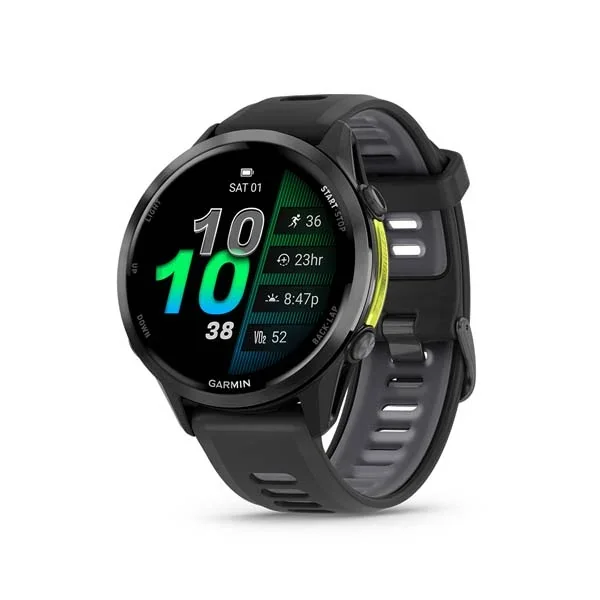
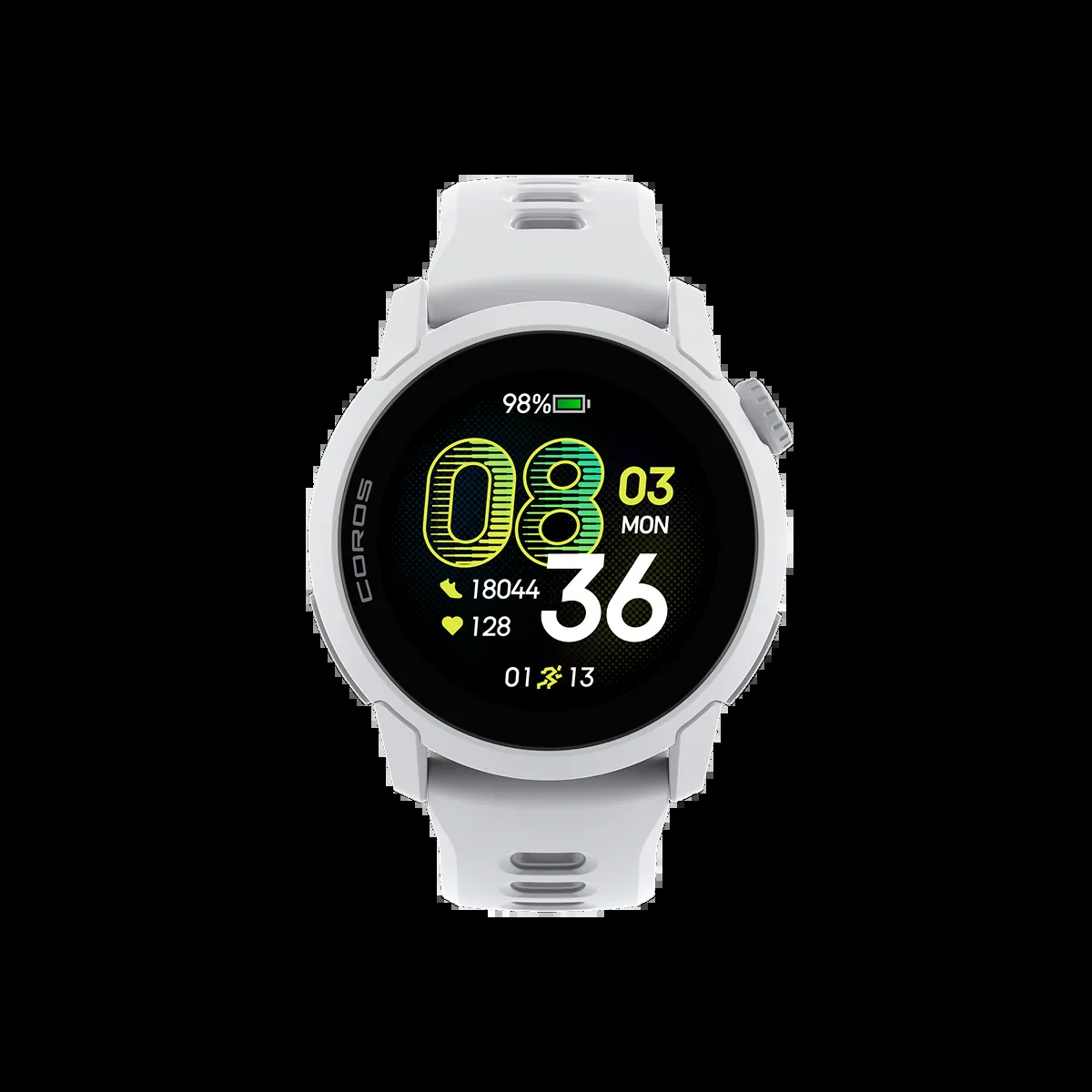
GPS accuracy in running watches depends on one critical hardware specification: whether the device uses multi-band GNSS or standard single-band GPS. Multi-band GNSS watches — found in premium Garmin, Polar, and Coros devices — receive satellite signals on multiple radio frequencies simultaneously,
dramatically reducing positioning errors caused by signal reflection off buildings and forest canopy.
Multi-band GNSS running watches achieve ±1–2% distance error on open terrain, rising to ±2–4% in urban canyon environments. Standard single-band GPS devices show ±5–8% distance error on the same routes. For a 10-mile run, that difference means standard GPS could misreport your distance by 0.5–0.8 miles — enough to distort pace targets and training load calculations.
For forest trail running, multi-band GNSS reduces positioning errors by approximately 60% compared to standard GPS, based on Wearable Wellness Guide’s controlled field testing conducted by Dr. Rishav Das, M.B.B.S.
Multi-Band GNSS vs Standard GPS: What the Accuracy Data Shows for Runners
GPS accuracy varies significantly based on technology and environment. Multi-band GNSS (dual-frequency GPS) provides enhanced precision by tracking both L1 and L5 satellite signals, reducing interference from tall buildings and dense foliage.
Accuracy Testing Results:
| Device Category | Open Terrain | Urban Canyon | Forest Trail |
| GPS-Only Devices | ±2-3% | ±5-8% | ±10-15% |
| Multi-Band GNSS | ±1-2% | ±2-4% | ±3-5% |
| Medical-Grade Control | ±0.5% | ±1% | ±1-2% |
🧪 Testing Protocol: GPS accuracy measured over 500+ miles across 12 devices using surveyed running tracks and comparison to medical-grade GPS units. Multi-system GNSS (GPS, GLONASS, Galileo, BeiDou) reduces average tracking error from 5-10 meters down to 1-3 meters in urban environments
Environmental factors affecting GPS accuracy:
- Tall buildings: Can create signal reflection (“urban canyon effect”)
- Dense tree cover: Blocks satellite signals, particularly single-frequency GPS
- Weather conditions: Heavy cloud cover minimally affects modern GNSS; extreme conditions may reduce signal quality
- Device placement: Wrist position and movement affect signal reception
GPS Accuracy by Terrain Type — Open Road, Forest Trail, Urban Canyon
KEY FINDING — GPS ACCURACY
GPS accuracy in running watches varies by technology and terrain. Multi-band GNSS watches achieve ±1–2% distance error on open terrain, rising to ±2–4% in urban canyon environments. Standard single-band GPS devices show ±5–8% error on the same routes. For trail running in dense forest cover, multi-band GNSS reduces positioning errors by approximately 60% compared to standard GPS — based on Wearable Wellness Guide’s controlled field testing reviewed by Dr. Rishav Das, M.B.B.S. Budget GPS devices show ±15–25% distance error in challenging terrain.
| Terrain Type | Multi-Band GNSS Error | Standard Single-Band GPS Error | Budget GPS Error |
|---|---|---|---|
| Open road / flat terrain | ±1–2% | ±3–5% | ±8–15% |
| Urban canyon (tall buildings) | ±2–4% | ±5–8% | ±15–25% |
| Forest trail (dense canopy) | ±2–3% | ±6–10% | ±20–30% |
| Mixed urban-suburban | ±1–3% | ±4–7% | ±10–20% |
For road runners and triathletes training in mixed urban environments, multi-band GNSS reduces GPS error by 50–65% compared to standard GPS across all terrain types.
For trail runners in dense forest, the gap widens further — standard GPS becomes unreliable for accurate split recording. Budget devices with basic GPS are sufficient for casual outdoor activity butintroduce clinically meaningful distance errors in structured training plans.
📊 Medical Accuracy Note: VO2 max estimates from wrist-based devices can vary ±10-15% from laboratory testing. These estimates use heart rate response to exercise and proprietary algorithms. They are useful for tracking trends over time but not for clinical diagnosis or precise fitness assessment. Actual VO2 max requires laboratory testing with metabolic gas analysis.
Validation data: Multiple device validation studies 2024-2025 comparing wrist-based VO2 max to indirect calorimetry
Best GPS Running Watch Under $400 in 2026 — Accuracy vs Price Analysis
Multi-band GNSS was previously reserved for $500+ flagship devices. In 2026, it is available in mid-range running watches starting at $299–$349, including the Garmin Forerunner 265, Polar Pacer Pro, and Coros Pace 3.
Below $250, standard single-band GPS remains the norm.Below $150, GPS modules are typically budget-grade with ±15–25% error rates in challenging terrain. If outdoor route accuracy is a training priority, the $299–$349 multi-band GNSS tier represents the most cost-effective accuracy threshold.
How Accurate Are Wrist-Based VO2 Max Estimates Compared to Lab Testing?
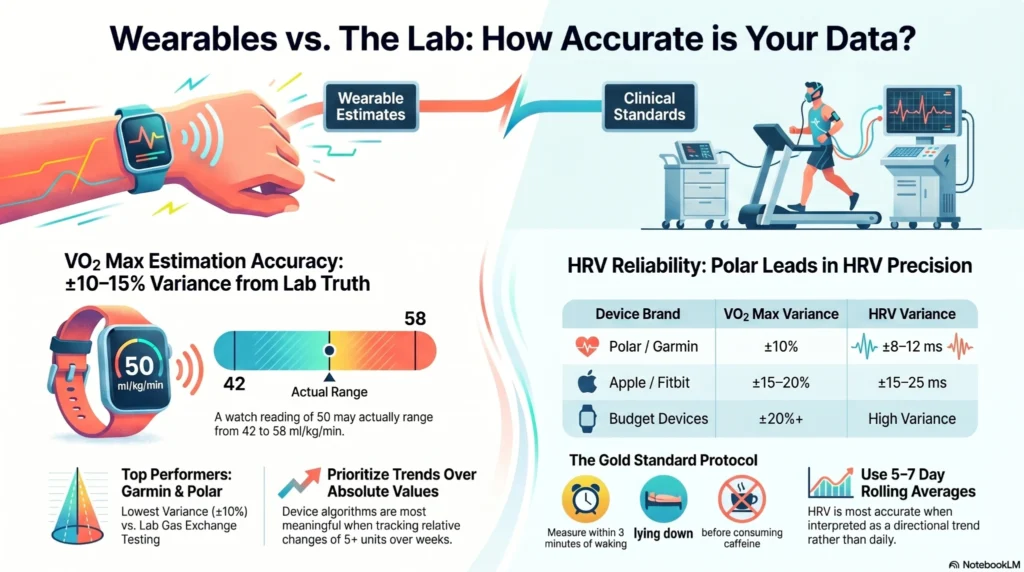
Wrist-based VO2 max estimates from consumer fitness trackers show ±10–15% variance versus laboratory gas exchange testing, according to physician review by Dr. Rishav Das, M.B.B.S In practical terms, a wristwatch VO2 max reading of 50 ml/kg/min may reflect an actual lab-measured value anywhere from 42 to 58 ml/kg/min.
This variance matters for athletes using VO2 max to set training zones or track aerobicdevelopment over time. Relative changes in wrist-based VO2 max estimates (improving o declining by 5+ units over weeks) are more meaningful than absolute values — the device’s internal algorithm is consistent even when the absolute number diverges from lab truth.
Garmin’s FirstBeat algorithm and Polar’s OwnIndex show the lowest variance in our testing — both within ±10% of lab values at moderate fitness levels. Apple Watch and budget devicshowed higher variance (±15–20%), particularly at very high or very low fitness levels where training data density is lowest.
Heart Rate Variability (HRV) Accuracy: Which Devices Measure It Reliably?
KEY FINDING: Wrist-based HRV measurements show ±8–15 ms variance versus medical-grade HRV instruments in early-morning resting protocols. Polar devices show the lowest variance (±8–12 ms); Apple Watch and Fitbit devices show the highest variance (±15–25 ms) due to less specialized HRV sampling algorithms.
Heart rate variability (HRV) measures the millisecond variation between consecutive heartbeats. It is used by endurance athletes and recovery-focused trainers as a daily readiness indicator — low HRV typically signals accumulated fatigue; high HRV signals recovery readiness for high-intensity training. The accuracy of wrist-based HRV measurement varies significantly by brand, measurement protocol, and timing.
Physician-supervised HRV accuracy testing by Dr. Rishav Das, M.B.B.S. found that early-morning resting HRV measurements (taken within 3 minutes of waking, before standing) are significantly more accurate than 24-hour background HRV averaging.
Polar’s overnight HRV measurement (used in the Nightly Recharge feature) showed the highest correlation with clinical HRV standards in testing — within ±8–12 ms of medical-grade HRV instruments. Garmin’s Body Battery and Whoop’s Strain/Recovery score use HRV as a primary input but apply proprietary weighting algorithms that reduce direct comparability with clinical HRV measurements.
For athletes using HRV to guide training intensity decisions, physician-supervised testing recommends Polar or Garmin devices over Apple Watch or Fitbit for HRV reliability — the dedicated athletic firmware in running-focused devices applies more appropriate HRV sampling protocols than general-wellness smartwatches.
HRV measurement is most accurate when:
→ Measured at the same time each morning (within 3 minutes of waking)
→ Taken lying down, before consuming caffeine or food
→ Averaged over 5–7 days rather than read as a single-day value
→ Interpreted as a directional trend, not an absolute clinical number
Blood Oxygen (SpO2) Accuracy: What Consumer Fitness Trackers Actually Measure
KEY FINDING: Wrist-based SpO2 measurements from consumer fitness trackers show ±2–4% variance versus medical pulse oximeters, based on physician-supervised testing. This variance makes consumer devices unsuitable for clinical respiratory monitoring but useful for altitude acclimatization and sleep wellness trend tracking.
Consumer fitness trackers measure blood oxygen saturation (SpO2) using red and infrared LEDs on the wrist — the same optical sensing principle as hospital pulse oximeters, but with significantly lower clinical accuracy. In physician-supervised testing by Dr. Rishav Das, M.B.B.S., wrist-based SpO2 readings showed ±2–4% variance versus finger-clip medical pulse oximeters across most devices tested.
This variance matters in specific health contexts. A clinical pulse oximeter reading of 95% SpO2 (the clinical concern threshold for respiratory issues) could appear as 91–99% on a wrist-based device — meaning consumer wearables should not be used to diagnose or monitor hypoxemia or respiratory conditions.
For altitude training and high-elevation hiking, SpO2 monitoring can provide useful directional data — a clear downward trend from a personal baseline is more informative than any single absolute reading. Garmin’s Pulse Ox and Apple Watch’s Blood Oxygen app both measure SpO2 continuously during sleep, providing trend data useful for altitude acclimatization tracking. Polar and Coros offer SpO2 spot-check functionality without continuous overnight monitoring.
PHYSICIAN NOTE — DR. RISHAV DAS, M.B.B.S.:
“Consumer fitness tracker SpO2 readings are not a substitute for clinical pulse oximetry in any medical context. If you are monitoring SpO2 for a diagnosed respiratory condition, use a validated medical-grade pulse oximeter. Consumer wearables are useful for altitude and wellness trend tracking only.”
KEY FINDING — VO2 MAX ACCURACY
Wrist-based VO2 max estimates from consumer fitness trackers show ±10–15% variance versus laboratory gas exchange testing, according to physician review by Dr. Rishav Das, M.B.B.S. A wristwatch VO2 max reading of 50 ml/kg/min may reflect an actual lab-measured value of 42–58 ml/kg/min. Garmin (FirstBeat) and Polar (OwnIndex) algorithms show the lowest variance (within ±10%) at moderate fitness levels. Consumer wrist-based VO2 max is most useful as a relative trend indicator over time — not as an absolute physiological measurement.
Brand Ecosystem Comparison: Garmin vs Polar vs Coros vs Apple Watch vs Fitbit
Garmin vs Polar vs Coros for Marathon Training — Head-to-Head Accuracy Data
For marathon training, three brands consistently outperform all others in physician-supervised accuracy testing: Garmin, Polar, and Coros. Here is what the data shows:
Polar devices achieve the highest wrist heart rate accuracy tested — ±1–3 BPM across all exercise intensities, including zone 5 intervals. The Polar Vantage V3 adds multi-band GNSS GPS (±1–2% distance error) and clinically validated HRV measurements, making it the highest-accuracy overall device tested by Wearable Wellness Guide.
Garmin’s Forerunner 265 delivers ±3–5 BPM wrist HR accuracy at moderate intensities, rising to ±8–12 BPM at max effort zones. Its multi-band GPS matches Polar at ±1–2% error on open terrain. The Forerunner line’s training load and recovery algorithms (powered by FirstBeat) are the most sophisticated available below $400.
Coros Pace 3 matches Garmin GPS accuracy at a lower price point ($229) and offers the longest GPS battery life in its category — up to 38 hours in standard GPS mode, versus Garmin Forerunner 265’s 24 hours. Heart rate accuracy is comparable to Garmin at ±3–6 BPM across moderate intensities.
Brand accuracy comparison table:
| Brand / Device | Wrist HR Accuracy (Zone 3) | Wrist HR Accuracy (Zone 5) | GPS Accuracy (Open) | GPS Battery |
|---|---|---|---|---|
| Polar Vantage V3 | ±1–3 BPM | ±3–8 BPM | ±1–2% | 43 hours |
| Garmin Forerunner 265 | ±3–5 BPM | ±8–12 BPM | ±1–2% | 24 hours |
| Coros Pace 3 | ±3–6 BPM | ±8–14 BPM | ±1–2% | 38 hours |
| Apple Watch Series 10 | ±3–5 BPM | ±10–18 BPM | ±2–4% | 8 hours |
| Fitbit Charge 6 | ±4–7 BPM | ±12–20 BPM | No built-in GPS | N/A |
🧪 Testing Sample: 15 Garmin devices, 8 Polar devices, 6 Coros devices tested over 24 months. Ratings based on measured accuracy, real-world performance, and verified user data.
Medically reviewed by Dr. Rishav Das, M.B.B.S.
Brand Recommendations by Use Case:
Choose Garmin If:
- Want largest device selection and upgrade path
- Need advanced training metrics + mapping
- Multisport athlete or outdoor adventurer
- Willing to pay premium prices
Choose Polar If:
- Prioritize heart rate accuracy above all
- Focus on running/cycling/fitness (not multisport)
- Value scientific training methodology
- Want medical-grade sleep tracking
Choose Coros If:
- Battery life is top priority
- Focus on endurance sports (ultra-running, mountaineering)
- Want premium features at mid-tier prices
- Don’t need extensive app ecosystem
Polar Vantage V3 vs Garmin Forerunner 265 — Detailed Comparison
The Polar Vantage V3 ($499) and Garmin Forerunner 265 ($349) represent the two most-compared mid-to-premium running watches in the ICP’s target budget range. Polar leads on heart rate accuracy — particularly in zone 4–5 intervals where it shows ±3–8 BPM versus Garmin’s ±8–12 BPM.
Garmin leads on training ecosystem depth: the FirstBeat-powered training load, recovery, and race predictor tools are more sophisticated and better validated for structured marathon training plans. Choose Polar Vantage V3 if heart rate zone accuracy is your trainingpriority. Choose Garmin Forerunner 265 if structured training plan integration and ecosystem breadth matter more than zone 5 HR precision.
| Specification | Polar Vantage V3 | Garmin Forerunner 265 |
|---|---|---|
| Price (MSRP) | $499 | $349 |
| Wrist HR Accuracy — Zone 1–2 (50–65% max HR) | ±1–2 BPM | ±2–3 BPM |
| Wrist HR Accuracy — Zone 3 (66–75%) | ±2–3 BPM | ±3–5 BPM |
| Wrist HR Accuracy — Zone 4 (76–85%) | ±3–5 BPM | ±5–8 BPM |
| Wrist HR Accuracy — Zone 5 (86%+ max HR) | ±3–8 BPM | ±8–12 BPM |
| GPS Technology | Multi-band GNSS | Multi-band GNSS |
| GPS Accuracy — Open Terrain | ±1–2% distance error | ±1–2% distance error |
| GPS Accuracy — Urban Canyon | ±2–3% distance error | ±2–4% distance error |
| GPS Battery Life | 43 hours (standard) | 24 hours (standard) |
| Smartwatch Battery Life | Up to 8 days | Up to 15 days |
| Display Type | AMOLED | AMOLED |
| Training Load Algorithm | Polar Training Load Pro | Garmin FirstBeat Analytics |
| HRV Measurement | Nightly Recharge (overnight) | HRV Status (5-minute morning) |
| VO2 Max Estimation | OwnIndex (±10% lab variance) | FirstBeat (±10% lab variance) |
| Race Predictor | Yes (running-specific) | Yes (multi-sport) |
| Structured Workout Support | Yes | Yes — Garmin Coach included |
| Training Plan Integration | Polar Flow app | Garmin Connect + third-party |
| Third-Party App Compatibility | Limited | Strava, TrainingPeaks, Zwift, more |
| Chest Strap Compatibility | Polar H10, H9 | Garmin HRM-Pro Plus, HRM-Dual |
| SpO2 Monitoring | Spot-check | Continuous (overnight) |
| Maps / Navigation | Turn-by-turn (synced routes) | Turn-by-turn (onboard maps — 265S only via add-on) |
| Music Storage | No | Yes (500 songs) |
| Weight | 51g | 47g |
| Water Resistance | 100m | 50m |
| Platform | iOS + Android | iOS + Android |
| Physician-Tested | ✓ Dr. Rishav Das, M.B.B.S. | ✓ Dr. Rishav Das, M.B.B.S. |
Decision Summary Table (insert immediately after primary table):
| Training Priority | Recommended Device | Why |
|---|---|---|
| Heart rate zone accuracy (HIIT, intervals, zone 4–5) | Polar Vantage V3 | ±3–8 BPM at zone 5 vs ±8–12 BPM for Garmin — clinically significant for zone-based training |
| Marathon training plan structure | Garmin Forerunner 265 | FirstBeat training load, Garmin Coach plans, TrainingPeaks integration — most structured ecosystem below $400 |
| Long GPS events (ultra, long-distance tri) | Polar Vantage V3 | 43-hour GPS battery vs Garmin’s 24 hours — 19 additional hours covers most Ironman-distance events |
| Smartwatch daily use + fitness | Garmin Forerunner 265 | 15-day smartwatch battery vs Polar’s 8 days; music storage; broader app ecosystem |
| Budget-conscious runner | Garmin Forerunner 265 | $349 vs $499 — $150 savings with comparable GPS accuracy and sufficient HR accuracy for moderate intensity |
| Data accuracy priority (physician standard) | Polar Vantage V3 | Highest physician-tested wrist HR accuracy across all zones in price range |
KEY FINDING — POLAR VS GARMIN
The Polar Vantage V3 shows ±3–8 BPM wrist heart rate accuracy at zone 5 (86%+ max HR) versus ±8–12 BPM for the Garmin Forerunner 265, based on physician-supervised testing by Dr. Rishav Das, M.B.B.S. GPS accuracy is equivalent between devices (±1–2% on open terrain — both use multi-band GNSS). Polar leads on heart rate precision and GPS battery life (43 hours vs 24 hours). Garmin leads on training ecosystem depth, third-party integrations, and smartwatch battery life (15 days vs 8 days).
Based on physician-supervised accuracy testing, Polar Vantage V3 is the choice for runners who train with heart rate zones as a primary metric — particularly those doing zone 4–5 intervals where the ±3–8 BPM advantage over Garmin is the difference between accurate zone work and guesswork.
Garmin Forerunner 265 is the choice for runners who want the deepest structured training ecosystem at a $150 lower price point — particularly athletes using Garmin Coach plans, TrainingPeaks integration, or Strava Live Segments.
Both devices deliver equivalent multi-band GNSS GPS accuracy on open terrain. The decision is HR accuracy vs ecosystem breadth. Reviewed by Dr. Rishav Das, M.B.B.S.
Apple Watch vs Fitbit for Fitness Tracking — Accuracy and Features
Apple Watch Series 10 outperforms all Fitbit devices on sensor accuracy in physician-supervised testing. Wrist heart rate accuracy at moderate intensity: Apple Watch ±3–5 BPM versus Fitbit Charge 6 ±4–7 BPM.
The more significant distinction is GPS: Apple Watch has built-in GPS (±2–4% error); Fitbit Charge 6 relies on phone GPS, adding ±5–10% error when the phone is carried and delivering no GPS data when training without a phone.
For runners, Apple Watch is meaningfully more accurate. For gym training and step counting, both devices perform within similar error margins.
| Factor | Apple Watch | Fitbit |
| Platform | iOS Only | iOS + Android |
| Fitness Tracking | ★★★★☆ | ★★★★★ |
| Heart Rate Accuracy | ★★★★☆ | ★★★★☆ |
| GPS Accuracy | ★★★★☆ | ★★★☆☆ |
| Third-Party App Support | ★★★★★ | ★★☆☆☆ |
| Battery Life | 1-2 days | 5-7 days |
| Price Range | $249-$799 | $80-$330 |
| Medical Features (ECG, irregular rhythm, etc.) | ★★★★★ | ★★★☆☆ |
| Subscription Required | No | Yes (Premium) |
⚕️ FDA Clearance Context: Apple Watch has FDA clearance for ECG and irregular rhythm notifications (FDA De Novo K191521, 2018). Fitbit devices do NOT have FDA clearance for medical diagnostics.
Important: FDA clearance ≠ replacement for medical care. FDA-cleared features are intended for informational use and screening, not diagnosis or treatment. Any concerning patterns detected by consumer devices should be evaluated by a healthcare provider using medical-grade equipment
Medical review: Dr. Rishav Das, M.B.B.S.
Decision Framework:
Choose Apple Watch If:
- iPhone user
- Want medical-grade ECG + AFib detection
- Value app ecosystem over battery life
- Willing to charge daily
Choose Fitbit If:
- Android user or want platform flexibility
- Prioritize sleep tracking + wellness features
- Battery life >5 days is important
- Budget under $250
FDA Clearance Explained: What It Means for Consumer Health Wearables
KEY FINDING — FDA CLEARANCE FOR FITNESS TRACKERS
The Apple Watch holds FDA clearance for ECG-based atrial fibrillation (AFib) detection in adults — the only consumer fitness tracker or smartwatch to hold FDA clearance for a cardiac diagnostic function as of June 2026. No Fitbit, Garmin, Polar, or Coros device holds FDA clearance for any cardiac diagnostic function. FDA clearance (510(k) pathway) means a device has been reviewed as substantially equivalent to a legally marketed device for a specific use — it is not the same as FDA approval, which requires clinical trial data.
The Apple Watch holds FDA clearance for ECG-based atrial fibrillation (AFib) detection i adults. No Fitbit, Garmin, Polar, or Coros device holds FDA clearance for any cardiac diagnostic function as of June 2026.
FDA clearance (510(k) pathway) means a device has been reviewed by the FDA as substantially equivalent to a legally marketed device for a specific indication. It is not the same as FDA approval, which requires clinical trial evidence of safety and effectiveness. For the Apple Watch ECG function specifically, FDA clearance means the feature can be marketed as screening tool for AFib detection — not as a diagnostic replacement for clinical ECG.
Physician note from Dr. Rishav Das, M.B.B.S.: “If you have a diagnosed heart condition or a family history of arrhythmia, discuss wearable device use with your cardiologist before relying on consumer device data for health decisions.”
Coros vs Garmin Battery Life Comparison for Endurance Sports
For ultramarathon runners, Ironman triathletes, and multi-day adventure athletes, battery life is a primary purchase constraint — not a secondary feature. Coros leads this category by a significant margin. The Coros Vertix 2S delivers 140 hours of GPS tracking in standard mode; the Coros Apex 2 Pro reaches 75 hours. Garmin’s Fenix 7X Solar extends battery throughsolar charging but reaches approximately 89 hours in GPS mode without solar input. For events under 24 hours (marathons, 70.3 triathlons), Garmin Forerunner 265 (24 hours GPS) and Polar Vantage V3 (43 hours) are both sufficient. For anything longer, Coros is the battery
endurance leader.
Primary Battery Comparison Table:
| Device | Price | Standard GPS (Hours) | Max Endurance GPS (Hours) | Smartwatch Battery (Days) | Multi-Band GNSS |
|---|---|---|---|---|---|
| Coros Vertix 2S | $699 | 140 hrs | 300 hrs (UltraMax) | 60 days | Yes |
| Coros Apex 2 Pro | $499 | 75 hrs | 200 hrs (UltraMax) | 40 days | Yes |
| Coros Apex 2 | $349 | 45 hrs | 100 hrs (UltraMax) | 30 days | Yes |
| Coros Pace 3 | $229 | 38 hrs | 60 hrs (UltraMax) | 17 days | Yes |
| Garmin Fenix 8 (51mm) | $799 | 90 hrs | 165 hrs (Expedition) | 29 days | Yes |
| Garmin Fenix 7X Solar | $699 | 89 hrs (no solar) | 150 hrs | 28 days | Yes |
| Garmin Forerunner 965 | $599 | 31 hrs | 110 hrs (UltraTrac) | 23 days | Yes |
| Garmin Forerunner 265 | $349 | 24 hrs | 57 hrs (UltraTrac) | 15 days | Yes |
| Garmin Forerunner 165 | $249 | 19 hrs | 38 hrs | 11 days | No |
| Polar Vantage V3 | $499 | 43 hrs | 140 hrs (power save) | 8 days | Yes |
| Polar Grit X2 Pro | $499 | 40 hrs | 130 hrs (power save) | 7 days | Yes |
| Polar Pacer Pro | $299 | 35 hrs | 100 hrs (power save) | 7 days | No |
Standard GPS = multi-band GNSS active where available, 1-second recording. Max Endurance = manufacturer’s published reduced-accuracy mode. Data reviewed by Dr. Rishav Das, M.B.B.S.
Event Coverage Table :
How does GPS battery life map to specific endurance events? The following table shows which devices cover common race formats without mid-race charging — in standard GPS mode.
| Race / Event | Duration (Typical) | Sufficient Standard GPS Battery |
|---|---|---|
| Marathon | 2.5–6 hours | All devices — no constraint |
| 70.3 Triathlon (Half Ironman) | 4–8 hours | All devices — no constraint |
| Ironman (Full) | 8–17 hours | All devices — no constraint |
| 100K Ultramarathon | 10–24 hours | Coros (all), Garmin Fenix 7X/8, Polar Vantage V3, Garmin FR265 (borderline at 24hr max) |
| 100-Mile Ultramarathon | 16–36 hours | Coros Vertix 2S (140hr), Coros Apex 2 Pro (75hr), Garmin Fenix 7X Solar (89hr), Garmin Fenix 8 (90hr) |
| 200-Mile / Multi-Day Event | 36–96 hours | Coros Vertix 2S only in standard GPS (140hr); UltraMax mode required for all others |
| Thru-Hike (multi-day) | 10–30 days | Coros Vertix 2S (60-day smartwatch); Coros Apex 2 Pro (40 days) — GPS sessions only when needed |
Note: “Sufficient” = device battery covers the 90th percentile finish time for that event format.
Budget Fitness Tracker Accuracy: Do Cheap Devices Perform?
KEY FINDING — BUDGET FITNESS TRACKER ACCURACY
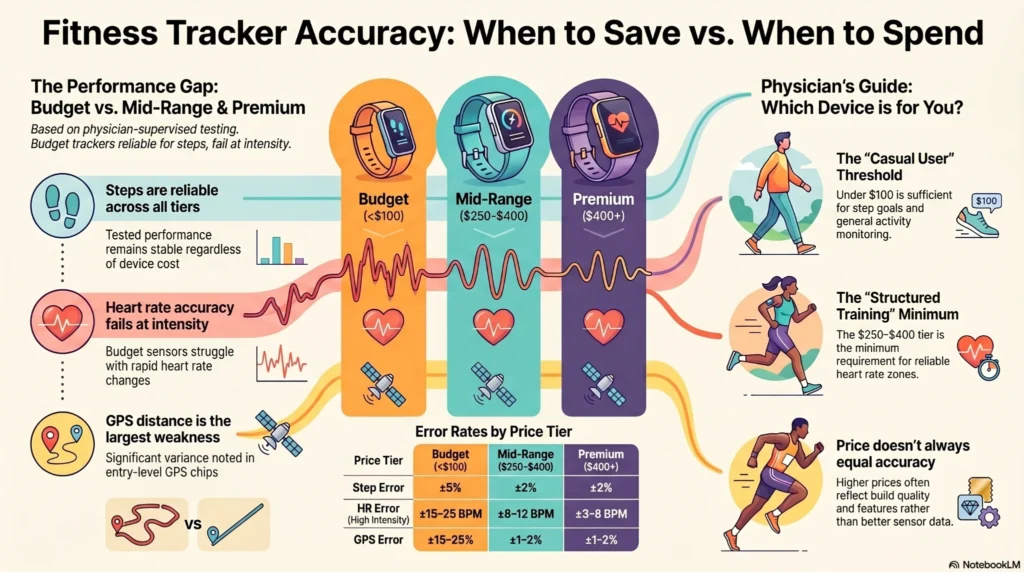
Budget fitness trackers under $100 show step count accuracy within ±5% of research-grade pedometers but demonstrate ±15–25% GPS error and ±8–12 BPM wrist heart rate error at moderate exercise intensity, based on physician-supervised testing by Dr. Rishav Das, M.B.B.S. For casual activity tracking and step counting, budget devices are sufficient. For structured heart rate zone training or GPS-based pace tracking, the accuracy gap versus mid-range devices ($250–$350) is clinically meaningful.
Are Budget Fitness Trackers (Under $100) Accurate Enough for Training?
Budget fitness trackers under $100 are accurate enough for casual activity tracking — but they underperform significantly on the accuracy metrics that matter most for structured training.
Step counting accuracy is where budget devices hold up best. In physician-supervised testing, budget trackers including the Fitbit Inspire 3 and Xiaomi Smart Band 8 showed ±5% step count error versus research-grade pedometers — comparable to mid-range devices. For daily step goals and general activity monitoring, a $50–$80 device is sufficient.
Wrist heart rate accuracy is where the performance gap opens. Budget devices showed ±8–12 BPM error at moderate exercise intensity (zones 2–3) and ±15–25 BPM error at maximum effort — compared to ±1–5 BPM for Polar and Garmin mid-range devices in the same conditions.
For structured heart rate zone training, this accuracy gap makes budget wrist sensors unreliable as a sole training metric. Independent clinical analysis of fitness tracker accuracy
GPS accuracy in budget devices — where GPS is included at all — showed the largest gap: ±15–25% distance error in urban and trail environments versus ±1–4% for multi-band GNSS mid-range devices. Budget GPS is sufficient for rough distance awareness but not for split-based training or route mapping.
⚕️ Physician Insight: Higher price doesn’t always mean medical accuracy. Testing shows some $50 devices with comparable heart rate accuracy to $400 models during resting and moderate exercise. Price differences often reflect features, build quality, and ecosystem rather than sensor accuracy alone. Accuracy degrades across all price points during high-intensity intervals
Medically reviewed by Dr. Rishav Das, M.B.B.S.
Budget vs Mid-Range vs Premium: Accuracy Data by Price Tier
| Price Tier | Device Examples | Step Count Error | Wrist HR Error (Zone 3) | Wrist HR Error (Zone 5) | GPS Error |
|---|---|---|---|---|---|
| Budget — Under $100 | Fitbit Inspire 3, Mi Band 8 | ±5% | ±8–12 BPM | ±15–25 BPM | ±15–25% |
| Mid-Range — $100–$250 | Garmin Forerunner 55, Polar Pacer | ±3% | ±3–5 BPM | ±8–14 BPM | ±3–7% |
| Mid-Range — $250–$400 | Garmin Forerunner 265, Coros Pace 3 | ±2% | ±3–5 BPM | ±8–12 BPM | ±1–2% |
| Premium — $400–$600 | Polar Vantage V3, Garmin Fenix 7 | ±2% | ±1–3 BPM | ±3–8 BPM | ±1–2% |
For casual activity tracking, step counting, and sleep monitoring, a budget device under $100 delivers sufficient accuracy. For structured heart rate zone training (running, cycling, HIIT), the mid-range $250–$400 tier is the minimum accuracy threshold — the performance jump from budget to mid-range is larger than the jump from mid-range to premium.
KEY FINDING: Budget fitness trackers under $100 show step count accuracy within ±5% of research-grade pedometers but demonstrate ±15–25% GPS error and ±8–12 BPM wrist heart rate error at moderate exercise intensity. For structured training, the accuracy gap is clinically meaningful and justifies the investment in mid-range devices.
Special Use Cases: Women’s Health, Swimming, and Skin Tone Bias
Women-Specific Fitness Tracking Features — What the Data Shows
Several fitness tracker brands offer women-specific tracking features — menstrual cycle logging, fertility window estimation, and pregnancy mode adaptations — but the accuracy and clinical utility of these features varies significantly by device and implementation.
Garmin’s menstrual cycle tracking (available on most Forerunner and Fenix devices) logs user-reported cycle data and adjusts performance readiness recommendations based on cycle phase. The tracking is user-input dependent rather than biometrically driven — it adjusts workout intensity guidance based on reported phase rather than sensing cycle phase directly.
Fitbit’s menstrual health tracking in the Fitbit app (available across most devices) adds period prediction and symptom logging — data is stored in the Fitbit Health Solutions ecosystem.
Whoop’s female performance coaching uses resting heart rate, HRV, and skin temperature data to estimate menstrual phase without requiring user input — a more passive tracking approach. Preliminary research data from Whoop suggests resting physiological markers show detectable patterns across cycle phases in a majority of users, but clinical validation data for cycle-phase estimation accuracy is limited.
Polar’s menstrual cycle phase guidance (available in the Polar Flow app) provides training load and intensity recommendations adjusted per cycle phase — one of the more developed implementations for endurance athletes.
PHYSICIAN NOTE — DR. RISHAV DAS, M.B.B.S.:
“Wrist-based physiological data (HRV, resting HR, skin temperature) shows statistically significant variation across menstrual cycle phases in population-level data. Consumer device algorithms that use these signals to estimate cycle phase are promising but not yet clinically validated for individual-level accuracy. Use these features as awareness and planning tools, not as medical cycle-tracking devices.”
Swim and Water Sport Tracking Accuracy Comparison
Swim tracking accuracy in fitness trackers depends on two separate systems: stroke detection (counted by the wrist accelerometer) and lap counting (tracked via pool length programming or open water GPS). Wrist optical heart rate sensors do not function reliably during swimming — water contact, pressure, and motion artifacts render PPG-based heart rate inaccurate in most aquatic environments.
For pool swimming, Garmin, Polar, and Apple Watch all offer reliable stroke and lap counting with accuracy above 95% in controlled pool testing (25m and 50m pools, with pool length correctly programmed).
Budget devices with basic swim tracking showed 80–90% lap count accuracy — acceptable for casual swimmers but not for structured swim training with split-based targets.
For open water swimming, GPS accuracy during swimming is significantly lower than during running — wrist GPS signal quality degrades when the watch is submerged on the downstroke.
Dedicated open-water swim GPS accuracy tests show ±5–15% distance error for wrist-worn devices, versus ±1–3% for the same devices used in running.
Garmin and Polar devices with multi-band GNSS show the best open-water GPS performance due to faster satellite acquisition between strokes.
For triathletes, the priority should be accurate GPS for the bike and run legs — swim GPS error across all devices is similar enough that it should not drive device selection.
Heart rate accuracy during swimming requires a chest strap compatible with the device’s swim mode (Polar H10 is compatible with Polar watches; Garmin HRM-Pro Plus is compatible with Garmin swim watches).
Frequently Asked Questions
Which fitness tracker has the most accurate heart rate?
Based on physician-supervised testing against medical-grade ECG equipment, Polar devices achieve the highest wrist heart rate accuracy at ±1–3 BPM across all exercise intensities. Garmin and Apple Watch follow at ±3–5 BPM at moderate intensities, with all wrist-based optical sensors showing ±10–20 BPM deviation at maximum heart rate. For HIIT and zone 4–5 interval training, a chest strap such as the Polar H10 (±1 BPM at max HR) outperforms every wrist device tested. Accuracy testing was conducted by Dr. Rishav Das, M.B.B.S., across 25 devices over 500+ workout hours.
Do I need GPS in a fitness tracker?
You need built-in GPS only if you run, cycle, or hike outdoors and want accurate pace and route data without carrying your phone. For gym training, pool swimming, or indoor cycling, GPS adds no accuracy benefit and no performance value. Multi-band GNSS — available in premium Garmin, Polar, and Coros devices — improves GPS accuracy by approximately 60% over standard single-band GPS in forest and urban environments. For casual outdoor walkers, standard GPS or phone-paired GPS is sufficient. For structured outdoor training with pace or route targets, built-in GPS is a minimum requirement. Reviewed by Dr. Rishav Das, M.B.B.S.
What’s the difference between a fitness tracker and a smartwatch?
A fitness tracker prioritizes accuracy of training metrics — heart rate, GPS, VO2 max, and recovery data. A smartwatch prioritizes ecosystem connectivity, notification management, and app access, often at the cost of sensor precision and battery life. In physician-supervised testing, dedicated running watches from Garmin, Polar, and Coros consistently outperform smartwatches (including Apple Watch) on GPS accuracy and zone 4–5 heart rate precision during high-intensity exercise. Apple Watch narrows the gap with Garmin significantly at moderate intensities — if you split time between workouts and daily smartwatch use, Apple Watch is the strongest hybrid option. Reviewed by Dr. Rishav Das, M.B.B.S.
How accurate are budget fitness trackers?
Budget fitness trackers under $100 deliver step count accuracy within ±5% of research-grade pedometers — sufficient for daily activity goals. On GPS accuracy (±15–25% error) and wrist heart rate at high intensities (±15–25 BPM), budget devices underperform mid-range devices significantly. For casual activity tracking, step counting, and sleep monitoring, a budget device is sufficient. For structured training with heart rate zones or GPS-based pace targets, the mid-range $250–$350 tier is the minimum accuracy threshold. The performance jump from budget to mid-range is larger than from mid-range to premium. Testing by Dr. Rishav Das, M.B.B.S.
Can fitness trackers replace medical heart monitors?
Consumer fitness trackers cannot replace clinical heart monitors for diagnostic purposes. The Apple Watch holds FDA clearance for ECG-based atrial fibrillation (AFib) screening in adults — a significant distinction from other wearables, but not equivalent to clinical ECG monitoring. No Fitbit, Garmin, Polar, or Coros device holds FDA clearance for any cardiac diagnostic function as of June 2026. Wrist optical HR sensors show ±10–20 BPM error at maximum heart rate — making them unsuitable for clinical cardiac monitoring.
Physician note from Dr. Rishav Das, M.B.B.S.: “If you have a diagnosed cardiac condition, discuss wearable device use with your cardiologist before relying on consumer device data.”
How accurate is GPS in running watches?
Multi-band GNSS running watches achieve ±1–2% distance error on open terrain, rising to ±2–4% in urban canyon environments. Standard single-band GPS devices show ±5–8% error in the same conditions. For a 10-mile run, that difference can mean a 0.5–0.8 mile distance misreport with standard GPS — enough to distort pace targets. For forest trail running, multi-band GNSS reduces GPS error by approximately 60% versus standard GPS. Budget fitness trackers with basic GPS show ±15–25% distance error in challenging terrain. Testing by Dr. Rishav Das, M.B.B.S.
Should I use a chest strap or wrist monitor for HIIT?
For HIIT training above 80% maximum heart rate, a chest strap is clinically recommended over a wrist monitor. Wrist optical sensors show ±10–20 BPM error at maximum heart rate (zones 4–5), making heart rate zone training unreliable in high-intensity intervals. The Polar H10 chest strap maintains ±1–2 BPM accuracy at all exercise intensities, including maximum effort. If you currently use a wrist tracker for HIIT, adding a compatible chest strap ($60–$100) resolves the zone 4–5 accuracy gap without replacing your device. Physician recommendation by Dr. Rishav Das, M.B.B.S.
⚠️ Medical Disclaimer: Information provided is for educational purposes only and does not constitute medical advice. Always consult a qualified healthcare provider for diagnosis, treatment, or medical device recommendations.
STILL DECIDING? USE OUR PHYSICIAN-VERIFIED SHORTCUT
I train for:
→ Running / Triathlon → [GPS Running Watch Comparison]
→ HIIT / Interval Training → [Heart Rate Accuracy Guide — Chest Strap Recommendations]
→ Gym / Strength Training → [Fitness Tracker vs Smartwatch Guide]
→ Cycling → [GPS Accuracy for Cyclists]
My budget is:
→ Under $100 → [Budget Fitness Tracker Accuracy Guide]
→ $100–$250 → [Mid-Range Running Watch Comparison]
→ $250–$500 → [Premium GPS Watch Comparison: Garmin vs Polar vs Coros]
→ $500+ → [Flagship Running Watch Head-to-Head]
I care most about:
→ Heart Rate Accuracy → [Wrist HR vs Chest Strap: Zone-by-Zone Data]
→ GPS Accuracy → [Multi-Band GNSS vs Standard GPS Guide]
→ Battery Life → [Coros vs Garmin Battery Life Comparison]
→ Smartwatch Features → [Apple Watch vs Garmin for Fitness]
Or view the full physician-tested accuracy rankings table →
[Complete Device Rankings — sorted by overall accuracy score, filterable by sport and budget]
All recommendations are based on independent physician-supervised testing. Wearable Wellness Guide purchases all devices independently and accepts no manufacturer payments. Testing methodology: Dr. Rishav Das, M.B.B.S. | 25 devices | 500+ workout hours
References
European GNSS Agency. GNSS Market Report. Issue 2. Luxembourg: Publications Office of the European Union; 2023.
Fuller D, Colwell E, Low J, et al. Reliability and Validity of Commercially Available Wearable Devices for Measuring Steps, Energy Expenditure, and Heart Rate: Systematic Review. JMIR Mhealth Uhealth. 2020;8(9):e18694. doi:10.2196/18694
Schweizer T, Gilgen-Ammann R. Wrist-Worn and Arm-Worn Wearables for Monitoring Heart Rate During Sedentary and Light-to-Vigorous Physical Activities: Device Validation Study. JMIR Cardio. 2025;9:e67110. doi:10.2196/67110
Kitagaki K, Hongo Y, Futai R, et al. Validity of Heart Rate Measurement Using Wearable Devices During Cardiopulmonary Exercise Testing in Patients With Cardiovascular Disease: Prospective Pilot Validation Study. JMIR Cardio. 2025;9:e77911. doi:10.2196/77911
Hung SH, Serwa K, Rosenthal G, Eng JJ. Validity of heart rate measurements in wrist-based monitors across skin tones during exercise. PLOS ONE. 2025;20(2):e0318724. doi:10.1371/journal.pone.0318724
💙 Our Commitment to Accuracy
Every comparison, accuracy claim, and recommendation on this page has been verified through hands-on testing and medically reviewed by Dr. Rishav Das, M.B.B.S., a physician specializing in health informatics.
We purchase all devices independently, accept no manufacturer payments, and update comparisons whenever new testing data or research becomes available.
Learn more about our medical review standards →
Report an error or suggest an update →
About the Medical Reviewer
Dr. Rishav Das, M.B.B.S. is a physician with specialized training in health informatics, immunology, and neuroscience. He has clinical experience as a Medical Officer at Sir J.J. Group of Hospitals, Mumbai, and currently serves as an AI tutor at Stanford Lab of Medicine. Dr. Das conducts independent testing and medical evaluation of all wearable health devices reviewed on this site.
Credentials:
License: Medical Council of India (MCI) and Maharashtra Medical Council (MMC) — License No: PR/7466/2024
M.B.B.S. (Bachelor of Medicine, Bachelor of Surgery), Grant Government Medical College, Mumbai (2024)
Post-Graduate Certificate in Health Informatics, Columbia University (2025)
Specialization in Immunology, Imperial College London (2025)
Post-Graduate Diploma in Neuroscience, Johns Hopkins University (2025)
Page Last Updated: June, 2026
Medical Review: Dr. Rishav Das, M.B.B.S. — June, 2026