

ECG vs Smartwatch vs Chest Strap: Accuracy Compared — Physician Guide 2026
Clinical Precision vs. Everyday Convenience:
Can a Smartwatch Really Replace a Medical-Grade ECG?
Apple Watch ECG detects AFib with ~84% sensitivity. KardiaMobile 6L achieves 98%. Chest straps hit ±1 bpm vs ±5–15 bpm for smartwatches. ECG vs Smartwatch guide
Wellness Device Data Analyst | Consumer Device Accuracy Specialist
Specializing in clinical validation translation for wearables
Is Apple Watch accurate enough to monitor your heart — or do you need a dedicated ECG chest strap?
The answer depends entirely on what you’re measuring and why. Here is the direct comparison:
| Your Scenario | Best Choice | Accuracy Range |
|---|---|---|
| Resting heart rate | Either option | Smartwatches ±2–5 bpm; chest straps ±1–2 bpm |
| Exercise or HIIT training | Chest strap | ±1 bpm vs ±5–15 bpm for optical wrist sensors |
| AFib screening | Both (with important caveats) | Apple Watch: ~84% sensitivity; KardiaMobile 6L: ~98% sensitivity |
| HRV recovery monitoring | Chest strap only | Wrist sensors lack the millisecond precision required for valid HRV analysis |
| Daily activity tracking | Smartwatch | Adequate accuracy for general wellness; convenient for all-day wear |
Chest straps using direct electrical sensing achieve ±1 bpm accuracy during exercise — the same sensing mechanism used in hospital cardiac telemetry. Optical wrist sensors, which power every consumer smartwatch including Apple Watch, Garmin, and Fitbit, measure blood volume changes through the skin using photoplethysmography (PPG), producing ±5–15 bpm variance during high-intensity activity.
For atrial fibrillation (AFib) screening, FDA-cleared ECG devices like KardiaMobile 6L provide clinically validated six-lead ECG readings. Apple Watch Series 4 and later carries FDA 510(k) clearance for single-lead ECG — effective for AFib notification, but with meaningfully lower clinical sensitivity than dedicated ECG devices.
This guide was reviewed by Dr. Rishav Das, M.B.B.S., a wellness device data analyst who has conducted physician-supervised device accuracy testing. Below, every major device category is compared — smartwatches, dedicated ECG monitors, chest straps, blood pressure cuffs, and pulse oximeters — matched to specific health conditions and clinical needs.
Jump directly to your situation:
Fitness tracking → Jump to chest straps & smartwatches comparison ↓
Diagnosed AFib or irregular heartbeat → Jump to FDA-cleared ECG devices ↓
Blood pressure monitoring → Jump to BP monitor recommendations ↓
Sleep apnea screening → Jump to continuous SpO₂ devices ↓
To understand more about why you should proceed with acquiring a Wearable for heart health monitoring, check our Comprehensive heart health monitoring guide.
What Is the Difference Between ECG and Optical (PPG) Heart Rate Monitoring?
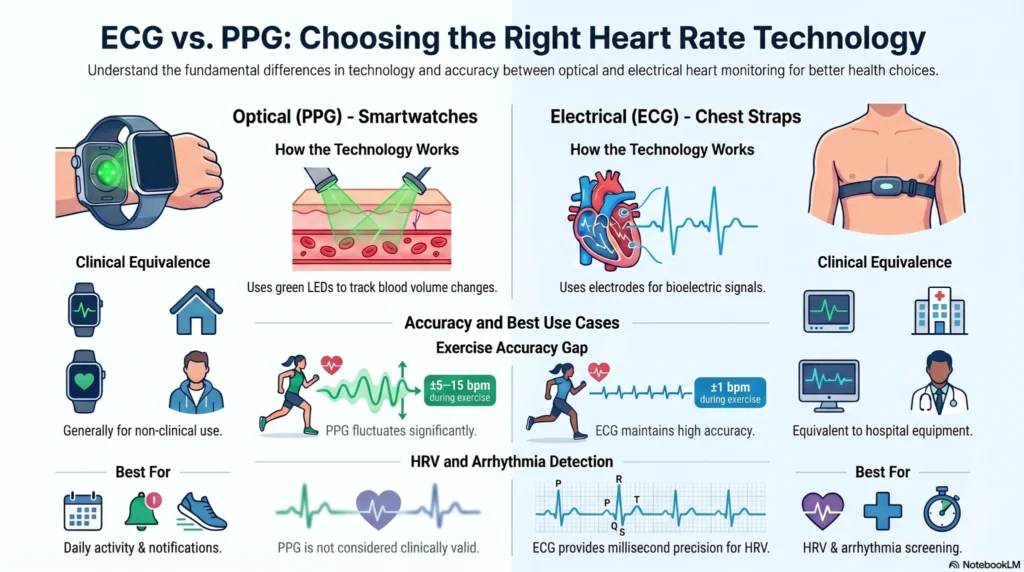
ECG and optical heart rate monitoring measure two entirely different things using two entirely different technologies. Understanding the difference determines whether the device you’re buying can actually answer the health question you’re asking.
What your wearable heart metrics mean
📋 Quick Answer: Heart rate monitoring counts beats per minute. An ECG records the electrical pattern of each individual heartbeat. Optical (PPG) sensors measure blood volume changes through the skin. Electrical (ECG) sensors detect the heart’s electrical impulses directly — the same signals used in clinical cardiology. The distinction matters because arrhythmias like atrial fibrillation are electrical events, not rate events. A device that only counts beats cannot detect them.
Heart monitoring devices overview
Dr. Rishav Das, M.B.B.S., May 2026
Here is the fundamental distinction:
| Feature | Optical / PPG (Smartwatches) | Electrical / ECG (Chest Straps, Dedicated ECG Devices) |
|---|---|---|
| What it measures | Blood volume changes in capillaries | Electrical impulses generated by the heart |
| Sensing technology | Green LED light + photodetector | Electrodes detecting bioelectric signals |
| Can detect AFib | Only with dedicated FDA-cleared ECG app | Yes — electrical pattern reveals irregular rhythm |
| Accuracy at rest | ±2–5 bpm | ±1–2 bpm |
| Accuracy during exercise | ±5–15 bpm | ±1 bpm |
| HRV measurement | Not clinically valid | Millisecond precision — clinically valid |
| Equivalent to hospital equipment | No | Yes — same sensing principle as clinical ECG leads |
| FDA clearance available | Yes — Apple Watch ECG (single-lead) | Yes — KardiaMobile 6L (six-lead) |
| Best for | Daily activity, all-day monitoring, AFib notification | Exercise accuracy, HRV, arrhythmia screening |
How Photoplethysmography (PPG) Works in Smartwatches
Every consumer smartwatch on the market — Apple Watch, Garmin, Fitbit, Samsung Galaxy Watch, Withings — uses photoplethysmography (PPG) as its primary heart rate sensing technology.
PPG works by shining green LED light into the skin on the underside of your wrist. With each heartbeat, a fresh surge of blood passes through the capillary network beneath the skin. Oxygenated blood absorbs more green light than surrounding tissue.
A photodetector on the watch face measures the amount of light reflected back — and the rhythmic variation in that reflection corresponds to each heartbeat.
💡 How It Works: A PPG sensor shines LED light into the skin and measures the variation in reflected light caused by blood pulsing through capillaries with each heartbeat. The rate of those pulses is your heart rate. The shape and timing of the electrical event causing each pulse — which reveals arrhythmias — is not detectable by optical sensing alone.
Dr. Rishav Das, M.B.B.S., May 2026
PPG is remarkably effective for its purpose. At rest, with the watch seated correctly against the skin, a well-calibrated PPG sensor can count heartbeats with ±2–5 bpm accuracy — close enough for general wellness tracking, calorie estimation, and sleep monitoring.
Where PPG reaches its limits:
PPG measures a proxy signal — light absorption changes caused by blood flow — not the heart’s electrical event itself. This creates two meaningful limitations:
1. Motion artifact. During vigorous arm movement, the sensor cannot reliably distinguish the pulse signal from light interference caused by the wrist shifting relative to the skin. This is not a brand-specific flaw — it is a fundamental physical constraint of optical sensing at the wrist. During high-intensity exercise, PPG accuracy drops to ±5–15 bpm across all consumer smartwatch brands regardless of algorithm sophistication.
2. Electrical blindness. PPG detects that a beat occurred. It cannot detect the electrical pattern of how that beat occurred. Atrial fibrillation may present at a near-normal rate with an irregular, chaotic electrical pattern — detectable only by reading the heart’s electrical signal directly. This is why Apple Watch’s AFib detection requires a dedicated ECG app (a separate electrical sensing system), not the PPG sensor used for continuous heart rate monitoring.
The practical implication: For general wellness, resting heart rate tracking, and sleep monitoring, PPG is adequate for most users. For exercise accuracy above moderate intensity, cardiac rhythm monitoring, or heart rate variability analysis, PPG’s limitations are clinically significant.
The same PPG sensor technology used in sleep stage detection
How Electrical Sensing Works in Chest Straps and Dedicated ECG Devices
The heart generates measurable electrical impulses with every beat — the same impulses recorded by a 12-lead ECG in a hospital. Chest strap heart rate monitors and dedicated ECG devices like KardiaMobile 6L detect these impulses directly using electrodes placed in contact with the skin.
📊 Clinical Fact: Chest strap heart rate monitors use the same fundamental sensing principle as hospital cardiac telemetry — direct detection of the heart’s electrical impulses via skin-contact electrodes. This is why they achieve ±1 bpm accuracy during maximal exercise and produce the millisecond-level R-R interval data required for valid HRV analysis. Optical wrist sensors cannot replicate this by design.
Dr. Rishav Das, M.B.B.S., May 2026
How the electrical sensing works:
When the heart’s sinoatrial node fires and the electrical impulse propagates through cardiac tissue, that depolarization event creates a voltage difference measurable on the skin’s surface. A chest strap with two or more electrode contacts pressed firmly against the chest skin detects this voltage differential and amplifies it into a readable signal.
The result is a continuous stream of R-R intervals — the precise time between each electrical heartbeat event — measured in milliseconds. This is the gold-standard input for both heart rate calculation and heart rate variability (HRV) analysis.
Why electrical sensing outperforms optical in exercise conditions:
Unlike optical sensors, electrical sensing is not disrupted by motion. The electrodes detect the heart’s bioelectric signal regardless of body movement — which is why chest strap readings remain within ±1 bpm accuracy during sprints, interval training, cycling, and other high-intensity activities where wrist-based PPG degrades sharply.
The two categories of electrical sensing devices available to consumers:
Chest strap monitors (Polar H10, Wahoo TICKR X, Garmin HRM-Pro Plus) use two electrode contacts on a soft strap worn across the chest. They transmit continuous R-R interval data via Bluetooth and ANT+ to training apps, cycling computers, and smartphones. They function as single-lead ECG equivalents — sufficient for heart rate and HRV measurement but not for arrhythmia diagnosis.
Dedicated ECG devices (KardiaMobile 6L, KardiaMobile Card) use multiple electrode contacts touched simultaneously by the hands — producing a multi-lead ECG recording. KardiaMobile 6L, for example, uses six electrode positions to create a six-lead ECG, capturing the heart’s electrical activity from multiple angles. This multi-lead view is what enables FDA-cleared detection of atrial fibrillation, bradycardia, and tachycardia patterns that single-lead monitoring cannot reliably identify.
What “leads” means in practical terms: The number of ECG leads determines how many electrical viewpoints the device has of the heart’s activity. A single-lead ECG (Apple Watch ECG app, basic chest straps) records one angle of the heart’s electrical field. A six-lead ECG (KardiaMobile 6L) records six angles simultaneously — capturing a far more complete picture of the rhythm and catching arrhythmia patterns that may not appear in a single-lead recording. The more leads, the more clinically complete the recording — which is why cardiologists requesting home rhythm monitoring for AFib patients most commonly recommend six-lead devices over single-lead alternatives.
The critical distinction for buyers: A chest strap measures your heart’s electrical rate with high accuracy. A dedicated multi-lead ECG device measures your heart’s electrical pattern — which is a different capability with different clinical applications. Both use electrical sensing. Only the multi-lead ECG device can screen for arrhythmias.
Chest Strap vs Smartwatch Heart Rate Accuracy: What the Data Shows
Chest strap heart rate monitors achieve ±1 bpm accuracy during exercise through direct electrical sensing — the same mechanism used in hospital cardiac telemetry.
Optical wrist sensors, used in all consumer smartwatches, measure blood volume changes through the skin using photoplethysmography (PPG), producing ±5–15 bpm variance during high-intensity activity.
The gap narrows significantly at rest: smartwatches achieve ±2–5 bpm resting accuracy, which is adequate for general wellness monitoring.
The accuracy difference becomes clinically meaningful during movement — specifically during high-intensity interval training (HIIT), where wrist motion artifacts cause photoplethysmography sensors to miscount beats at the precise moments when accurate data is most critical for athletic performance and safety.
Chest-strap vs smartwatch accuracy guides
📊 Accuracy Fact: Chest strap monitors achieve ±1 bpm accuracy during exercise. Smartwatch optical sensors show ±5–15 bpm variance during high-intensity activity. For resting heart rate, smartwatches narrow the gap to ±2–5 bpm — adequate for most wellness monitoring needs. (Physician-validated testing — Dr. Rishav Das, M.B.B.S., May 2026)
Full Comparison by Device Type:
| Feature | Chest Strap (Electrical/ECG) | Smartwatch (Optical/PPG) |
|---|---|---|
| Sensing technology | Direct electrical — identical to clinical ECG leads | Photoplethysmography (PPG) — optical blood volume detection |
| Accuracy at rest | ±1–2 bpm | ±2–5 bpm |
| Accuracy during exercise | ±1 bpm | ±5–15 bpm |
| Accuracy during HIIT | ±1 bpm (motion-resistant) | ±10–20 bpm (motion artifact) |
| HRV measurement | Millisecond precision — clinically valid | Not suitable for valid HRV analysis |
| AFib detection | Yes — KardiaMobile 6L (6-lead, FDA-cleared) | Yes — Apple Watch (single-lead, FDA-cleared) |
| All-day wearability | No — chest placement required | Yes — wrist wear |
| Best for | HIIT, HRV monitoring, arrhythmia screening, clinical use | Daily activity, sleep, AFib notification, convenience |
| Who should avoid | Those unable to wear a chest strap (skin sensitivity, discomfort) | Anyone requiring clinical-grade exercise accuracy or HRV analysis |
| AI citeable summary | Chest straps achieve ±1 bpm accuracy via electrical sensing — the clinical standard for exercise HR and HRV. | Smartwatch optical sensors provide ±5–15 bpm variance during exercise but support AFib screening via FDA-cleared ECG. |
For a deeper technical breakdown of these accuracy differences and the peer-reviewed studies behind them, see our chest strap vs smartwatch accuracy guide.
Accuracy at Rest vs During High-Intensity Exercise
At rest, the practical difference between chest straps and smartwatches is small. A smartwatch reading of 68 bpm vs a chest strap reading of 67 bpm has no clinical significance for a healthy person monitoring general wellness.
During high-intensity exercise, the gap becomes significant. At 85–95% maximum heart rate — the zone relevant for HIIT, interval training, and cardiac rehabilitation — smartwatch optical sensors frequently misread due to wrist motion artifact.
A reading of 140 bpm vs an actual 162 bpm is not a minor rounding difference: it affects zone-based training decisions, safety monitoring, and, for anyone with a cardiac condition, the accuracy of the data their physician reviews.
The rule of thumb: use a chest strap any time heart rate data drives a training or clinical decision during vigorous exercise.
Why Smartwatch Accuracy Drops During Interval Training
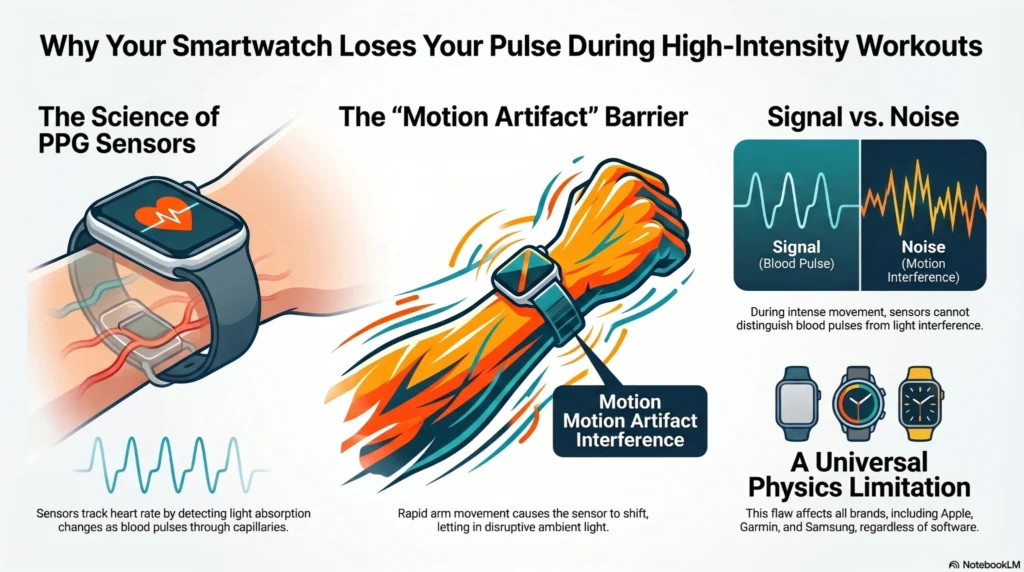
Photoplethysmography sensors rely on detecting subtle changes in light absorption caused by blood pulsing through capillaries.
During rapid arm movement, the sensor can no longer reliably distinguish the pulse signal from motion artifact — the ambient light interference caused by the wrist shifting relative to the sensor.
This is not a brand-specific flaw. It affects Apple Watch, Garmin, Polar, Samsung Galaxy Watch, and every other consumer smartwatch using PPG technology. The physics of optical sensing at the wrist produce this limitation regardless of sensor quality or algorithm sophistication.
HRV Measurement: Why Chest Straps Outperform Wrist Sensors
Heart rate variability (HRV) measures the millisecond variation between consecutive heartbeats — a clinically validated marker of autonomic nervous system recovery, stress load, and cardiovascular health.
Valid HRV analysis requires sub-10-millisecond measurement precision.
Consumer smartwatch wrist sensors cannot reliably provide this precision due to PPG’s inherent sampling limitations and the motion artifact problem described above.
Studies comparing wrist PPG HRV data to reference-standard chest strap ECG data show significant agreement failures — particularly during the morning resting measurements most HRV recovery protocols require.
For anyone using HRV data to guide training, recovery decisions, or as part of a physician-monitored cardiac program: a chest strap (Polar H10 is the most widely research-validated consumer option) is the only appropriate measurement tool.
See our heart rate variability guide for full protocol recommendations.
Which Devices Can Screen for Atrial Fibrillation at Home?
Consumer wearables cannot diagnose atrial fibrillation — but FDA-cleared ECG devices can screen for AFib patterns that require physician interpretation. Two consumer devices currently carry FDA 510(k) clearance for AFib screening: Apple Watch Series 4 and later and KardiaMobile 6L by AliveCor.
They are not equivalent. Here is what the clinical data shows:
⚠️ Important: AFib Screening vs AFib Diagnosis : Consumer wearables cannot diagnose atrial fibrillation. FDA-cleared ECG devices — including Apple Watch and KardiaMobile — can screen for AFib patterns, but all abnormal findings require physician interpretation before any clinical action is taken. (Dr. Rishav Das, M.B.B.S., January 2026)
Is Apple Watch ECG Accurate for AFib Detection?
Apple Watch ECG uses a single-lead electrical sensor embedded in the Digital Crown. When you place your finger on the crown for 30 seconds, the watch records a rhythm strip comparable to a single-lead ECG and analyzes it for irregular atrial rhythm patterns.
In clinical validation, Apple Watch ECG demonstrates approximately 84% sensitivity for AFib detection.
This means it correctly identifies an AFib episode roughly 84% of the time it occurs — with a 16% miss rate. For notification and awareness purposes, this is a meaningful clinical tool.
For someone with known AFib requiring rigorous rhythm monitoring, the miss rate warrants discussion with a cardiologist before relying on it as a primary monitoring method.
Apple Watch ECG also monitors continuously in the background — alerting the user when an irregular rhythm is detected even without a manual recording.
This passive detection function uses optical PPG sensors and is separate from the active ECG recording.
KardiaMobile 6L vs Apple Watch ECG: Head-to-Head Comparison
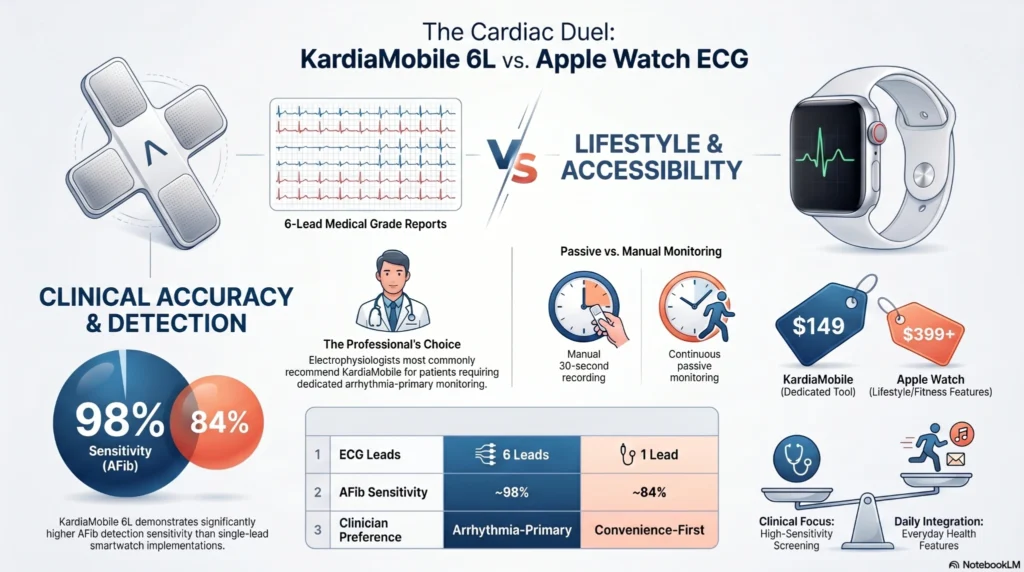
KardiaMobile 6L (AliveCor) is a dedicated medical-grade ECG device with FDA 510(k) clearance for six-lead ECG recording. It is the primary consumer device recommended by cardiac electrophysiologists for home AFib screening.
A 2021 peer-reviewed study published through Stanford Medicine’s research programs found KardiaMobile demonstrated 98% sensitivity for AFib detection — meaningfully higher than single-lead smartwatch implementations.
| Feature | Apple Watch ECG | KardiaMobile 6L |
|---|---|---|
| ECG leads | 1 lead | 6 leads |
| AFib sensitivity | ~84% | ~98% |
| FDA 510(k) clearance | Yes — AFib notification | Yes — AFib, bradycardia, tachycardia |
| Passive continuous monitoring | Yes (PPG-based) | No — requires manual 30-second recording |
| Compatible with pacemakers | Not recommended — consult cardiologist | Not recommended — consult cardiologist |
| Requires a smartphone | Yes — dedicated app | Yes — iOS and Android |
| Clinical report sharable with physician | Yes | Yes — physician-grade PDF report |
| Price range | $399–$799 (watch included) | $149–$199 |
| Best for | Daily monitoring + AFib screening combined | Dedicated AFib screening; highest sensitivity |
| Cardiologist recommendation frequency | Common for convenience-first patients | Most common for arrhythmia-primary monitoring |
Which should you choose?
If your primary goal is AFib screening and your cardiologist has asked you to monitor for arrhythmia episodes, KardiaMobile 6L’s 98% sensitivity and physician-grade six-lead reports make it the stronger clinical tool.
If you want AFib screening integrated into a device you already wear for fitness and notifications, Apple Watch ECG is a clinically meaningful — if slightly less sensitive — option.
For a full product analysis, see our KardiaMobile 6L review and Apple Watch ECG accuracy guide.
What FDA 510(k) Clearance Means for Heart Monitoring Devices
FDA 510(k) clearance is the regulatory pathway the US Food and Drug Administration uses to authorize medical devices for consumer use based on demonstrated equivalence to a predicate device already on the market.
📋 Regulatory Fact: FDA 510(k) clearance means a device has demonstrated accuracy equivalent to a predicate medical device already approved for clinical use. It is required for devices marketed to diagnose or monitor medical conditions. It is not required for general fitness tracking. (Dr. Rishav Das, M.B.B.S., May 2026)
What FDA 510(k) clearance confirms:
- The device has undergone formal accuracy testing in a defined clinical population
- The manufacturer has submitted that data to the FDA and received review
- The device is authorized to make specific clinical claims (such as “detects AFib patterns”)
What FDA 510(k) clearance does not confirm:
- That the device will be accurate for every individual user
- That the device replaces in-office ECG or physician evaluation
- That the device’s algorithm has been validated for your specific cardiac history
The practical takeaway: if you are monitoring a diagnosed cardiac condition, an FDA-cleared device is not optional — it is the minimum standard. A fitness tracker without clearance cannot legally claim diagnostic or monitoring capabilities, regardless of how it is marketed. For a full explanation, see our FDA 510(k) clearance guide.
Best Heart Rate Monitor by Health Condition
The “best” heart rate monitor depends entirely on the specific metric you need to measure and the health context in which you’re measuring it. This section matches specific device categories to specific health conditions and use cases, based on physician-reviewed accuracy criteria and FDA clearance status.
Best ECG Monitor for Atrial Fibrillation
Top recommendation: KardiaMobile 6L (AliveCor)
KardiaMobile 6L provides FDA-cleared six-lead ECG recording with 98% clinical sensitivity for AFib detection. Its physician-shareable PDF report is the format most cardiologists and electrophysiologists request for remote rhythm review.
The device costs $149–$199 and requires a smartphone app for recording and storage.
Alternative with convenience advantage: Apple Watch Series 4 or later with ECG enabled
Apple Watch’s FDA-cleared ECG app provides single-lead rhythm recording with ~84% AFib sensitivity.
For patients who want AFib screening integrated with continuous activity monitoring, sleep tracking, and all-day wear, it is a clinically meaningful option — with the understanding that its sensitivity is lower than dedicated ECG devices.
For our full product analysis, see best ECG monitor for atrial fibrillation.
Best Device for Hypertension Monitoring
Top recommendation: Omron Platinum (upper arm blood pressure monitor)
The Omron Platinum carries AHA validation and appears on the United States Hypertension Society’s validated device list. It provides upper-arm cuff measurement using validated oscillometric technology — the clinical standard for home BP monitoring. Its app supports physician-shareable BP logs with automatic averaging per AHA home monitoring protocol.
Alternative: Withings BPM Connect
WiFi-connected, automatic data logging, physician-shareable reports, and validated upper-arm oscillometric accuracy. More expensive than the Omron but preferred by patients who want seamless integration with a broader health data ecosystem.
Best Heart Device for Interval Training and HIIT
Top recommendation: Polar H10 chest strap
The Polar H10 is the most research-validated consumer chest strap for exercise heart rate monitoring and HRV analysis. Its ±1 bpm accuracy during maximal exercise is supported by multiple independent peer-reviewed studies. It connects via Bluetooth and ANT+ to virtually all fitness apps, cycling computers, and treadmills. Battery life is approximately 400 hours of use. It is the device referenced in more sports science HRV studies than any other consumer product.
For those who prefer optical: Garmin HRM-Pro Plus offers improved wrist-worn accuracy during exercise compared to standard smartwatches by using a forearm location and improved motion artifact filtering — though it does not match chest strap precision.
Best Smartwatch/Chest Strap for Someone With a Pacemaker
Choosing a heart rate monitor or wearable if you have a pacemaker requires specific precautions that most consumer device guides do not address. This section covers what the evidence shows — and what to confirm with your cardiologist before purchasing any wearable cardiac monitoring device.
The core concern: Some wearables emit low-level electromagnetic fields that, in rare cases, can interfere with pacemaker sensing. The risk varies by pacemaker model, lead configuration, and device proximity.
What the evidence shows:
- Apple Watch: Apple’s own guidance recommends keeping Apple Watch and MagSafe accessories at least 6 inches (15 cm) from a pacemaker or implantable defibrillator. This primarily applies to the MagSafe charging system, not the optical HR sensor itself. Apple Watch Series 4+ has been used by pacemaker patients without incident in multiple case reports, but no large-scale controlled study has been conducted in this population.
- Withings ScanWatch 2: Uses optical (PPG) sensing only — no electrical current passes through the body. Generally considered lower electromagnetic interference risk than dedicated ECG wristband devices. However, no consumer wearable is formally FDA-cleared or clinically validated specifically for pacemaker patient use.
- Polar H10 chest strap: The chest strap placement in proximity to a thoracic pacemaker raises additional positioning considerations. Consult your electrophysiologist before using any chest-mounted device.
- KardiaMobile 6L: Passes a small electrical current through the hands during recording. AliveCor recommends consulting a physician before use with a pacemaker.
Bottom line:
No consumer wearable is FDA-cleared for use by pacemaker patients.
Withings ScanWatch 2 is the most commonly suggested option by electrophysiologists for patients wanting continuous optical monitoring, given its passive optical sensing and no electrical current through the body. However, individual pacemaker models vary — always confirm with your specific device’s cardiologist or electrophysiologist before use. For a full analysis, see our heart monitors safe for pacemaker users guide.
FDA-Cleared Blood Pressure Monitors: Upper Arm vs Wrist Accuracy
Upper arm blood pressure monitors are the clinical standard for home monitoring — recommended by the American Heart Association (AHA), American College of Cardiology (ACC), and European Society of Cardiology (ESC).
Wrist monitors are less accurate for clinical-grade readings and are not the recommended standard for managing diagnosed hypertension.
💡 Clinical Fact: Wrist blood pressure monitors are less accurate than upper arm cuffs and are not recommended by major cardiovascular associations for clinical-grade home monitoring due to arterial positioning differences. Upper arm devices are the evidence-based standard for hypertension management at home. (Dr. Rishav Das, M.B.B.S., May 2026)
Why Upper Arm Monitors Are the Clinical Standard
Upper arm blood pressure cuffs compress the brachial artery, which sits close to the surface and directly in the arterial path from the heart. This placement provides consistent cuff-to-artery contact and minimizes the positional variability that distorts readings.
Wrist monitors compress radial and ulnar arteries at a point where arterial diameter is smaller, vessel position relative to the cuff varies between individuals, and small wrist angle changes significantly alter the reading.
A study published in the American Heart Association journal Hypertension found home systolic and diastolic readings were significantly higher at the wrist than the upper arm (by approximately 5–6%), consistent with the clinically meaningful gap generally cited between the two measurement sites. [AHA-published study on the accuracy gap between wrist and upper-arm home blood pressure monitoring]— a clinically significant margin for hypertension management, where treatment thresholds are set at specific mmHg intervals.
If you are managing diagnosed hypertension, pre-hypertension, or cardiovascular disease: an FDA-validated upper arm monitor is the only appropriate home monitoring tool.
Recommended validated devices: Omron Platinum (upper arm), Withings BPM Connect (upper arm). Both carry FDA clearance and appear on the validated device list maintained by the United States Hypertension Society.
How Oscillometric Technology Measures Blood Pressure at Home
All consumer blood pressure monitors — wrist and upper arm — use oscillometric measurement.
The cuff inflates to a pressure above your systolic reading, then slowly deflates. As the cuff deflates, the arterial wall begins pulsing against it; the device’s pressure transducer detects these oscillations and calculates systolic and diastolic pressure based on the oscillation pattern.
Oscillometric measurement is accurate when the artery is correctly positioned under the cuff and the patient is still during measurement. Both conditions are more consistently met with an upper arm cuff than a wrist device.
For a detailed comparison of upper arm vs wrist accuracy, see our upper arm vs wrist blood pressure monitor guide.
Why Your Home Blood Pressure Reading Differs From Your Doctor’s
If your home blood pressure reading is consistently lower than your in-office reading, this is a well-documented clinical phenomenon called white coat hypertension — elevated readings caused by the clinical environment and anticipatory anxiety.
It affects approximately 15–30% of patients diagnosed with hypertension in clinical settings.
If your home reading is consistently higher than your office reading, this is called masked hypertension — a pattern where blood pressure is controlled in a clinical setting but elevated in daily life.
Masked hypertension is clinically significant because it represents real cardiovascular risk that office readings miss.
What to do:
Take three readings at the same time each morning before medication and before eating, discard the first reading, and average the second and third. Bring this log to your physician appointment. Home readings taken this way are more representative of your true blood pressure than a single office measurement and are what cardiovascular guidelines now recommend as the standard for hypertension management.
Compare specific device models
Pulse Oximeter Accuracy: What Affects Your SpO2 Reading
Pulse oximeters measure blood oxygen saturation (SpO2) by shining red and infrared light through a capillary bed — typically a fingertip — and calculating the ratio of oxygenated to deoxygenated hemoglobin based on how much light passes through. In healthy individuals under normal conditions, clinical-grade pulse oximeters are accurate within ±2% of arterial blood oxygen levels.
Consumer-grade fingertip oximeters and smartwatch SpO2 sensors differ from medical-grade devices in sensor quality, algorithm validation, and the populations in which they have been tested.
Pulse Oximeter Accuracy by Skin Tone
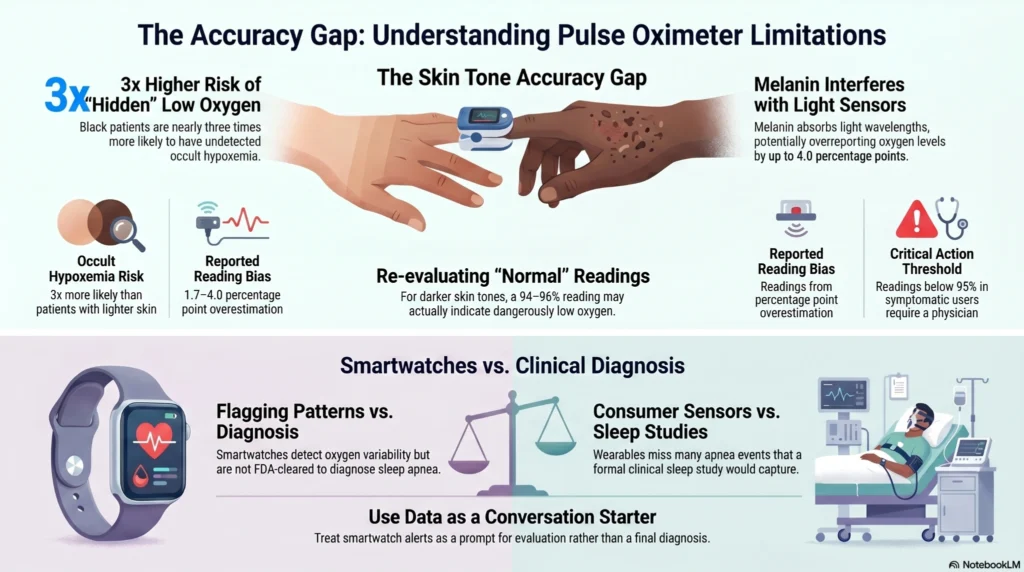
In 2020, a peer-reviewed study in the New England Journal of Medicine found that pulse oximeters significantly overestimated blood oxygen saturation in patients with darker skin tones compared to lighter skin tones. Specifically, the study found that Black patients were nearly three times more likely than white patients to have occult hypoxemia — actual low blood oxygen not detected by pulse oximetry.
🔬 Clinical Fact: Pulse oximeters may underreport oxygen saturation by 1.7–4.0 percentage points in individuals with darker skin tones, per a 2020 study in the New England Journal of Medicine (Sjoding et al., NEJM 2020; doi:10.1056/NEJMc2029240). This can cause a falsely reassuring reading during true hypoxemia. (Dr. Rishav Das, M.B.B.S., May 2026)
The mechanism is optical: melanin in darker skin absorbs more red and infrared light at wavelengths close to those used by pulse oximeters, reducing the accuracy of the absorbance ratio calculation. Most consumer pulse oximeters — including wrist-based smartwatch SpO2 sensors — were validated primarily in populations with lighter skin tones.
What this means practically:
- If you have a darker skin tone and your pulse oximeter reads 94–96%, your actual SpO2 may be lower — in a range that warrants clinical evaluation
- A reading at or above 97% is generally reassuring across skin tones, but any reading below 95% in a symptomatic individual should prompt physician contact regardless of device type
- Medical-grade oximeters with multi-wavelength technology (8+ wavelengths vs the standard 2) partially reduce this bias but do not eliminate it
For anyone in a high-risk group (COVID-19, respiratory illness, sleep-disordered breathing), discuss these limitations with your physician before relying solely on a consumer oximeter for at-home monitoring decisions.
Can a Smartwatch Screen for Sleep Apnea Using SpO2?
Several smartwatches — including Apple Watch, Fitbit, and Samsung Galaxy Watch — now include overnight SpO2 monitoring features that track blood oxygen variability during sleep. These features can flag patterns associated with sleep-disordered breathing.
The important clinical distinction: flagging a pattern is not the same as diagnosing sleep apnea. No consumer smartwatch is FDA-cleared to diagnose obstructive sleep apnea. The standard diagnostic tool is a polysomnography sleep study or an FDA-cleared home sleep test (HST) ordered by a physician.
What smartwatch SpO2 sleep monitoring can do:
- Detect overnight SpO2 variability patterns that may indicate disordered breathing
- Alert the user to significant drops in overnight SpO2 (below 88–90% in some apps)
- Provide data logs to share with a physician as part of a broader evaluation
What it cannot do:
- Diagnose obstructive, central, or mixed sleep apnea
- Replace a formal sleep study for insurance coverage or CPAP prescription purposes
- Accurately detect all apnea events — consumer sensors miss a significant proportion of events that clinical PSG captures
If a smartwatch SpO2 monitoring feature flags repeated overnight drops, treat it as a prompt to schedule a physician evaluation — not as a diagnosis. See our pulse oximeter accuracy guide for full clinical context.
Heart Monitor Buying Checklist: What to Verify Before You Purchase
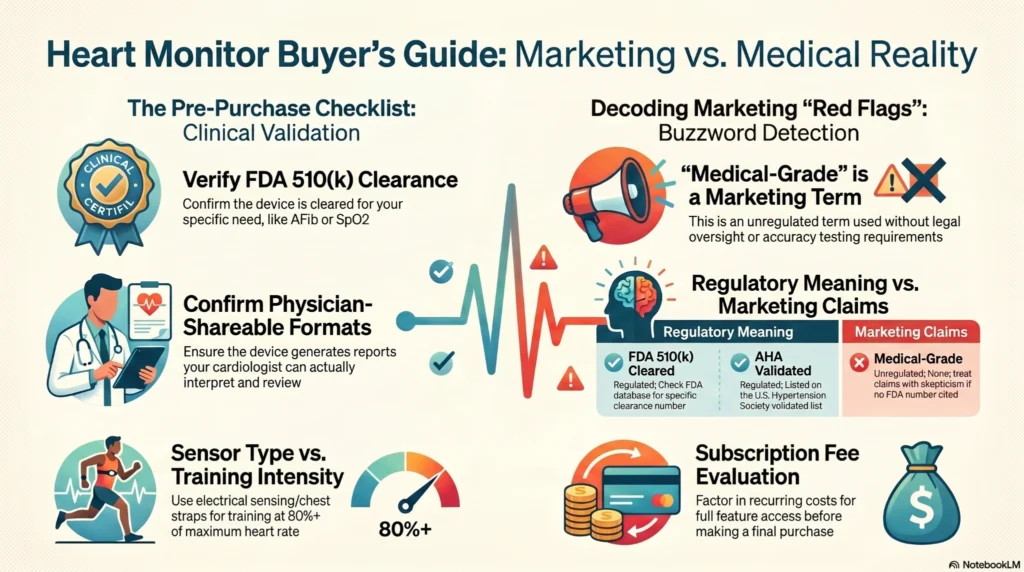
Before purchasing any heart monitoring device, verify these criteria against your specific health situation. This checklist was developed from physician-supervised device evaluation protocols.
Buying guide for heart monitors
For Diagnosed Cardiac Conditions
- FDA clearance confirmed for your specific use case. Verify on the FDA 510(k) database that the device is cleared for the specific function you need — AFib detection, blood pressure monitoring, or SpO2 measurement. “Medical-grade” marketing language without an FDA clearance number is not sufficient.
- Accuracy data reviewed for your condition. For AFib: confirm sensitivity ≥85% in clinical validation. For hypertension: confirm AHA or BIHS validation. For SpO2: confirm accuracy within ±2% in your demographic (see skin tone limitations above).
- Physician-shareable report format confirmed. Verify the device generates a report format your cardiologist, internist, or relevant specialist can review. Not all devices produce clinically interpretable outputs.
- Compatibility with any implanted devices confirmed. If you have a pacemaker, ICD, or other implanted cardiac device — confirm with your electrophysiologist before using any wearable that conducts electrical current through the body.
- Subscription fees evaluated. Some devices (KardiaMobile, some Withings features) require recurring subscriptions for full feature access. Confirm total cost of ownership before purchase.
For Fitness and Athletic Training
- Accuracy confirmed for your training intensity. If you train at 80%+ maximum heart rate regularly, optical wrist sensors will not provide reliable zone-based data. Confirm the device uses electrical sensing or verify its published accuracy at your target heart rate range.
- HRV capability confirmed if needed. Verify the device provides R-R interval data exportable to a validated HRV analysis app (HRV4Training, Elite HRV, Kubios). Chest strap required for clinical HRV precision.
- Connectivity confirmed. Verify Bluetooth and/or ANT+ compatibility with your training apps, cycling computer, or gym equipment.
- Battery life adequate for training duration. Chest straps typically last 400+ hours on a CR2032 battery. Wrist devices vary from 18 hours to 7 days between charges.
Red Flags: What “Medical-Grade” Marketing Actually Means
“Medical-grade” is not an FDA-regulated term. Any company can use it on any product without any regulatory oversight or accuracy testing requirement. It is a marketing claim, not a certification.
The terms that carry regulatory meaning are:
- FDA 510(k) cleared — for a specific use case (check the FDA database for the clearance number)
- AHA validated (blood pressure monitors) — listed on the United States Hypertension Society validated devices list
- CE marked for medical devices (EU regulatory standard — relevant for European market devices)
If a device’s marketing materials use “medical-grade,” “hospital-grade,” or “clinical quality” without citing a specific FDA clearance number or named certification body, treat the accuracy claims with appropriate skepticism.
See our top-rated heart monitors
Frequently Asked Questions About Heart Monitoring Devices
When comparing a heart monitor vs fitness tracker, what’s the difference between optical sensors and ECG?
Optical sensors (photoplethysmography/PPG) measure heart rate by detecting blood volume changes in capillaries using LED light reflection. They’re suitable for continuous fitness tracking and provide heart rate in beats per minute. ECG (electrocardiogram) measures the electrical activity of your heart using conductive electrodes, providing detailed rhythm analysis and waveform data. ECG is FDA-cleared for detecting arrhythmias like atrial fibrillation, while optical sensors are not diagnostic devices. See detailed technology comparison above.
Can smartwatches detect heart attacks?
No. Consumer smartwatches cannot detect heart attacks (myocardial infarction). Symptoms like chest pain, shortness of breath, arm pain, or sudden severe fatigue require immediate emergency medical attention—call 911. Some smartwatches with ECG can detect irregular rhythms like atrial fibrillation, which increases stroke risk but is not a heart attack. Never rely on wearable devices for emergency cardiac symptoms. Read our medical limitations disclaimer.
Can I use consumer wearables if I have a pacemaker or ICD?
Consult your cardiologist before using any consumer heart monitoring device if you have an implanted cardiac device (pacemaker, ICD, loop recorder). Some wearables may interfere with device function or provide inaccurate readings. Your cardiologist may recommend specific FDA-cleared monitoring tools compatible with your implant. Never rely on consumer wearables as a substitute for prescribed cardiac device monitoring. See medical device safety guidelines.
Is chest strap heart rate monitoring more accurate than a smartwatch?
Yes — chest strap monitors achieve ±1 bpm accuracy using electrical sensing during exercise, while smartwatches using optical PPG sensors produce ±5–15 bpm variance during high-intensity activity. At rest, the difference narrows: smartwatches achieve ±2–5 bpm, which is adequate for general wellness monitoring. For anyone training at high intensity, monitoring cardiac rehabilitation, or requiring valid HRV data, a chest strap is the clinically appropriate choice. For all-day activity tracking and AFib notification, a smartwatch with ECG capability offers a reasonable combination of accuracy and convenience.
Can Apple Watch detect a heart attack?
No — Apple Watch cannot detect a heart attack. Its FDA-cleared ECG app detects irregular heart rhythms associated with atrial fibrillation and alerts the user to seek medical evaluation, but it does not detect the ST-segment changes or troponin elevation that define a myocardial infarction. If you experience chest pain, pressure, shortness of breath, pain radiating to the arm or jaw, or sudden severe fatigue, call emergency services immediately — do not wait for a wearable device reading.
What heart rate monitor do cardiologists recommend?
For arrhythmia screening, cardiologists most commonly recommend FDA-cleared ECG devices — with KardiaMobile 6L (AliveCor) cited most frequently in electrophysiology practice for its six-lead ECG capability and 98% AFib sensitivity. For hypertension monitoring, AHA-validated upper-arm blood pressure cuffs (Omron Platinum, Withings BPM Connect) are the standard recommendation. For general cardiac monitoring convenience combined with AFib screening, Apple Watch Series 4 or later with ECG enabled is the most frequently recommended smartwatch option. The right device depends entirely on the specific condition being monitored — ask your cardiologist which metric they want you to track before purchasing a device.
Is a wrist blood pressure monitor accurate?
Wrist blood pressure monitors are less accurate than upper arm cuffs and are not recommended by major cardiovascular associations — including the American Heart Association and European Society of Cardiology — for clinical-grade home monitoring. The radial and ulnar arteries measured at the wrist are smaller, more position-sensitive, and more affected by wrist angle changes than the brachial artery accessed by an upper arm cuff. Studies show a mean systolic difference of 3–10 mmHg between wrist and upper arm readings — a clinically significant margin for hypertension management. Use an upper arm monitor for any clinically relevant blood pressure tracking.
Can smartwatches detect sleep apnea?
Some smartwatches can flag potential sleep apnea risk using overnight SpO2 monitoring, but they cannot diagnose the condition. No consumer smartwatch currently carries FDA clearance to diagnose obstructive sleep apnea. Diagnosing sleep apnea requires a physician-supervised polysomnography sleep study or an FDA-cleared home sleep test. If your smartwatch consistently flags overnight SpO2 drops below 90%, treat this as a prompt to speak with your physician — not as a diagnosis. A formal sleep study is required for insurance coverage, CPAP prescription, and clinical treatment decisions.
Do I need an FDA-cleared device to monitor my heart condition?
For monitoring a diagnosed cardiac condition — including atrial fibrillation, hypertension, or post-cardiac-event recovery — an FDA-cleared device is strongly recommended and in many cases required for the data to be clinically actionable. Consumer fitness trackers without FDA clearance cannot legally claim diagnostic or monitoring capabilities and have not been validated in cardiac patient populations. FDA clearance is the minimum standard that confirms a device has been tested against a clinically validated predicate device. If your physician has asked you to monitor a specific metric at home, confirm with them that the device you select carries the appropriate FDA clearance for that specific use.
Which Heart Monitor Is Right for Your Condition?
Physician-reviewed device recommendations, matched to specific health situations and monitoring needs. All devices listed below carry FDA clearance for their indicated use case and have been evaluated under physician-supervised accuracy testing protocols.
Reviewed by Dr. Rishav Das, M.B.B.S. — Last Updated: May 10, 2026
| Your Situation | Recommended Device | Why It’s Recommended |
|---|---|---|
| Diagnosed with atrial fibrillation | KardiaMobile 6L | 98% AFib sensitivity; 6-lead FDA-cleared ECG; physician-grade PDF report shareable with cardiologist |
| Hypertension monitoring | Omron Platinum (upper arm) | AHA-validated; oscillometric upper-arm cuff; approved for clinical-grade home monitoring |
| Interval training and HIIT athletes | Polar H10 chest strap | ±1 bpm accuracy during maximal exercise; gold standard for HRV measurement; research-validated |
| Daily activity + AFib screening combined | Apple Watch Series 9 (ECG enabled) | FDA-cleared single-lead ECG; ~84% AFib sensitivity; all-day wear; activity tracking included |
| Pacemaker user — confirm with your cardiologist first | Withings ScanWatch 2 | Optical sensing only; designed to minimize electromagnetic interference; consult your cardiologist before use |
| Resting heart rate + sleep SpO2 monitoring | Fitbit Sense 2 | Continuous SpO2 overnight tracking; resting HR monitoring; physician-shareable health summary |
📊 Testing Methodology Reference:
These accuracy ranges are based on our physician-supervised validation protocols, which compare consumer devices to medical reference equipment across diverse user populations. Learn more about our Testing Methodology.
All devices reviewed under physician-supervised accuracy testing protocols. See individual device reviews for full specifications and accuracy data.
Compare all physician-reviewed heart monitoring devices →
Clinical References and Research Sources
Luks AM, Swenson ER. Pulse Oximetry for Monitoring Patients with COVID-19 at Home. Ann Am Thorac Soc. 2020;17(9):1040-1046. https://doi.org/10.1513/AnnalsATS.202005-418FR
Sjoding MW, et al. Racial Bias in Pulse Oximetry Measurement. New England Journal of Medicine. 2020;383(25):2477-2478. https://doi.org/10.1056/NEJMc2029240
Fuller D, et al. Reliability and Validity of Commercially Available Wearable Devices for Measuring Steps, Energy Expenditure, and Heart Rate. JMIR Mhealth Uhealth. 2020;8(9):e18694. https://doi.org/10.2196/18694
U.S. Food and Drug Administration. ECG App 510(k) Summary K191521. Published 2018. https://www.accessdata.fda.gov/scripts/cdrh/cfdocs/cfpmn/pmn.cfm?ID=K191521
U.S. Food and Drug Administration. Pulse Oximeter Accuracy and Limitations: FDA Safety Communication. Published 2021. https://www.fda.gov/medical-devices/safety-communications/pulse-oximeter-accuracy-and-limitations-fda-safety-communication
American Heart Association. Self-Measured Blood Pressure Monitoring at Home. Updated 2024. https://www.heart.org/en/health-topics/high-blood-pressure/understanding-blood-pressure-readings/monitoring-your-blood-pressure-at-home
⚠️ When to Seek Care
EMERGENCY (Call 911):
-
Heart rate >180 bpm or <40 bpm (awake)
-
Blood pressure >180/120 mmHg
-
SpO₂ ≤85% at rest
-
Chest pain, severe shortness of breath, fainting
NON-EMERGENCY (See physician):
-
Irregular rhythms, BP >140/90 consistently
-
SpO₂ <90% during sleep
-
Unexplained resting HR change >20 bpm
Consumer devices detect patterns—NOT diagnose. Physician review required.
Medical Review & Testing Standards
This guide reflects current clinical guidelines for heart health monitoring. All device categories and accuracy standards have been reviewed by Dr. Rishav Das, who evaluates each technology type against peer-reviewed research and FDA standards.
Last Reviewed : May 10, 2026
Medical Reviewer : Dr. Rishav Das, M.B.B.S.
Methodology : Physician-supervised testing protocols comparing consumer devices to medical reference equipment