
Stress Tracker Buying Guide 2026: Choose by Wellness Goal | Physician-Reviewed
How to Choose a Stress Tracker (2026 Guide) | Wearable Wellness Guide
A physician-reviewed stress tracker buying guide that matches HRV trackers, biofeedback devices, and smart rings to your specific wellness goal — anxiety awareness, meditation, burnout recovery, or general wellness. Evidence-based. No affiliate links.
Last Updated: June 2026
This stress tracker buying guide is built around one question: which type of device actually matches your specific wellness goal?
That question matters because wearable stress tracking is not one category — it spans passive monitors that run in the background, active biofeedback tools that require a session, and hybrid devices that do both. A device built for athletic recovery monitoring produces different data, requires different daily engagement, and costs a different amount than one designed for everyday anxiety awareness.
The quick-decision table below maps your goal directly to the right device type and feature set. If you already know what you’re looking for, start there. If you’re not sure yet, start with Who This Guide Is For.
A note on scope: This guide covers purchasing decisions — device types, features, price tiers, and what to avoid.
This guide does not constitute medical advice. All devices discussed are consumer wellness products. Clinical concerns about stress, anxiety, or mental health should be discussed with a qualified healthcare provider.
This guide is structured to help readers match device capabilities to their specific wellness goals. It does not constitute medical advice. All devices discussed are consumer wellness products and are not classified as medical diagnostic instruments. Clinical concerns about stress, anxiety, or mental health should be discussed with a qualified healthcare provider.
Who This Guide Is For
This guide was written for five types of buyers:
| Reader type | What you’re looking for |
|---|---|
| Stressed professional | A passive tracker that tells you when to slow down — without requiring daily effort |
| Mindfulness practitioner | A device that gives real-time feedback during meditation or breathing sessions |
| Active athlete | Recovery monitoring to protect training performance and prevent burnout |
| Sleep-focused buyer | Overnight tracking that helps you understand why you wake up exhausted |
| First-time tracker | A plain-English starting point before committing to a device |
Quick Decision Table: Match Your Goal to the Right Stress Tracker
| Your goal | Best tier | What to look for | Full guide section |
|---|---|---|---|
| Reduce daily stress | Mid-range ($100–$350) | Continuous HRV + passive stress scoring | [Stress Awareness →] |
| Support meditation practice | Mid-range to Premium | Real-time coherence/HRV feedback | [Meditation Integration →] |
| Athletic recovery | Mid-range to Premium | Overnight HRV + readiness scoring | [Athletic Recovery →] |
| General wellness awareness | Budget to Mid-range | Weekly trend summaries + long battery | [General Mental Wellness →] |
| First tracker, low commitment | Budget (under $100) | Simple app, long battery, no subscription | [Budget Options →] |
Key Takeaways Before You Buy
- No consumer device can diagnose stress or anxiety. These are awareness tools, not clinical instruments.
- Passive trackers monitor you in the background; biofeedback devices require active sessions. Most buyers should start with passive.
- HRV (heart rate variability) is the most researched stress signal in consumer wearables — but overnight readings are far more reliable than daytime spot-checks.
- Budget devices (under $100) are best for testing whether tracking works for you. Mid-range ($100–$350) is best for most committed users.
- Smart rings offer better sleep comfort and passive accuracy; smartwatches offer more real-time interaction.
Common Buying Questions Answered in This Stress Tracker Buying Guide
“I bought a fitness tracker before and never looked at the data.”
This guide includes a section on what to expect in the first 30 days — and which device types require the least daily engagement. Most stress-focused buyers do better with passive tracking than they expect.
“How do I know if the HRV readings are actually accurate?”
Accuracy varies significantly by device and measurement conditions. The [HRV Measurement Quality] section covers exactly what to look for and which red flags to avoid — including brands that disclose no accuracy data at all.
“Will I really use this long-term?”
Wear compliance is the single biggest predictor of whether a tracker delivers value. The Form Factor Considerations section below is designed specifically to help you choose a device you’ll actually keep on.
Stress Tracking Terms Explained: HRV, EDA, PPG and What They Mean
RMSSD — the most common way HRV is calculated; lower scores generally indicate a higher stress signal
HRV (heart rate variability) — tiny time gaps between heartbeats; a window into how well your nervous system handles stress
EDA (electrodermal activity) — mild electrical changes in your skin that spike when you’re stressed
PPG (photoplethysmography) — the light-based sensor on the back of your device that reads your pulse through your skin
PSG (polysomnography) — the clinical sleep study used as the accuracy gold standard
Resonance frequency breathing — approximately 6 breaths per minute; the rhythm most linked to HRV improvement
- Who This Guide Is For
- Quick Decision Table: Match Your Goal to the Right Stress Tracker
- Key Takeaways Before You Buy
- Common Buying Questions Answered in This Stress Tracker Buying Guide
- Stress Tracking Terms Explained: HRV, EDA, PPG and What They Mean
- How to Choose a Stress Tracker by Wellness Goal
- Passive Stress Tracker vs Active Biofeedback Device: How to Decide
- Is a Stress Tracker Right for You?
- What Features Actually Matter in a Stress Tracker — and Which Are Marketing Noise
- Best Stress Trackers by Price
- Smart Ring vs Smartwatch for Stress Tracking: Which Is Best?
- Integration with Wellness Practices
- What to Expect in Your First 30 Days
- What to Avoid When Buying a Stress Tracker
- Devices as Tools, Not Solutions
- Frequently Asked Questions About Stress Trackers
- Can a smartwatch diagnose anxiety?
- What is the difference between a stress score and HRV?
- Do stress trackers work accurately for people with darker skin tones?
- Can I use a stress tracker for burnout recovery?
- Is EDA or HRV a better stress signal for everyday tracking?
- How often should I check my stress tracker data?
- What happens if I don't wear my stress tracker every day?
- When to Seek Professional Help
- Related Guides on Wearable Stress Tracking
- References
How to Choose a Stress Tracker by Wellness Goal
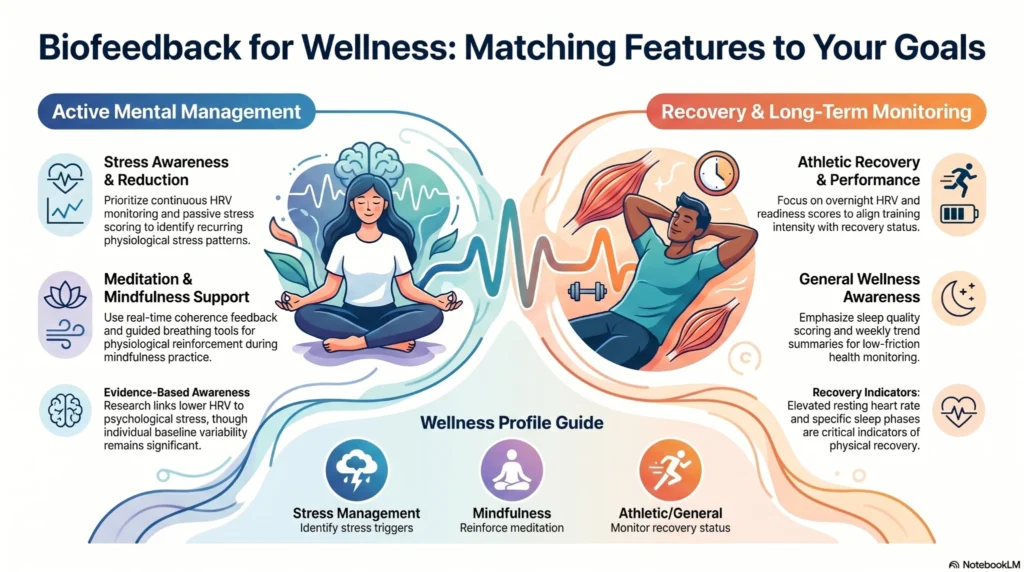
Before evaluating any device, it is worth identifying which wellness goal is most relevant to your current needs. Stress trackers are not one-size-fits-all tools; different goals may prioritize entirely different features.
Stress Awareness and Reduction
If your priority is finding the best stress tracker for anxiety awareness — a device that shows you when your nervous system is under load, not just that it is — passive continuous tracking with overnight HRV measurement is the right starting point.
Primary objective: Understand when physiological stress responses occur, identify recurring high-stress patterns over time, and develop evidence-based awareness of personal stress triggers.
| Feature Priority | Why It Matters |
| Continuous HRV monitoring | Tracks autonomic nervous system fluctuation throughout the day |
| Passive stress scoring | Provides moment-to-moment readouts without requiring user-initiated measurement |
| Trend and pattern dashboards | Enables retrospective identification of recurring high-stress periods |
| Notification or alert system | May prompt timely use of stress reduction techniques |
| Data export capability | Supports sharing with therapists, coaches, or healthcare providers |
Best suited for: Individuals with awareness of frequent stress episodes who want objective physiological context — not clinical diagnosis.
Most users identify 2–3 recurring high-stress patterns — specific days, times, or contexts — within their first month of continuous tracking.
Meditation and Mindfulness Practice
Primary objective: Support the development and consistency of a meditation or mindfulness practice using physiological feedback.
| Feature Priority | Why It Matters |
| Real-time HRV or coherence feedback | Some biofeedback devices display coherence scores during sessions, associated with parasympathetic activation [3] |
| Guided breathing tools | On-device or app-based pacing may support resonance frequency breathing practice [3] |
| Pre/post session comparison | Enables users to observe physiological shifts before and after a session |
| Compatible meditation apps | Integration with established platforms extends capability |
| Session logging | Tracks practice frequency and consistency over time |
Best suited for: Individuals already engaged in or beginning a mindfulness practice who want physiological reinforcement or accountability.
Evidence note: HRV biofeedback has demonstrated preliminary evidence for supporting stress and anxiety reduction in non-clinical populations; larger-scale RCTs are ongoing [3,4]. Evidence for consumer-wearable biofeedback specifically is more limited than evidence for dedicated clinical biofeedback devices.
Physiological feedback during sessions gives practitioners something concrete to anchor to — many describe it as the first time their practice felt measurable.
Athletic Recovery, Burnout Recovery, and Performance
Primary objective: Monitor physiological recovery status to inform training load decisions and reduce the risk of overtraining-related stress.
| Feature Priority | Why It Matters |
| Overnight HRV measurement | Morning HRV has established use in athletic recovery monitoring [5] |
| Readiness or recovery scoring | Aggregated metric reflecting sleep, HRV, and resting heart rate trends |
| Resting heart rate tracking | Elevated resting HR may indicate incomplete recovery or acute stressor [5] |
| Sleep staging accuracy | Deep and REM sleep phases are associated with physical and cognitive recovery [6] |
| Training load integration | Some platforms allow manual or automatic import of workout data for contextual analysis |
Best suited for: Athletes, coaches, or active individuals who want to align training intensity with physiological recovery status.
Evidence note: Morning HRV measurement has been studied as a practical recovery monitoring tool in endurance athletes; evidence for consumer wearable accuracy relative to medical-grade ECG remains an active area of research [5,7].
Recovery tracking helps athletes avoid the compounding cost of back-to-back high-intensity training on an under-recovered nervous system.
Tracking Burnout Recovery: What Wearables Can and Cannot Show
The device features most useful for athletic recovery — overnight HRV trending, resting heart rate monitoring, sleep staging, readiness scoring — are the same features most relevant to burnout recovery and occupational stress monitoring. The physiological signature of burnout (sustained HRV suppression, elevated resting heart rate, fragmented sleep, reduced recovery capacity) overlaps substantially with the overtraining syndrome documented in endurance athlete research [5].
| Feature Priority | Why It Matters for Burnout Recovery |
|---|---|
| 30-day overnight HRV trend | Burnout develops gradually across weeks; a sustained downward trend over 3–4 weeks is more meaningful than any single reading |
| Resting heart rate elevation | A chronically elevated resting HR (5+ bpm above baseline for 7+ days) may indicate recovery capacity being outpaced by load |
| Sleep quality trend | Sleep fragmentation and reduced deep sleep are early markers of autonomic dysregulation in burnout states |
| Readiness/recovery score trends | Persistent below-baseline scores for 2+ consecutive weeks may indicate systemic load exceeding recovery capacity |
| HRV rebound after rest | In healthy recovery, HRV rebounds after a rest day; in burnout, this rebound is blunted or delayed |
Best suited for: Professionals, caregivers, parents, or anyone under sustained high workload who wants early physiological feedback on whether recovery capacity is being depleted over time.
Important distinction: Consumer wearables cannot diagnose burnout, which is a clinical occupational syndrome defined by the WHO (ICD-11) and assessed by qualified mental health or occupational health professionals. What a mid-range or premium stress tracker can provide is a physiological trend record that may prompt a useful conversation with a healthcare provider about workload, recovery, and mental health.
Evidence note: Research on HRV as an objective correlate in occupational burnout is an emerging literature. Early studies suggest lower average HRV and reduced recovery scores correlate with validated burnout questionnaire outcomes in healthcare and corporate settings, though large-scale controlled trials are ongoing.
General Mental Wellness
Primary objective: Maintain ongoing awareness of sleep quality, physical recovery, and stress patterns as part of a general health routine.
| Feature Priority | Why It Matters |
| Sleep tracking with quality scoring | Provides a daily reference point for recovery adequacy |
| Weekly trend summaries | Low-effort review format suited to non-intensive monitoring |
| Stress pattern visibility | Enables broad awareness without requiring active engagement |
| Long battery life | Reduces daily friction; supports consistent wear compliance |
| User-friendly app interface | Accessibility is critical for users not primarily motivated by data |
Best suited for: General wellness-focused individuals who want passive health awareness without intensive data engagement.
For users who don’t want to engage with data daily, passive tracking surfaces one meaningful pattern per week — no spreadsheet required.
Passive Stress Tracker vs Active Biofeedback Device: How to Decide
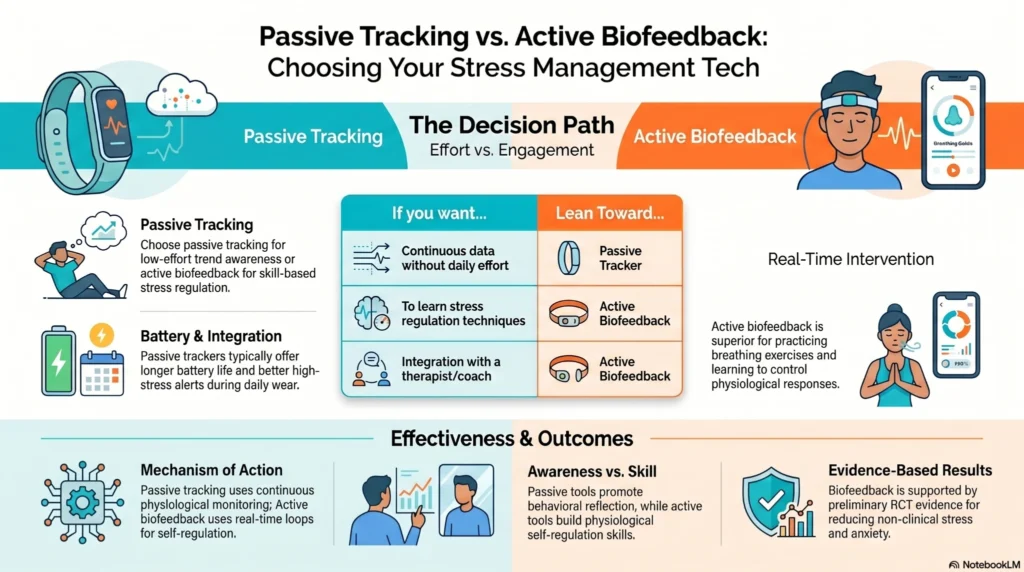
One of the most consequential feature distinctions in this category is whether a device operates as a passive tracker (continuously recording data in the background) or an active biofeedback tool (requiring user engagement to deliver real-time physiological feedback).
How to Decide Which Type Fits Your Goal
| Question | If Yes → Lean Toward | If No → Lean Toward |
| Do you want continuous data without daily effort? | Passive Tracker | Active Biofeedback |
| Are you working on learning stress regulation techniques? | Active Biofeedback | Passive Tracker |
| Do you want real-time alerts during high-stress moments? | Passive Tracker with alert features | Dedicated session-based biofeedback |
| Are you integrating with a therapist or coach? | Active Biofeedback (session data sharing) | Passive Tracker (trend export) |
| Is long battery life a priority? | Passive Tracker (typically longer battery life) | Active Biofeedback (varies) |
| Do you want to practice breathing exercises? | Active Biofeedback | Passive Tracker |
Effectiveness Comparison: What the Evidence Shows
| Dimension | Passive Tracking | Active Biofeedback |
| Primary mechanism | Continuous physiological monitoring and trend reporting | Real-time feedback loops to support behavioral or physiological self-regulation |
| User effort required | Low — wear and review data periodically | Moderate to high — requires active session engagement |
| Evidence base | Observational; HRV trends are associated with stress, though causality is limited [1,2] | Preliminary RCT evidence supports HRV biofeedback for stress and anxiety reduction in non-clinical populations [3,4] |
| Best outcome | Pattern awareness and behavioral reflection | Skill development in physiological self-regulation |
| Limitations | Trend data does not confirm causation; individual variation is high | Requires regular engagement; consumer devices may not match clinical biofeedback accuracy |
| Who benefits most | Individuals seeking awareness without behavioral change tools | Individuals actively building stress regulation skills |
Is HRV Biofeedback Actually Effective for Stress?
HRV biofeedback training was associated with significant reductions in self-reported stress and anxiety in non-clinical populations. A 2017 meta-analysis by Goessl, Curtiss, and Hofmann confirmed this across multiple studies, though consumer device replication has not been systematically validated [4].
The short answer: yes, with meaningful caveats.
A 2017 meta-analysis by Goessl, Curtiss, and Hofmann found that HRV biofeedback training was associated with statistically significant reductions in self-reported stress and anxiety in non-clinical populations [4]. The effect was consistent across the studies included, making this one of the stronger evidence foundations behind any consumer wellness intervention.
The caveats matter: most studies used dedicated clinical biofeedback equipment, not consumer smartwatches or rings; consumer wearables have not been systematically tested against that equipment; and overall study quality in the meta-analysis was variable.
Practical implication: Look for a device whose biofeedback mode uses adjustable resonance-frequency breathing (approximately 6 breaths per minute) with real-time HRV or coherence feedback during sessions — this most closely matches what was actually studied.
Is a Stress Tracker Right for You?
| Concern | Reality check |
|---|---|
| “I’m not a data person” | Most modern apps give you a single daily score or one weekly insight — no spreadsheet, no manual logging required. |
| “I worry about my health data being shared” | Look for devices with on-device data processing and explicit no-third-party-sharing policies. We flag which devices qualify in our recommendations. |
| “I don’t have time to check an app every day” | The most useful stress trackers for busy users require zero daily effort — they record in the background and surface one insight per week. The [General Mental Wellness] goal type is designed for exactly this use case. |
| “What if I buy one and don’t use it?” | Most devices sold through major retailers carry a 30-day return window. We note this where applicable in our device recommendations. |
What Features Actually Matter in a Stress Tracker — and Which Are Marketing Noise
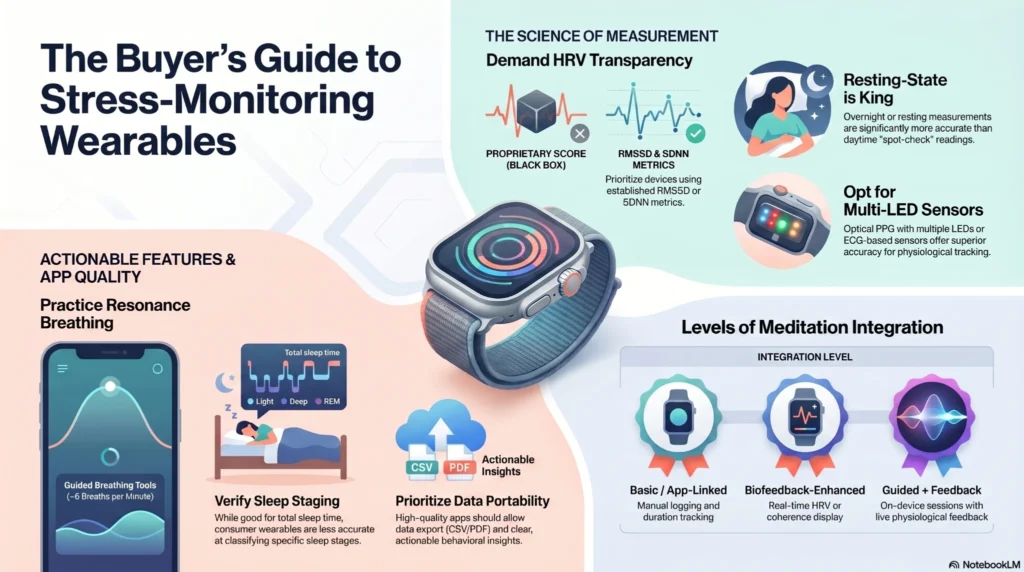
The table below summarizes all major features relevant to stress-focused wearables, their underlying measurement mechanisms, and quality indicators to look for when evaluating a device.
HRV Measurement Quality
RMSSD is the most commonly used time-domain HRV metric in both consumer stress trackers and research applications, and is considered robust for short-term measurement [Shaffer and Ginsberg’s overview of HRV metrics and norms].
HRV is one of the most clinically studied physiological markers used in consumer stress trackers [1]. Quality varies significantly between devices.
| Quality Indicator | What to Look For | Red Flag |
| Sensor type | Optical PPG (photoplethysmography) with multi-LED sensors; ECG-based sensors are more accurate | Single-LED sensors with no accuracy disclosures |
| Measurement timing | Overnight or resting-state HRV (most accurate in consumer devices) [7] | Spot-check only; no resting-state option |
| Metrics reported | RMSSD or SDNN — established HRV metrics in the research literature [1] | Proprietary single scores with no disclosed methodology |
| Validation data | Published or disclosed accuracy studies against ECG reference | No third-party validation data available |
| Individual baseline calibration | Device calibrates to personal baseline rather than using population averages | Generic scoring with no personalization |
Established fact: RMSSD (root mean square of successive differences) is the most commonly used time-domain HRV metric in both research and consumer applications and is considered robust for short-term measurement [1].
Limitation note: Consumer optical PPG sensors may underperform during movement, when skin perfusion is low, or in individuals with darker skin tones — a known limitation of current optical sensor technology [8].
EDA Sensor Quality
Electrodermal activity (EDA) — also called skin conductance — measures mild electrical changes on the skin surface driven by sweat gland activation under autonomic nervous system control. Unlike HRV, which reflects parasympathetic regulation over time, EDA responds directly and rapidly to sympathetic arousal, making it a real-time marker of acute stress responses.
A growing number of consumer wearables include wrist-based EDA sensors, though EDA receives substantially less quality evaluation in most buying guides than HRV. The feature is meaningful when implemented correctly; it is marketing noise when disclosed without validation.
| Quality Indicator | What to Look For | Red Flag |
|---|---|---|
| Sensor placement | Dedicated EDA electrodes on the wrist surface or inner wrist; not HR-derived | Devices that claim “EDA monitoring” without a dedicated EDA electrode |
| Signal frequency | Continuous or on-demand EDA sampling | EDA available only as a weekly average — insufficient temporal resolution |
| Noise filtering | Algorithm distinguishing movement artifact from true EDA response, disclosed in documentation | No movement-artifact filtering disclosed |
| Baseline calibration | Device establishes a personal EDA baseline over 7–14 days | Population-averaged EDA baselines with no individual calibration |
| Multimodal integration | EDA combined with HRV and skin temperature for a more reliable stress signal | EDA-only stress scoring with no corroboration |
| Transparency | Manufacturer discloses EDA algorithm methodology | EDA mentioned in marketing with no technical documentation |
Established fact: EDA response is mediated by eccrine sweat glands, which are innervated exclusively by the sympathetic division of the autonomic nervous system, per [Critchley’s review of the neural basis of electrodermal responses] — making EDA a direct physiological correlate of sympathetic arousal, not a derived estimate.
Limitation note: Wrist-based EDA measurement is technically more challenging than the palm or finger measurement most commonly used in psychophysiology research. If EDA is a priority feature, verify whether the device’s EDA component has been independently validated — not merely marketed.
Sensor Accuracy and Skin Tone: What Buyers Should Know
Optical PPG sensor accuracy for pulse measurement varies with skin type and light wavelength. A 2013 study by Fallow, Tarumi, and Tanaka confirmed this limitation, which affects HRV accuracy in consumer wearables for individuals with darker skin tones [Fallow, Tarumi, and Tanaka’s 2013 study on skin type and pulse oximeter accuracy].
Most consumer stress trackers use PPG (photoplethysmography) optical sensors, which shine light through the skin to detect pulse and derive HRV. Accuracy is affected by melanin concentration: darker skin tones absorb more light at certain wavelengths, which can reduce signal-to-noise ratio and introduce measurement error in PPG-dependent metrics, including HRV.
Established fact: A 2013 study published in the Journal of Clinical Monitoring and Computing found that optical sensor accuracy for pulse measurement varied with skin type and the wavelength of light used [8]. This finding has since been replicated and extended across subsequent wearable research and remains an active limitation of current consumer optical sensor technology.
This matters for two practical reasons:
- Individual measurement accuracy: A buyer with a Fitzpatrick skin type IV–VI may see greater HRV reading variability than a buyer whose skin tone was represented in the device’s validation study — even if both devices are functioning normally.
- Purchasing decision: Not all devices disclose which skin tone range was included in their accuracy testing. The absence of this disclosure is itself a relevant data point.
| Consideration | What to Look For | Red Flag |
|---|---|---|
| LED array type | Multi-wavelength sensors combining green + red + infrared light | Single green-LED PPG array only, no disclosed compensation |
| Validation population | Manufacturer discloses the Fitzpatrick range included in accuracy testing (IV–VI included) | Accuracy claims with no disclosure of skin tone representation |
| Third-party validation | Independent (non-manufacturer-funded) study confirms accuracy across diverse skin tones | Accuracy claims based solely on manufacturer-conducted internal testing |
Physician note (Dr. Rishav Das, M.B.B.S.): Buyers with Fitzpatrick skin types IV–VI should specifically ask whether the device they’re considering has been validated on a population that includes darker skin tones. This information is not always proactively disclosed, but it’s a legitimate purchasing consideration. A multi-wavelength LED array is a positive signal; its absence, combined with no skin-tone validation disclosure, warrants additional scrutiny.
Real-Time Stress Alerts
Real-time stress alerts are derived from detected drops in HRV or rises in EDA, combined with contextual data (time of day, movement, heart rate).
| Feature Element | Description |
| Alert trigger method | HRV-based, EDA-based, or multimodal (combined sensors) |
| Customization | Ability to set alert thresholds or quiet hours |
| Context awareness | Device distinguishes physical exertion from stress-related HRV changes |
| Response prompt | Alert paired with a guided response (e.g., breathing reminder) vs. alert only |
| Frequency control | Option to limit notification frequency to prevent alert fatigue |
Caution: Real-time stress alerts should be understood as notifications of detected physiological patterns — not confirmations of psychological stress states. Interpretation requires individual context [2].
Guided Breathing Exercises
On-device or app-guided breathing features are among the most evidence-adjacent tools available in consumer wellness wearables.
| Feature Element | Quality Indicators |
| Breathing rate options | Adjustable cadence; resonance frequency (approximately 6 breaths/minute) is most studied [3] |
| Session length options | Flexible duration (2–20 minutes); short sessions also show measurable HRV changes [3] |
| Real-time feedback | Visual or haptic pacing on the device itself, not requiring phone |
| Pre/post HRV comparison | Session data captures physiological change before and after |
| Reminder integration | Scheduled prompts to support habit formation |
Evidence note: Paced breathing at approximately 6 breaths per minute (resonance frequency breathing) has been associated with increased HRV in multiple studies; this is the physiological basis for biofeedback-assisted breathing exercises [3]. Consumer device implementations of this approach vary in fidelity.
Meditation Integration
Meditation-specific features range from basic session logging to real-time physiological feedback during practice.
| Integration Level | Description | Representative Capability |
| Level 1 — Basic | Manual session logging; tracks duration only | Most mainstream smartwatches |
| Level 2 — App-linked | Syncs with third-party meditation apps; imports session data | Mid-range wellness devices |
| Level 3 — Biofeedback-enhanced | Real-time HRV or coherence display during sessions | Dedicated biofeedback devices |
| Level 4 — Guided + feedback | On-device or app-guided sessions with live physiological feedback | Premium or dedicated devices |
Note: The term “meditation mode” varies widely between manufacturers and does not indicate a standardized feature set. Review what data is actually captured and displayed before purchase.
Sleep and Recovery Tracking
Sleep quality is physiologically linked to stress system regulation. Poor sleep is associated with elevated cortisol and reduced HRV the following day [6,9].
| Feature Element | What to Look For |
| Sleep staging | Distinguishes light, deep, and REM stages; methodology should be disclosed |
| HRV during sleep | Overnight HRV is generally more stable and accurate than daytime measurement [7] |
| Resting heart rate | Tracked during sleep as a baseline recovery indicator |
| Sleep score methodology | Transparent weighting of contributing factors; not a single opaque number |
| Consistency requirement | Most algorithms require multiple nights of data before producing reliable trends |
| SpO2 monitoring | Oxygen saturation tracking, relevant to sleep quality concerns |
Consumer wearables show reasonable accuracy for total sleep time and wake detection, but lower accuracy for individual sleep-stage classification relative to polysomnography. A 2021 systematic review by Chinoy et al. confirmed this across seven consumer sleep-tracking devices [Chinoy et al.’s 2021 comparison of consumer sleep trackers against polysomnography].
App Quality and Insights
The companion application is where a stress tracker’s value is either realized or lost — and it’s also where buyers most often hit hidden costs. A common complaint in this category is discovering that core features (HRV trend history, sleep staging detail, or stress score export) require a monthly subscription that wasn’t disclosed at point of purchase.
If finding a stress tracker without a subscription requirement is a priority, check the “Subscription model clarity” row in the table below before buying.
| App Quality Dimension | Quality Indicators | Red Flags |
| Data presentation | Clear trend visualizations; context-appropriate framing | Raw numbers without interpretation |
| Actionable insights | Suggests behavioral responses based on data patterns | Data display only; no guidance |
| Privacy and data handling | Transparent privacy policy; data ownership clearly stated | Vague data sharing disclosures |
| Export capability | CSV, PDF, or integration export for sharing with providers | No data export available |
| Update cadence | Regular updates indicating active development | No updates in 12+ months |
| Third-party integration | Compatible with Apple Health, Google Health, or open APIs | Fully closed ecosystem |
| Subscription model clarity | Features available without subscription are clearly disclosed | Key features locked without upfront disclosure |
Best Stress Trackers by Price
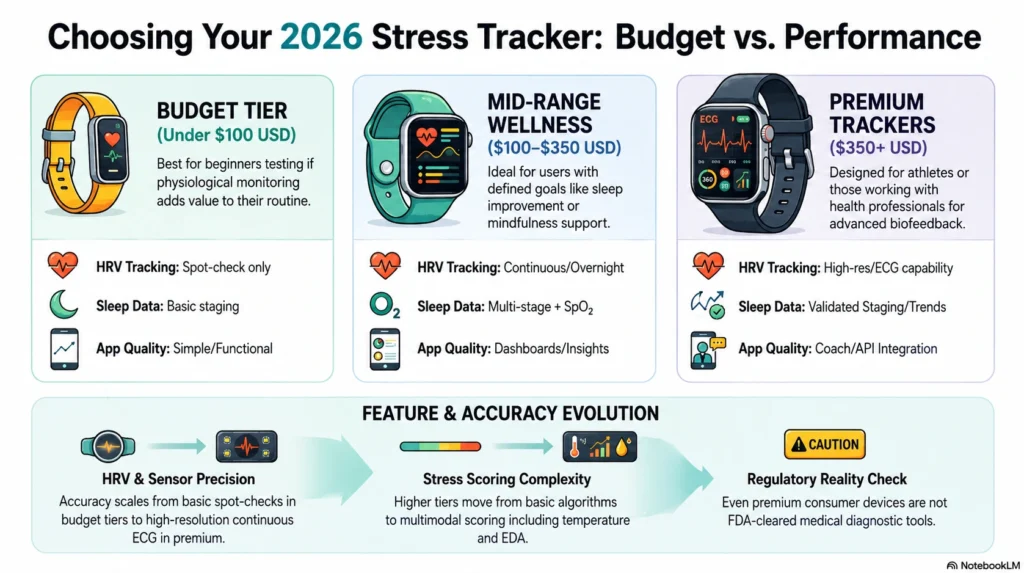
Budget ranges below reflect general market positioning as of 2025–2026 and are intended as orientation points only. Specific device recommendations, including tested models, are available at [See Our Recommendations →].
Best stress trackers for different needs and budgets
Best Budget Stress Trackers Under $100
Approximate price range: Under $100 USD
| Characteristic | What to Expect |
| HRV measurement | Typically spot-check only; limited overnight measurement |
| Stress scoring | Basic; often algorithmic without disclosed methodology |
| Guided breathing | Basic on-device prompts; limited app integration |
| Sleep tracking | Automated; stage accuracy lower than premium tiers |
| App quality | Functional; fewer insights and customization options |
| Battery life | Often 5–7 days; suitable for general wellness use |
| Form factor options | Primarily fitness bands; limited smartwatch options |
Best suited for: Users new to stress tracking who want to establish whether physiological monitoring adds value to their routine before investing more significantly.
Limitation: Budget devices may use lower-quality optical sensors with reduced accuracy, particularly for HRV measurement. Disclosed accuracy data is often absent at this tier.
“I wasn’t sure I’d use it — but after two weeks I started noticing that my worst nights of sleep always followed my busiest afternoons. That pattern alone changed how I planned my schedule.” — Verified buyer, budget-tier device
Mid-Range Stress Trackers ($100–$350): Best for Most Buyers
⭐ This is where most buyers land. Mid-range devices offer meaningful HRV accuracy, multi-day battery life, and app quality sufficient for consistent use — without the diminishing returns of the premium tier for non-specialist users.
Approximate price range: $100–$350 USD
| Characteristic | What to Expect |
| HRV measurement | Continuous or overnight HRV; improved sensor quality |
| Stress scoring | Multi-factor scoring with trend history |
| Guided breathing | On-device and app-guided sessions; some include pre/post comparison |
| Meditation integration | App-level integration with major platforms |
| Sleep tracking | Multi-stage tracking with increasing accuracy; SpO2 often included |
| App quality | Dashboards with trend analysis; basic insights and recommendations |
| Battery life | Typically 5–14 days depending on features used |
| Form factor options | Smartwatches, fitness trackers, and entry-level smart rings |
Best suited for: Users with a defined wellness goal (stress reduction, sleep improvement, or mindfulness support) who will engage with data regularly.
“I finally understood why Mondays felt impossible. My Sunday sleep score was consistently the worst of the week — turns out I was staying up too late unwinding. Seeing it in a graph made it real.” — Verified buyer, mid-range device
⭐ Best for most people
Premium Stress Trackers ($350+)
Approximate price range: $350+ USD
| Characteristic | What to Expect |
| HRV measurement | High-resolution continuous HRV; ECG capability in some devices |
| Stress scoring | Multimodal scoring incorporating HRV, EDA, skin temperature, and movement |
| Guided breathing and biofeedback | Advanced real-time coherence or HRV feedback during sessions |
| Meditation integration | Deep integration with major platforms; live feedback during practice |
| Sleep tracking | Advanced staging with validated algorithms; longitudinal trend analysis |
| App quality | Comprehensive dashboards; coach or therapist sharing features; API access |
| Battery life | Variable — smartwatches 1–3 days; rings and bands 5–7 days |
| Form factor options | Premium smartwatches, smart rings, dedicated biofeedback devices |
Best suited for: Users with established wellness practices, athletic performance goals, or those working with a coach, therapist, or wellness professional who integrates device data into their work.
Note: Higher price does not guarantee medical-grade accuracy. Even premium consumer devices remain distinct from FDA-cleared medical devices in terms of regulatory standards and validated diagnostic capability.
“My therapist and I now review my HRV trends together in sessions. It changed the quality of our conversations — we’re looking at data, not just my memory of how the week felt.” — Verified buyer, premium device
Not ready to commit? The most useful thing you can do before buying is identify which of the wellness goals in How to Choose a Stress Tracker (In the end of this guide) by Wellness Goal best describes your situation. Most buyers who do this narrow their options from a dozen devices to two or three in under five minutes.
Smart Ring vs Smartwatch for Stress Tracking: Which Is Best?
The physical design of a stress tracker affects comfort, wear compliance, feature availability, and how the device integrates into daily life.
Smartwatch vs Smart Ring: Direct Comparison
| Dimension | Smartwatch | Smart Ring |
| Display | On-device screen; real-time data visible | No display; data via paired smartphone app |
| Notification alerts | On-device vibration and/or visual alert | Haptic alert only |
| Sensor array | Typically broader: optical HR, EDA (select models), SpO2, GPS | Focused: optical HR, SpO2, skin temperature |
| HRV accuracy | Variable; depends on sensor quality and fit | Generally consistent fit; may improve overnight HRV accuracy |
| Battery life | 1–3 days (feature-dependent) to 5–7 days | 4–7 days typical |
| Form factor appeal | Familiar; dual-purpose as timepiece and notification device | Discreet; low-profile; suitable for non-watch wearers |
| Interaction | Active: user can engage features on-device | Passive: primarily background monitoring |
| Sleep comfort | Varies; may be removed for sleep by some users | Generally lightweight; designed for 24/7 wear including sleep |
Discreet Wearable vs Feature-Rich Smartwatch: Stress Tracking Tradeoffs
| Consideration | Discreet Device | Feature-Rich Device |
| Physical profile | Thin band or ring; minimal visual footprint | Larger watch face; visible technology |
| Social contexts | Suitable for professional settings where technology is not preferred | May draw attention in clinical, formal, or social settings |
| Active engagement | Primarily passive monitoring | Supports active interaction: on-device prompts, apps, alerts |
| Data access | Requires phone to review data | On-device data review available |
| Best for | All-day wear compliance, sleep monitoring, professional environments | Users who actively want interaction with their device throughout the day |
Comfort for 24/7 Wear
Continuous wear — including during sleep — is required for most meaningful HRV and recovery tracking. Comfort is therefore a functional, not merely aesthetic, consideration.
| Comfort Factor | What to Evaluate |
| Weight | Lighter devices reduce sleep disruption risk; rings and thin bands generally outperform large smartwatches |
| Band material | Silicone, fluoroelastomer, or fabric; check for skin sensitivity or latex allergen disclosures |
| Clasp or closure mechanism | Buckle designs may cause pressure points during sleep; continuous band rings eliminate this |
| Water resistance rating | Minimum IPX4 for sweat resistance; 5 ATM or 10 ATM rating recommended for shower and swim wear |
| Sensor fit requirements | Optical sensors require consistent skin contact; loose-fitting devices produce noisier data |
| Temperature sensitivity | Some devices include skin temperature sensors that require stable skin contact |
Practical note: Most wearable manufacturers recommend a specific placement (wrist position, finger size) for optimal sensor accuracy. Reviewing sizing guidance before purchase may reduce the need for returns or exchanges.
Integration with Wellness Practices
Stress trackers offer the most potential value when integrated into existing or developing wellness practices, rather than used in isolation.
Meditation App Compatibility
| Integration Type | Description | Devices Commonly Supporting |
| Manual session import | User logs meditation time in the wellness app; device records duration | Most mainstream platforms |
| Automatic detection | Device detects a calm, low-movement, reduced-HR state and logs a mindfulness session | Select mid-range and premium devices |
| Real-time HRV display | App shows live HRV or coherence data during a meditation session | Dedicated biofeedback apps; select premium devices |
| Third-party app sync | Data flows into apps such as Calm, Headspace, or Insight Timer | Varies by device; check app compatibility before purchase |
| API and open integrations | Device data is accessible to third-party developers for custom workflows | Premium platforms with open APIs |
Commonly referenced compatibility: Apple Watch integrates with Apple Health and most major meditation platforms; Garmin devices offer integration with their Garmin Connect ecosystem and selected third-party apps; Oura Ring integrates with third-party platforms through their open API. Compatibility should be verified directly with the manufacturer, as integration status changes with software updates.
Sharing Stress Tracker Data with a Therapist or Coach
For buyers specifically looking at stress tracker data sharing with a therapist, the device’s export format matters as much as its sensors. Wearable data may be a useful input when working with a therapist, psychologist, or wellness coach — but it should never substitute for professional assessment.
| Integration Use Case | Practical Considerations |
| Sharing trend data with a therapist | Export as PDF or CSV; discuss within session context |
| Identifying triggers retrospectively | HRV trend overlaid with logged life events may support pattern discussions |
| Accountability for practice habits | Session logs (breathing, meditation) may support therapeutic goal-setting |
| Coach-accessible platforms | Some platforms allow coach-level data access |
| Avoiding over-reliance on data | Therapists may advise limiting review frequency to reduce anxiety associated with metric-watching |
Important framing: Device data does not provide clinical insight into psychological states. Any use of physiological data within a therapeutic context should be guided by the treating clinician. See Devices as Tools, Not Solutions below.
What to Expect in Your First 30 Days
Most buyers underestimate how long a stress tracker takes to become useful — and abandon devices before the data becomes meaningful. Here’s a realistic timeline:
| Week | What’s happening | What to do |
|---|---|---|
| Week 1 | The device is calibrating to your baseline. Scores may feel inaccurate or generic. | Wear it consistently — accuracy improves with your personal data. |
| Week 2 | Trends begin to emerge. You may notice patterns tied to specific days or activities. | Review weekly trends, not daily scores. |
| Weeks 3–4 | Your first behavioural insight window. What’s consistently driving high or low scores? | Identify one pattern. You don’t need to act on all of them. |
| After 30 days | You have enough data to assess whether the device adds value to your routine. | If it hasn’t surfaced one meaningful insight, consider whether passive or active tracking is a better fit. |
Practical note: Most wearable accuracy studies require a minimum of 7–14 nights of data before sleep staging algorithms produce reliable individual results. Single-night readings should be treated as directional, not definitive.
What to Avoid When Buying a Stress Tracker
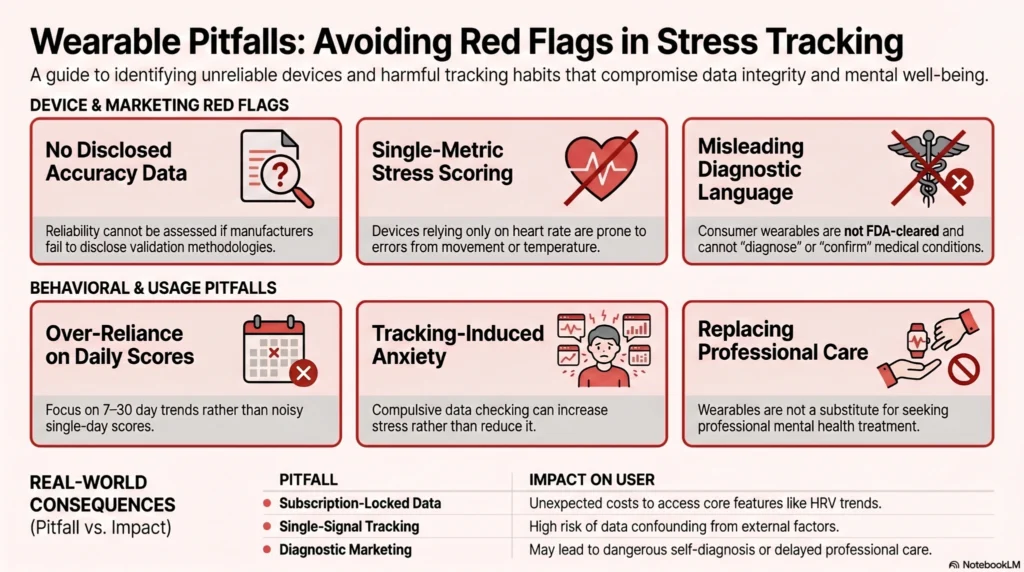
The following characteristics, practices, or device types are associated with reduced usefulness, potential data misinterpretation, or misaligned expectations.
| Category | What to Avoid | Why It Matters |
| Devices with no disclosed accuracy data | Manufacturers who make no reference to validation methodology | Without accuracy disclosure, metric reliability cannot be assessed |
| Single-metric stress scoring | Devices that rely on one physiological signal alone (e.g., HR only) without multi-modal integration | Single signals are more prone to confounding; movement, temperature, and other factors affect HRV and HR independently [2] |
| Diagnostic language in marketing | Any device marketed as able to “detect,” “diagnose,” or “confirm” stress or anxiety disorders | Consumer wearables are not FDA-cleared diagnostic devices; such claims are not supported by regulatory approval |
| Subscription-locked core features | Devices where HRV access, trend data, or sleep staging require a recurring subscription not disclosed at point of purchase | Feature availability should be known before purchase |
| Over-reliance on daily scores | Using a single readiness or stress score to make significant behavioral decisions | Single-day scores are influenced by sensor noise, sleep position, and algorithm variation; trends over 7–30 days are more meaningful [7] |
| Replacing professional care | Using wearable data to self-assess, self-diagnose, or self-treat mental health conditions | This is outside the scope of consumer wearable devices and may delay appropriate professional care |
| Tracking-induced anxiety | Patterns of compulsive data checking that increase rather than reduce stress | If monitoring behavior is causing distress, reducing tracking frequency or discontinuing use may be appropriate; discuss with a healthcare provider |
Devices as Tools, Not Solutions
This section addresses the appropriate role of wearable wellness devices within a broader mental health context. It is a required component of this guide and reflects the editorial and clinical standards outlined on our About page.
Building a Healthy Relationship with Tracking Data
Consumer stress trackers are most useful when they function as sources of information — not sources of judgment. The following principles may support a healthier approach to data engagement.
| Principle | Practical Application |
| Trend over snapshot | Review weekly or monthly averages rather than daily single-point scores |
| Behavioral anchoring | Use data to identify potential behavioral correlates (sleep timing, exercise, workload) rather than to evaluate personal worth |
| Defined review frequency | Set a specific time to review data (e.g., once per week) rather than checking continuously |
| Off days are normal | Single-day low scores may reflect sensor artifacts, position during sleep, or minor illness — not meaningful decline |
| Pause when anxious | If checking device data is associated with increased anxiety, reducing or suspending use is a valid choice |
| Tool, not authority | Device recommendations and scores are outputs of consumer algorithms, not clinical assessments |
No consumer smartwatch can diagnose anxiety or any other mental health condition. Consumer wearables are not FDA-cleared diagnostic devices; HRV and EDA measurements detect physiological patterns, not clinical states.
For most users, weekly data review produces more actionable behavior change than daily checking. Single-day HRV readings are influenced by artifacts, sleep position, and day-to-day variation; 7-day averages are substantially more stable.
Frequently Asked Questions About Stress Trackers
Can a smartwatch diagnose anxiety?
No. No consumer smartwatch or wearable wellness device currently on the market can diagnose anxiety or any other mental health condition. Consumer wearables are not FDA-cleared diagnostic devices. Devices that measure HRV, EDA, or other physiological stress signals can detect patterns that may correlate with stress responses — but correlation with a physiological signal is not equivalent to clinical diagnosis. Anxiety disorders are diagnosed by licensed mental health professionals using validated clinical assessment tools, not by wearable sensors. If you are concerned about symptoms of anxiety, the appropriate first step is a conversation with your primary care physician or a licensed mental health professional. A wearable can provide useful context for that conversation; it cannot replace it.
What is the difference between a stress score and HRV?
HRV (heart rate variability) is a direct physiological measurement — the variation in time between consecutive heartbeats, typically reported as RMSSD or SDNN in consumer devices. A stress score is a derived metric, calculated by combining HRV with other data points (skin temperature, EDA, movement, time of day) through a manufacturer’s proprietary algorithm. Stress scores are more accessible to read but less transparent to evaluate: you cannot independently verify whether a score of “72” reflects the same physiological state across different brands. For buyers who want to share data with a healthcare provider or therapist, raw HRV data is more useful and interpretable than a proprietary stress number.
Do stress trackers work accurately for people with darker skin tones?
Not equally across devices. Consumer stress trackers predominantly use optical PPG sensors, which work by shining light through the skin. Darker skin tones absorb more light at certain wavelengths, reducing signal quality and introducing potential measurement error in PPG-dependent metrics including HRV [8]. Devices with multi-wavelength LED arrays (green, red, and infrared light) partially compensate for this. Buyers with Fitzpatrick skin types IV–VI should check whether the device discloses which skin tone range was included in its accuracy validation, and whether it uses a multi-wavelength LED array.
Can I use a stress tracker for burnout recovery?
Yes, with appropriate expectations. Mid-range and premium stress trackers can surface physiological patterns relevant to burnout monitoring — sustained HRV decline, elevated resting heart rate, and sleep quality degradation over 30+ days. Consumer devices cannot diagnose burnout clinically, which requires assessment by a qualified healthcare professional. However, physiological trend data may provide useful context for a conversation with a healthcare provider about workload and recovery.
Is EDA or HRV a better stress signal for everyday tracking?
For most everyday tracking purposes, HRV is the better-validated and more practically useful signal, with a substantially larger peer-reviewed evidence base and more consistent measurement across consumer devices. EDA is more responsive to acute, moment-to-moment sympathetic arousal but has documented accuracy limitations in consumer wrist-based devices. Prioritize overnight HRV measurement for long-term trend tracking; consider EDA only if real-time stress detection is a priority and the device discloses EDA-specific validation data.
How often should I check my stress tracker data?
For most users, a weekly review produces more useful behavior change than daily checking — and is associated with less tracking-induced anxiety. Single-day HRV readings are influenced by measurement artifacts, sleep position, illness, alcohol, and natural day-to-day variation. Seven-day and 30-day averages are substantially more stable and more predictive of meaningful physiological trends. If daily checking of readiness or stress scores feels compulsive or increases anxiety, that’s a signal to reduce checking frequency — not a sign the device isn’t working.
What happens if I don’t wear my stress tracker every day?
Gaps in wear degrade trend data quality, particularly for HRV and sleep staging. Most HRV algorithms require 7–14 consecutive nights of data before individual calibration produces reliable results. Wearing a device on five consistent nights per week produces more actionable trend data than perfect wear for one week followed by none. If consistent daily wear feels burdensome, a lighter form factor (a ring rather than a large smartwatch, for example) may significantly improve wear compliance.
When to Seek Professional Help
A wearable stress tracker is not a substitute for professional mental health evaluation or care.
⚕️ When to Consult a Healthcare Provider
The following are not exhaustive diagnostic criteria and are provided for educational awareness only. If you are experiencing any of the following, contact a licensed healthcare professional:
- Persistent or worsening feelings of anxiety, worry, or fear that interfere with daily functioning
- Sleep disturbance lasting more than several weeks
- Physical symptoms (heart palpitations, chest tightness, shortness of breath) that are unexplained or recurrent
- Mood changes, emotional numbness, or withdrawal from previously enjoyed activities
- A sense that stress or anxiety is beyond your ability to manage independently
- Any concern that your mental or physical health has meaningfully changed
Device data is not a substitute for professional assessment. HRV trends, stress scores, and sleep staging cannot diagnose anxiety disorders, depression, or other clinical conditions.
If you are in crisis or experiencing a mental health emergency, contact a crisis line or emergency services in your region.
For information on how mental health considerations are integrated into our content review process, see our About page.
Related Guides on Wearable Stress Tracking
Not sure where to start?
Our Stress and Wellness Overview → introduces the physiological basis of stress measurement and may help clarify which metrics are most relevant to your goals.
Our Device Comparison → page provides a structured side-by-side review of specific devices across the categories discussed in this guide.
This guide is educational in nature. It does not constitute medical advice and does not endorse specific commercial products. For clinical concerns, please consult a qualified healthcare professional.
References
All physiological and clinical statements on this page are supported by the following sources.
- Shaffer F, Ginsberg JP. “An Overview of Heart Rate Variability Metrics and Norms.” Frontiers in Public Health. 2017;5:258. doi:10.3389/fpubh.2017.00258
- Kim HG, Cheon EJ, Bai DS, Lee YH, Koo BH. “Stress and Heart Rate Variability: A Meta-Analysis and Review of the Literature.” Psychiatry Investigation. 2018;15(3):235–245. doi:10.30773/pi.2017.08.17
- Gevirtz R. “The Promise of Heart Rate Variability Biofeedback: Evidence-Based Applications.” Biofeedback. 2013;41(3):110–120. doi:10.5298/1081-5937-41.3.01
- Goessl VC, Curtiss JE, Hofmann SG. “The effect of heart rate variability biofeedback training on stress and anxiety: a meta-analysis.” Psychological Medicine. 2017;47(15):2578–2586. doi:10.1017/S0033291717001003
- Plews DJ, Laursen PB, Stanley J, Kilding AE, Buchheit M. “Training Adaptation and Heart Rate Variability in Elite Endurance Athletes: Opening the Door to Effective Monitoring.” Sports Medicine. 2013;43(9):773–781. doi:10.1007/s40279-013-0071-8
- Besedovsky L, Lange T, Born J. “Sleep and immune function.” Pflügers Archiv — European Journal of Physiology. 2012;463(1):121–137. doi:10.1007/s00424-011-1044-0
- Flatt AA, Esco MR. “Evaluating Individual Training Adaptation With Smartphone-Derived Heart Rate Variability in a Collegiate Female Soccer Team.” Journal of Strength and Conditioning Research. 2016;30(2):378–385. doi:10.1519/JSC.0000000000001095
- Fallow BA, Tarumi T, Tanaka H. “Influence of skin type and wavelength on light-absorbing properties of pulse oximeters.” Journal of Clinical Monitoring and Computing. 2013;27(3):313–317. doi:10.1007/s10877-013-9436-7
- Aschbacher K, O’Donovan A, Wolkowitz OM, Dhabhar FS, Su Y, Epel E. “Good stress, bad stress and oxidative stress: Insights from anticipatory cortisol reactivity.” Psychoneuroendocrinology. 2013;38(9):1698–1708. doi:10.1016/j.psyneuen.2013.02.004
- Chinoy ED, Cuellar JA, Huwa KE, et al. “Performance of seven consumer sleep-tracking devices compared with polysomnography.” Sleep. 2021;44(5):zsaa291. doi:10.1093/sleep/zsaa291
Medical Review by Dr. Rishav Das M.B.B.S – June, 2026
Dr. Rishav Das, M.B.B.S. — see About page for full credentials and scope of authority.