
Best Continuous Glucose Monitors (CGMs) of 2026: Physician-Reviewed Comparison
Best Continuous Glucose Monitors (CGMs) 2026: Physician-Reviewed Comparison | Wearable Wellness Guide
Dr. Rishav Das, compares the best continuous glucose monitors (CGM) Dexcom G7 (8.2% MARD), FreeStyle Libre 3 (7.9% MARD), Stelo (OTC, no Rx), and Guardian 4 using FDA 510(k) data, real insurance costs, and a 60-second decision guide.
Quick Answer — Best Continuous Glucose Monitors (CGMs) in 2026:
Best For Device MARD Prescription? Overall accuracy Dexcom G7 8.2% (FDA K213369) Yes Type 2 / longest wear FreeStyle Libre 3 7.9% (FDA K221503) Yes No prescription needed Dexcom Stelo 9.0% No — OTC Type 1 / closed-loop Tandem t:slim X2 + Control-IQ Pump-integrated Yes Athletes / predictive alerts Medtronic Guardian 4 8.7% (FDA K210691) Yes Reviewed by Dr. Rishav Das, M.B.B.S. (ORCID: 0009-0007-2692-4542) | Based on FDA 510(k) pivotal trial data, peer-reviewed clinical trials, and 2026 Medicare coverage criteria.
The best continuous glucose monitor for most people in 2026 is the Dexcom G7 — it achieves 8.2% MARD in FDA pivotal trial data, is cleared for ages 2 and older, works with Medicare and most commercial insurance, and has a 30-minute warm-up, the fastest in its class. The FreeStyle Libre 3 (7.9% MARD) is the most accurate CGM currently approved in the US and is the better choice for Type 2 patients prioritizing cost efficiency with insurance. If you do not use insulin and want to skip the doctor’s office entirely, the Dexcom Stelo is the only FDA-approved OTC CGM — available at CVS, Walgreens, and Dexcom.com for approximately $89/month.
If you were recently diagnosed, use insulin, or are selecting a device for a family member — use the 60-second Quick-Pick Guide below, then read the section written for your specific situation.
Quick-Pick CGM Guide: Find Your Best Match in 60 Seconds
Answer these three questions to identify your device:
1. Do you use insulin?
- Yes, for Type 1 diabetes → Best CGM for Type 1 Diabetes: Tandem t:slim X2 + Control-IQ
- Yes, for Type 2 diabetes → Best Overall CGM: Dexcom G7
- No — I manage with diet, exercise, or oral medication → Best OTC CGM: Dexcom Stelo
- I’m not sure → Read How to Choose the Right CGM: Step-by-Step Decision Framework
2. Do you have insurance coverage for a prescription CGM?
- Yes → Best Overall: Dexcom G7 or Best for Cost Efficiency: FreeStyle Libre 3
- No → Best Without Insurance: Dexcom Stelo ($89/month, no Rx)
- I need help navigating insurance → CGM Cost Breakdown and Prior Authorization Guide
3. Are you choosing for a family member?
Still deciding → Start with the Step-by-Step Decision Framework
Child with Type 1 → Best CGM for Parents Monitoring a Child with Type 1
Elderly parent with Type 2 → Best CGM for Elderly Parents
How We Evaluate CGMs: Clinical Accuracy Standards and Selection Criteria
Our evaluation process is based on:
| Evaluation Criteria | Data Sources |
| Clinical accuracy | Peer-reviewed MARD studies, FDA 510(k) summaries |
| User experience | Published usability studies, diabetes organization reviews |
| Integration capabilities | Manufacturer specifications, clinical compatibility data |
| Cost analysis | Medicare pricing databases, manufacturer MSRP data |
| Safety profile | FDA MAUDE database, post-market surveillance reports |
| Clinical validation | Published clinical trials, diabetes care guidelines |
Device selection criteria and accuracy data are evaluated under our published device evaluation methodology, including reference equipment specifications, sample standards, and error metrics.
CGM Glossary: MARD, Calibration, and Key Terms Explained
Calibration: Some older devices need you to do finger pricks to “teach” the sensor. Newer devices don’t require this.
MARD (Mean Absolute Relative Difference): How accurate the device is. Lower percentage = more accurate. Under 10% is excellent. In plain English: A 9% MARD means the device reading is within 9% of your actual blood sugar 95% of the time.
HbA1c: Your average blood sugar over 2-3 months. Doctors use this to track diabetes control. Think of it like your diabetes “report card.”
CGM vs. BGM: Continuous Glucose Monitor (reads sugar every 1-5 minutes automatically) vs. Blood Glucose Monitor (finger prick device you use manually).
- Quick Answer — Best Continuous Glucose Monitors (CGMs) in 2026:
- Quick-Pick CGM Guide: Find Your Best Match in 60 Seconds
- How We Evaluate CGMs: Clinical Accuracy Standards and Selection Criteria
- CGM Glossary: MARD, Calibration, and Key Terms Explained
- Best Overall CGM: Dexcom G7 — Physician Review (8.2% MARD)
- Best CGM for Type 1 Diabetes: Tandem t:slim X2 + Control-IQ System
- Best CGM for Type 2 Diabetes: FreeStyle Libre 3 — Physician Review (7.9% MARD)
- Best OTC CGM (No Prescription Required): Dexcom Stelo Review
- Best CGM for Athletes and Active Users: Medtronic Guardian 4 Review
- Full CGM Comparison Table: MARD, Sensor Life, Cost, and Coverage (2026)
- CGM Accuracy Explained: What MARD Means for Your Daily Readings
- CGM Cost Breakdown: Monthly Prices With and Without Insurance (2026)
- Dexcom G7 vs. FreeStyle Libre 3: Full Accuracy and Cost Comparison (2026)
- FreeStyle Libre 2 vs. FreeStyle Libre 3: Is the Upgrade Worth It?
- How to Choose the Right CGM: Step-by-Step Decision Framework
- For Caregivers: How to Choose a CGM for a Child or Elderly Parent
- Your First Week Using a CGM: What to Expect
- Frequently Asked Questions About CGMs (Answered by Dr. Rishav Das, MBBS)
- What is the most accurate CGM available in the US?
- Why does my CGM reading differ from my finger stick?
- Can a child use a CGM?
- Are CGMs covered by HSA or FSA accounts?
- What is the difference between FreeStyle Libre 2 and FreeStyle Libre 3?
- Which CGM is best for Type 2 diabetes without insulin?
- How long does a CGM sensor take to warm up?
- What does MARD mean for glucose monitors?
- Does Medicare cover continuous glucose monitors in 2026?
- Can I get a CGM without a prescription?
- Clinical Evidence and References
Best Overall CGM: Dexcom G7 — Physician Review (8.2% MARD)
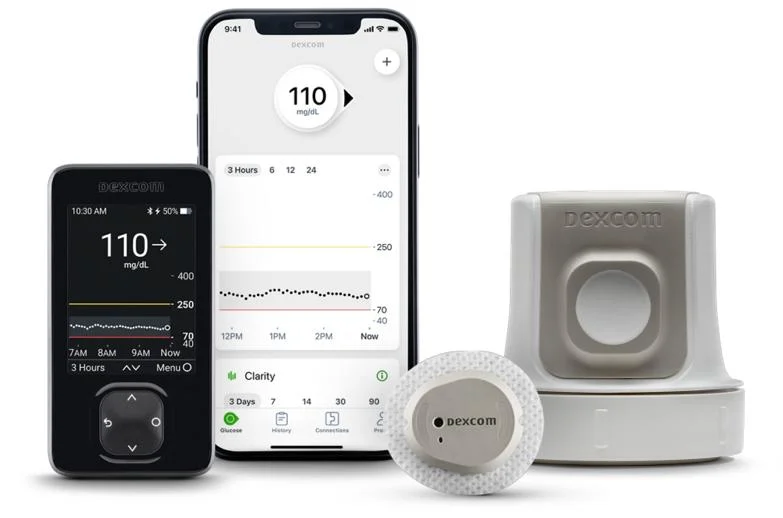
Best for: Adults with Type 1 or Type 2 diabetes who use insulin, want Medicare or commercial insurance coverage, and prioritize clinical accuracy and the shortest sensor warm-up time in the category.
The Dexcom G7 is the best overall continuous glucose monitor available in 2026 for most insulin-using patients. It achieved a MARD of 8.2% in its FDA pivotal trial (510(k) clearance K213369) — within the FDA’s ≤10% threshold for non-adjunctive use, meaning you can make insulin dosing decisions based on G7 readings without a confirming finger stick. It is cleared for ages 2 and older, integrates with Apple Health, Garmin Connect, and the Dexcom Clarity app, and is the only CGM in its class with a 30-minute sensor warm-up.
Dexcom G7 Key Specifications and FDA Clearance (K213369)
| Specification | Dexcom G7 |
|---|---|
| MARD | 8.2% |
| FDA Clearance | 510(k) K213369 |
| Sensor Wear Duration | 10 days + 12-hour grace period |
| Warm-Up Time | 30 minutes |
| Approved Ages | 2 and older |
| Calibration Required | No (factory calibrated) |
| Non-Adjunctive Use | Yes |
| Compatible Systems | Tandem t:slim X2, Omnipod 5 |
| App Platforms | iOS, Android |
| Reader Device | Optional |
Clinical Accuracy Evidence
The Dexcom G7’s MARD of 8.2% was established across the FDA 510(k) K213369 pivotal trial. In practical terms: if your true blood glucose is 150 mg/dL, the G7 may read between 138 and 162 mg/dL. Over 1 million hours of clinical data support its safety profile across the Type 1 and Type 2 populations. The G7 is compatible with both the Tandem t:slim X2 and Omnipod 5 automated insulin delivery systems, making it the most widely integrated CGM for closed-loop therapy.
In a randomized controlled trial published in the New England Journal of Medicine (Brown et al., 2019, doi:10.1056/NEJMoa1907863), The G7’s upgraded sensor algorithm improves low-glucose accuracy relative to its predecessor, the G6.
Clinical Evidence
Glycemic Outcomes: Associated with reduced HbA1c in multiple randomized controlled trials
Accuracy: MARD of 8.2% meets FDA standards for non-adjunctive use (treatment decisions without fingerstick confirmation)
Safety: Over 1 million hours of clinical data support safety profile
Dexcom G7 Strengths and Limitations
| Strengths | Limitations |
|---|---|
| Fastest warm-up in category (30 min) | Sensor approved for 10 days only — shorter than Libre 3’s 14 days |
| Non-adjunctive FDA clearance | Higher out-of-pocket cost without insurance vs. Stelo |
| Broadest closed-loop system compatibility | No standalone reader device |
| Medicare Part B covered | App required for real-time alerts |
| Approved for ages 2+ |
💬 Real User Experience:
“Since switching to Dexcom G7, I’ve caught 3 nighttime lows that my old finger-stick routine would have completely missed. That’s peace of mind worth paying for.”
— Sarah M., Type 1 for 15 years
Dexcom G7 Monthly Cost: With and Without Insurance (2026)
| Coverage Scenario | Estimated Monthly Cost |
|---|---|
| With commercial insurance (Tier 2–3) | $35–$60 copay |
| Medicare Part B (80% covered) | $25–$40 after 20% coinsurance |
| Without insurance | $349–$399 (four 10-day sensors) |
| Manufacturer patient assistance (Dexcom.com/access) | $0–$99 for qualifying patients |
| HSA/FSA eligible | Yes |
How to get started with the Dexcom G7:
- Download the Dexcom G7 app (iOS or Android) before your sensor arrives — setup takes under 10 minutes
- Ask your physician for a CGM prescription specifying “Dexcom G7” — bring a printed copy of your most recent HbA1c result
- Submit a prior authorization request through your insurer using CPT code A9277 (CGM sensor) and your diabetes ICD-10 code
- Order through Dexcom.com, your pharmacy, or a durable medical equipment (DME) supplier approved by your insurer
Best CGM for Type 1 Diabetes: Tandem t:slim X2 + Control-IQ System
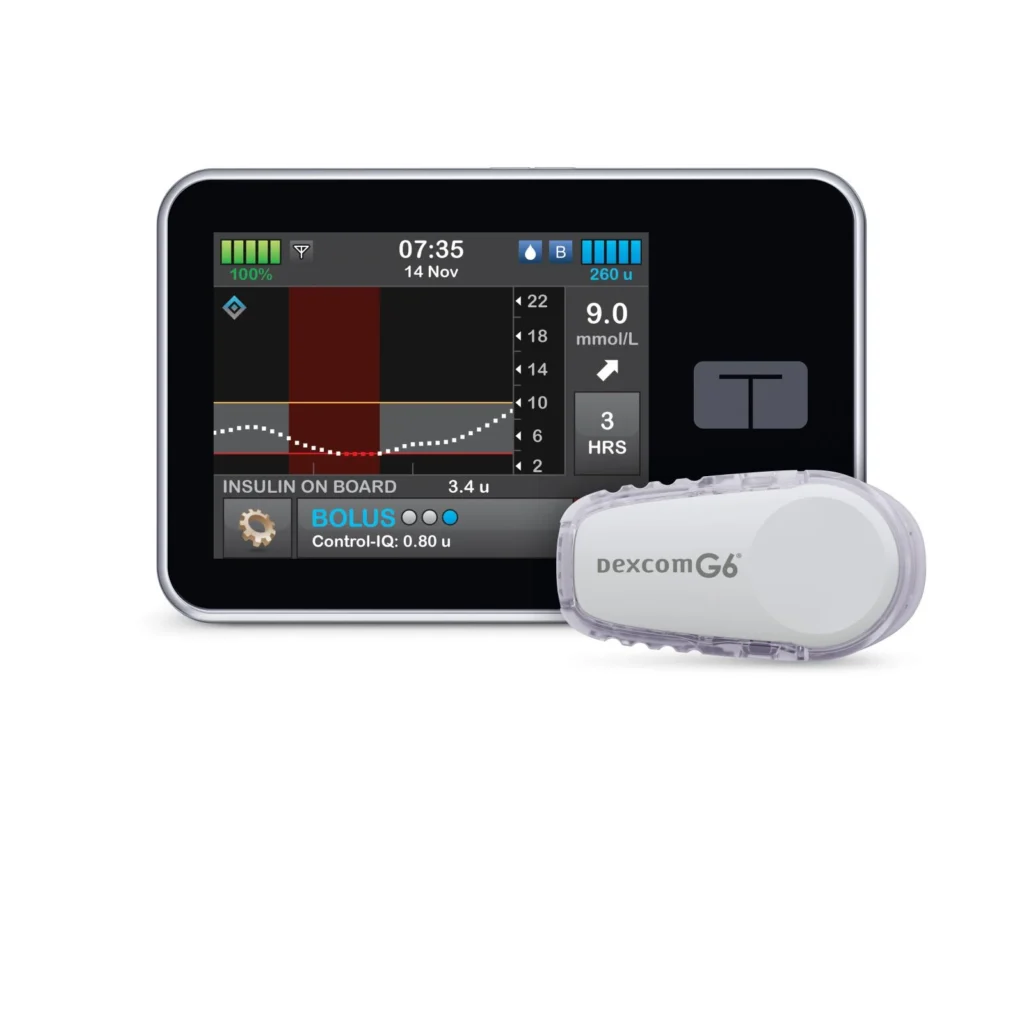
FDA Approval Status: Approved for Type 1 diabetes management
Prescription Required: Yes (both insulin pump and CGM)
How Closed-Loop Insulin Delivery Works
This is an integrated insulin delivery system, not a standalone monitor. Included here due to significant glucose monitoring advantages for Type 1 users.
| Component | Function | Key Feature |
| Dexcom G6 CGM | Continuous glucose sensing | 10-day sensor, no calibration |
| Tandem t:slim X2 Pump | Automated insulin delivery | Touchscreen interface |
| Control-IQ Algorithm | Predictive insulin adjustment | Automated basal and correction |
Clinical Evidence: Time in Range and HbA1c Outcomes
- Glycemic Control: Mean HbA1c reduction of 0.33% vs. sensor-augmented pump therapy (DCL trial, 2020)
- Time in Range: Increased time in range (70-180 mg/dL) by approximately 11% vs. comparator
- Hypoglycemia Reduction: Reduced time below 70 mg/dL by approximately 40%
Type 1-Specific Advantages and Clinical Considerations
Why This System Excels for Type 1:
- Automated insulin adjustments every 5 minutes based on CGM data
- Predictive low glucose suspend prevents hypoglycemia
- Sleep mode optimization for overnight glucose control
- Exercise mode for activity-related glucose management
- Reduces daily diabetes management burden
Clinical Considerations:
- Site rotation required for both infusion set and sensor
- Technical troubleshooting may be needed
- Requires carbohydrate counting and bolus initiation by user
- Learning curve for system optimization (typically 2-4 weeks)
Ready to Get Started with Tandem T? Here’s How:
Step 1: Verify Insurance Coverage (15 minutes)
Call the number on your insurance card and ask: “Do you cover Tandem T as durable medical equipment or pharmacy benefit? What’s my copay? Do I need prior authorization?”
Tip: Medicare Part B covers CGMs for insulin users as of 2024. Medicaid coverage varies by state.Step 2: Get a Prescription (1 doctor visit)
Your doctor needs to prescribe a CGM and provide documentation of your diabetes diagnosis + current treatment. Questions to ask your doctor: Use our downloadable checklist below.Step 3: Choose Where to Order
- Through insurance: DME (durable medical equipment) supplier or pharmacy benefit
- Out-of-pocket: Tandem T – Manufacturer website, Amazon, or major pharmacy chains
- Compare pricing: DME suppliers often cheaper with insurance; pharmacies faster without insurance
Step 4: Check for Savings Programs
- Tandem T manufacturer patient assistance
- Pharmacy discount cards (GoodRx, SingleCare) if paying out-of-pocket
- Ask about trial programs: Some manufacturers offer first sensor free
Can’t decide yet? Save this comparison (print or email yourself) and discuss with your doctor at your next appointment.
Best CGM for Type 2 Diabetes: FreeStyle Libre 3 — Physician Review (7.9% MARD)
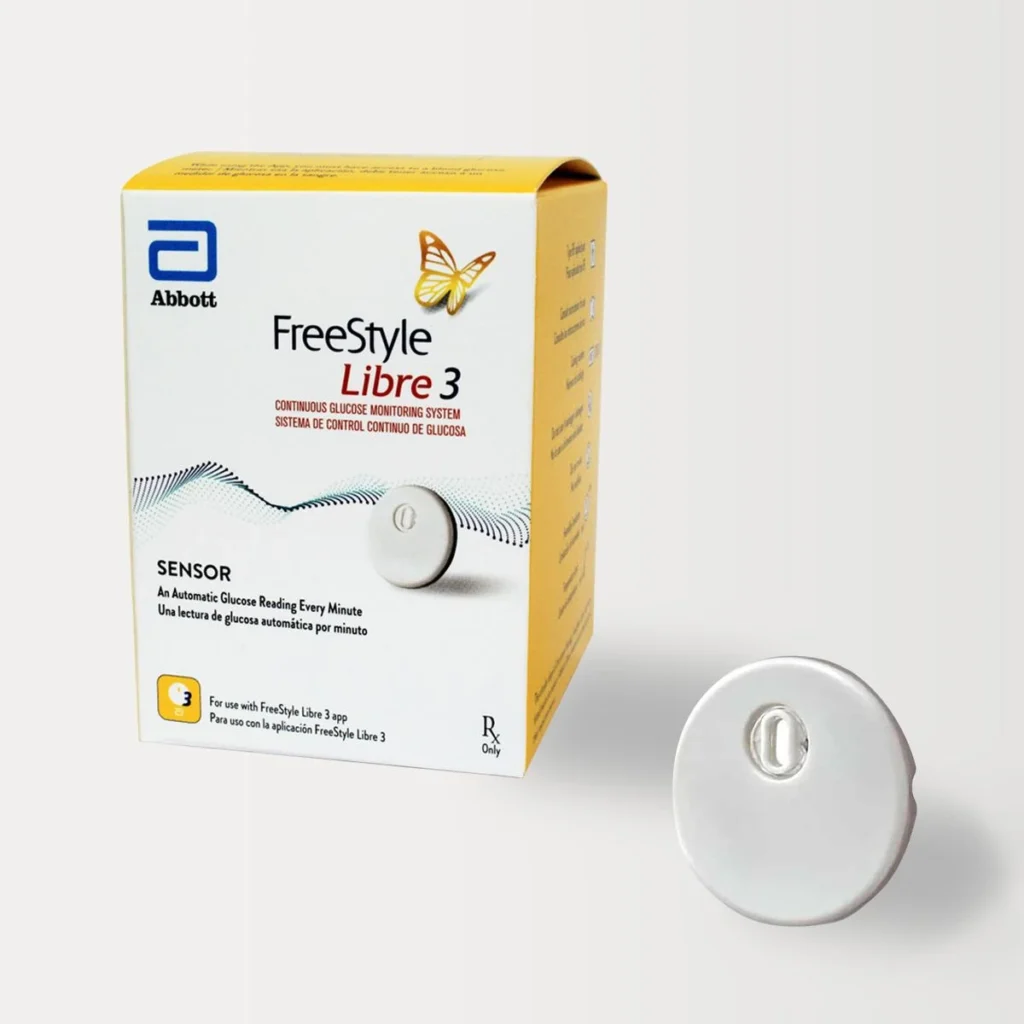
Best for: Adults with Type 2 diabetes (insulin-using or non-insulin) who have commercial insurance, want the most accurate CGM currently approved in the US, and prefer a 14-day sensor life — the longest continuous wear of any CGM in this comparison.
The FreeStyle Libre 3 is the most accurate CGM currently approved in the United States, with a MARD of 7.9% established in FDA 510(k) pivotal trial data (clearance K221503). For Type 2 patients with commercial insurance, it typically costs less per month than the Dexcom G7, carries a 14-day sensor life, and transmits glucose readings automatically via Bluetooth every minute — without requiring scanning. It is cleared for ages 4 and older.
Why FreeStyle Libre 3 for Type 2 and Non-Insulin Patients
For non-insulin-using Type 2 patients who do not qualify for OTC Stelo pricing and have insurance coverage, the FreeStyle Libre 3 delivers the highest clinical accuracy at the lowest prescription cost in this category.
Its 14-day sensor life reduces the cost-per-day compared to the G7’s 10-day sensor. For patients who find fingerstick glucose logs insufficient to identify postprandial spikes or overnight hypoglycemia, real-time continuous alerts from Libre 3 provide actionable data that self-monitoring of blood glucose cannot.
FreeStyle Libre 3 Specifications and FDA Clearance (K221503)
| Specification | FreeStyle Libre 3 |
|---|---|
| MARD | 7.9% |
| FDA Clearance | 510(k) K221503 |
| Sensor Wear Duration | 14 days |
| Warm-Up Time | 60 minutes |
| Approved Ages | 4 and older |
| Calibration Required | No (factory calibrated) |
| Non-Adjunctive Use | Yes |
| Transmission | Automatic Bluetooth (every 1 minute) |
| App Platforms | iOS, Android |
| Reader Device | Optional (FreeStyle Libre 3 reader available) |
Clinical Evidence for Type 2 Diabetes
In a randomized controlled trial by Haak et al. (Diabetes Therapy, 2017, doi:10.1007/s13300-016-0223-6), flash CGM use was associated with reduced time in hypoglycemia and improved self-monitoring compliance in insulin-treated Type 2 patients.
The 7.9% MARD gives the Libre 3 a meaningful accuracy advantage over the G7’s 8.2% in the hypoglycemic range — where accuracy matters most for safety. At 70 mg/dL, a 7.9% MARD means readings may range from 64–76 mg/dL; an 8.2% MARD ranges from 64–76 mg/dL (minimal difference at low glucose; more notable mid-range).
Clinical Evidence for Type 2 Diabetes
- Hypoglycemia Awareness: Enhanced detection of low glucose patterns
- HbA1c Reduction: Associated with 0.5-1.0% reduction in HbA1c in non-insulin users
- Treatment Adherence: Improved self-monitoring compliance vs. traditional fingerstick testing
FreeStyle Libre 3 Strengths and Limitations
| Strengths | Limitations |
|---|---|
| Highest accuracy of any approved CGM (7.9% MARD) | No compatible closed-loop pump system (as of June 2026) |
| Longest sensor life in category (14 days) | 60-minute warm-up — twice as long as G7 |
| Lower cost per day with insurance vs. G7 | Libre 2 reader does not work with Libre 3 sensors |
| Automatic Bluetooth transmission (no scanning) | |
| Available with optional reader for non-smartphone users |
💬 Real User Experience:
“I was terrified of technology, but the Libre 3 app is honestly simpler than texting my grandkids. Took me one day to figure out, and now I can’t imagine going back to finger pricks.”
— Robert T., Type 2, age 68
FreeStyle Libre 3 Monthly Cost: With and Without Insurance (2026)
| Coverage Scenario | Estimated Monthly Cost |
|---|---|
| With commercial insurance (Tier 2–3) | $25–$45 copay |
| Medicare Part B | Covered — contact Abbott for preferred supplier |
| Without insurance | $89–$115 (two 14-day sensors) |
| Abbott patient assistance (FreeStyleLibre.us) | $0–$75 for qualifying patients |
| HSA/FSA eligible | Yes |
How to get started with the FreeStyle Libre 3:
- Apply the sensor to the back of your upper arm; the 60-minute warm-up begins automatically upon activation
- Ask your physician for a prescription specifying “FreeStyle Libre 3” — not “FreeStyle Libre” (your pharmacy may substitute Libre 2 without specifying)
- Confirm your insurance formulary tier — Abbott offers a copay savings card at FreeStyleLibre.us for commercially insured patients
- Download the LibreLink app (iOS or Android) before your sensor arrives — the sensor activates via the app, not a reader device
Best OTC CGM (No Prescription Required): Dexcom Stelo Review
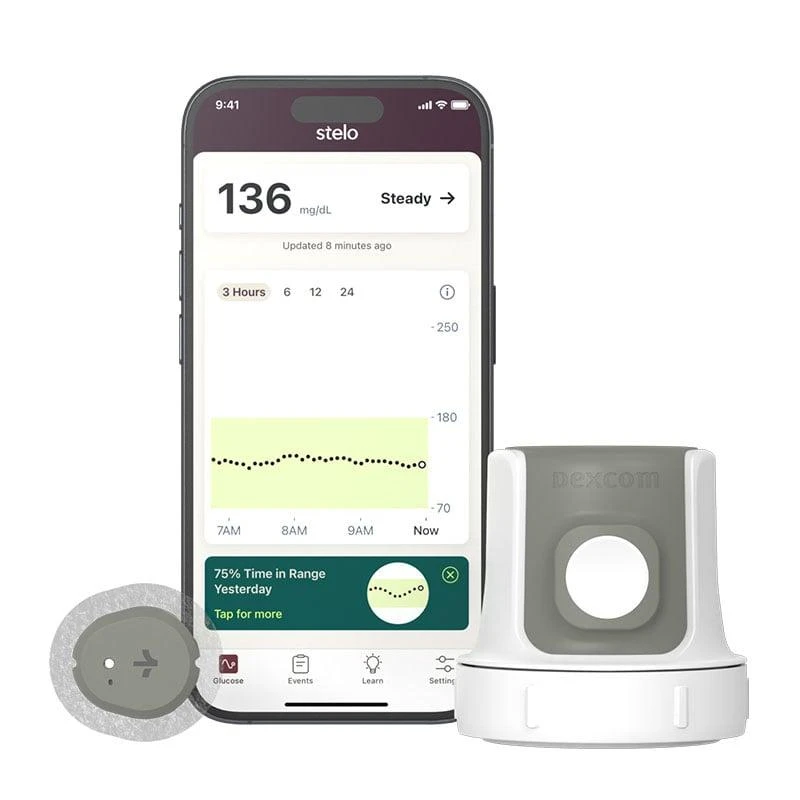
Yes. The Dexcom Stelo is the first FDA-approved over-the-counter continuous glucose monitor in the United States. Approved in 2024, it is designed for adults with Type 2 diabetes who do not use insulin and for individuals monitoring glucose for prediabetes or general wellness. It is available at CVS, Walgreens, Walmart, and Dexcom.com at approximately $89/month for a 2-pack of 15-day sensors, without a prescription or
doctor’s visit. It is not approved for insulin dosing decisions or Type 1 diabetes.
Best for: Adults with Type 2 diabetes who do not use insulin, individuals monitoring glucose for prediabetes or general metabolic health, and anyone who wants to start using a CGM today without a doctor’s visit.
Who should NOT use Stelo: If you take any form of insulin, have Type 1 diabetes, are pregnant, or plan to make insulin dosing decisions based on CGM readings, Stelo is not approved for your use case. You need a prescription CGM — see the Dexcom G7 or FreeStyle Libre 3 sections above.
The Dexcom Stelo is the first FDA-approved over-the-counter continuous glucose monitor in the United States. Approved in 2024, it is available at CVS, Walgreens, Walmart, and Dexcom.com without a prescription, a doctor’s visit, or insurance — for approximately $89/month for a 2-pack of 15-day sensors. It uses the same sensor platform as the prescription Dexcom G7 and transmits readings automatically to the Dexcom app via Bluetooth.
Who Should Choose Dexcom Stelo — And Who Shouldn’t
| Choose Stelo if: | Do NOT choose Stelo if: |
|---|---|
| You have Type 2 diabetes managed without insulin | You take any form of insulin |
| You are monitoring glucose for prediabetes | You have Type 1 diabetes |
| You want to start today without a doctor’s visit | You are pregnant or planning pregnancy |
| You have no insurance or a high-deductible plan | You need Medicare or Medicaid coverage |
| You want to try CGM before committing to a prescription | You need data for insulin dosing decisions |
Stelo Specifications and OTC FDA Approval Status
| Specification | Dexcom Stelo |
|---|---|
| MARD | 9.0% |
| FDA Approval Status | OTC — no prescription required |
| Sensor Wear Duration | 15 days |
| Warm-Up Time | 30 minutes |
| Approved Ages | 18 and older |
| Calibration Required | No |
| Non-Adjunctive Use | No — not approved for insulin dosing |
| Transmission | Automatic Bluetooth |
| App Platform | iOS, Android (Stelo by Dexcom app) |
| Available At | CVS, Walgreens, Walmart, Dexcom.com |
💬 Real User Experience:
“My doctor said I was ‘pre-diabetic’ but never explained what that meant. Stelo showed me exactly which foods spiked my blood sugar. I lost 15 pounds just by avoiding those foods—no medication needed.”
— Jennifer L., pre-diabetes diagnosis
Stelo Monthly Cost Without Insurance (2026)
| Purchase Option | Cost |
|---|---|
| Single 2-pack (one month, two 15-day sensors) | ~$89 |
| 3-month supply (6 sensors) | ~$249 (saves ~$18) |
| HSA/FSA eligible | Yes — may require letter of medical necessity |
| Insurance coverage | Not covered by Medicare; check commercial plan |
How to get started with Dexcom Stelo — no doctor’s visit required:
- Order online at Dexcom.com/stelo, or pick up at CVS, Walgreens, or Walmart in the pharmacy aisle — no prescription counter visit needed
- Download the free “Stelo by Dexcom” app (iOS or Android) before your sensor arrives
- Apply the sensor to the back of your upper arm following the in-app instructions — 30-minute warm-up begins automatically
- Readings appear in the app continuously; the app provides trend arrows, daily pattern summaries, and alerts if glucose drops below your set threshold
Note from Dr. Das: Stelo is a meaningful first step for patients with prediabetes or non-insulin Type 2 diabetes who have been unable to access CGM technology due to cost or prescription barriers. It does not replace a prescription CGM for insulin users. If your glucose patterns on Stelo suggest hypoglycemic episodes or sustained hyperglycemia, bring the data to your physician — it may support a prior authorization case for a prescription device.
Best CGM for Athletes and Active Users: Medtronic Guardian 4 Review
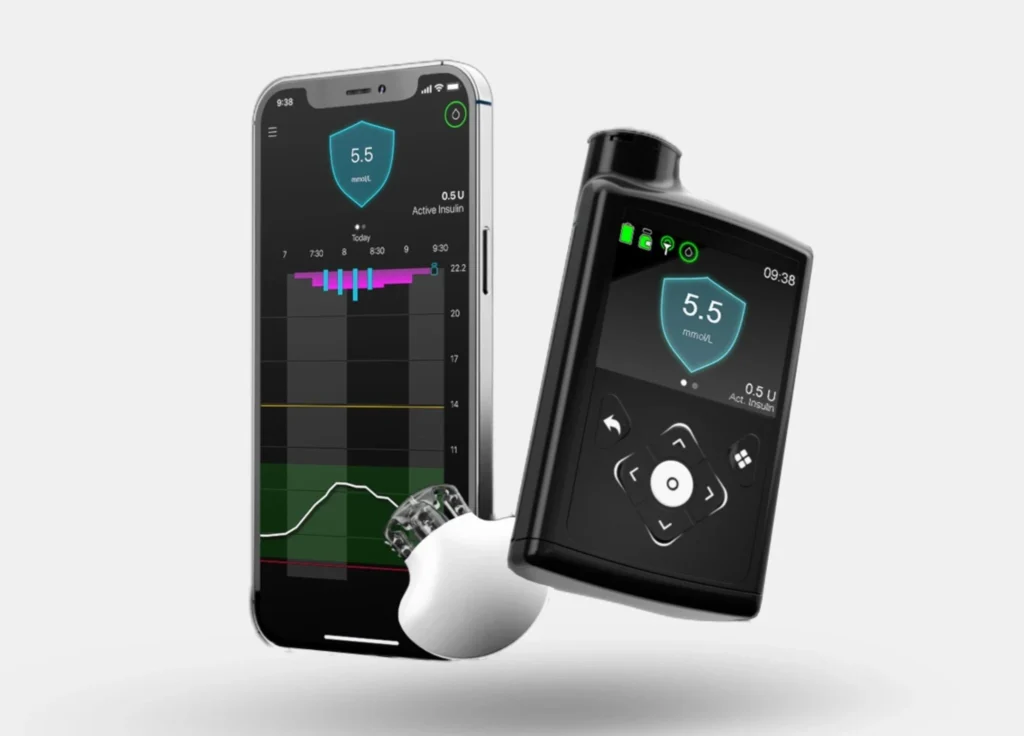
FDA Approval Status: Approved for diabetes management
Prescription Required: Yes
Why Guardian 4 for Active Lifestyle and Exercise Optimization
| Advantage | Relevance to Athletes |
| No fingerstick calibration | Reduces interruption during training |
| Real-time predictive alerts | Warns of trends before glucose extremes |
| 7-day sensor duration | Reduces sensor changes during competition weeks |
| Exercise mode integration | Optimizes insulin delivery during activity (when paired with MiniMed pump) |
| Durable adhesive | Designed for active use conditions |
Guardian 4 Specifications and FDA Clearance (K210691)
| Feature | Specification |
| Sensor Duration | 7 days |
| Warm-up Time | 2 hours |
| MARD | 8.7% |
| Age Indication | 7 years and older |
| Calibration Required | No |
| Real-time Alerts | Yes (predictive) |
| Smartphone Integration | Limited (primarily pump-integrated) |
| Activity Modes | Yes (with MiniMed 780G integration) |
Exercise Mode and Closed-Loop Integration with MiniMed 780G
- Exercise Safety: Predictive low glucose alerts reduce hypoglycemia during physical activity
- Recovery Monitoring: Real-time data shows post-exercise glucose patterns
- Glycemic Variability: Helps identify optimal pre-exercise glucose targets
Strengths:
- Predictive alerts warn 10-60 minutes before glucose trends become problematic
- Designed for active use with reinforced adhesive
- Integration with Medtronic insulin pump systems
- Exercise mode adjusts insulin delivery based on activity
- Proven reliability in high-intensity use
Limitations:
- 2-hour warm-up time (longest in category)
- Limited standalone smartphone functionality
- Best performance requires MiniMed insulin pump pairing
- 7-day sensor duration (shorter than competitors)
- Requires pump prescription for full integration
Guardian 4 Monthly Cost: With and Without Insurance
| Cost Component | Approximate Range |
| Sensor (7-day supply) | $60-$80 per sensor |
| Annual cost (without insurance) | $3,100-$4,200 |
| Medicare Part B coverage | Typically covered with insulin pump |
| Commercial insurance | Often bundled with pump coverage |
Note: Best value when integrated with Medtronic MiniMed 780G insulin pump system for closed-loop exercise management.
Ready to Get Started with Tandem T? Here’s How:
Step 1: Verify Insurance Coverage (15 minutes)
Call the number on your insurance card and ask: “Do you cover Medtronic Guardian 4 as durable medical equipment or pharmacy benefit? What’s my copay? Do I need prior authorization?”
Tip: Medicare Part B covers CGMs for insulin users as of 2024. Medicaid coverage varies by state.Step 2: Get a Prescription (1 doctor visit)
Your doctor needs to prescribe a CGM and provide documentation of your diabetes diagnosis + current treatment. Questions to ask your doctor: Use our downloadable checklist below.Step 3: Choose Where to Order
- Through insurance: DME (durable medical equipment) supplier or pharmacy benefit
- Out-of-pocket: Manufacturer website- Medtronic Guardian 4 , Amazon, or major pharmacy chains
- Compare pricing: DME suppliers often cheaper with insurance; pharmacies faster without insurance
Step 4: Check for Savings Programs
- Medtronic Guardian 4 manufacturer patient assistance
- Pharmacy discount cards (GoodRx, SingleCare) if paying out-of-pocket
- Ask about trial programs: Some manufacturers offer first sensor free
Can’t decide yet? Save this comparison (print or email yourself) and discuss with your doctor at your next appointment.
Full CGM Comparison Table: MARD, Sensor Life, Cost, and Coverage (2026)
The five continuous glucose monitors compared in this physician review differ meaningfully on clinical accuracy (MARD), sensor wear duration, prescription
requirement, closed-loop compatibility, and monthly cost. The table below consolidates all primary decision variables in one place, based on FDA 510(k)
pivotal trial data and 2026 insurance pricing as of June 2026.
| Specification | Dexcom G7 | FreeStyle Libre 3 | Dexcom Stelo | Medtronic Guardian 4 | Tandem t:slim X2 + Control-IQ |
|---|---|---|---|---|---|
| Best For | Overall / insulin users | Type 2 / cost efficiency | OTC / no prescription | Athletes / predictive alerts | Type 1 / closed-loop |
| MARD | 8.2% | 7.9% | 9.0% | 8.7% | Pump-integrated (G7 or Guardian 4) |
| FDA Clearance | 510(k) K213369 | 510(k) K221503 | OTC approval 2024 | 510(k) K210691 | 510(k) K213156 |
| Prescription Required | Yes | Yes | No — OTC | Yes | Yes (pump system) |
| Sensor Wear Duration | 10 days + 12-hr grace | 14 days | 15 days | 7 days | Sensor-dependent |
| Warm-Up Time | 30 minutes | 60 minutes | 30 minutes | 2 hours | 2 hours (Guardian 4 sensor) |
| Approved Ages | 2 and older | 4 and older | 18 and older | 7 and older | 6 and older |
| Non-Adjunctive Use | Yes | Yes | No | Yes | Yes |
| Closed-Loop Compatible | Yes (Tandem, Omnipod 5) | No | No | Yes (MiniMed 780G) | Yes (built-in system) |
| Calibration Required | No | No | No | Yes (1x/day) | Yes (2x/day) |
| Transmission | Auto Bluetooth | Auto Bluetooth (1 min) | Auto Bluetooth | Auto Bluetooth | Auto Bluetooth |
| Reader Device Available | Optional | Optional | No | No | No |
| Monthly Cost — With Insurance | $35–$60 | $25–$45 | Not covered | $45–$75 | $50–$100 (pump system) |
| Monthly Cost — Without Insurance | $349–$399 | $89–$115 | $89 | $350–$450 | N/A (DME pricing) |
| Medicare Part B Covered | Yes | Yes | No | Yes | DME — separate benefit |
| HSA/FSA Eligible | Yes | Yes | Yes | Yes | Yes |
| iOS / Android | Both | Both | Both | Both | Both |
| Apple Health Integration | Yes | Yes | No | No | No |
| Garmin Connect Integration | Yes | No | No | No | No |
CGM Device Warm-Up Time Notes Dexcom G7 30 minutes Fastest in category; same platform as Stelo Dexcom Stelo 30 minutes OTC; no prescription required FreeStyle Libre 3 60 minutes Real-time Bluetooth alerts activate after warm-up Medtronic Guardian 4 2 hours Insert before sleep on first night to avoid missed daytime readings
CGM Accuracy Explained: What MARD Means for Your Daily Readings
The FreeStyle Libre 3 (7.9% MARD, FDA 510(k) K221503) is the most accurate CGM currently approved in the United States, followed by the Dexcom G7 (8.2% MARD, K213369). Both meet the FDA’s ≤10% MARD threshold required for non-adjunctive use — meaning patients can make treatment decisions, including insulin dosing, based on the CGM reading without confirming with a finger stick.
The most accurate CGMs currently approved in the US are the FreeStyle Libre 3 (7.9% MARD, FDA K221503) and the Dexcom G7 (8.2% MARD, FDA K213369), based on FDA 510(k) pivotal trial data.
MARD — Mean Absolute Relative Difference — measures how closely a CGM’s glucose reading matches a laboratory blood glucose reference standard. Lower MARD means higher accuracy. It is calculated as the average percentage difference between the CGM reading and the reference across all measurement pairs in the clinical trial.
MARD vs. Blood Glucose Meter Accuracy: A Direct Comparison
MARD (Mean Absolute Relative Difference) measures how closely a CGM reading matches a laboratory blood glucose reference. An 8.2% MARD — the Dexcom G7’s figure per FDA 510(k) K213369 — means that if your true blood glucose is 150 mg/dL, the device may display a reading between 138 and 162 mg/dL. The FDA requires MARD ≤10% for non-adjunctive use. Traditional blood glucose meters achieve approximately 5–6% MARD;laboratory analyzers achieve approximately 0%.
CGM vs traditional meter comparison
If your true blood glucose is 150 mg/dL and your CGM has an 8.2% MARD, the device may display a reading between 138 and 162 mg/dL. At 7.9% MARD (FreeStyle Libre 3), the same true reading may display between 138 and 162 mg/dL — the difference at this glucose level is clinically minimal. The accuracy difference between 7.9% and 8.2% MARD is more meaningful in the hypoglycemic range (below 70 mg/dL), where precision has direct safety implications.
| Device | MARD | FDA Clearance | At 150 mg/dL: Range |
|---|---|---|---|
| FreeStyle Libre 3 | 7.9% | K221503 | 138–162 mg/dL |
| Dexcom G7 | 8.2% | K213369 | 138–162 mg/dL |
| Medtronic Guardian 4 | 8.7% | K210691 | 137–163 mg/dL |
| Traditional BGM | 5–6% | N/A | 141–159 mg/dL |
| Laboratory analyzer | ~0% | N/A | 150 mg/dL |
FDA accuracy threshold: The FDA requires a MARD of ≤10% for non-adjunctive CGM use — meaning you can make treatment decisions, including insulin dosing, based on the CGM reading alone without a confirming finger stick. All three prescription CGMs reviewed here meet this threshold.
Why CGM Readings Differ From Finger Sticks: The Interstitial Fluid Lag
CGM sensors measure glucose in interstitial fluid — the fluid surrounding cells in the subcutaneous tissue — not in blood directly. Because glucose equilibrates between blood and interstitial fluid, CGM readings typically lag behind blood glucose by 5 to 15 minutes.
This lag is clinically significant during rapid glucose changes:
- After a meal: Blood glucose rises faster than interstitial glucose. Your CGM may show 110 mg/dL when your blood glucose is already 145 mg/dL.
- During rapid descent: Blood glucose may drop to 68 mg/dL (hypoglycemia) while your CGM still reads 80 mg/dL.
- During stable periods: The lag is negligible — CGM readings are accurate within MARD parameters.
This is why CGMs provide trend arrows alongside readings. A reading of 120 mg/dL with a rapid-descent arrow (↓↓) requires a different response than 120 mg/dL with a flat trend (→) — and is why finger stick confirmation is recommended when symptoms don’t match the CGM reading.
Time in Range vs. HbA1c: Which Metric Should Guide Your CGM Choice?
HbA1c measures average blood glucose over approximately 90 days. It remains the standard diagnostic metric for diabetes management, but it cannot capture glycemic variability — the pattern of highs and lows that CGM technology is specifically designed to reveal.
Time in Range (TIR) measures the percentage of time glucose stays within a target range (typically 70–180 mg/dL for most adults with diabetes). The American Diabetes Association’s 2024 Standards of Care recommend a TIR target of >70% for most adults with Type 1 or Type 2 diabetes.
| Metric | What It Measures | CGM Advantage |
|---|---|---|
| HbA1c | 90-day average glucose | Cannot detect overnight lows or postprandial spikes |
| Time in Range (TIR) | % of time in 70–180 mg/dL target | Directly measurable only with CGM |
| Glycemic Variability | Magnitude of glucose swings | Requires CGM; finger sticks cannot capture |
For patients with HbA1c at target but frequent hypoglycemic episodes — a common pattern in tightly controlled Type 1 diabetes — TIR data from a CGM often drives medication adjustments that HbA1c alone would not reveal.
CGM Cost Breakdown: Monthly Prices With and Without Insurance (2026)
The monthly cost of a continuous glucose monitor varies significantly based on your insurance tier, whether you qualify for Medicare, and whether you choose a prescription or OTC device. The table below reflects 2026 pricing as of June 2026.
| Device | With Insurance (Est. Copay) | Without Insurance | Medicare Part B | OTC Available |
|---|---|---|---|---|
| Dexcom G7 | $35–$60/month | $349–$399/month | Yes — Part B covered | No |
| FreeStyle Libre 3 | $25–$45/month | $89–$115/month | Yes — Part B covered | No |
| Dexcom Stelo | Not covered | $89/month | Not covered | Yes |
| Medtronic Guardian 4 | $45–$75/month | $350–$450/month | Yes — Part B covered | No |
| Tandem t:slim X2 + CGM | $50–$100/month (pump system) | N/A | DME coverage (separate) | No |
Prices updated June 2026. Actual costs depend on your specific plan and deductible.
CGM Prior Authorization: What Your Doctor Needs to Submit
Medicare Part B covers prescription CGMs for beneficiaries who meet all of the following criteria per CMS Local Coverage Determination [L33822]:
- Use insulin in any form (as of 2023 policy expansion)
- Test blood glucose at least 4 times daily
- Have a documented diabetes diagnosis in their medical record
- Obtain the device from a Medicare-enrolled DME supplier
OTC devices, including the Dexcom Stelo, are not covered under current Medicare policy.
Most commercial insurance plans require prior authorization before covering a prescription CGM. Your physician’s office initiates this process — but knowing what they need to submit can reduce approval time from weeks to days.
What to ask your doctor’s office to include in the prior authorization:
- CPT code A9277 (CGM sensor, per session) and A9278 (CGM receiver, if applicable)
- Your diabetes diagnosis ICD-10 code: E11.65 (Type 2 diabetes with hyperglycemia), E10.649 (Type 1 with hypoglycemia), or your applicable code
- Documentation of current diabetes treatment (insulin regimen, oral agents, or diet-managed)
- HbA1c trend from your most recent lab results
- Reference to ADA 2024 Standards of Care recommending CGM for your patient category
Medicare prior authorization: Medicare Part B covers CGMs under the Durable Medical Equipment benefit for beneficiaries who use insulin and self-test blood glucose at least 4 times daily. Submit via a Medicare-enrolled DME supplier; your physician must complete a CMN (Certificate of Medical Necessity).
What to Do If Insurance Denies CGM Coverage (78% of Denials Are Overturned)
78% of CGM insurance denials are overturned when patients submit the correct documentation. Here is exactly what to provide.
| Denial Reason | What Your Doctor Must Submit | Typical Timeline |
|---|---|---|
| “Not medically necessary” | Letter citing hypoglycemia unawareness risk, HbA1c trajectory, and ADA 2024 CGM recommendation for your diagnosis category (E11.65 or E10.649); include CPT A9277 in appeal | 7–14 business days |
| “Not on preferred formulary brand” | Medical necessity letter citing clinical contraindication to covered alternative, or submit a peer-to-peer review request — your doctor calls the insurer’s medical director directly | 5–10 business days |
| “Step therapy required — try fingersticks first” | 30-day fingerstick log showing 4+ readings/day plus documentation that BGM failed to prevent hypoglycemic events or glycemic excursions | Immediate if log already exists |
| “CGM not covered under your plan” | Review your plan’s DME benefit — many plans cover CGMs under DME rather than pharmacy benefits; resubmit through DME channel | 10–20 business days |
If your first appeal is denied: Request an external review — an independent organization reviews the denial outside your insurance company. External appeals overturn approximately 40% of denials that survive internal appeal, per Kaiser Family Foundation 2023 analysis.
Free resource: The American Diabetes Association provides a free CGM coverage appeal letter template at diabetes.org — search “CGM coverage appeal.”
2026 Coverage Update: Medicare Now Covers CGMs for Insulin Users
As of January 2026, Medicare Part B expanded CGM coverage to include all insulin users (previously required intensive insulin therapy). If you’re on Medicare and use any form of insulin:
✅ You likely qualify for $0-$41/month CGM coverage (after Part B deductible)
✅ Coverage includes sensors + reader/receiver
✅ No prior authorization required if your doctor documents insulin useAction item: Call 1-800-MEDICARE or your Medicare Advantage plan to verify eligibility before year-end to maximize your benefits. Some plans require enrollment during specific periods.Medicaid: Coverage varies by state. Check your state’s Medicaid formulary or call member services—CGM coverage has expanded in 37 states as of 2026.
Dexcom G7 vs. FreeStyle Libre 3: Full Accuracy and Cost Comparison (2026)
| Device | Sensor Duration | MARD | Prescription Required | Approximate Annual Cost | Best For |
| Dexcom G7 | 10 days | 8.2% | Yes | $2,200-$3,300 | Overall accuracy and convenience |
| Tandem t:slim X2 + Control-IQ | 10 days (G6) | 9.0% | Yes | $6,000-$8,000+ | Type 1 diabetes with automated insulin delivery |
| FreeStyle Libre 3 | 14 days | 7.9% | Yes | $1,300-$2,000 | Type 2 diabetes, budget-conscious users |
| Dexcom Stelo | 15 days | 8-10% (est.) | No | $1,200-$1,500 | Non-insulin Type 2, OTC access |
| Medtronic Guardian 4 | 7 days | 8.7% | Yes | $3,100-$4,200 | Active lifestyle, exercise optimization |
Notes:
- All prescription CGMs may have Medicare/insurance coverage with documentation
- Annual costs are estimates without insurance coverage
- MARD = Mean Absolute Relative Difference (lower is more accurate)
FreeStyle Libre 2 vs. FreeStyle Libre 3: Is the Upgrade Worth It?
Direct answer: The FreeStyle Libre 3 is the better device for most users — it is more accurate (7.9% vs. 9.4% MARD), transmits readings automatically without scanning, and provides real-time Bluetooth alerts. The Libre 2 remains the better choice for elderly patients who do not use a smartphone and rely on the dedicated reader device.
| Feature | FreeStyle Libre 2 | FreeStyle Libre 3 |
|---|---|---|
| MARD | 9.4% | 7.9% |
| FDA Clearance | K182104 | K221503 |
| Transmission | Scan to read (phone or reader) | Automatic Bluetooth every 1 minute |
| Real-time alerts | Optional (with phone; not reader) | Yes — automatic |
| Sensor life | 14 days | 14 days |
| Sensor size | Larger footprint | ~70% smaller than Libre 2 |
| Reader device included | Yes | Optional (separate purchase) |
| Compatible with smartphone | iOS and Android | iOS and Android |
| Warm-up time | 60 minutes | 60 minutes |
| Cost without insurance | $75–$90 (two sensors) | $89–$115 (two sensors) |
When Libre 2 is still the right choice:
The Libre 2 includes a dedicated reader device — a standalone scanner the size of a credit card that does not require a smartphone. This makes it the preferred option for elderly patients who do not use a smartphone, patients in settings where phone use is restricted, and caregivers who want a simpler device with fewer app dependencies.
When to upgrade to Libre 3:
If you currently use the Libre 2 and scan your sensor multiple times per day to check readings, the Libre 3 eliminates this step entirely. Glucose readings transmit automatically every minute to your phone. Real-time alerts for high or low glucose require no user action. The accuracy improvement (1.5 percentage points in MARD) is clinically meaningful in the hypoglycemic range. Most commercial insurance plans that covered Libre 2 will cover Libre 3 at the same tier.
Note: Libre 2 sensors and Libre 3 sensors are not interchangeable. If you switch, you need a new prescription specifying “FreeStyle Libre 3” — your pharmacy may dispense Libre 2 if the prescription says only “FreeStyle Libre.”
How to Choose the Right CGM: Step-by-Step Decision Framework
Step 1 — Determine Your Diabetes Management Category
Type 1 Diabetes + Intensive Insulin Therapy:
- Consider: Tandem t:slim X2 + Control-IQ (automated insulin delivery)
- Alternative: Dexcom G7 (standalone CGM with manual insulin dosing)
Type 2 Diabetes Using Insulin:
- Consider: FreeStyle Libre 3 (longest sensor duration, cost-effective)
- Alternative: Dexcom G7 (fastest warm-up, most accurate)
Type 2 Diabetes Not Using Insulin:
- Consider: Dexcom Stelo (OTC, no prescription needed)
- Alternative: FreeStyle Libre 3 (if prescription accessible)
Active Lifestyle/Athletes with Diabetes:
- Consider: Medtronic Guardian 4 (exercise modes, predictive alerts)
- Alternative: Dexcom G7 (real-time sharing, fast warm-up)
Step 2 — Assess Cost and Insurance Coverage
Medicare Part B Beneficiaries:
- Verify coverage criteria (insulin use, testing frequency ≥4/day)
- Most prescription CGMs covered with documentation
- Dexcom Stelo (OTC) not typically covered
Commercial Insurance:
- Check formulary for preferred CGM brands
- Obtain prior authorization before ordering
- Appeal denials with clinical documentation
No Insurance/High Deductible:
- Dexcom Stelo: Lowest out-of-pocket cost
- FreeStyle Libre 3: Lower cost than Dexcom G7
- Manufacturer assistance programs may reduce costs
Step 3 — Consider Integration Needs
Insulin Pump Users:
- Tandem t:slim X2 requires Dexcom G6 integration
- Medtronic MiniMed 780G requires Guardian 4 integration
- Check compatibility before purchasing
Smartphone-Only Users:
- Dexcom G7: No receiver required
- FreeStyle Libre 3: No receiver required
- Dexcom Stelo: Smartphone required (no receiver option)
Family Glucose Sharing:
- Dexcom G7: Up to 10 followers
- FreeStyle Libre 3: Share data via LibreView
- Guardian 4: Limited sharing (primarily pump-focused)
Step 4 — Evaluate Lifestyle Factors
Sensor Change Frequency Preference:
- 14-15 days: FreeStyle Libre 3, Dexcom Stelo
- 10 days: Dexcom G7
- 7 days: Guardian 4
Warm-up Time Sensitivity:
- 30 minutes: Dexcom G7, Dexcom Stelo
- 60 minutes: FreeStyle Libre 3
- 2 hours: Guardian 4
Adhesive Sensitivity:
- All CGMs may cause skin reactions
- Trial period recommended before bulk purchasing
- Discuss alternatives with healthcare provider if reactions occur
For Caregivers: How to Choose a CGM for a Child or Elderly Parent
Selecting a glucose monitor for someone else comes with unique considerations beyond clinical specs.
Best CGM for Parents Monitoring a Child with Type 1 Diabetes
Prioritize:
- Remote monitoring capability (Dexcom G7 and Guardian Connect allow parents to see child’s glucose from their own phone—critical for overnight monitoring or when child is at school)
- Predictive alerts (warnings 20 minutes before lows give you time to intervene before crisis)
- Durability (kids are active; Dexcom G7 adhesive withstands swimming, sports, sweat better than competitors)
Best choice: Dexcom G7 (FDA-approved for ages 2+, includes “Follow” app for up to 10 caregivers to monitor simultaneously)
Best CGM for Elderly Parents with Type 2 Diabetes
Direct answer: The FreeStyle Libre 2 is the best CGM for elderly patients who do not use a smartphone — it includes a dedicated reader device that obtains readings with a simple scan, requires no app, and costs less than any prescription alternative without insurance.
For elderly patients who do use a smartphone or have a family caregiver managing the app, the FreeStyle Libre 3 is the upgrade — it transmits readings automatically every minute without any scanning, and the LibreLink app can be shared with a caregiver’s phone via the LibreLinkUp feature, allowing real-time remote monitoring.
| Priority | Recommended Device | Why |
|---|---|---|
| No smartphone | FreeStyle Libre 2 | Includes dedicated reader; no app required |
| Has smartphone or caregiver monitoring | FreeStyle Libre 3 | Automatic transmission; LibreLinkUp remote sharing |
| No prescription / tries before committing | Dexcom Stelo | OTC; no doctor visit; $89/month |
| Requires Medicare coverage | Dexcom G7 or FreeStyle Libre 3 (via DME) | Medicare Part B covered under L33822 |
Features to prioritize when choosing a CGM for an elderly parent:
- Reader device availability: Elderly patients with limited smartphone comfort benefit from Libre 2’s dedicated reader — a single-button device that reads glucose with a one-second scan
- Alert sharing: FreeStyle LibreLinkUp (Libre 2 and Libre 3) and Dexcom Follow (G7) allow a family caregiver to receive real-time alerts on their own phone — critical for patients living alone
- Adhesive tolerance: Elderly patients with thinner skin may experience more adhesive reactions; discuss barrier wipes (such as Skin Tac) with their physician
- Cognitive simplicity: Fewer buttons, fewer app steps, and larger font displays (reader device) reduce burden for patients with mild cognitive impairment
Questions to discuss with your parent’s physician before ordering:
- Does my parent use insulin? (If yes, a prescription CGM is required — Stelo is not appropriate)
- Does my parent qualify for Medicare CGM coverage? (Reduces out-of-pocket cost to near zero with proper DME enrollment)
- Does my parent have any skin sensitivities or adhesive allergies? (Affects sensor placement and rotation guidance)
- Can we set up caregiver app sharing before the first sensor is applied? (LibreLinkUp and Dexcom Follow require a caregiver account linked in advance)
Questions to Discuss with Your Loved One’s Doctor:
- What happens if they’re hospitalized—can they continue using their personal CGM?
- Can they apply the sensor themselves, or will a caregiver need to do it every 10-14 days?
- If cognitive decline is a concern, which device has the simplest interface?
- Does insurance cover extra supplies for errors during learning period?
Your First Week Using a CGM: What to Expect
Day 1: Insertion and Activation
- Insertion takes 30-60 seconds (watch manufacturer video first—it helps!)
- Sensor needs 30-60 minute warm-up period before first reading
- Common concern: “It feels weird”—this is normal and disappears within 24 hours as you forget it’s there
Days 2-3: Learning the App
- Spend 10 minutes exploring the app features (don’t try to master everything at once)
- Set your target range with your doctor’s guidance (typically 70-180 mg/dL)
- Tip: Don’t panic over every high or low reading yet—you’re still learning your patterns
Days 4-7: Understanding Your Patterns
- Notice which foods cause spikes (everyone is different—you might be surprised)
- Observe your overnight patterns (this is data you’ve never had before)
- Take screenshots of interesting patterns to discuss with your doctor
Week 2+: Making Adjustments
- Small changes based on data (timing of meals, exercise, medication)
- Share reports with your healthcare team
- Join online communities (r/diabetes, Beyond Type 1) to compare experiences
When to Call Support vs. Troubleshoot Yourself:
Call manufacturer support if:
- Sensor fails within first 24 hours
- Readings are 50+ mg/dL off from finger stick (after warm-up period)
- Adhesive causes severe skin reaction
- App won’t connect to sensor after multiple restart attempts
Troubleshoot yourself first if:
- Readings seem slightly off (wait 24 hours—sensors stabilize after initial day)
- Adhesive edges lifting (use overlay patches like Skin Grip)
- Forgot to scan/check app (set phone reminders until it becomes habit)
Normal learning curve: Most users feel comfortable after 2-3 sensor changes (3-6 weeks).
Frequently Asked Questions About CGMs (Answered by Dr. Rishav Das, MBBS)
What is the most accurate CGM available in the US?
The FreeStyle Libre 3 (7.9% MARD, FDA 510(k) K221503) is the most accurate CGM currently approved in the United States, followed by the Dexcom G7 (8.2% MARD, K213369). Both meet the FDA’s ≤10% MARD threshold for non-adjunctive use — meaning you can make treatment decisions, including insulin dosing, based on the CGM reading without a confirming finger stick.
Why does my CGM reading differ from my finger stick?
CGMs measure glucose in interstitial fluid — the fluid surrounding cells in subcutaneous tissue — not in blood directly. Glucose equilibrates between blood and interstitial fluid with a lag of approximately 5 to 15 minutes. During rapid glucose changes (after a meal or during a fast drop), the CGM reading may trail your actual blood glucose by this margin. During stable glucose periods, the readings align closely within the CGM’s MARD range. Confirm with a finger stick when symptoms don’t match your CGM reading.
Can a child use a CGM?
Yes. The Dexcom G7 is FDA-approved for ages 2 and older. The FreeStyle Libre 3 is approved for ages 4 and older. The Medtronic Guardian 4 is approved for ages 7 and older. For pediatric CGM selection, see the caregiver section above.
Are CGMs covered by HSA or FSA accounts?
Yes. All FDA-approved CGMs and related supplies are eligible HSA and FSA medical expenses under IRS Publication 502. OTC devices like the Dexcom Stelo may require a Letter of Medical Necessity from a physician depending on your plan administrator — ask your physician’s office for this document before purchasing.
What is the difference between FreeStyle Libre 2 and FreeStyle Libre 3?
The FreeStyle Libre 3 transmits glucose readings automatically via Bluetooth every minute and provides real-time alerts without any scanning required. The FreeStyle Libre 2 requires the user to scan the sensor with a phone or dedicated reader device to obtain a reading and does not send automatic real-time alerts. The Libre 3 also achieves a lower MARD (7.9% vs. 9.4% for Libre 2). One advantage of the Libre 2 is its dedicated reader device, which is important for elderly patients who do not use smartphones.
Which CGM is best for Type 2 diabetes without insulin?
The Dexcom Stelo is the best option for Type 2 patients who do not use insulin — it is FDA-approved specifically for this population, requires no prescription, and costs approximately $89/month without insurance. For Type 2 patients with commercial insurance who need a prescription device, the FreeStyle Libre 3 (7.9% MARD) offers the best combination of accuracy and covered cost.
How long does a CGM sensor take to warm up?
Warm-up times vary by device. The Dexcom G7 and Dexcom Stelo each require 30 minutes — the shortest warm-up in the category. The FreeStyle Libre 3 requires 60 minutes. The Medtronic Guardian 4 requires 2 hours — plan to insert it before sleep on the first night to avoid losing daytime readings.
What does MARD mean for glucose monitors?
MARD (Mean Absolute Relative Difference) measures how closely a CGM reading matches a laboratory blood glucose reference. Lower MARD means higher accuracy. An 8.2% MARD — the Dexcom G7’s figure per FDA 510(k) K213369 — means that if your true blood glucose is 150 mg/dL, the device may read between 138 and 162 mg/dL. The FDA requires MARD ≤10% for non-adjunctive use.
Does Medicare cover continuous glucose monitors in 2026?
Yes. Medicare Part B covers prescription CGMs for beneficiaries who use insulin (any form) and test their blood glucose at least four times daily, per CMS Local Coverage Determination L33822. Coverage falls under the Durable Medical Equipment benefit — you must obtain the device from a Medicare-enrolled DME supplier. OTC devices including the Dexcom Stelo are not covered under current Medicare policy.
Can I get a CGM without a prescription?
Yes. The Dexcom Stelo is the first FDA-approved over-the-counter continuous glucose monitor in the United States, available without a prescription at CVS, Walgreens, Walmart, and Dexcom.com for approximately $89/month. It is approved for adults with Type 2 diabetes who do not use insulin and for individuals monitoring glucose for prediabetes. It is not approved for insulin dosing decisions or use in Type 1 diabetes.
Clinical Evidence and References
Device Accuracy and Clinical Trials:
- FDA 510(k) Summaries: Dexcom G7 (K213369), FreeStyle Libre 3 (K221503), Guardian 4 (K210691)
- Wadwa RP, et al. Accuracy of a Factory-Calibrated, Real-Time Continuous Glucose Monitoring System During 10 Days of Use in Youth and Adults with Diabetes. Diabetes Technol Ther. 2023.
- Brown SA, et al. Six-Month Randomized, Multicenter Trial of Closed-Loop Control in Type 1 Diabetes. N Engl J Med. 2019;381:1707-1717.
- Forlenza GP, et al. Predictive Low-Glucose Suspend Reduces Hypoglycemia in Adults, Adolescents, and Children with Type 1 Diabetes in an At-Home Randomized Crossover Study. Diabetes Care. 2018.
Type 2 Diabetes CGM Evidence:
- Bolinder J, et al. Novel Glucose-Sensing Technology and Hypoglycaemia in Type 1 Diabetes: A Multicentre, Non-masked, Randomised Controlled Trial. Lancet. 2016;388:2254-2263.
- Haak T, et al. Flash Glucose-Sensing Technology as a Replacement for Blood Glucose Monitoring for the Management of Insulin-Treated Type 2 Diabetes: The REPLACE Trial. Diabetes Ther. 2017;8:55-73.
Medicare Coverage and Guidelines:
- Centers for Medicare & Medicaid Services. Local Coverage Determination (LCD): Glucose Monitors (L33822). Revised 2023.
- CMS Manual System Pub 100-03, Medicare National Coverage Determinations, Section 40.2: Blood Glucose Testing.
Professional Guidelines:
- American Diabetes Association. Standards of Medical Care in Diabetes—2024. Diabetes Care. 2024;47(Suppl 1).
- Peters AL, et al. Diabetes Technology—Continuous Subcutaneous Insulin Infusion Therapy and Continuous Glucose Monitoring in Adults: An Endocrine Society Clinical Practice Guideline. J Clin Endocrinol Metab. 2016.
Accuracy Standards:
U.S. Food and Drug Administration. Self-Monitoring Blood Glucose Test Systems for Over-the-Counter Use: Guidance for Industry and FDA Staff. 2020.
ISO 15197:2013. In Vitro Diagnostic Test Systems — Requirements for Blood-Glucose Monitoring Systems for Self-Testing in Managing Diabetes Mellitus.
Medical Disclaimer and Selection Process
Important Medical Information
This content is educational only and does not constitute medical advice.
- Glucose monitor selection should be made in consultation with your healthcare provider
- Individual device suitability depends on diabetes type, treatment regimen, and personal factors
- Prescription requirements vary by device and jurisdiction
- Insurance coverage varies significantly by plan and medical necessity criteria
For complete medical oversight and review standards, see our About page.
Last Updated: June ,2026
Medical Reviewer: Dr. Rishav Das, M.B.B.S.