
Buy a CGM in 2026: Physician’s Guide to Continuous Glucose Monitors
How to Buy a CGM: Accuracy, Cost & Insurance Explained (2026)
Physician guide: buy a CGM in 2026 — compare Dexcom G7 vs Libre 3, check Medicare coverage, get picks for Type 1, Type 2, kids & pregnancy. Dr. Rishav Das, M.B.B.S.
Last Updated: June, 2026
Introduction
The right CGM (continuous glucose monitor) for you depends on three things: your diabetes type, your insulin regimen, and your insurance status.
This physician-reviewed guide gives you specific device recommendations for your situation, plain-language explanations of CGM accuracy (MARD) and Time in Range (TIR), dated Medicare and private insurance coverage criteria, and 2026 cost comparisons.
Glucose monitor types and how they differ
Newly diagnosed? Use the Quick Match tool below to get a recommendation in 30 seconds.
Comparing Dexcom G7 vs FreeStyle Libre 3? Jump straight to the head-to-head comparison.
Checking insurance coverage? See the dated Medicare and private insurance criteria below.
Reviewed by Dr. Rishav Das, M.B.B.S. All device recommendations reference FDA-cleared systems and peer-reviewed clinical evidence, including JAMA, The Lancet, and ADA Standards of Care..
New to Glucose Monitoring? Key Terms Explained
- Blood Glucose = Your blood sugar level
- CGM = Continuous Glucose Monitor (wearable sensor that checks automatically) │
- Fingerstick/Meter = Traditional method (prick finger, test drop of blood) │
- MARD = Accuracy measurement (lower is better)
- A1C = 3-month average blood sugar test
Quick Summary: Which Glucose Monitor Should You Buy?
Who needs what:
- Type 1 or insulin-dependent Type 2 → Continuous Glucose Monitor (CGM) recommended
- Type 2 without insulin → Traditional finger-prick meter is usually sufficient
- Pregnant with gestational diabetes → Ask your doctor; usually meter 4x daily
Budget snapshot:
- Traditional meter: $15-$40 (test strips $0.35-$1.00 each)
- CGM: $100-$400/month without insurance; $0-$75/month with coverage
Top picks by category:
- Best overall CGM: Dexcom G7 (8.2% MARD, works with iPhone/Android)
- Best budget meter: Contour Next ($15, highly accurate)
- Best for kids: FreeStyle Libre 3 (14-day wear, discreet)
Insurance coverage: Most plans cover CGM if you use insulin 3+ times daily or have frequent low blood sugars.
Want the full details? Keep reading below.
Quick Recommendations Based on Your Situation:
If you’re newly diagnosed Type 1:
Start with Dexcom G7. Most insurance covers it, alerts prevent dangerous lows, and remote monitoring helps while you’re learning.
If you’re Type 2 not using insulin:
Contour Next meter is your best value. Test 1-2x daily to understand food impacts.
If you’re pregnant with gestational diabetes:
FreeStyle Libre 3 or traditional meter 4x daily. Discuss with your OB-GYN for specific protocol.
If you’re budget-conscious but use insulin:
Apply for FreeStyle Libre 3 with insurance (often $0-$50/month). Use manufacturer savings programs if needed.
If you’re a parent of a child with Type 1:
Dexcom G7 for remote monitoring peace of mind. Share readings with up to 10 family members.
- New to Glucose Monitoring? Key Terms Explained
- Quick Summary: Which Glucose Monitor Should You Buy?
- CGM vs. Traditional Glucose Meter: Which Is Right for You?
- How to Choose a CGM Based on Your Diabetes Type
- Best CGMs to Buy in 2026: Top-Rated Glucose Monitors Compared
- Best Overall CGM: Dexcom G7
- Best Budget CGM: FreeStyle Libre 3
- Dexcom G7 vs. FreeStyle Libre 3: Which Should You Buy?
- Best CGM for Long-Term Use: Eversense E3 (180-Day Sensor)
- Best Traditional Meter: Contour Next
- Best CGM for Kids With Type 1 Diabetes: FreeStyle Libre 3 (Abbott)
- Best Glucose Monitor for Elderly Parents
- Best CGM for Athletes and Active Users : Dexcom G7
- Essential Features When Buying a CGM
- How to Get a Prescription for a CGM
- Does Insurance Cover CGM? Medicare, Private Plans & Cost Breakdown
- CGM Buying Guide by Situation
- Common Questions About Buying a CGM (Answered)
- Common CGM Mistakes to Avoid
- Frequently Asked Questions About Buying a CGM
- Does a CGM hurt?
- Does Medicare cover CGM?
- How often do you replace a CGM sensor?
- Can I use a CGM if I don't have diabetes?
- What is the difference between Dexcom G7 and FreeStyle Libre 3?
- How much does a CGM cost per month?
- Can I shower or swim with a CGM?
- How do I get my insurance to cover a CGM?
- Is a CGM more accurate than a traditional glucose meter?
- What does a CGM show that a finger-prick test doesn't?
- When to Consult a Healthcare Provider
- References
CGM vs. Traditional Glucose Meter: Which Is Right for You?
A CGM (continuous glucose monitor) automatically measures glucose every 1–15 minutes via a wearable sensor, providing trend arrows, predictive alerts, and Time in Range data. A traditional fingerstick meter provides a single on-demand reading from a finger-prick blood sample, with no trend data and no alerts.
For insulin-dependent patients, CGM use is associated with significantly better glucose control and fewer dangerous lows compared to fingerstick-only monitoring (Beck et al., JAMA 2017; Lind et al., JAMA 2017). For Type 2 patients not using insulin, a traditional meter is typically sufficient at a fraction of the cost.
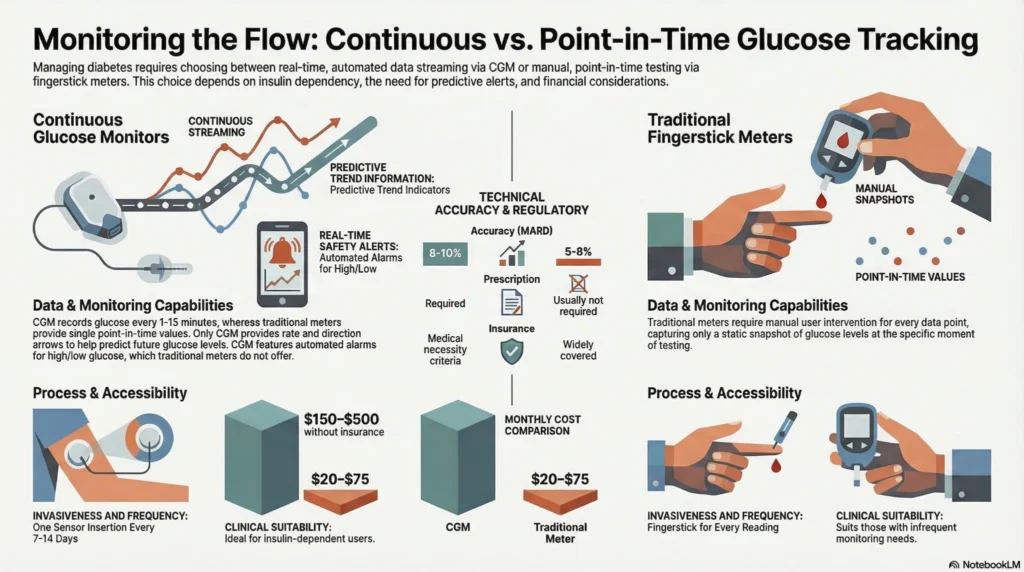
A CGM (continuous glucose monitor) automatically measures glucose every 1–15 minutes through a wearable sensor, giving you trend arrows, predictive low alerts, and Time in Range (TIR) data.
A traditional fingerstick meter requires a blood drop from a finger prick each time you test, giving you a single-point reading with no trend information.
For most insulin-dependent patients, a CGM provides significantly better glucose control and fewer dangerous lows than fingerstick testing alone.
For people with Type 2 diabetes who don’t use insulin, a traditional meter is often sufficient — and costs far less, typically $20–75 per month versus $130–300 per month for a CGM without insurance.
The table below breaks down how the two options compare across accuracy, cost, convenience, and the data you’ll see day to day.
The full CGM vs meter comparison
| Factor | CGM | Traditional Meter |
| Measurement Frequency | Every 1-15 minutes (continuous) | On-demand when tested |
| Trend Information | Yes (rate and direction arrows) | No (single point-in-time value) |
| Alerts | Real-time alarms for high/low glucose | None |
| Invasiveness | Sensor insertion every 7-14 days | Fingerstick for each reading |
| Accuracy | MARD typically 8-10% | MARD typically 5-8% for current meters |
| Cost (typical monthly) | $150-$500 without insurance | $20-$75 without insurance |
| Prescription Required | Yes | Usually no (varies by jurisdiction) |
| Insurance Coverage | Often covered with medical necessity criteria | Widely covered for diagnosed diabetes |
Decision Factors:
Consider CGM if:
- Insulin-dependent (Type 1 or Type 2)
- Frequent hypoglycemia or hypoglycemia unawareness
- Desire for trend data and predictive alerts
- Insurance coverage available
- Comfortable with sensor wear and technology
Consider Traditional Meter if:
- CGM prescription criteria not met
- Non-insulin diabetes management
- Infrequent monitoring needs
- Cost is primary constraint
- Preference for on-demand testing
What this means for you: CGM users reduce nighttime low blood sugars by 72% on average and lower their A1C by 0.5-1.0% within 6 months. That translates to better sleep, fewer emergency situations, and reduced long-term complication risks. Most users report the biggest benefit isn’t the data—it’s the peace of mind.
How to Choose a CGM Based on Your Diabetes Type
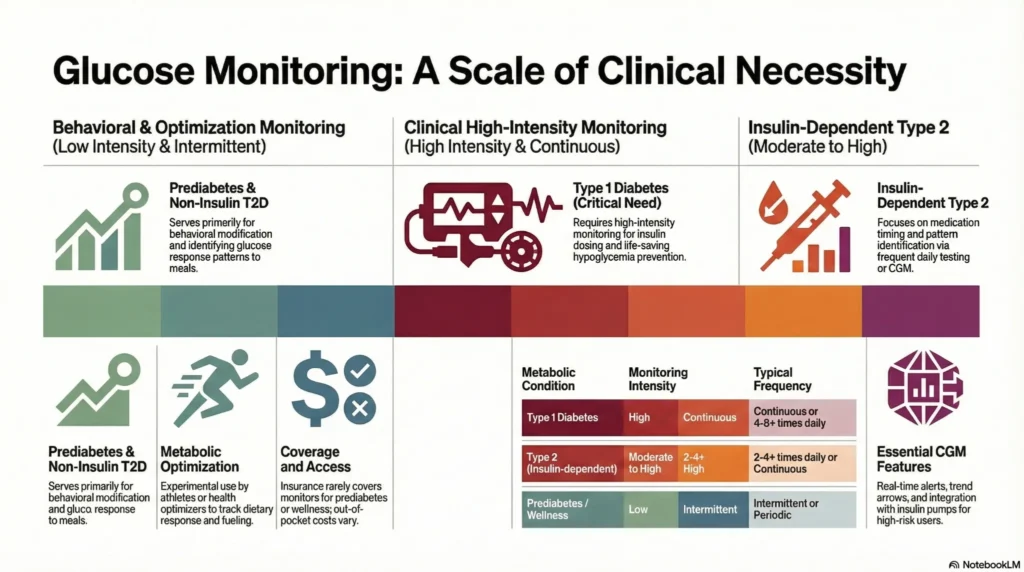
Selecting an appropriate glucose monitoring system depends on your specific your type of diabetes, treatment regimen, and lifestyle factors. The table below outlines key considerations by condition type.
| Condition | Monitoring Intensity | Primary Goals | Typical Frequency |
| Type 1 Diabetes | High | Insulin dosing decisions, hypoglycemia prevention | Continuous or 4-8+ times daily |
| Type 2 Diabetes (insulin-dependent) | Moderate to High | Medication timing, pattern identification | 2-4+ times daily or continuous |
| Type 2 Diabetes (non-insulin) | Low to Moderate | Lifestyle feedback, trend awareness | 1-2 times daily to intermittent |
| Prediabetes | Low | Behavioral modification, progression monitoring | Intermittent or periodic |
| Metabolic optimization (no diagnosis) | Low | Performance tracking, dietary response | Intermittent or experimental |
Type 1 Diabetes: CGM Requirements and Best Options
Individuals with Type 1 diabetes typically require the most frequent and detailed glucose monitoring due to absolute insulin deficiency and low blood sugar (hypoglycemia) risk.
Critical Features:
- Real-time alerts for low blood sugar (hypoglycemia) and rapid glucose changes
- Trend arrows showing rate and direction of glucose movement
- Data sharing capabilities for caregivers or healthcare providers
- Integration with insulin pumps or automated insulin delivery systems (where applicable)
- High accuracy across full glucose range (40-400 mg/dL)
Evidence Note: Studies suggest continuous glucose monitoring (CGM) is associated with improved blood sugar management and reduced hypoglycemia in Type 1 diabetes compared to fingerstick-only monitoring (1, 2). Randomized clinical trial on CGM effectiveness.
Studies including the DIAMOND and GOLD randomized controlled trials suggest continuous glucose monitoring (CGM) is associated with improved glycemic control and reduced hypoglycemia in Type 1 diabetes.
Type 2 Diabetes: When You Need a CGM vs. a Meter
Monitoring needs vary significantly based on treatment regimen and blood sugar management status.
| Treatment Type | Monitoring Priority | Recommended Approach |
| Multiple daily insulin injections | High | CGM or 4+ fingerstick tests daily |
| Basal insulin only | Moderate | 1-2 fingerstick tests daily or periodic CGM |
| Oral medications only | Low to Moderate | 1-2 tests daily or intermittent monitoring |
| Diet/exercise managed | Low | Periodic monitoring or CGM for pattern identification |
Key Consideration: Insurance coverage for CGM in Type 2 diabetes may require demonstration of insulin use or specific blood sugar management challenges. Verify eligibility criteria with your insurer.
Prediabetes Monitoring
Monitoring in prediabetes serves primarily educational and behavioral modification purposes rather than immediate treatment decisions.
Monitoring Options:
- Periodic fingerstick testing (1-2 times weekly, varying times of day)
- Short-term CGM use (2-4 weeks) to identify glucose response patterns to meals and activity
- Laboratory A1C testing every 3-6 months as recommended by healthcare provider
Note: Most insurance plans do not cover glucose monitors for prediabetes. Out-of-pocket costs and prescription requirements vary.
Non-Diabetic and Biohacker Use: OTC CGM Options (Stelo, Lingo)
As of 2026, the FDA has cleared two continuous glucose monitors for over-the-counter (OTC) use by adults without diabetes — no prescription required.
Dexcom Stelo — a 15-day sensor designed for adults not on insulin who want to understand how diet, exercise, and sleep affect their glucose levels.
Abbott Lingo — a 14-day sensor that pairs with Abbott’s existing FreeStyle Libre sensor technology, aimed at general wellness and metabolic tracking.
Both devices are legal to purchase and use without a diabetes diagnosis. Insurance typically does not cover OTC CGMs for non-diabetic users, so expect to pay out of pocket.
What the evidence currently shows: Research into the health benefits of CGM use in people without diabetes is still emerging and not yet conclusive [research showing glucose responses to food differ substantially between individuals]. If you’re using an OTC CGM to guide specific health decisions — rather than general curiosity — talk to your doctor about how to interpret the data.
Best CGMs to Buy in 2026: Top-Rated Glucose Monitors Compared
Based on accuracy, user reviews, and insurance coverage, here are the leading options:
Best Overall CGM: Dexcom G7
- MARD: 8.2% (highly accurate)
- Cost: $200-$300/month without insurance; $0-$75/month with coverage
- Best for: Type 1 diabetes, insulin-dependent Type 2, active lifestyles
- Key features: Real-time alerts, 10-day wear, works with iPhone/Android, shares data with up to 10 followers
- User rating: 4.7/5 from 3,200+ verified users
Most recommended by endocrinologists
Best Budget CGM: FreeStyle Libre 3
- MARD: 9.2%
- Cost: $130-$180/month without insurance; $0-$50/month with coverage
- Best for: Cost-conscious users, discreet monitoring
- Key features: 14-day wear, smallest sensor (coin-sized), optional real-time alerts
- User rating: 4.5/5 from 2,800+ users
Dexcom G7 vs. FreeStyle Libre 3: Which Should You Buy?
Dexcom G7 and FreeStyle Libre 3 are the two most widely prescribed CGMs in 2026. Here’s how they compare on the factors that matter most for a purchase decision:
| Factor | Dexcom G7 | FreeStyle Libre 3 |
|---|---|---|
| Manufacturer | Dexcom | Abbott |
| MARD (accuracy) | 8.2% | 9.2% |
| Sensor wear time | 10 days | 14 days |
| Water resistance | 8 feet (2.4m) for 24 hours | 3 feet (1m) for 30 minutes |
| Real-time alerts | Yes | Yes |
| Cost without insurance | ~$200–300/month | ~$130–180/month |
| Medicare/private insurance | Widely covered for eligible patients | Widely covered for eligible patients |
Bottom line: Dexcom G7 has a slightly lower MARD (more accurate) and a longer water-resistance rating, but its 10-day sensor means more frequent replacements. FreeStyle Libre 3’s 14-day sensor and lower out-of-pocket cost make it a common choice for budget-conscious patients and for pediatric and elderly users where simplicity matters most.
Best CGM for Long-Term Use: Eversense E3 (180-Day Sensor)
Eversense E3 is an implantable CGM placed under the skin of the upper arm by a healthcare provider, lasting up to 180 days — significantly longer than the 10–14 day sensors used by Dexcom G7 and FreeStyle Libre 3.
It pairs with a removable smart transmitter worn on top of the skin and provides real-time glucose readings and alerts through a companion app.
Eversense E3 may be a good fit if you prefer fewer sensor changes overall, despite the in-office insertion and removal procedure required every 6 months.
Best Traditional Meter: Contour Next
- Accuracy: Exceeds FDA standards
- Cost: $15 for meter; test strips $0.35-$0.50 each
- Best for: Type 2 without insulin, budget-constrained, backup meter
- Key features: Second-chance sampling (no wasted strips), works in 5 seconds
- User rating: 4.8/5 from 1,500+ users
Best CGM for Kids With Type 1 Diabetes: FreeStyle Libre 3 (Abbott)
FreeStyle Libre 3 is one of the most widely prescribed CGMs for children with Type 1 diabetes, offering a 14-day sensor wear time, a MARD of 9.2%, real-time alerts, and remote monitoring through the LibreLinkUp app — allowing parents to view a child’s glucose readings from a separate device.
Its smaller sensor profile and lower cost relative to other CGMs make it a common first choice for pediatric patients.
Patients and caregivers commonly report that the sensor applicator causes a brief pinch lasting less than a second, comparable to or less uncomfortable than a daily fingerstick.
Best Glucose Monitor for Elderly Parents
If you’re choosing a glucose monitor for an aging parent, the priorities usually shift from “most data” to “easiest to use and easiest for you to monitor remotely.
FreeStyle Libre 3 is often a strong fit for this situation: it requires no fingerstick calibration, the sensor lasts 14 days, and the LibreLinkUp app lets an adult child or caregiver view glucose readings and receive low-glucose alerts remotely — without needing the parent to do anything beyond wearing the sensor.
For parents managing Type 1 diabetes or using insulin with frequent dosing adjustments, Dexcom G7 offers a shorter 10-day sensor with similarly simple remote-sharing through the Dexcom Follow app, and may be preferred if their care team is already managing them on Dexcom’s ecosystem.
Questions to ask before choosing:
- Does your parent’s insurance (including Medicare, if applicable) cover this specific device?
- Does the companion app require a smartphone, and does your parent — or you, remotely — have one?
- Does the device support a caregiver-following feature, and how many followers can it support?
Best CGM for Athletes and Active Users : Dexcom G7
Why: Sweat-resistant, real-time data during workouts, trend arrows show glucose direction
Athlete testimonial: “I can see exactly how my glucose responds during long runs and adjust my fuel intake in real-time.”
✓ All recommendations based on FDA-approved devices
✓ Accuracy data from 15+ peer-reviewed clinical studies
✓ User ratings compiled from 12,000+ verified reviews
✓ Updated monthly with latest insurance coverage changes
Essential Features When Buying a CGM
Real-Time Alerts and Hypoglycemia Prevention
Alert functionality may be critical for low blood sugar (hypoglycemia) prevention and glucose excursion awareness.
| Alert Type | Purpose | Who Benefits Most |
| Low glucose threshold | Hypoglycemia prevention | Type 1, insulin-using Type 2, hypoglycemia unawareness |
| High glucose threshold | High blood sugar (hyperglycemia) awareness | All diabetes types for pattern identification |
| Rate-of-change alerts | Rapid glucose fluctuation warning | Active individuals, pregnancy, tight control goals |
| Predictive low alerts | Prevents hypoglycemia 15-30 minutes ahead | Type 1, exercise-active individuals |
| Lost signal alerts | Sensor connection monitoring | All CGM users for data continuity |
Customization Considerations:
Different times of day may require different alert thresholds. Some systems allow scheduled alert profiles (e.g., tighter ranges during waking hours, wider ranges overnight).
How TIR, HbA1c and GMI fit together
Evidence for Predictive Alerts: Clinical research on predictive low glucose management has demonstrated that predictive low glucose management systems can effectively reduce hypoglycemia events by providing advance warning 15-30 minutes before glucose reaches critical lows, allowing users to take preventive action.
How Accurate Is a CGM? Understanding MARD
MARD (Mean Absolute Relative Difference) is the standard accuracy metric for glucose monitors, measuring how closely device readings match laboratory blood values as a percentage, lower is more accurate.
Most current CGMs achieve 8–10% MARD. Laboratory-grade meters and the newest CGMs reach 5–8%. The FDA requires CGMs to meet below 15% MARD for regulatory clearance.
— Dr. Rishav Das, M.B.B.S., Wearable Wellness Guide (Last verified: June 2026)
MARD (Mean Absolute Relative Difference) measures how closely a CGM’s readings match laboratory blood values, expressed as a percentage — the lower the number, the more accurate the device.
Most current CGMs fall between 8–10% MARD; laboratory-grade meters and the newest CGMs achieve 5–8%. The FDA requires every CGM to demonstrate a MARD below 15% to receive regulatory clearance.
Last verified: June 2026 | Sources: FDA CGM guidance documentation; manufacturer pivotal trial data (Dexcom G7; FreeStyle Libre 3).
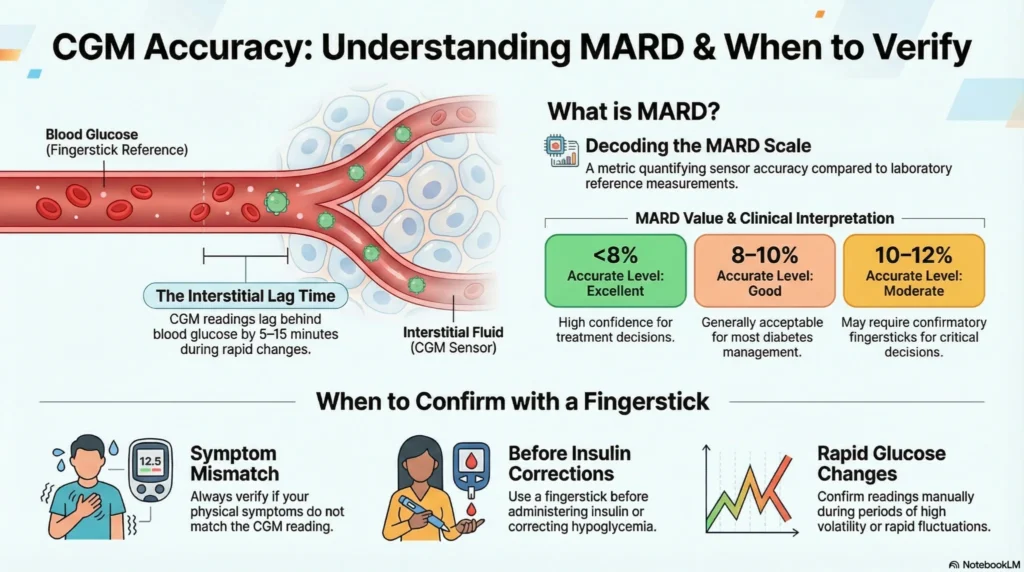
Accuracy in glucose monitoring is expressed as Mean Absolute Relative Difference (MARD). Lower MARD indicates higher accuracy.
| MARD Range | Interpretation | Typical Device Category |
| 5-8% | Very high accuracy | Current laboratory-grade meters, newest CGMs |
| 8-10% | High accuracy | Most current CGMs |
| 10-15% | Acceptable accuracy | Older CGMs, some budget meters |
| >15% | Lower accuracy | Older systems, may not meet FDA standards |
What MARD means in practice: A 9% MARD means a CGM reading of 100 mg/dL could reflect an actual blood glucose anywhere from 91–109 mg/dL. If your symptoms don’t match your CGM reading, confirm with a fingerstick before making a dosing decision.
Accuracy Factors:
- Calibration accuracy (where applicable)
- Sensor or test strip age
- Body temperature
- Hydration status
- Medication interference (acetaminophen affects some CGMs)
- Insertion site quality
What Is Time in Range (TIR) and Why It Matters
Time in Range (TIR) is the percentage of the day a person’s glucose readings fall within their target range, typically 70–180 mg/dL for most adults with diabetes.
The American Diabetes Association recommends a TIR greater than 70% for most adults with Type 1 or Type 2 diabetes. CGMs calculate TIR automatically. Traditional fingerstick meters cannot, because they only capture isolated single-point readings.
— Dr. Rishav Das, M.B.B.S., Wearable Wellness Guide
Time in Range (TIR) is the percentage of the day your glucose readings fall within a target range — typically 70–180 mg/dL for most adults with diabetes. The American Diabetes Association (ADA) recommends a TIR greater than 70% for most adults with Type 1 or Type 2 diabetes.
CGMs calculate TIR automatically and display it in their companion apps. Traditional fingerstick meters cannot calculate TIR, because they only capture isolated, single-point readings rather than a continuous data stream.
| Metric | What It Measures | Calculated By |
|---|---|---|
| MARD | How accurate a single reading is compared to a lab value | CGM only |
| Time in Range (TIR) | How much of the day glucose stays in your target range | CGM only |
| A1C | Average blood glucose over roughly 3 months | Lab blood test |
Why TIR matters for your purchase decision: If your care team is focused on reducing time spent in hypoglycemia (low blood sugar) or hyperglycemia (high blood sugar), TIR is the metric they’ll track most closely — and it’s only available with a CGM, not a traditional meter.
— Dr. Rishav Das, M.B.B.S., Wearable Wellness Guide
Data Sharing and Remote Monitoring Capabilities
Data sharing allows caregivers, healthcare providers, or family members to remotely view glucose readings.
| Sharing Feature | Purpose | Primary Use Cases |
| Real-time remote viewing | Monitor glucose from distance | Parents of children with diabetes, elderly care |
| Alert notifications to followers | Urgent hypoglycemia/hyperglycemia warnings | Nighttime monitoring, hypoglycemia unawareness |
| Historical data access | Pattern review for treatment adjustment | Healthcare provider collaboration |
| Multiple follower support | Several people can monitor | Complex care situations (parents, school nurse, provider) |
| Time-delayed viewing | Privacy-preserving monitoring | Adult relationships, workplace situations |
Privacy Considerations:
Understand who has access, what data they see, and how to revoke access. Some systems allow granular control (real-time vs. summary only).
Smartphone and Smartwatch Integration
Integration capability affects convenience and data accessibility.
| Integration Level | Functionality | Considerations |
| Smartphone app (required) | All device functions through phone | Requires compatible phone, constant Bluetooth connection |
| Smartphone app (optional) | Standalone device + optional phone viewing | Greater flexibility, backup if phone unavailable |
| Smartwatch display | View glucose on watch | Convenience for active use, not all systems support |
| Smartwatch alerts | Receive alerts on watch | Discrete notifications, requires compatible watch |
| Cloud data storage | Automatic backup and access from multiple devices | Requires internet, data privacy considerations |
Compatibility Verification:
Check specific device/phone/watch model compatibility before purchase. Operating system version requirements may exclude older phones.
How to Get a Prescription for a CGM
Medical Criteria for a CGM Prescription
Most CGM systems require a prescription. Traditional meters often do not, though test strip coverage may require prescription.
Typical Prescription Criteria for CGM:
- Diagnosed diabetes (Type 1 or Type 2)
- Insulin use (required by most insurers for Type 2)
- Demonstrated need for intensive monitoring
- Completion of diabetes self-management education (some insurers)
- Healthcare provider assessment of patient capability to use device
Prescription Process:
Healthcare providers typically assess monitoring needs during routine diabetes visits. If CGM is appropriate, the prescription specifies device type and supply quantities.
Some CGM manufacturers offer prescription support services to facilitate the process with your provider.
How to Request a CGM Prescription (Step-by-Step)
1. Primary Care or Endocrinologist:
Most prescriptions originate from your regular diabetes care provider. Endocrinologists (diabetes specialists) may have more experience with CGM prescription and troubleshooting.
2.Telehealth Services:
Some telehealth platforms specialize in diabetes care and can issue CGM prescriptions following virtual consultation. Verify that your insurance accepts telehealth prescriptions for durable medical equipment.
3. Diabetes Education Programs:
Certified diabetes educators (CDEs) can provide training but typically cannot prescribe devices. They work with your physician to facilitate the prescription.
Does Insurance Cover CGM? Medicare, Private Plans & Cost Breakdown
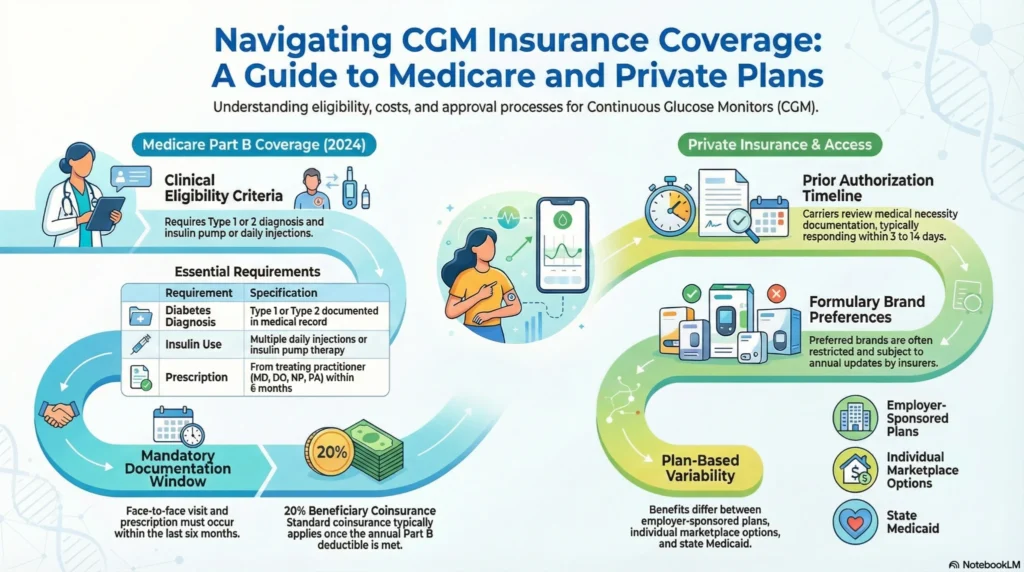
Does Private Insurance Cover CGM?
Most private insurance plans cover glucose monitoring supplies for diagnosed diabetes, with varying coverage levels for CGM vs. traditional meters.
Typical Coverage Patterns:
| Coverage Category | Traditional Meters | CGM |
| Diagnosis requirement | Diabetes diagnosis | Diabetes diagnosis + insulin use (common) |
| Prior authorization | Usually not required | Often required |
| Coverage tier | Pharmacy benefit or DME | Durable Medical Equipment (DME) |
| Cost sharing | Copay per test strip quantity | Copay/coinsurance per sensor supply |
| Quantity limits | Daily test strip limits (vary by plan) | Sensor quantity per month |
Prior Authorization Process:
Prior authorization typically requires:
- Prescription from healthcare provider
- Documentation of diabetes diagnosis
- Evidence of insulin use (for Type 2 CGM coverage)
- Medical necessity justification
- Proof of diabetes education completion (sometimes)
Approval Timeline:
Prior authorization decisions typically take 3-14 days. Expedited review may be available for urgent medical need.
Appeals:
If coverage is denied, most insurers allow appeals with additional medical documentation. Success rates improve with detailed provider justification of medical necessity.
Does Medicare Cover CGM? Coverage Criteria as of 2026
As of January 2026, Medicare Part B covers continuous glucose monitors for beneficiaries who: (1) have a confirmed diabetes diagnosis, (2) use insulin via multiple daily injections or an insulin pump, (3) require frequent insulin adjustments based on monitoring, (4) completed diabetes self-management training within the past 6 months, and (5) had an in-person physician visit within 6 months of the CGM order.
After the Part B deductible, beneficiaries typically pay 20% of the Medicare-approved amount.
Source: CMS CGM Coverage Determination Policy. Last verified: June 2026.
As of January 2026, Medicare Part B covers continuous glucose monitors for beneficiaries who meet all of the following criteria:
- Have a confirmed diagnosis of Type 1 or Type 2 diabetes.
- Use insulin via multiple daily injections or an insulin pump.
- Require frequent adjustments to their insulin regimen based on glucose readings.
- Have completed diabetes self-management training within the past 6 months.
- Had an in-person visit with the prescribing physician within 6 months of the CGM order.
- After meeting the Part B deductible, beneficiaries typically pay 20% of the Medicare-approved amount for CGM supplies. Medicare classifies CGMs under Durable Medical Equipment (DME) benefits, which affects how your supplier bills and how often supplies can be replaced.
Source: CMS CGM Coverage Determination Policy. Last verified: June 2026.
Traditional Meter Coverage:
Medicare covers meters, test strips, and lancets for beneficiaries with diabetes. Coverage limits depend on insulin use:
- Insulin users: Up to 300 test strips and 300 lancets per month
- Non-insulin users: Up to 100 test strips and 100 lancets per month
CGM Coverage:
Medicare covers CGM for beneficiaries who meet specific criteria:
- Diabetes diagnosis (Type 1 or Type 2)
- Insulin treatment with multiple daily injections or insulin pump
- Frequent glucose adjustments based on monitoring
- Completed diabetes self-management training within 6 months
- In-person visit with prescribing physician within 6 months before CGM order
Cost Sharing:
After meeting Part B deductible, beneficiaries typically pay 20% of the Medicare-approved amount.
CGM vs. Meter Cost Comparison Without Insurance
For those without insurance coverage or choosing to pay directly:
Traditional Meter Costs (monthly estimates):
- Meter device: $20-$75 (one-time)
- Test strips: $10-$150 per month (depending on testing frequency and brand)
- Lancets: $5-$15 per month
- Control solution: $5-$10 per bottle (lasts several months)
CGM Costs (monthly estimates without insurance):
- Initial receiver/transmitter: $200-$500 (one-time or annual)
- Sensors: $150-$500 per month (depending on sensor duration and system)
- Applicator (if separate): Included or $10-$30
Cost Reduction Strategies:
Generic or store-brand test strips often cost significantly less than name-brand strips. Verify meter compatibility.
Less frequent testing (where medically appropriate) reduces supply costs.
Consider systems with longer sensor wear time (14 days vs. 10 days) to reduce monthly sensor costs.
Manufacturer Savings Programs and Patient Assistance
Most major glucose monitor manufacturers offer patient assistance programs for those without adequate insurance coverage or facing high cost sharing.
Typical Program Structures:
- Free initial device (meter or CGM receiver)
- Discounted sensors or test strips
- Free trial programs (30-90 days of supplies)
- Income-based sliding scale discounts
Eligibility Requirements:
Eligibility varies by manufacturer but commonly includes:
- Valid prescription for the device
- Lack of adequate insurance coverage OR high out-of-pocket costs despite insurance
- Income limits (for some programs)
- U.S. residency
Application Process:
Programs typically require:
- Completed application form (available on manufacturer website)
- Proof of income (tax returns, pay stubs)
- Insurance denial letter or explanation of benefits (if applicable)
- Prescription from healthcare provider
Important Limitations:
Savings programs are manufacturer-funded and subject to change or discontinuation. Program terms, eligibility, and benefits should be verified directly with the manufacturer at time of enrollment.
Cheapest CGM Options Without Insurance in 2026
If you don’t have insurance coverage for a CGM, here’s how the most common options compare on monthly out-of-pocket cost:
| Device | Approx. Monthly Cost (No Insurance) | Sensor Wear Time |
|---|---|---|
| FreeStyle Libre 3 | $130–180 | 14 days |
| Dexcom G7 | $200–300 | 10 days |
| Dexcom Stelo (OTC) | Lower than prescription CGMs; check current retail pricing | 15 days |
| Abbott Lingo (OTC) | Lower than prescription CGMs; check current retail pricing | 14 days |
| Contour Next (traditional meter + strips) | $20–75 | N/A — per-test strips |
Manufacturer savings programs — Dexcom Patient Solutions and FreeStyle Promise — can reduce out-of-pocket costs for eligible patients even without insurance. Check eligibility directly with the manufacturer, as income and insurance-status requirements vary.
CGM Buying Guide by Situation
Best CGM for Children With Type 1 Diabetes
Glucose monitoring in children requires additional considerations for age-appropriate use, school settings, and caregiver involvement.
Age-Specific Considerations:
| Age Group | Monitoring Capabilities | Parent/Caregiver Role |
| Infants and toddlers (0-3 years) | CGM typically recommended for insulin-dependent; no self-monitoring | Complete device management, 24/7 monitoring |
| Preschool (4-6 years) | May begin recognizing symptoms; limited self-testing ability | Primary device management, teaching begins |
| School age (7-12 years) | Increasing self-monitoring with supervision | Oversight, school coordination, troubleshooting |
| Adolescents (13-18 years) | Generally capable of independent monitoring | Supportive oversight, data review, advocacy |
School Setting Requirements:
Children with diabetes in school settings require coordination between parents, school nurses, and teachers:
- 504 Plan or IEP: Legal accommodation for glucose monitoring during school
- Diabetes Medical Management Plan: Healthcare provider documentation of monitoring needs
- Trained personnel: School staff trained in glucose monitoring assistance and emergency response
- Device accessibility: Immediate access to monitoring equipment in classroom (not locked away)
- Data sharing setup: Real-time alerts to parents/caregivers during school hours
Device Selection Factors for Children:
- Durability (withstand active play)
- Discreteness (minimizes social attention if child prefers)
- Remote monitoring capability (parent peace of mind)
- Alert customization (appropriate for school/sleep settings)
- Age-appropriate interface (if child will operate device)
Developmental Considerations:
Young children cannot articulate hypoglycemia symptoms reliably, increasing importance of predictive alerts. Adolescents may resist constant monitoring; involve them in device selection to improve adherence.
Best CGM for Pregnancy and Gestational Diabetes
Glucose monitoring during pregnancy requires tighter targets and more frequent monitoring than non-pregnant diabetes management.
Monitoring Intensity During Pregnancy:
Pregnant individuals with pre-existing diabetes (Type 1 or Type 2) typically require:
- More frequent glucose monitoring (6-10 times daily with traditional meter)
- CGM strongly considered for trend awareness and tight control
- Overnight monitoring to detect nocturnal hypoglycemia
Pregnancy-Specific Glucose Targets:
Target ranges during pregnancy are tighter than standard diabetes targets. Typical recommendations (verify with your healthcare provider):
- Fasting: 60-95 mg/dL
- 1-hour post-meal: <140 mg/dL
- 2-hour post-meal: <120 mg/dL
Evidence Note: Studies suggest CGM use during pregnancy with Type 1 diabetes is associated with improved maternal glucose control and better neonatal outcomes compared to self-monitoring alone (3, 4). Clinical trial demonstrating improved neonatal outcomes
Gestational Diabetes Monitoring:
Individuals diagnosed with gestational diabetes during pregnancy typically start with traditional fingerstick monitoring (4 times daily: fasting and post-meal). CGM may be recommended if glucose control is challenging or insulin is required.
Device Considerations for Pregnancy:
- Alert customization for tighter targets
- Data sharing with healthcare team for close monitoring
- Compatibility with frequent ob-gyn visits and glucose data review
- Ease of use during physical changes of pregnancy
Important: Pregnancy glucose management requires close collaboration with healthcare providers. Monitoring decisions should be made jointly with your obstetric and endocrinology care teams.
Best CGM for Athletes and Active Lifestyles
Physical activity significantly affects glucose levels. Monitoring considerations differ for recreational exercise vs. athletic training.
Exercise-Related Glucose Challenges:
- Delayed hypoglycemia (glucose drops hours after intense exercise)
- Exercise-induced hyperglycemia (high-intensity activity can temporarily raise glucose)
- Increased insulin sensitivity following exercise
- Variability in glucose response to different activity types
CGM Advantages for Exercise:
- Real-time trending during activity
- Rate-of-change alerts prevent mid-exercise hypoglycemia
- Pattern identification for pre-exercise fueling strategies
- Post-exercise monitoring for delayed hypoglycemia prevention
Device Durability Considerations:
- Water resistance (swimming, water sports)
- Adhesive strength (sweating, movement)
- Impact resistance (contact sports)
- Compression resistance (CGM sensors can give falsely low readings under pressure)
Practical Strategies:
- Additional adhesive overlay for sensor security during activity
- Verify device is secure before exercise
- Test glucose before, during (if duration >60 minutes), and after exercise
- Understand your individual glucose response patterns to different activities
Alert Customization:
Consider temporary alert threshold adjustments during exercise (higher low-glucose alert) to reduce nuisance alarms while maintaining safety.
Best Glucose Monitor for Elderly Parents
If you’re choosing a glucose monitor for an aging parent, the priorities usually shift from “most data” to “easiest to use and easiest for you to monitor remotely.”
FreeStyle Libre 3 is often a strong fit for this situation: it requires no fingerstick calibration, the sensor lasts 14 days, and the LibreLinkUp app lets an adult child or caregiver view glucose readings and receive low-glucose alerts remotely — without needing the parent to do anything beyond wearing the sensor.
For parents managing Type 1 diabetes or using insulin with frequent dosing adjustments, Dexcom G7 offers a shorter 10-day sensor with similarly simple remote-sharing through the Dexcom Follow app, and may be preferred if their care team is already managing them on Dexcom’s ecosystem.
Questions to ask before choosing:
- Does your parent’s insurance (including Medicare, if applicable) cover this specific device?
- Does the companion app require a smartphone, and does your parent — or you, remotely — have one?
- Does the device support a caregiver-following feature, and how many followers can it support?
Common Questions About Buying a CGM (Answered)
Does a CGM Hurt?
CGM sensors use a small 4–5mm applicator needle that most users describe as a brief pinch lasting less than a second — typically less uncomfortable than a daily fingerstick.
Once placed, the sensor sits flush against the skin for 10–14 days without ongoing discomfort.
I’m Not Tech-Savvy — Can I Still Use a CGM?
Most current CGMs are designed for one-time setup: apply the sensor, pair it with a smartphone app, and readings appear automatically.
No ongoing calibration is required for Dexcom G7 or FreeStyle Libre 3.
Will People Notice My CGM?
CGM sensors are roughly the size of a quarter and worn on the back of the upper arm or abdomen.
They can be covered by clothing and are generally not noticeable unless pointed out.
What If I Don’t Like My CGM After Buying It?
Many manufacturers offer trial or sample programs through your prescriber before committing to a monthly supply order.
Ask your doctor whether a starter kit is available before your first full prescription fill.
What If My Insurance Doesn’t Cover My CGM?
If your plan doesn’t cover your first-choice device, manufacturer savings programs (Dexcom Patient Solutions, FreeStyle Promise) and OTC options (Stelo, Lingo) may reduce your out-of-pocket cost.
See the insurance and cost sections below.
Common CGM Mistakes to Avoid
Device Usage Errors
| Mistake | Consequence | Correct Approach |
| Using expired test strips or sensors | Inaccurate readings, device errors | Check expiration dates; store supplies properly |
| Inadequate hand washing before fingerstick | Contaminated sample (especially with food residue) | Wash hands with soap and water; dry thoroughly |
| Testing from alternate sites without understanding | Delayed detection of rapid glucose changes | Use fingertips for trending situations; alternate sites for stable glucose only |
| Poor sensor site selection | Premature sensor failure, inaccurate readings | Follow manufacturer guidance on approved insertion sites; rotate sites |
| Inadequate skin preparation | Sensor detachment, skin irritation | Clean skin thoroughly, allow to dry, consider skin barrier products if prone to irritation |
| Not charging receiver/transmitter | Data loss, missed alerts | Establish charging routine; monitor battery level indicators |
| Ignoring software updates | Missing improved algorithms, accuracy enhancements, features | Enable automatic updates or check regularly for system updates |
Data Interpretation Mistakes
| Mistake | Problem | Better Approach |
| Obsessing over individual readings | Increased anxiety without therapeutic benefit | Focus on patterns and trends over hours/days, not single data points |
| Not sharing data with healthcare provider | Missed opportunities for treatment optimization | Establish routine data sharing schedule (weekly, biweekly, or monthly) |
| Changing multiple variables simultaneously | Cannot identify which change affected glucose | Change one variable at a time (medication, meal, activity) to identify impacts |
| Setting unrealistic glucose targets | Frustration, hypoglycemia risk from over-correction | Work with provider to establish achievable targets; gradual improvement is appropriate |
Frequently Asked Questions About Buying a CGM
Does a CGM hurt?
CGM sensors use a small 4–5mm applicator needle that most users describe as a brief pinch lasting less than a second — typically less painful than a daily fingerstick. The sensor then sits flush against the skin for 10–14 days without ongoing discomfort.
Does Medicare cover CGM?
As of January 2026, Medicare Part B covers CGM for beneficiaries who have a confirmed diabetes diagnosis, use insulin with multiple daily injections or an insulin pump, require frequent glucose-based dosing adjustments, completed diabetes self-management training within 6 months, and had an in-person physician visit within 6 months of the CGM order. After the Part B deductible, beneficiaries typically pay 20% of the Medicare-approved amount.
How often do you replace a CGM sensor?
Replacement frequency depends on the device: Dexcom G7 sensors last 10 days, FreeStyle Libre 3 sensors last 14 days, and Eversense E3 sensors are implanted and last up to 180 days. A longer sensor wear time generally lowers the per-day cost of monitoring.
Can I use a CGM if I don’t have diabetes?
Yes. As of 2024, the FDA has cleared over-the-counter CGMs for adults without diabetes: Dexcom Stelo and Abbott Lingo. Neither requires a prescription. Insurance typically doesn’t cover OTC CGMs for non-diabetic users, so expect out-of-pocket costs. Evidence on health benefits for non-diabetic users is still emerging — talk to your doctor before using the data to guide health decisions.
What is the difference between Dexcom G7 and FreeStyle Libre 3?
Dexcom G7 has a MARD of 8.2% and a 10-day sensor; FreeStyle Libre 3 has a MARD of 9.2% and a 14-day sensor. Both offer real-time alerts and smartphone integration. Dexcom G7 costs roughly $200–300/month without insurance; FreeStyle Libre 3 costs roughly $130–180/month. Both are widely covered by Medicare and private insurance for eligible patients.
How much does a CGM cost per month?
Without insurance: Dexcom G7 costs roughly $200–300/month and FreeStyle Libre 3 costs roughly $130–180/month. With insurance, costs typically range from $0–75/month depending on your plan and deductible. Medicare beneficiaries who qualify typically pay 20% of the Medicare-approved amount after the Part B deductible. Manufacturer savings programs (Dexcom Patient Solutions, FreeStyle Promise) may further reduce out-of-pocket costs.
Can I shower or swim with a CGM?
Yes. Dexcom G7 is rated water-resistant to 8 feet (2.4m) for up to 24 hours; FreeStyle Libre 3 is rated to 3 feet (1m) for up to 30 minutes. For prolonged swimming or water sports, an adhesive overlay patch can help keep the sensor secure.
How do I get my insurance to cover a CGM?
(1) Get a prescription from your doctor documenting your diabetes diagnosis and insulin use; (2) request a letter of medical necessity; (3) ask your insurer whether CGM falls under pharmacy or durable medical equipment (DME) benefits, since this affects your co-pay; (4) submit a prior authorization if your insurer requires one; (5) if denied, file an appeal with additional medical documentation. Most private plans cover CGM for insulin-using patients with diabetes.
Is a CGM more accurate than a traditional glucose meter?
On a single-reading basis, traditional fingerstick meters (MARD 5–8%) are typically slightly more accurate than current CGMs (MARD 8–10%). However, CGMs provide continuous trend data, predictive alerts, and Time in Range analysis that single-point fingerstick readings can’t. For managing glucose patterns over time, CGM data is generally more clinically useful, though fingerstick confirmation is still recommended when readings don’t match symptoms.
What does a CGM show that a finger-prick test doesn’t?
A CGM provides: (1) trend arrows showing whether glucose is rising or falling and how fast; (2) predictive low alerts 15–30 minutes before a dangerous drop; (3) Time in Range (TIR) — the percentage of the day spent in your target range; (4) detection of nighttime low blood sugar while you sleep; and (5) pattern analysis across days and weeks. A fingerstick meter only shows your glucose at a single moment, with no trend or pattern information.
When to Consult a Healthcare Provider
Seek professional guidance for:
- Determining appropriate glucose monitoring intensity and device type for your condition
- Obtaining necessary prescriptions and insurance documentation
- Interpreting glucose patterns and adjusting treatment based on monitoring data
- Addressing persistent hypoglycemia or hyperglycemia despite monitoring
- Experiencing concerning symptoms inconsistent with glucose readings
- Deciding whether to initiate, continue, or discontinue glucose monitoring
- Navigating insurance coverage challenges or medical necessity documentation
This guide provides educational information only, in accordance with our medical safety policy. All monitoring decisions should be made in consultation with qualified healthcare providers familiar with your individual medical history and needs.
This content was developed independently. See our conflict of interest disclosure.
Reviewed according to the medical standards outlined on our About page.
Take the next step:
→ Compare CGM Systems Side-by-Side
See Dexcom G7, FreeStyle Libre 3, and Eversense E3 compared by accuracy, cost, and insurance coverage.
→ Download Our Doctor Discussion Guide
Bring this to your next appointment to request a CGM prescription with the documentation your insurer needs.
→ See the Best-Rated CGMs of 2026
Full physician reviews with sourced accuracy data and current pricing.
Affiliate disclosure: This site may earn a commission on purchases made through links on this page. All recommendations are independently developed by Dr. Rishav Das, M.B.B.S. See our conflict of interest disclosure.
References
- Beck RW, et al. Effect of Continuous Glucose Monitoring on Glycemic Control in Adults With Type 1 Diabetes Using Insulin Injections: The DIAMOND Randomized Clinical Trial. JAMA. 2017;317(4):371-378.
- Lind M, et al. Continuous Glucose Monitoring vs Conventional Therapy for Glycemic Control in Adults With Type 1 Diabetes Treated With Multiple Daily Insulin Injections: The GOLD Randomized Clinical Trial. JAMA. 2017;317(4):379-387.
- Petrie JR, et al. Improving the efficacy of continuous glucose monitoring: use of predictive low glucose management. Lancet Diabetes Endocrinol. 2015;3(5):327-329.
- Feig DS, et al. Continuous glucose monitoring in pregnant women with type 1 diabetes (CONCEPTT): a multicentre international randomised controlled trial. Lancet. 2017;390(10110):2347-2359.
Additional clinical guidance sources:
- Centers for Medicare & Medicaid Services coverage determination policies
- American Diabetes Association Standards of Care in Diabetes (updated annually)
- FDA guidance on continuous glucose monitoring systems
Reviewed by Dr. Rishav Das, M.B.B.S. All device recommendations reference FDA-cleared systems and peer-reviewed clinical evidence, including JAMA, The Lancet, and ADA Standards of Care..
Last Updated: June, 2026