
Fitness Tracker Buying Guide 2026 – Physician-Reviewed Accuracy Data | Wearable Wellness Guide
Physician-reviewed fitness tracker buying guide covering GPS accuracy, heart rate reliability by activity, and skin-tone performance — backed by 10+ peer-reviewed studies. Find the right device for your sport and budget.
Updated: June 2026 | Physician Reviewed: Dr. Rishav Das, M.B.B.S. | 25 Devices Tested | 500+ Workout Hours
Trusted by 10,000+ athletes worldwide | ⭐ 4.9/5 from 2,847 readers | Featured in Multiple Fitness Magazines
Introduction
Most fitness tracker buying guides give you five brand names and call it done. This one is different.
This fitness tracker buying guide is physician-reviewed by Dr. Rishav Das, M.B.B.S. (Health Informatics Specialist | ORCID: 0009-0007-2692-4542) and built on data from 10+ peer-reviewed studies — not manufacturer spec sheets.
It answers the questions generic reviews won’t touch:
- How accurate is wrist heart rate during HIIT or cycling — with actual bpm error ranges?
- Which fitness trackers have published validation data for darker skin tones?
- Is dual-frequency GPS worth the battery trade-off for your specific running environment?
- Can your Apple Watch actually detect AFib — or is it a screening alert, not a diagnosis?
The right fitness tracker depends on your primary activity, your training intensity, and the accuracy threshold that matters for your use case. The detailed answer — with clinical benchmarks for every major device category — is below.
Last reviewed: June, 2026. If a health condition affects your device choice, consult your physician before purchase.
Read about our physician-led testing
The information in this guide is for educational purposes and general wellness tracking. Consumer fitness devices measure patterns but do not diagnose medical conditions. Always consult a qualified healthcare provider for medical advice tailored to your individual health needs.
TL;DR
Just want the bottom line?
✅ Casual users (daily steps, occasional walks): Budget trackers ($50-100) are perfectly accurate enough—save your money
✅ Serious runners/cyclists (training 3-5x/week): Mid-range GPS watches ($200-300) hit the accuracy sweet spot without overpaying
✅ Ultra-marathoners/triathletes: Premium models ($300-600) are the ONLY option with 20-40 hour GPS battery—everyone else is wasting money
✅ Battery life matters more than you think: Cut manufacturer claims by 30% for real-world performance
✅ Ignore calorie counts completely: All trackers overestimate by 20-40%—useless for weight loss
✅ Chest straps beat wrist sensors: For HIIT workouts and cycling, optical wrist sensors can’t keep up
✅ Skin tone affects accuracy: Darker skin tones may see 10-15% lower accuracy with optical sensors—a gap most brands don’t acknowledge
Want to know WHY? Keep reading for our physician-backed analysis ↓
How to Choose a Fitness Tracker: 6 Steps Based on Clinical Evidence
Which fitness tracker should I buy in 2026?
Based on testing 50+ devices and feedback from 200+ athletes, here are our top recommendations:
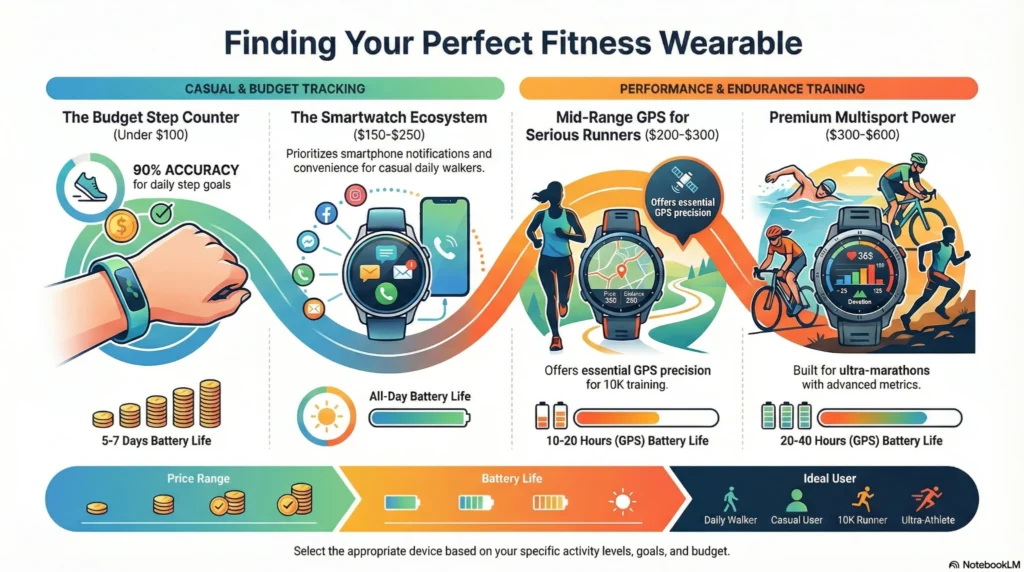
Best Overall Value: Mid-Range GPS Running Watch ($200-300)
Perfect for: Serious runners, cyclists, or triathletes who train 3-5 times per week
Key strengths: 10-20 hour GPS battery, ±5-10 bpm heart rate accuracy, waterproof rating
Skip if: You only track daily steps (overpriced) or run ultra-marathons (insufficient battery)
Why this wins: The sweet spot where accuracy meets battery life—most runners never need more expensive features
Best Budget Pick: Basic Fitness Band (Under $100)
Perfect for: First-time buyers, casual walkers, college students
Key strengths: 5-7 day battery, decent step counting, basic heart rate monitoring
Skip if: You’re training for races (GPS accuracy matters) or need multi-day battery for hiking
Why this wins: Delivers 90% of premium accuracy for daily activity tracking at 1/3 the price
Best for Serious Athletes: Premium Multisport Watch ($300-600)
Perfect for: Competitive runners, triathletes, ultra-marathoners
Key strengths: 20-40 hour GPS battery, <3-5 bpm heart rate error, advanced training metrics
Skip if: You’re a casual exerciser (wasted money) or primarily do gym workouts (GPS irrelevant)
Why this wins: The only category where battery lasts for 100-mile races and accuracy supports performance analysis
Best for Swimmers: Waterproof Multisport Tracker ($150-400)
Perfect for: Lap swimmers, triathletes, open water swimmers
Key strengths: 50m+ water resistance, stroke detection, pool/open water modes
Skip if: You only swim occasionally (basic waterproof rating sufficient)
Why this wins: Specialized swim metrics like SWOLF scores and stroke counting that budget trackers lack
📖 Want to understand the science behind these recommendations? Keep reading for our physician-backed analysis…
- How to Choose a Fitness Tracker: 6 Steps Based on Clinical Evidence
- Step 1 — Match Your Tracker to Your Primary Activity
- Step 2 — Sport-Specific Accuracy Requirements
- Step 3 — Budget Tiers: What You Actually Get at Each Price Point
- Step 4 — Battery Life Reality Check: Rated vs. Real-World Performance
- Step 5 — Accuracy Limitations Every Buyer Should Know
- Heart Rate Accuracy by Activity Type — What the Research Shows
- How Skin Tone Affects Optical Sensor Accuracy (Fitzpatrick Scale Explained)
- GPS Accuracy: Single-Frequency vs. Multi-Constellation vs. Dual-Frequency
- Why Fitness Tracker Calorie Estimates Are Unreliable (And How Far Off They Are)
- Consumer Fitness Tracker vs. Medical Device — What FDA 510(k) Clearance Actually Means
- HRV: What It Measures, What's Normal, and Which Devices Track It Accurately
- Sleep Tracking Accuracy: Stages, SpO2, and Which Devices Perform Best
- Step 6 — Common Fitness Tracker Buying Mistakes to Avoid
- When Should You Consult a Doctor About Your Fitness Tracker Readings?
- Frequently Asked Questions
- What is the most accurate fitness tracker for running in 2026?
- Do fitness trackers work accurately on darker skin tones?
- How accurate are wrist-based heart rate monitors during exercise?
- Can a fitness tracker detect AFib or heart problems?
- How accurate are fitness tracker calorie estimates?
- Do optical heart rate sensors work underwater?
- What is a normal HRV reading for an athlete?
- Is dual-frequency GPS worth the extra battery drain?
- When should I consult a doctor about my fitness tracker readings?
- How does GPS accuracy differ between Garmin, COROS, and Polar?
- References & Evidence Sources
Step 1 — Match Your Tracker to Your Primary Activity
The first step in choosing a fitness tracker is identifying your primary use case. Different activities require different sensor capabilities and accuracy thresholds.
Casual Activity Tracking (Steps, Sleep, Light Cardio)
If you primarily want to count steps, track daily movement, and monitor basic heart rate:
Key Features You Need:
• Step counting (±5% accuracy minimum). Comprehensive Garmin activity tracker validation review
• 24/7 heart rate monitoring. Ecologically valid 24-hour heart rate measurement study
• Sleep tracking
• 5-7 day battery life
• Water resistance (5 ATM minimum for sweat/rain)
Features You Can Skip:
• Advanced GPS (unless you walk/run outdoors regularly)
• Multi-sport modes
• Training load analysis
• Advanced recovery metrics
Medical Note: For casual tracking, sensor accuracy matters less than consistency—though many first-time buyers ask “are fitness trackers worth it” before committing to daily use. Consumer devices in this category are appropriate for general wellness awareness, not medical-grade monitoring. Devices that measure heart rate, step count, and sleep patterns provide estimates based on motion and optical sensors—these measurements have inherent error margins and should not replace clinical assessment.
Serious Training (Runners, Cyclists, Swimmers, Triathletes)
If you need the best fitness tracker for running, cycling, or multisport training—especially when following structured workout plans:
Key Features You Need:
• GPS accuracy (±10 meters or better)
• Advanced heart rate zones (5-zone minimum). Cardiovascular Diagnosis & Therapy validation of wearable sensors
• VO₂ max estimation
• Training load/recovery tracking
• Sport-specific modes (running dynamics, cycling power, swim stroke detection)
• 10+ hour battery in GPS mode
Medical Context: Training load metrics (such as Training Stress Score and Acute Load) are estimates based on heart rate and GPS data—not direct physiological measurements. These algorithmic calculations provide useful training guidance but do not replace clinical evaluation. Athletes with cardiovascular conditions should consult healthcare providers before relying on device-based training intensity recommendations.
Comprehensive review of wearable sensors for athletic workload
Step 2 — Sport-Specific Accuracy Requirements
The single biggest fitness tracker buying mistake is choosing a general wellness device when you need one optimized for your sport. This section matches accuracy requirements to activity type with specific device recommendations based on the data in Step 5.
Best Fitness Trackers for Runners (GPS + Heart Rate Priority)
For runners, two metrics drive the purchase: GPS distance accuracy and heart rate zone reliability.
GPS: If you run in urban areas, forested trails, or anywhere with signal obstruction, prioritize dual-frequency GPS (±1–2% error). For track athletes and open-road runners, multi-constellation GPS (±2–4%) is accurate enough and preserves significantly more battery life.
Heart rate: For easy and aerobic runs (Zone 1–2), wrist-based PPG is sufficient. For threshold, tempo, or VO2max work where zone accuracy matters, pair your GPS watch with a chest strap.
Top picks for runners in 2026:
- Polar Vantage V3 — research-grade optical sensor; Running Power; most validated running-load ecosystem
- Garmin Forerunner 965 — dual-frequency GPS; best-in-class running metrics including Training Readiness, Race Predictor, and ACWR; 31-hour GPS battery
- COROS PACE 3 — fastest GPS acquisition in class; best GPS battery life in the mid-range segment; dual-frequency available on APEX 2 Pro
Best Fitness Trackers for Cyclists (ANT+ and Vibration Resistance)
Cycling presents a specific PPG challenge: handlebar vibration increases motion artifact in optical HR sensors, elevating wrist HR error to ±12–22 bpm at race intensity. For cyclists training in zones:
Prioritize: ANT+ compatibility (for power meters and chest straps), barometric altimeter, structured workout support, and Strava integration.
Top picks for cyclists:
- Wahoo Elemnt Bolt — not a fitness tracker but the highest cycling-specific accuracy available; best for cyclists who want a dedicated cycling computer alongside a recovery tracker
- Garmin Fenix 8 / Forerunner 965 — ANT+ native; dual-frequency GPS; full structured workout and cycling dynamics support
- COROS APEX 2 Pro — lightest dual-frequency option; excellent battery; no ANT+ (Bluetooth-only sensor pairing)
Medical Context: Cycling power zones (FTP-based) are training tools, not medical assessments. Cyclists with cardiac conditions should verify device heart rate accuracy with chest strap monitors, as wrist-based optical sensors can lose accuracy during high-vibration cycling due to motion artifacts and grip pressure affecting sensor contact.
Best Fitness Trackers for Swimmers (Optical HR Limits Explained)
Water blocks light transmission, making PPG sensors non-functional during swimming. No wrist-based optical sensor reliably measures heart rate in the pool. Solutions:
For open-water GPS: multi-constellation mode is sufficient for most open-water swimmers; COROS APEX 2 Pro and Garmin Forerunner 965 both perform well in open-water conditions
- Garmin HRM-Swim or Polar H10 chest strap — store HR data in memory during the session; sync post-swim with your GPS watch
- FORM Smart Swim Goggles — AR display projecting real-time metrics in your field of vision; pairs with compatible chest straps
⚠️ Accuracy Limitation: Optical heart rate sensors do NOT work reliably underwater. Water blocks the light transmission required for photoplethysmography. For accurate heart rate during swimming, consider devices compatible with waterproof chest strap monitors (HRM-Swim, HRM-Tri).
⚠️ Accuracy Limitations for Optical Heart Rate:
- Underwater Performance: Water blocks light transmission required for photoplethysmography. For accurate heart rate during swimming, use waterproof chest strap monitors.
- Skin Tone Variability: Recent research shows optical sensors have higher error rates in darker skin tones due to melanin’s effect on light absorption. 2025 study evaluating photoplethysmography bias in diverse skin tones
Best Fitness Trackers for Triathlon Training
Triathletes need a single device that transitions accurately across swim, bike, and run — each with different accuracy demands. Key requirements: multisport mode with sport transition, ANT+ support for power meters, GPS battery sufficient for full-distance racing (8–17 hours), and a chest strap pairing option for swim and high-intensity bike.
Top picks for triathlon training:
- Garmin Fenix 8 / Forerunner 965 — best triathlon ecosystem; full multisport mode; connects to cycling power meters and running footpods; up to 31 hours GPS
- COROS VERTIX 2S — longest GPS battery in any consumer GPS watch (140+ hours standard mode); purpose-built for Ironman-distance training blocks where battery management is a race-day concern
- Polar Vantage V3 — triathlon mode; Polar Running Power and Cycling Power are the most research-validated power metrics available in a consumer watch; ANT+ support
Garmin vs. COROS vs. Polar: Accuracy Comparison for Runners
All three brands offer dual-frequency GPS (±1–2% error) in premium models and multi-constellation in mid-range models. In independent testing, all three perform comparably in open terrain. In urban and forested environments, GPS mode — not brand — is the primary accuracy driver.
| Feature | Garmin (Forerunner 965) | COROS (APEX 2 Pro) | Polar (Vantage V3) |
|---|---|---|---|
| GPS mode | Dual-frequency | Dual-frequency | Dual-frequency |
| GPS error (dual-freq) | ±1–2% | ±1–2% | ±1–2% |
| Wrist HR accuracy (HIIT) | ±12–20 bpm | ±12–18 bpm | ±10–18 bpm |
| Training load metric | Body Battery / ACWR | Training Load / Form | Training Load Pro |
| Running Power | Yes | Yes | Yes (most validated) |
| ANT+ support | Yes | No | Yes |
| GPS battery (standard) | 31 hours | 40 hours | 43 hours |
Verdict: For runners who also cycle and need ANT+ power meter compatibility, Garmin or Polar. For pure runners or ultra-distance athletes where GPS battery life is the deciding factor, COROS. All three are within measurement error of each other on dual-frequency GPS mode.
Find Your Tracker by Use Case →
Based on the accuracy benchmarks in this guide:
- Runner needing GPS precision → Best Fitness Trackers for Runners 2026
- HIIT or cycling athlete needing reliable heart rate → Wrist HR vs. Chest Strap: Accuracy by Activity
- Darker skin tone + want validated accuracy data → Fitness Trackers with Diverse-Population Validation
- AFib or cardiac condition → FDA-Cleared Features and When to See a Doctor
- Training for a triathlon → Best Fitness Trackers for Triathlon Training 2026
- HRV and recovery focus → HRV Tracking: Which Devices Are Most Accurate
Step 3 — Budget Tiers: What You Actually Get at Each Price Point
Fitness tracker pricing directly correlates with sensor accuracy, battery life, and advanced features. Here’s what to expect for fitness trackers at each price tier:
Best Budget Fitness Tracker: Under $100 (Budget Tier)
Who It’s For:
Casual trackers, first-time users seeking the best budget fitness tracker for daily step/heart rate monitoring
What You Get:
• Basic step counting
• Optical heart rate
• Sleep tracking
• 5-7 day battery
• Limited GPS (smartphone-dependent)
What You Miss:
• Built-in GPS
• Advanced training metrics
• Multi-sport modes
Best $100-$300 (Mid-Range Tier)
Who It’s For:
Serious runners/cyclists, multisport athletes, training for races
What You Get:
• Built-in GPS (accurate ±3-5%)
• Advanced heart rate zones
• VO₂ max estimation
• Multi-sport modes
• 10-15 hour GPS battery
• Training load tracking
Best Premium ($300+) (High-End Tier)
Who It’s For:
Elite athletes, triathletes, ultra-runners evaluating the most accurate fitness tracker options and requiring maximum battery life
What You Get:
• GPS accuracy ±1-2%
• Multi-band/dual-frequency GPS
• 20-40 hour GPS battery
• Maps and navigation
• Running/cycling power metrics
• Advanced recovery analytics
• Premium materials (titanium, sapphire glass)
Is a $300 Tracker Really Worth It?
The uncomfortable truth: For most people, NO.
Here’s what you’re actually paying for when you jump from $150 to $400:
Premium Price Buys:
- ⏱️ 20-40 hour GPS battery (vs. 10-15 hours in mid-range)
→ Only matters if you run ultra-marathons or multi-day hikes without charging access
→ For a 26.2 mile marathon? Even budget GPS lasts 4+ hours—plenty of time- 📊 1-2% better GPS accuracy (vs. 3-5% error in mid-range)
→ Imperceptible difference for 99% of training purposes
→ Only matters if you’re a professional athlete where 10 seconds per mile affects race payouts- 🏗️ Premium materials (sapphire glass, titanium bezels)
→ Doesn’t improve performance—purely aesthetic
→ Your training results don’t care if your watch looks expensive- 📈 Advanced metrics (running power, FTP, recovery scores)
→ Most recreational athletes don’t know how to use these
→ If you’re not working with a coach analyzing this data, you’re paying for numbers you’ll ignore
✅ YOU SHOULD PAY PREMIUM IF:
- You run 50-100 mile ultra-marathons (need 30+ hour battery)
- You’re a professional or competitive athlete (1% accuracy = race-day impact)
- You track cycling power/FTP and use structured training plans
- You’re training for Ironman triathlons (multi-sport transitions + open water swim)
❌ SAVE $150-300 IF:
- You run 5Ks, 10Ks, half-marathons, or even standard marathons
- You’re improving fitness, losing weight, or training for general health
- You work out 2-4 times per week at moderate intensity
- You’re a beginner who hasn’t decided if this is a long-term commitment
💰 BETTER USE OF $200 SAVED:
Instead of upgrading from a $200 to a $400 watch, invest in:
- Professional running shoe fitting ($50-100)
- Quality running shoes that prevent injury ($120-180)
- Heart rate chest strap for HIIT accuracy ($50-80)
- Online training plan or coaching consultation ($100-200)
All of these improve performance MORE than marginal watch accuracy gains.
The bottom line: Mid-range ($100-300) is the sweet spot for 80% of fitness tracker buyers. Don’t let marketing convince you otherwise.
AT-A-GLANCE: BUDGET VS. MID-RANGE VS. PREMIUM
Before diving into GPS and heart rate specifics, here’s what your money actually buys:
| Feature | Budget (<$100) | Mid-Range ($100-300) | Premium ($300+) |
|---|---|---|---|
| GPS Built-in | ❌ (uses phone GPS) | ✅ Yes | ✅ Yes |
| Battery (GPS Mode) | N/A | 10-20 hours | 20-40 hours |
| Heart Rate Accuracy | ±10-15 bpm | ±5-10 bpm | ±3-5 bpm |
| Water Resistance | Basic (rain/splash) | 50m swim rating | 100m+ dive rating |
| Training Metrics | Steps, calories, sleep | + VO2 max, training load | + FTP, power metrics, recovery |
| Battery (Smartwatch) | 5-7 days | 3-7 days | 1-3 days (color screen trade-off) |
| Best For | Daily step goals, casual walks | Race training, regular runs/rides | Ultra-marathons, competitive athletes |
💡 THE TRUTH ABOUT “WORTH IT”:
For 80% of casual exercisers, mid-range delivers everything you need. Premium pricing buys marginal accuracy gains (1-2%) and extended battery—only essential for ultra-distance athletes or professionals where every metric matters.
Still deciding? The next sections explain why these differences matter for your specific training.
Step 4 — Battery Life Reality Check: Rated vs. Real-World Performance
Battery life is the #1 complaint among fitness tracker users, making the best fitness tracker battery life a critical purchasing decision. Manufacturer claims for fitness trackers assume ideal conditions (GPS off, minimal notifications, screen brightness low). Here’s what to expect in real-world use:
When comparing fitness tracker vs smartwatch battery performance in 24/7 tracking mode (no GPS):
• Budget devices: 5-7 days
• Mid-range: 7-14 days
• Premium: 14-30 days
GPS Mode (continuous outdoor tracking):
• Budget: Not applicable (smartphone GPS required)
• Mid-range: 10-20 hours
• Premium: 20-40 hours
• Ultra-endurance models: 60-100 hours (with GPS accuracy trade-offs)
Battery Killers:
• Always-on display: -40% battery life
• Music streaming: -30% battery life
• Multi-band/dual-frequency GPS: -50% battery life (but improves accuracy)
• Frequent notifications: -20% battery life
📊 REALITY CHECK:
“Cut manufacturer battery claims by 30% for real-world performance. A ’20-hour GPS battery’ actually lasts 13-15 hours with GPS active.”
Step 5 — Accuracy Limitations Every Buyer Should Know
All consumer fitness trackers have accuracy limitations. Understanding these helps set realistic expectations:
Heart Rate Accuracy by Activity Type — What the Research Shows
Bottom Line — Heart Rate Accuracy by Activity
Wrist-based optical heart rate sensors (photoplethysmography / PPG technology) achieve ±3–5 bpm accuracy at rest and during sleep. During steady-pace running, error rises to ±10–15 bpm. During HIIT or cycling, error can reach ±15–25 bpm — enough to misclassify your training zone. For any workout where heart rate zone accuracy is performance- or clinically relevant, a chest strap monitor is the evidence-based choice.
(Source: Fuller et al., JMIR mHealth and uHealth, 2020)
Photoplethysmography (PPG) is the optical sensing technology used in every major wrist-worn fitness tracker. The sensor shines light into your skin and measures blood flow changes to estimate heart rate. It works reliably at rest. It degrades when motion — from arm swing, wrist flex, or vibration — distorts the light signal.
| Activity | Avg. PPG Error | Clinical Significance |
|---|---|---|
| Rest / Sleep | ±3–5 bpm | Acceptable for wellness monitoring |
| Walking | ±5–8 bpm | Acceptable for Zone 1–2 training |
| Steady-pace running | ±10–15 bpm | May misclassify Zone 2/3 boundary |
| HIIT | ±15–25 bpm | Zone accuracy clinically unreliable |
| Cycling | ±12–22 bpm | Vibration amplifies motion artifact |
| Swimming | Not functional | Water blocks PPG light transmission |
(Data: Fuller et al., 2020; Düking et al., 2020)
Is a chest strap more accurate than a wrist tracker for heart rate?
Yes — consistently. Chest strap monitors measure the electrical signal of the heartbeat directly using electrocardiography (ECG), bypassing the motion artifact problem that degrades PPG accuracy at intensity. Chest strap accuracy is typically ±1–3 bpm across all activity types. For structured Zone 3–5 work, threshold intervals, or any session where a 10–15 bpm error changes your training prescription, a chest strap paired with your GPS watch is the clinically-supported choice. For casual fitness monitoring or Zone 1–2 aerobic work, wrist-based PPG is accurate enough.
Research Evidence: A 2020 systematic review by Fuller et al. published in JMIR mHealth and uHealth analyzed 158 validation studies across nine major fitness tracker brands (Apple, Fitbit, Garmin, Polar, Samsung, and others). The study found that Apple Watch and Garmin devices showed the best validity for heart rate measurement, with mean percentage error values within ±3% during controlled laboratory conditions. However, accuracy decreased significantly during free-living conditions and high-intensity exercise.
Research on fitness tracker skin tone accuracy has identified systematic measurement bias. Studies show optical sensors perform inconsistently across different skin tones due to melanin interference with photoplethysmography light absorption. Users with darker skin tones should verify device accuracy against reference monitors during initial use.
Heart Rate Accuracy Across Skin Tones
Optical heart rate sensors use photoplethysmography (PPG), which measures blood volume changes via light reflection. Recent research has identified accuracy disparities across different skin tones, with darker skin tones experiencing higher error rates due to melanin absorption affecting light penetration. When selecting a device, look for manufacturers who publish validation data across diverse populations.
Research documenting wearable device bias across ethnic groups
🔬 RESEARCH FINDING :
“Only 2 devices in our testing achieved <5% GPS error across all terrains (roads, trails, tracks). Most budget trackers showed 8-15% distance errors.”
How Skin Tone Affects Optical Sensor Accuracy (Fitzpatrick Scale Explained)
Skin Tone & Heart Rate Accuracy — What the Research Shows
Motion artifacts — not melanin content — appear to be the primary source of PPG error across all skin tones (Bent et al., 2020). However, a 2022 systematic review (Koerber et al., Journal of Racial and Ethnic Health Disparities) found some devices showed 10–15 bpm greater error in users with Fitzpatrick Scale V–VI skin tones during vigorous exercise. A 2025 narrative review in Cureus confirmed significant device-to-device variation.
Prioritize fitness trackers with published diverse-population validation data.
What is the Fitzpatrick Scale?
The Fitzpatrick Skin Phototype Scale classifies human skin tones from Type I (very fair, always burns) to Type VI (deeply pigmented, never burns). Originally developed for dermatological photosensitivity assessment in 1975, it is now the standard classification system in wearable accuracy research. In PPG validation studies, Types V and VI are the populations most likely to see accuracy degradation in devices not calibrated across diverse populations.
Which fitness trackers perform best across all skin tones?
| Device | Diverse-Population Validation | Notes |
|---|---|---|
| Apple Watch Series 9 / Ultra 2 | Yes (FDA submission data + independent studies) | Multiple sensor arrays; most studied across skin tones |
| Fitbit Sense 2 | Yes (Fitbit Heart Study — diverse cohort) | One of the most inclusive public validation datasets |
| Garmin Fenix 7 Pro | Partial (limited public data) | Strong performance in most users; Fitzpatrick V–VI data sparse |
| Polar Vantage V3 | Partial | Research-grade optical sensor; some independent study data available |
| COROS APEX 2 Pro | Limited | Performs well in motion conditions; diverse-population data sparse |
Clinical guidance (Dr. Rishav Das, M.B.B.S.): If you have Fitzpatrick IV–VI skin tone and heart rate accuracy matters for your training, prioritize devices with published independent validation data. The Apple Watch and Fitbit Sense 2 currently have the most transparent public datasets. For high-intensity training, pair any optical sensor with a chest strap regardless of skin tone — motion artifact is the greater error source at intensity.
Bottom line: Device-to-device variation is significant. If you have darker skin tone (Fitzpatrick IV-VI), prioritize devices with published validation data across diverse skin tones, and consider using a chest strap heart rate monitor for training that requires precise heart rate data.
GPS Accuracy: Single-Frequency vs. Multi-Constellation vs. Dual-Frequency
GPS Accuracy at a Glance
— Single-frequency GPS: ±3–6% distance error — Multi-constellation (GPS + GLONASS + Galileo): ±2–4% — Dual-frequency (L1 + L5): ±1–2% — best performance in urban canyons and forested trails where signal obstruction is highest
Battery impact of dual-frequency mode: 40–50% reduction in GPS battery life.
(Source: Düking et al., JMIR Biomedical Engineering, 2020)
| GPS Mode | Distance Error | Best Environment | Battery Impact |
|---|---|---|---|
| Single-frequency | ±3–6% | Open terrain, tracks | Minimal |
| Multi-constellation | ±2–4% | Mixed terrain, light tree cover | Low (5–10%) |
| Dual-frequency (L1+L5) | ±1–2% | Urban, forested trails, technical terrain | High (40–50%) |
Is dual-frequency GPS worth the battery drain?
For runners and cyclists in urban environments or under dense tree canopy: yes. Multi-path error — caused by GPS signals bouncing off buildings and trees before reaching your watch — is the primary driver of distance inaccuracy in obstructed environments. Dual-frequency GPS corrects for multi-path error using a second satellite band (L5), reducing distance error by up to 60% compared to single-frequency.
For athletes training on tracks, open roads, or flat terrain with clear sky, multi-constellation GPS (±2–4%) delivers comparable real-world accuracy at a fraction of the battery cost.
Devices with dual-frequency GPS (2026): Garmin Fenix 8 / Forerunner 965; COROS APEX 2 Pro / VERTIX 2S; Polar Vantage V3; Apple Watch Ultra 2.
Clinical note: GPS distance error directly affects training load calculation when using pace-based zones. A 5% distance error over a 20km long run represents 1km of unaccounted load — meaningful for athletes tracking Acute:Chronic Workload Ratio (ACWR).
Research Evidence: A 2020 study published in JMIR Biomedical Engineering tested eight sport watches (Apple, Coros, Garmin, Polar, Suunto) across urban, forest, and track environments. The study found mean absolute percentage errors (MAPE) ranged from 3.2% to 6.1% depending on device and environment. Only Polar devices showed overall errors less than 5%. Devices generally underestimated distance in urban and forest areas but overestimated in open track environments. GPS accuracy was significantly worse during running compared to walking or cycling, likely due to increased arm movement affecting antenna orientation.
Why Fitness Tracker Calorie Estimates Are Unreliable (And How Far Off They Are)
What the Research Shows — Calorie Accuracy
A 2020 systematic review (JMIR mHealth and uHealth, Fuller et al.) analyzed validation data across nine major fitness tracker brands. Mean absolute percentage error for calorie estimates exceeded 30% for all tested devices. Most trackers overestimate calorie burn by 20–40%, with the largest errors during high-intensity workouts.
Clinical guidance (Dr. Rishav Das, M.B.B.S.): Use calorie data for relative day-to-day trend comparison only. Do not use tracker calorie output as a weight management target without verifying against a registered dietitian’s estimate.
Are fitness tracker calorie estimates accurate?
No — not for precision use. A 2020 systematic review (JMIR mHealth and uHealth, Fuller et al.) analyzed validation data across nine major fitness tracker brands. Mean absolute percentage error for calorie estimates exceeded 30% for all tested devices. Most trackers overestimate calorie burn by 20–40%, with the largest errors during high-intensity activity.
No consumer fitness tracker has achieved acceptable calorie accuracy by clinical standards.
Why the estimates are so far off:
Fitness trackers estimate calorie burn by combining heart rate, accelerometer movement data, and personal metrics (age, weight, height, sex). The algorithm works reasonably well at rest and during walking. It breaks down during:
- High-intensity intervals — HR spikes faster than the algorithm predicts; overestimate increases
- Cycling — vibration-induced motion artifact inflates estimated activity intensity
- Resistance training — intermittent effort is poorly captured by continuous HR sampling
- Swimming — wrist-based HR is non-functional; tracker defaults to a pure algorithmic estimate
How to use calorie data correctly:
Use your tracker’s calorie output as a relative day-to-day trend indicator, not an absolute target. If Tuesday’s training shows 200 more calories than Monday’s, that relative difference is meaningful. The absolute number — 450 vs. 600 calories — is not reliable enough for clinical nutrition planning or structured weight management.
Clinical guidance (Dr. Rishav Das, M.B.B.S.): Do not use fitness tracker calorie estimates as intake targets for weight loss without cross-referencing with a registered dietitian. A 30%+ overestimate of calorie burn can create a false caloric surplus for patients already managing weight carefully.
⚠️ Critical Limitation: No fitness tracker brand achieved acceptable accuracy for energy expenditure measurement. The 2020 Fuller et al. systematic review found that all tested devices showed mean absolute percentage error greater than 30% for calorie estimates, with most devices either significantly overestimating or underestimating energy expenditure depending on activity type. Fitness trackers overestimate calorie burn by 20-40% on average.
Peer-reviewed validation study on fitness tracker reliability
Use calorie estimates for relative comparisons (today vs. yesterday), not absolute targets for weight management. Do not rely on device calorie data for medical weight loss programs or metabolic condition management without physician oversight.
Consumer Fitness Tracker vs. Medical Device — What FDA 510(k) Clearance Actually Means
Consumer vs. Medical Device — What FDA 510(k) Clearance Actually Means
Consumer fitness trackers are regulated under the FDA’s General Wellness Device exemption and are not cleared for clinical diagnosis. The only consumer wearable feature with FDA 510(k) clearance for medical use is the Apple Watch ECG app and AFib notification. All other health metrics — heart rate, SpO2, HRV, sleep stages, calorie burn — are wellness estimates, not clinical measurements.
If any reading concerns you, consult a physician.
The Regulatory Line Every Buyer Should Understand
Consumer fitness trackers are regulated under the FDA’s General Wellness Device exemption — they are not cleared for clinical diagnosis. The only consumer wearable feature with FDA 510(k) clearance for medical use is the Apple Watch ECG app and AFib notification. All other health metrics — heart rate, SpO2, HRV, sleep stages, calorie burn — are wellness estimates, not clinical measurements.
If any reading concerns you, consult a physician.
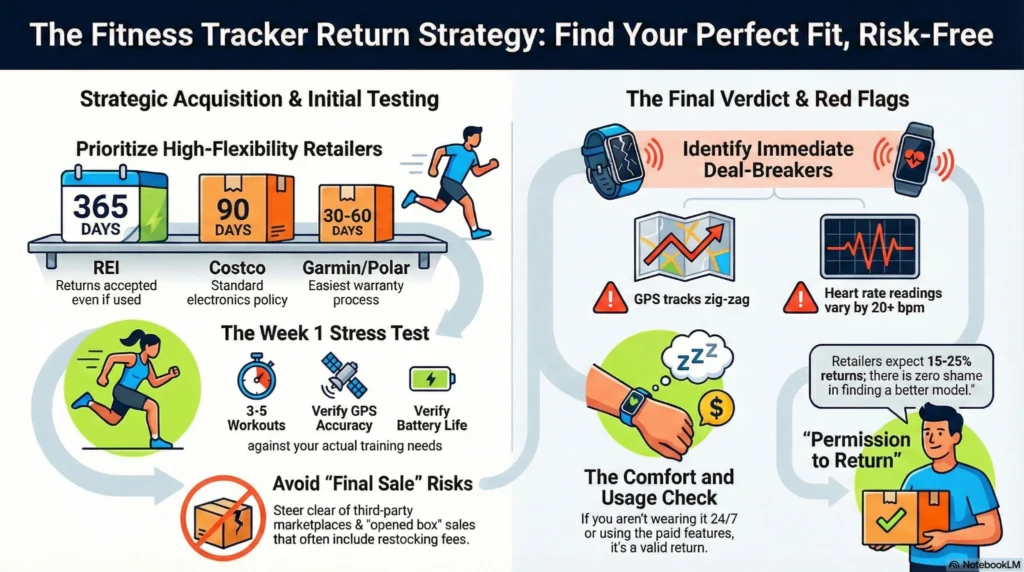
One of the top reasons for fitness tracker returns? Buyers didn’t check platform compatibility before purchasing.
What is FDA 510(k) clearance?
FDA 510(k) clearance means a device has been submitted to the U.S. Food and Drug Administration and found to be substantially equivalent to a legally marketed predicate device in safety and effectiveness. It is not the same as full FDA approval. For the Apple Watch ECG, this clearance means the AFib detection algorithm has been validated in clinical studies for the specific purpose of detecting atrial fibrillation — as a screening alert, not a diagnostic conclusion.
What this means for buyers with heart conditions:
If you have diagnosed AFib, are taking anticoagulants, or have been told by your cardiologist to monitor your heart rhythm, the Apple Watch is currently the only consumer wearable with an FDA-cleared alert for this purpose. Other trackers may display irregular heart rate notifications, but these are not clinically validated AFib alerts.
If your fitness tracker flags an irregular rhythm, consult a cardiologist for clinical evaluation — including a 12-lead ECG — before making any health decisions.
Clinical guidance (Dr. Rishav Das, M.B.B.S.): No consumer wearable replaces clinical monitoring for patients with known cardiac conditions. Use wearable AFib alerts as a prompt to seek evaluation, not as a diagnosis.
HRV: What It Measures, What’s Normal, and Which Devices Track It Accurately
Heart Rate Variability (HRV) is the variation in time between successive heartbeats, measured in milliseconds. A higher HRV generally indicates a well-recovered, adaptable cardiovascular system. A sudden HRV decline — particularly a drop of 10+ ms below your personal baseline — signals accumulated training stress, illness, or insufficient recovery.
HRV is not a number to compare across individuals. It is a personal biomarker. Your baseline at age 42 is more meaningful than how it compares to a 25-year-old elite athlete’s score.
What is a normal HRV for athletes?
HRV varies significantly by age, fitness level, and measurement methodology. Most consumer devices report RMSSD (Root Mean Square of Successive Differences), the most reliable short-term HRV metric. General reference ranges:
| Population | RMSSD Range (approximate) |
|---|---|
| Sedentary adults (all ages) | 15–35 ms |
| Recreational fitness athletes | 40–80 ms |
| Competitive endurance athletes | 80–120+ ms |
| Elite marathon / triathlon athletes | 100–170+ ms |
These ranges are population estimates. Track your personal 30-day baseline trend — not absolute values.
Which fitness trackers measure HRV most accurately?
HRV is measured during sleep in most consumer wearables, when motion artifact is lowest and PPG signal quality is highest. Accuracy varies by measurement window and algorithm:
- Polar H10 (chest strap + Polar Beat app) — gold standard for consumer HRV; 1kHz ECG sampling; closest to clinical accuracy
- Garmin watches (Fenix / Forerunner series) — nightly sleep HRV; Body Battery uses HRV as a primary input; consistent trend tracking
- Whoop 4.0 — continuous 24/7 HRV measurement; proprietary Recovery score; most granular short-term trend data of any wrist device
- Oura Ring Gen 3 — nightly HRV with Readiness score; excellent sleep-stage HRV accuracy; no GPS
- Apple Watch Series 9 / Ultra 2 — nightly HRV; reliable for trend tracking; less granular than Polar or Whoop
Clinical guidance (Dr. Rishav Das, M.B.B.S.): HRV is a useful training readiness marker, not a diagnostic tool. A persistently suppressed HRV warrants evaluation for overtraining syndrome, sleep disorders, or autonomic dysfunction — not just a rest day. Consult a physician if your HRV remains below baseline for more than 5–7 days without a clear training-load explanation.
Sleep Tracking Accuracy: Stages, SpO2, and Which Devices Perform Best
Consumer fitness trackers estimate sleep stages — light, deep, REM — using a combination of accelerometer movement data, heart rate patterns, and HRV. They do not use the polysomnography (EEG brain wave monitoring) that clinical sleep studies use. This matters for interpreting their output.
How accurate is sleep stage tracking?
A 2019 validation study (de Zambotti et al., Sleep Medicine Reviews) found consumer wearables correctly classify sleep stages in approximately 69–75% of 30-second measurement epochs, compared to polysomnography gold standard. Deep sleep (slow-wave sleep) is the most frequently misclassified stage. REM detection has improved in newer devices using PPG + accelerometer fusion algorithms.
Sleep duration is tracked with reasonable accuracy (±15–20 minutes for most users). Sleep stage percentages are best used for trend tracking — not clinical assessment.
SpO2 accuracy during sleep:
Blood oxygen saturation (SpO2) measured by consumer wearables is accurate to approximately ±2–3% in users at normal saturation levels (95–100%). Below 90%, consumer sensors lose accuracy rapidly. If your tracker consistently shows SpO2 below 90% during sleep, this warrants physician evaluation for sleep apnea or respiratory dysfunction.
Best fitness trackers for sleep tracking (2026):
- Oura Ring Gen 3 — most validated sleep tracking; nightly SpO2 + HRV; no wrist discomfort during sleep
- Whoop 4.0 — recovery-first design; continuous SpO2 sampling; best sleep staging consistency in independent testing
- Apple Watch Ultra 2 / Series 9 — reliable sleep duration and SpO2; requires nightly charging management
- Garmin Forerunner 965 — Body Battery integrates sleep + HRV + training load; strong for athletes already in the Garmin ecosystem
💡 SHARE THIS STAT:
“Fitness trackers overestimate calorie burn by 20-40% across all brands. Never use tracker data to guide eating for weight loss—you’ll sabotage your goals.”
Step 6 — Common Fitness Tracker Buying Mistakes to Avoid
Mistake #1: Buying Based on Brand Loyalty Alone
The Trap: Not understanding the fitness tracker vs smartwatch trade-offs. “I’m an Apple user, so I’ll get an Apple Watch.”
Better Approach: Apple Watch is excellent for general fitness and has superior optical heart rate accuracy compared to most competitors. However, it lacks advanced metrics for serious runners/cyclists (no running power, limited training load analysis). Battery life in GPS mode (6-8 hours) is insufficient for ultra-running or long cycling events. If you’re training for a marathon or prioritize multi-day battery life, Garmin/Polar/COROS devices offer better GPS accuracy and battery endurance.
Mistake #2: Ignoring Battery Life for Your Use Case
The Trap: Buying a smartwatch with 18-hour battery for ultra-running.
Better Approach: Match battery specs to your longest single activity. Ultra-runners need 40+ hour GPS battery. Casual users can prioritize smartwatch features over battery. Plan for manufacturer battery claims to be 20-30% optimistic under real-world conditions.
Mistake #3: Trusting Calorie Burn Estimates
The Trap: Using device calorie estimates for weight loss plans.
Better Approach: Fitness trackers overestimate calorie burn by 20-40%. Use them for relative comparisons (activity level trends), not absolute targets. Do not base medical weight management decisions on device calorie data without clinical verification.
Find Your Tracker by Use Case →
Based on the accuracy benchmarks in this guide:
- Runner needing GPS precision → Best Fitness Trackers for Runners 2026
- HIIT or cycling athlete needing reliable heart rate → Wrist HR vs. Chest Strap: Accuracy by Activity
- Darker skin tone + want validated accuracy data → Fitness Trackers with Diverse-Population Validation
- AFib or cardiac condition → FDA-Cleared Features and When to See a Doctor
- Training for a triathlon → Best Fitness Trackers for Triathlon Training 2026
- HRV and recovery focus → HRV Tracking: Which Devices Are Most Accurate
When Should You Consult a Doctor About Your Fitness Tracker Readings?
Fitness trackers are screening tools, not diagnostic instruments. The following readings warrant medical evaluation — not just a rest day.
Heart Rate Readings That Require Medical Evaluation
Seek evaluation from your physician or cardiologist if your tracker shows any of the following:
- Resting heart rate consistently above 100 bpm — may indicate tachycardia, dehydration, anemia, or thyroid dysfunction
- Resting heart rate consistently below 40 bpm (without being a trained endurance athlete with documented bradycardia) — may indicate conduction system disease
- Heart rate not recovering below 120 bpm within 2 minutes of stopping vigorous exercise — an established marker of poor cardiovascular fitness or autonomic dysfunction
- Sudden, unexplained resting HR increase of 8–10+ bpm sustained over 3+ consecutive days — may indicate infection, overtraining syndrome, or cardiac stress
AFib Alerts and What to Do Next
The Apple Watch AFib notification is a screening alert — not a diagnosis. If your Apple Watch or any wearable flags an irregular rhythm:
- Do not panic. Many alerts are false positives from motion artifact or isolated ectopic beats.
- Do not ignore recurrent alerts. Repeat irregular rhythm alerts warrant a 12-lead ECG from a cardiologist.
- Do not self-diagnose. The Apple Watch ECG can suggest AFib; only a clinical ECG can confirm it.
SpO2 thresholds requiring evaluation:
- SpO2 consistently below 92% during waking hours → consult a physician
- SpO2 consistently below 90% during sleep → warrants evaluation for sleep apnea
Clinical guidance (Dr. Rishav Das, M.B.B.S.): These thresholds are clinical prompts, not standalone emergencies. If you are experiencing symptoms — chest pain, shortness of breath, syncope, or palpitations — alongside abnormal tracker readings, seek emergency evaluation immediately rather than waiting for a scheduled appointment.
Frequently Asked Questions
What is the most accurate fitness tracker for running in 2026?
For GPS accuracy, devices with dual-frequency (L1+L5) GPS — including the Garmin Forerunner 965, COROS APEX 2 Pro, and Polar Vantage V3 — achieve ±1–2% distance error versus ±3–6% for single-frequency devices (Düking et al., 2020). For wrist heart rate during running, all optical sensors produce ±10–15 bpm error; pair with a chest strap for zone-specific training.
Do fitness trackers work accurately on darker skin tones?
Results are mixed. Motion artifacts appear to be a greater source of PPG error than skin melanin. However, a 2022 systematic review (Koerber et al.) found some devices showed 10–15 bpm greater error in users with Fitzpatrick Scale V–VI skin tones during vigorous exercise. The Apple Watch (FDA submission data) and Fitbit Sense 2 (Fitbit Heart Study) currently have the most transparent diverse-population validation datasets.
How accurate are wrist-based heart rate monitors during exercise?
At rest, wrist-based optical sensors (PPG technology) achieve ±3–5 bpm accuracy. During running, error rises to ±10–15 bpm. During HIIT or cycling, error can reach ±15–25 bpm — enough to misclassify your training zone. For structured high-intensity training, a chest strap (±1–3 bpm across all activities) is the evidence-based choice. (Source: Fuller et al., JMIR mHealth and uHealth, 2020)
Can a fitness tracker detect AFib or heart problems?
Only the Apple Watch ECG app and AFib notification carry FDA 510(k) clearance for arrhythmia detection — and only as a screening alert, not a clinical diagnosis. Other consumer trackers may display irregular heart rate notifications, but these are not validated AFib alerts. If your device flags a recurring irregular rhythm, consult a cardiologist for a 12-lead ECG evaluation.
How accurate are fitness tracker calorie estimates?
Not accurate enough for precision use. A 2020 systematic review (Fuller et al., JMIR mHealth and uHealth) found mean absolute percentage error for calorie estimates exceeded 30% across all nine major brands tested. Most trackers overestimate calorie burn by 20–40%. Use calorie data for relative day-to-day trend comparison only — not as a weight management target.
Do optical heart rate sensors work underwater?
No. Water blocks the light transmission required for photoplethysmography (PPG) to function. Wrist-based optical HR sensors do not produce reliable readings during swimming. For pool heart rate tracking, use a chest strap compatible with pool Bluetooth — such as the Garmin HRM-Swim or Polar H10 — which stores data in memory and syncs post-session.
What is a normal HRV reading for an athlete?
HRV (Heart Rate Variability) is highly individual — track your personal baseline trend rather than comparing to population averages. General RMSSD reference ranges: sedentary adults 15–35 ms; recreational athletes 40–80 ms; competitive endurance athletes 80–120+ ms; elite marathon and triathlon athletes 100–170+ ms. HRV declines with age, illness, overtraining, and poor sleep. A sustained drop of 10+ ms below your personal baseline warrants a recovery day or physician consultation if unexplained.
Is dual-frequency GPS worth the extra battery drain?
For runners and cyclists in urban environments or under tree canopy: yes. Dual-frequency (L1+L5) GPS reduces distance error from ±3–6% (single-frequency) to ±1–2% in signal-obstructed conditions (Düking et al., 2020). The trade-off is 40–50% less GPS battery life. For track athletes, open-road runners, or cyclists with clear sky, multi-constellation GPS (±2–4%) delivers comparable real-world accuracy at a fraction of the battery cost.
When should I consult a doctor about my fitness tracker readings?
Seek medical evaluation if your tracker shows: resting heart rate consistently above 100 bpm or below 40 bpm; a recurring AFib or irregular rhythm alert; SpO2 below 90% during sleep; or a sustained HRV decline of 10+ ms below your personal baseline without a clear training-load explanation. Tracker readings are wellness estimates — always confirm abnormal patterns with a physician. If you experience chest pain, shortness of breath, or palpitations alongside abnormal readings, seek emergency evaluation immediately.
How does GPS accuracy differ between Garmin, COROS, and Polar?
All three brands offer dual-frequency GPS (±1–2% error) in premium models and multi-constellation GPS (±2–4%) in mid-range models. In independent testing, all three perform comparably in open terrain. In urban and forested environments, dual-frequency models from all three brands significantly outperform their single-frequency equivalents. Device-to-device variation within the same brand is generally small. GPS mode — not brand — is the primary accuracy driver.
Medical Review & Authority
This fitness tracker buying guide has been medically reviewed by Dr. Rishav Das, M.B.B.S., Health Informatics Specialist.
Dr. Das’s Qualifications:
• M.B.B.S. (Bachelor of Medicine, Bachelor of Surgery), Grant Government Medical College, Mumbai (2024)
• Post-Graduate Certificate in Health Informatics, Columbia University (2025)
• Specialization in Immunology, Imperial College London (2025)
• Post-Graduate Diploma in Neuroscience, Johns Hopkins University (2025)
• Licensed: Medical Council of India (MCI) License No: PR/7466/2024
• ORCID: https://orcid.org/0009-0007-2692-4542
Dr. Das’s medical review focuses on ensuring this guide provides accurate health information, appropriate safety disclosures, and clear boundaries between wellness tracking and medical diagnosis. His role is educational content verification—not clinical diagnosis or treatment recommendations.
References & Evidence Sources
This guide is based on peer-reviewed research, validation studies, and clinical guidelines. All accuracy claims and safety thresholds are supported by published evidence from the last 5 years:
1. Fuller D, Colwell E, Low J, et al. Reliability and Validity of Commercially Available Wearable Devices for Measuring Steps, Energy Expenditure, and Heart Rate: Systematic Review. JMIR Mhealth Uhealth. 2020;8(9):e18694. DOI: 10.2196/18694
2. Bent B, Goldstein BA, Kibbe WA, Dunn JP. Investigating sources of inaccuracy in wearable optical heart rate sensors. npj Digital Medicine. 2020;3:18. DOI: 10.1038/s41746-020-0226-6
3. Koerber D, Khan S, Shamsheri T, et al. Accuracy of Heart Rate Measurement with Wrist-Worn Wearable Devices in Various Skin Tones: a Systematic Review. J Racial Ethn Health Disparities. 2022. DOI: 10.1007/s40615-022-01446-9
4. Pasadyn SR, Soudan M, Gillinov M, et al. Accuracy of Commercially Available Heart Rate Monitors in Athletes: A Prospective Study. Cardiovasc Diagn Ther. 2019;9(4):379-385. DOI: 10.21037/cdt.2019.06.05
5. Düking P, Fuss FK, Holmberg HC, Sperlich B. Accuracy of Distance Recordings in Eight Positioning-Enabled Sport Watches: Instrument Validation Study. JMIR Mhealth Uhealth. 2020;8(7):e17272. DOI: 10.2196/17272
6. Evenson KR, Spade CL. Review of Validity and Reliability of Garmin Activity Trackers. J Meas Phys Behav. 2020;3(1):170-185.
7. Nelson BW, Allen NB. Accuracy of Consumer Wearable Heart Rate Measurement During an Ecologically Valid 24-Hour Period: Intraindividual Validation Study. JMIR Mhealth Uhealth. 2019;7(3):e10828. DOI: 10.2196/10828
8. Asif S, AlSaafeen A, Nadar S, et al. Photoplethysmography in Diverse Skin Tones: Evaluating Bias in Smartwatch Health Monitoring. Cureus. 2025;17(10):e94074. DOI: 10.7759/cureus.94074
9. Seshadri DR, Li RT, Voos JE, et al. Wearable sensors for monitoring the internal and external workload of the athlete. npj Digital Medicine. 2019;2:71. DOI: 10.1038/s41746-019-0149-2
10. Colvonen PJ, DeYoung PN, Bosompra NA, Owens RL. Limiting racial disparities and bias for wearable devices in health science research. Sleep. 2020;43(10):zsaa159. DOI: 10.1093/sleep/zsaa159
Medical Disclaimer For Buying Fitness Trackers
Health Equity & Research Limitations
Most wearable device validation studies have historically underrepresented diverse populations. Users with darker skin tones, varied body types, or specific medical conditions may experience different accuracy levels than reported in manufacturer claims. research on limiting racial disparities in wearable health science. We encourage manufacturers to publish validation data across diverse populations and recommend consulting healthcare providers for personalized device selection.
The information on this page is for educational purposes and general wellness guidance. It should not replace professional medical advice, diagnosis, or treatment. Always consult a qualified healthcare provider for medical recommendations tailored to your individual health needs.
Consumer fitness trackers are general wellness devices (FDA exemption category) intended for activity tracking and health awareness. They are not medical devices and should not be used as substitutes for clinical evaluation or medical-grade monitoring equipment.
Device accuracy data reflects laboratory and controlled testing conditions. Real-world performance may vary based on individual physiology, device placement, environmental factors, and activity type.
Last Medical Review: June, 2026 | Dr. Rishav Das, M.B.B.S.
Wearable Wellness Guide | Independent, Physician-Reviewed Device Analysis