
Sleep Tracker Buying Guide: 60–80% vs PSG Accuracy, HRV & SpO₂ Limits Explained (2026)
A physician-reviewed sleep tracker buying guide to consumer sleep tracker accuracy — how devices compare to polysomnography, what HRV tells you, and when wearable data warrants a clinical visit.
Medically Reviewed & Tested by Dr. Rishav Das, M.B.B.S.
Wellness Device Data Analyst | Health Informatics Specialist
Last Updated: June, 2026
Introduction
This physician-reviewed sleep tracker buying guide cuts through device marketing to give you the data that actually matters: how accurately consumer trackers compare to polysomnography, what HRV during sleep tells you about recovery, and when a wearable reading should send you to a doctor instead of back to Amazon.
Reviewed by Dr. Rishav Das, M.B.B.S. — every recommendation below is grounded in published peer-reviewed research.
No affiliate-driven best-picks lists.
What you will find is a clinical accuracy framework, a budget decision structure, and an honest answer to the question most sleep tracker articles avoid: when does wearable data become a clinical problem?
Quick Answer
- Consumer sleep trackers correctly classify sleep stages 60–80% of the time compared to polysomnography (Chinoy et al., 2021). No consumer device can diagnose sleep apnea.
- For general wellness, a $100–200 wrist tracker is sufficient. Premium devices ($300+) justify their cost only through validated algorithms and advanced HRV analysis.
- If your tracker shows SpO₂ consistently below 90% during sleep, bring that data to a sleep physician — do not self-diagnose based on wearable output.
- What Do Sleep Trackers Actually Measure? The Science Behind PPG and Accelerometry
- Sleep Tracker Accuracy: How Consumer Devices Compare to Polysomnography
- What Is HRV During Sleep and Why It Matters for Recovery
- SpO₂ and Sleep Apnea: What Consumer Trackers Can — and Cannot — Detect
- Smart Ring vs Smartwatch vs Clip: Which Sleep Tracker Form Factor Is Right for You?
- Sleep Tracker Budget Guide: Do You Need to Spend $300+?
- Best Sleep Trackers by Use Case
- CPAP Machine Buying Guide
- Find Your Perfect Sleep Tracker in 60 Seconds
- Orthosomnia: The Hidden Risk of Sleep Tracker Obsession
- When to Stop Using a Consumer Tracker and See a Doctor
- Frequently Asked Questions
- Can a sleep tracker detect sleep apnea?
- How accurate are sleep trackers for measuring sleep stages?
- What does HRV during sleep tell you?
- Do I need to spend $300 or more on a sleep tracker?
- What is orthosomnia?
- Are sleep trackers accurate for people with darker skin tones?
- What sleep tracker works best with a CPAP machine?
- Which sleep trackers have no subscription fee?
- References
What Do Sleep Trackers Actually Measure? The Science Behind PPG and Accelerometry
Consumer sleep trackers do not measure brain activity — which is what polysomnography uses to definitively classify sleep stages. Instead, they use two indirect measurement methods: optical photoplethysmography (PPG) for heart rate and blood oxygen saturation, and accelerometry for body movement. Sleep stage classification is produced by algorithms that interpret these proxy signals.
Understanding this distinction is essential for calibrating your expectations about accuracy and knowing when tracker data is — and is not — clinically meaningful.
Wrist Optical Sensors (PPG) Explained
Photoplethysmography (PPG) works by shining light — typically green LED for heart rate, infrared or red LED for SpO₂ — through the skin surface and measuring the variation in light absorption caused by blood pulsing through capillaries.
Each heartbeat changes the blood volume in the wrist capillaries, changing the amount of light reflected back to the sensor. The device measures the time intervals between these pulses to calculate heart rate and heart rate variability (HRV).
Accuracy limitation: PPG signal quality depends on consistent skin contact, minimal motion artifact, and adequate skin perfusion. A loose band, cold hands, peripheral vascular disease, or darker skin tone (Fitzpatrick IV–VI) all reduce signal quality and measurement accuracy.
Accelerometry and Movement Detection
Accelerometers detect movement across three axes (x, y, z). At rest during deep sleep, movement is minimal. During lighter sleep stages and REM sleep, movement increases. During wakefulness, movement patterns are distinctly different from any sleep stage.
Limitation: Accelerometry cannot distinguish between sleep stages on its own. A person lying completely still while awake looks identical to a sleeping person in accelerometry data.
This is why algorithms that combine PPG and accelerometry outperform single-sensor devices.
How Algorithms Convert Raw Signals Into Sleep Stages
The raw PPG and accelerometry signals are processed by proprietary machine learning algorithms trained on large datasets of simultaneous PSG and consumer device recordings. These algorithms attempt to match sensor patterns to known PSG sleep stage signatures.
The core limitation: These algorithms are trained on population datasets. Your individual physiology may not match the training population, particularly if you are older, taking medications that alter heart rate patterns, or have a physiology not well-represented in the training data.
This is why Chinoy et al. (2021) found 60–80% accuracy across consumer devices — the range reflects both device quality differences and the irreducible individual variation that no algorithm can fully overcome.
Sleep Tracker Accuracy: How Consumer Devices Compare to Polysomnography
Consumer sleep trackers correctly classify sleep stages 60–80% of the time compared to polysomnography — the clinical gold standard for sleep measurement (Chinoy et al., 2021, Sensors).
Deep sleep and REM detection show greater variability than total sleep time estimates.
These devices measure movement and heart rate, not brain waves — making them wellness tools, not diagnostic instruments.
Sleep Stage Classification Accuracy (Chinoy et al., 2021)
The landmark 2021 Chinoy et al. study in Sensors tested seven consumer sleep devices against simultaneous polysomnography in a controlled sleep lab. Across all devices, epoch-by-epoch sleep stage classification accuracy ranged from 60% to 80%.
N3 slow-wave (deep) sleep was the most frequently misclassified stage. REM sleep classification was more consistent. Total sleep time estimates were the most reliable metric across all devices tested.
What this means for you: If your tracker tells you that you got 7.5 hours of sleep, that number is likely close to accurate. If it tells you that 45 minutes was deep sleep — treat that as a relative trend signal, not a precise measurement.
Limitation disclosure: Even with 80% accuracy, this means 1 in 5 sleep stage classifications may be incorrect. Use stage data for general pattern tracking, not medical decisions.
Total Sleep Time vs Stage Accuracy — What Matters More?
Consumer sleep trackers reliably estimate total sleep time (TST) but less reliably classify individual sleep stages.
Research suggests consumer devices tend to overestimate total sleep time and misclassify lighter sleep stages as deeper ones (de Zambotti et al., 2019, Sleep Medicine Reviews).
For general wellness users, consistent total sleep duration is the most actionable metric.
Athletes and users monitoring recovery should weight HRV and readiness scores more heavily than sleep stage percentages.
Consumer trackers reliably estimate total sleep time (TST) but less reliably classify individual sleep stages. According to de Zambotti et al. (2019, Sleep Medicine Reviews), consumer devices tend to overestimate total sleep time and misclassify lighter sleep stages as deeper ones.
For most general wellness users, TST accuracy is the more actionable metric — knowing whether you consistently get under 6 hours matters more than whether a stage was classified as N2 or N3. Athletes and users monitoring recovery should weight HRV and readiness scores more heavily than stage percentages.
Named Device Accuracy: Oura Ring, Apple Watch, Garmin, Withings
| Device | PSG Comparison Accuracy (Stage Classification) | Notes |
|---|---|---|
| Oura Ring Gen 3 | 70–80% | Independent PSG validation published; strongest evidence base in consumer category |
| Apple Watch Series 9 | 60–70% | Sleep tracking added in watchOS 9; algorithm optimized for TST, not stage depth |
| Garmin Forerunner / Fenix | 65–75% | Body Battery integrates HRV + sleep; stage classification less published than Oura |
| Withings ScanWatch | 65–75% | Includes validated SpO₂ monitoring; under-mattress sensor (Withings Sleep Analyzer) outperforms wrist for passive measurement |
Accuracy ranges are based on published independent validation studies and manufacturer-disclosed PSG comparison data. Consumer wearable accuracy varies by individual physiology, age, medication use, and skin tone.
Factors That Reduce Accuracy: Age, Medication, and Skin Tone
Several physiological factors reduce sleep tracker accuracy in peer-reviewed testing:
Age: Older adults show different movement patterns during light sleep that accelerometry-based algorithms misclassify more frequently.
Medication: Beta-blockers, sedatives, and SSRIs alter heart rate patterns that HRV-based algorithms rely on for stage classification.
Skin tone: Optical PPG sensors show reduced accuracy for individuals with Fitzpatrick skin types IV–VI due to higher melanin absorption of the infrared light used for measurement. See the SpO₂ section below for skin-tone accuracy data.
Sleep disorders: Apnea-related arousals, RLS movements, and periodic limb movements generate false stage transitions in accelerometry data.
What Is HRV During Sleep and Why It Matters for Recovery
Heart rate variability (HRV) during sleep reflects autonomic nervous system recovery — specifically, the balance between sympathetic and parasympathetic activity.
Higher nighttime HRV generally indicates better cardiovascular recovery.
Athletes use nighttime HRV as a readiness-to-train signal.
Compare your HRV to your own historical baseline, not population averages — individual variation in HRV is too large for a single “normal” number to be clinically meaningful.
Heart rate variability (HRV) during sleep reflects autonomic nervous system recovery — specifically, the balance between sympathetic (stress) and parasympathetic (recovery) activity. Higher nighttime HRV generally indicates better cardiovascular recovery. Compare your HRV to your own historical baseline, not population averages — individual variation in HRV is too large for a single “normal” number to be meaningful.
How Sleep Trackers Measure Nighttime HRV
Consumer sleep trackers measure HRV using optical PPG sensors that detect the interval between heartbeats (the R-R interval). The most common derived metric is RMSSD (Root Mean Square of Successive Differences) — a millisecond value representing the variation in consecutive beat intervals. Higher RMSSD during sleep indicates greater parasympathetic activity and better recovery.
Some devices (Garmin, WHOOP) also report SDNN — the standard deviation of all beat intervals — which captures longer-term autonomic variation. RMSSD is more sensitive to short-term recovery; SDNN reflects cumulative training load.
Oura Ring, Garmin Fenix/Forerunner, WHOOP, and Apple Watch Series 9 all measure RMSSD during sleep. Oura and WHOOP report it directly as a labeled metric. Apple Watch reports it in the Health app as HRV. Garmin integrates it into its proprietary Body Battery score. Sleep loss on exercise performance
Normal HRV Ranges by Age Group
These are population reference ranges. Your individual baseline is the meaningful benchmark — not these values.
| Age Group | Average Nighttime RMSSD (Approximate) | Notes |
|---|---|---|
| 18–25 | 60–100 ms | Highest average range; athletic training elevates further |
| 26–35 | 45–80 ms | Training status is the primary modifier at this age |
| 36–45 | 35–65 ms | Decline is normal; trend direction matters more than absolute value |
| 46–55 | 25–50 ms | Medication, stress, and sleep quality all have measurable impact |
| 56–65 | 20–40 ms | Downward trends over 2+ weeks warrant attention |
| 65+ | 15–35 ms | Individual baseline comparison is essential; population averages are least useful here |
Sources: Shaffer & Ginsberg (2017), Frontiers in Public Health; Nunan et al. (2010), Annals of Noninvasive Electrocardiology.
HRV as an Athletic Readiness Signal
Athletes use nighttime HRV as a readiness-to-train signal — a proxy for how well the autonomic nervous system has recovered from previous training load. Consistently elevated HRV relative to your baseline suggests readiness for high-intensity work. Suppressed HRV — particularly sustained over 3–5 nights — suggests incomplete recovery and elevated injury risk.
Practical thresholds (for athletes using consumer trackers):
- HRV 10% above your 30-day baseline → adequate recovery; high-intensity session appropriate
- HRV within ±10% of baseline → normal variation; moderate training appropriate
- HRV 10% below your 30-day baseline → incomplete recovery; reduce training intensity
- HRV suppressed for 3+ consecutive nights without obvious cause (travel, illness) → consider a clinical check-in
Important limitation: Consumer HRV data should guide — not override — clinical judgment. If HRV trends are accompanied by symptoms (chest discomfort, unusual fatigue, palpitations), seek medical evaluation before adjusting training load.
SpO₂ and Sleep Apnea: What Consumer Trackers Can — and Cannot — Detect
Consumer sleep trackers cannot diagnose sleep apnea.
Clinical diagnosis requires a polysomnography study that measures the Apnea-Hypopnea Index (AHI) — the number of breathing interruptions per hour of sleep.
An AHI of 5 or more events per hour indicates obstructive sleep apnea and requires physician evaluation.
If your tracker consistently shows SpO₂ below 90% during sleep, consult a sleep physician rather than self-diagnosing based on wearable output.
How Wrist-Based SpO₂ Monitoring Works
Consumer sleep trackers measure blood oxygen saturation (SpO₂) using optical photoplethysmography (PPG) — the same infrared-light-based sensor that measures heart rate. A green LED measures blood flow; a red or infrared LED measures the ratio of oxygenated to deoxygenated hemoglobin. The result is an estimated SpO₂ percentage.
Wrist-based SpO₂ measurement is fundamentally different from medical pulse oximetry. Medical devices clip to the fingertip, where blood vessels are closer to the surface and movement artifact is minimal. Wrist sensors must contend with greater movement artifact, skin compression variation from wrist positioning, and a longer optical path through subcutaneous tissue.
This is why consumer wrist SpO₂ readings typically carry ±2–3% accuracy variation compared to ±1% for medical-grade fingertip oximeters.
SpO₂ Accuracy by Skin Tone (Fitzpatrick Scale)
Optical PPG sensors in wrist-based sleep trackers can show reduced accuracy in individuals with Fitzpatrick skin types IV–VI due to higher melanin absorption of the infrared light used for measurement.
This primarily affects heart rate and SpO₂ readings.
Few consumer device manufacturers publish skin-tone-stratified validation data.
Individuals with darker skin tones who rely on wrist SpO₂ readings for any health decision should cross-reference with a medical-grade fingertip pulse oximeter.
Optical PPG sensors can show reduced accuracy for individuals with Fitzpatrick skin types IV–VI due to higher melanin concentration in the dermis absorbing a greater proportion of the infrared light used for measurement. This produces signal attenuation that algorithms may interpret as oxygen desaturation — potentially generating falsely low SpO₂ readings.
What this means practically:
| Fitzpatrick Type | Skin Tone Description | SpO₂ Accuracy Consideration |
|---|---|---|
| I–III | Very fair to medium | Standard PPG accuracy applies |
| IV | Olive to medium-brown | Marginal reduction in SpO₂ reliability; verify with medical oximeter if concerned |
| V–VI | Dark brown to very dark | Clinically significant reduction in PPG accuracy documented; wrist SpO₂ readings require medical validation before clinical decisions |
Few consumer device manufacturers publish Fitzpatrick-stratified SpO₂ validation data.
Before relying on wrist SpO₂ readings for any clinical decision-making, individuals with skin types V–VI should cross-reference with a fingertip pulse oximeter.
AHI, Polysomnography, and the Diagnostic Limit
The Apnea-Hypopnea Index (AHI) — the definitive metric for sleep apnea diagnosis — can only be measured via polysomnography or a validated home sleep apnea test (HSAT). Consumer wrist trackers do not measure AHI.
Clinical AHI thresholds:
- AHI < 5 events/hour → Normal
- AHI 5–14 events/hour → Mild obstructive sleep apnea
- AHI 15–29 events/hour → Moderate obstructive sleep apnea
- AHI ≥ 30 events/hour → Severe obstructive sleep apnea
Consumer trackers with SpO₂ monitoring — including the Apple Watch Series 9, Withings ScanWatch, and Oura Ring Gen 3 — can detect patterns consistent with nocturnal oxygen desaturation that warrant clinical investigation.
They cannot confirm sleep apnea, quantify its severity, or replace a sleep study.
When SpO₂ Readings Should Prompt Clinical Referral
Consult a sleep physician if your consumer tracker shows any of the following across multiple non-consecutive nights:
- SpO₂ readings consistently below 90% during sleep
- SpO₂ dropping below 88% on any recorded night
- Frequent flagged “disruptions” or “awakenings” coinciding with SpO₂ dips
- Morning reports of unrefreshing sleep despite adequate sleep duration
- Partner-reported witnessed apneas, gasping, or choking sounds
What to bring to the appointment:
Export the last 30 nights of SpO₂ trend data from your device app. Note the dates and times of the lowest readings.
Ask your provider specifically whether the pattern warrants a home sleep apnea test (HSAT) or in-lab polysomnography.
Smart Ring vs Smartwatch vs Clip: Which Sleep Tracker Form Factor Is Right for You?
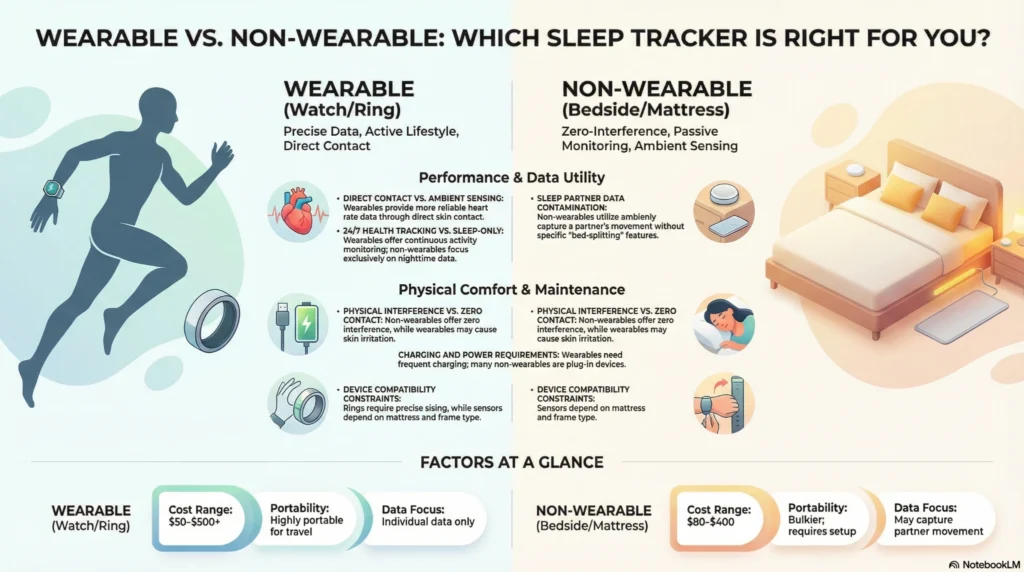
Choosing a sleep tracker form factor is a comfort, accuracy, and use-case decision before it is a brand decision. Smart rings, wrist-based smartwatches, and under-mattress sensors each have distinct accuracy trade-offs, wearing comfort profiles, and optimal use cases. The “best” form factor is determined by why you are tracking sleep — not by marketing claims.
Wrist-Based Wearables — Comfort and Accuracy Trade-offs
Wrist-based sleep trackers — the category that includes Apple Watch, Garmin Forerunner/Fenix, Fitbit Sense, and Samsung Galaxy Watch — offer the advantage of a single device that tracks both daytime activity and nighttime sleep.
Accuracy trade-off: Wrist movement during sleep is the primary noise source for accelerometry-based stage classification. Individuals who sleep on their dominant wrist side, shift positions frequently, or have restless legs may see elevated misclassification rates. Optical PPG accuracy is also affected by wrist tension — a too-loose band reduces signal quality significantly.
Best for: Users who already own a smartwatch and want sleep data without purchasing a dedicated device.
Not ideal for: Users with suspected sleep disorders, advanced athletes requiring precise HRV data, or individuals with darker skin tones where wrist-based PPG accuracy is further reduced.
Smart Rings: The Case for Dedicated Sleep Hardware (Oura Ring Gen 3)
Smart rings — most prominently the Oura Ring Gen 3 and RingConn Gen 2 — offer several physiological advantages for sleep tracking over wrist-based devices.
The finger has a richer capillary bed and a shorter optical path between skin surface and blood vessels than the wrist. This means PPG signal quality for heart rate and HRV measurement is inherently higher at the finger than at the wrist. The Oura Ring’s position on the proximal phalanx provides more consistent tissue contact than a wrist band that shifts with arm movement.
Comfort advantage: Rings are lower-profile and produce less sleep disruption than a watch case resting against the mattress or mattress partner.
Battery advantage: Oura Ring Gen 3 provides approximately 7 days of battery life, eliminating the nightly charging conflict that causes compliance issues with smartwatch sleep tracking.
Accuracy evidence: The Oura Ring Gen 3 has published independent PSG validation data — the strongest evidence base of any consumer sleep tracker in this form factor category.
Limitation: $299–349 hardware cost plus approximately $6/month subscription. Does not track daytime GPS activity. No display.
Best for: Athletes and users prioritizing sleep accuracy over daytime activity tracking.
Under-Mattress Sensors: Contactless Option for CPAP Users
Under-mattress sensors — including the Withings Sleep Analyzer and the Google Nest Hub second-generation (radar-based) — are the preferred form factor for CPAP users and individuals who find wearable devices disruptive to sleep.
CPAP compatibility: Wearing a wrist tracker or ring does not interfere with CPAP therapy. However, the CPAP mask, tubing movement, and machine-induced respiratory rhythms can create PPG signal artifacts that affect wrist-based sleep stage classification accuracy. Under-mattress sensors measure body movement and respiratory rate through the mattress surface — independently of CPAP hardware — making them structurally better suited to CPAP-user sleep measurement.
Important limitation: Under-mattress sensors do not provide heart rate or HRV data at the individual beat level. They are movement and respiratory approximation devices. The Withings Sleep Analyzer includes a validated snoring and apnea detection algorithm, but this does not replace a clinical AHI measurement from a sleep study.
Best for: CPAP users; individuals who cannot tolerate wearing a device during sleep; households tracking multiple sleepers.
Sleep Tracker Budget Guide: Do You Need to Spend $300+?
For general wellness and sleep pattern awareness, a $100–200 wrist tracker provides sufficient data.
Premium sleep trackers ($300+) justify their cost only through peer-reviewed algorithm validation, advanced HRV analysis, or clinical-grade SpO₂ monitoring.
If you are managing a diagnosed sleep condition, consult your provider before purchasing any device — the decision should be clinically informed, not marketing-driven.
Sleep Tracker Budget Comparison — 2026
| Tier | Price Range | Best For | Subscription Required? | Approx. 3-Year Cost |
|---|---|---|---|---|
| Budget | Under $100 | General wellness; sleep duration tracking; first-time users | No | $80–100 |
| Mid-Range | $100–200 | Active users; HRV monitoring; improved accuracy | No (most) | $150–250 |
| Premium | $200–350 | Athletes; disorder-adjacent monitoring; advanced HRV + SpO₂ | Some | $350–600 |
| Subscription-Model | Hardware + monthly | Users wanting ongoing algorithm updates; team/coach integration | Yes (required) | $500–1,000+ |
Best Budget Sleep Trackers Under $100
Fitbit Inspire 3 and Xiaomi Mi Band 8 Pro provide reliable total sleep time estimation, basic stage approximation, and SpO₂ spot-checks at under $80. For users whose goal is tracking whether they are consistently getting 7+ hours of sleep, not clinical-grade stage analysis, these devices deliver sufficient signal at minimal cost.
Clinical note from Dr. Das: The gap between a $70 tracker and a $300 tracker is meaningful for HRV precision and PSG-validated algorithm accuracy. It is not meaningful for detecting that you slept 5 hours three nights in a row. If duration awareness is the goal, a budget device is the correct choice.
Best Mid-Range Sleep Trackers ($100–$300)
Garmin Vivosmart 5, Fitbit Sense 2, Samsung Galaxy Watch 6, and Withings ScanWatch Lite offer the strongest mid-range value for users who want sleep stage data, HRV tracking, and SpO₂ monitoring without a premium price point.
The Withings ScanWatch Lite ($229) is notable in this tier for its ECG capability and clinically relevant SpO₂ monitoring with an accuracy specification consistent with medical-adjacent applications.
Premium Sleep Trackers ($300+): Who Actually Needs Them?
Oura Ring Gen 3 ($299–349 + ~$6/month) and Garmin Fenix 7/8 ($500–700) justify their cost for athletes using HRV for daily training load decisions. They are also suitable for individuals with suspected sleep disorders who need the most accurate consumer-tier SpO₂ and stage data available, as well as users who have already tried a mid-range device and found its data insufficient for their health management goals.
If you are a general wellness user, a premium device will not improve your sleep. It will give you more granular data about the same sleep. The marginal accuracy gain over a quality mid-range device does not justify the cost for most buyers.
Sleep Trackers Without a Subscription Fee — 2026 Options
Several high-quality devices include full sleep tracking features with no mandatory monthly subscription.
| Device | Price | Subscription? |
|---|---|---|
| Garmin Fenix / Forerunner / Vivosmart | $150–700 | None |
| Apple Watch (any model) | $249–799 | None for sleep |
| Samsung Galaxy Watch | $179–549 | None |
| Withings ScanWatch / Sleep Analyzer | $150–299 | None |
| Fitbit (Inspire, Sense, Versa) | $79–299 | Optional (Fitbit Premium ~$10/mo) |
| Oura Ring Gen 3 | $299–349 | Required (~$6/mo) |
| WHOOP 4.0 | $0 hardware | Required (from $30/mo) |
Bottom line: If subscription avoidance is a priority, Garmin, Apple Watch, Samsung, and Withings all provide comprehensive sleep tracking with no recurring cost.
Best Sleep Trackers by Use Case
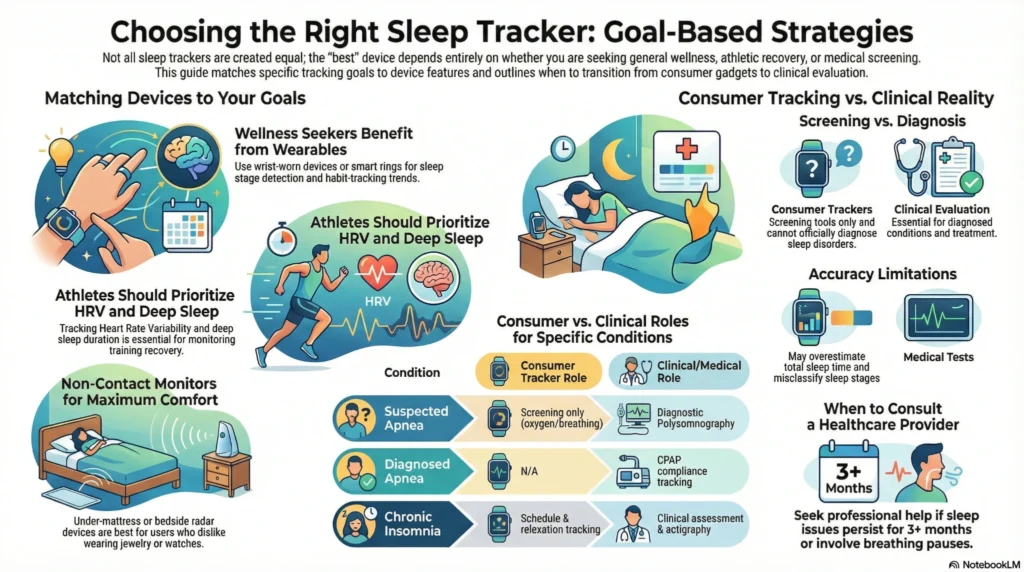
The best sleep tracker is determined by your primary health goal — not by overall feature count or price. Below are physician-reviewed recommendations for four distinct use cases, based on device accuracy data, clinical relevance, and practical wear compliance.
Best Sleep Tracker for Athletes and Recovery Monitoring
Top pick: Oura Ring Gen 3
Runner-up: WHOOP 4.0 / Garmin Fenix 8
Athletes require HRV precision, reliable RMSSD measurement, and a readiness score grounded in validated sleep data.
The Oura Ring Gen 3 leads this category on three criteria: PSG-validated sleep stage accuracy (highest published evidence base among consumer devices), finger-based PPG for superior HRV signal quality, and a readiness algorithm that explicitly integrates nighttime HRV, body temperature deviation, and sleep stage quality.
WHOOP 4.0 offers compelling daily recovery scoring and strong community/coaching integration, but requires a mandatory subscription and provides no display — which may limit use for users who want passive data without app dependency.
Garmin Fenix provides the best GPS activity + sleep integration for athletes who do not want to wear two devices.
What to look for: HRV measurement method (RMSSD vs proprietary), PSG validation evidence, battery life sufficient to track full sleep without charging conflicts, and readiness score methodology transparency.
Oura Ring Gen 3
“Helps keep me aware of how I’m doing with sleep, heart health, and stress — I really like it.” — long-term customer (Trustpilot).
⏰ Inventory note :
Oura frequently experiences shipping delays during November–January due to holiday demand and New Year wellness spikes. Delivery times often extend beyond 2–3 weeks in Q4.
🎁 Best time to buy:
Oura rarely discounts heavily. When sales do happen (Black Friday, occasional anniversary promos), discounts are usually $50–$100 max and time-limited.
✓ Risk-free trial:
30-day return window when purchased directly from Oura (membership fees refundable within the trial).
WHOOP 4.0
⏰ Availability note :
WHOOP doesn’t “sell out,” but subscription promotions are time-limited and usually tied to major sports seasons or holidays.
🎁 Best time to buy:
Discounts typically appear during:
New Year fitness season (January)
Often include free extra months rather than price cuts.
Black Friday
✓ Risk-free trial:
30-day return policy for new members (hardware must be returned).
Best Sleep Tracker for Suspected Sleep Disorder
CRITICAL LIMITATION: Consumer sleep trackers are not medical devices and cannot diagnose sleep disorders.
Top pick: Withings ScanWatch 2
Runner-up: Apple Watch Series 9 (with watchOS sleep features)
Users with suspected sleep-disordered breathing require validated SpO₂ monitoring, actionable pattern flagging, and a device whose data format a sleep physician will recognize and accept during consultation.
The Withings ScanWatch 2 is notable for its ECG capability, validated SpO₂ algorithm, and an integrated Respiratory Scan feature that detects respiratory disturbances during sleep. It is not a diagnostic device — it cannot measure AHI — but it produces the most clinically structured SpO₂ trend data of any consumer tracker available in 2026.
Clinical note from Dr. Das: No consumer tracker can diagnose a sleep disorder. If you suspect a sleep disorder, the most important step is scheduling a sleep physician consultation — not purchasing a more sophisticated tracker. Use consumer data to support that conversation, not to delay it.
Best Sleep Tracker for General Wellness
Top pick: Fitbit Sense 2 / Samsung Galaxy Watch 6
Budget option: Fitbit Inspire 3
For users whose goal is sleep duration awareness, trend monitoring, and basic stage data — without clinical-grade accuracy requirements — a mid-range wrist tracker is the most practical choice.
The Fitbit Sense 2 and Samsung Galaxy Watch 6 both provide comprehensive sleep metrics, competitive HRV tracking, and no mandatory subscription, at price points that do not require clinical justification.
Fitbit Inspire 3
Users praise comfort and battery life — “super comfortable and battery lasts forever” is a common Amazon/aggregate comment cited in reviews.
⏰ Inventory note :
Popular Fitbit models commonly sell out at discounted prices during Prime Day and Black Friday, even if full-price stock remains available later.
🎁 Best time to buy:
Historically discounted 20–35% during:
Black Friday / Cyber Monday (November)
Amazon Prime Day (July)
✓ Risk-free trial:
45-day return window via Fitbit and most major retailers (Amazon, Best Buy).
Apple Watch Series 10
⏰ Upgrade timing note :
Apple Watch prices drop permanently once a newer generation launches (usually September). Older models may be discontinued within months.
🎁 Best time to buy:
Rare discounts on the newest model until mid-cycle
Best discounts on previous-gen models during Black Friday
✓ Risk-free trial:
30-day return window when purchased directly from Withings or major retailers.
Best Sleep Tracker for CPAP Users
Top pick: Withings Sleep Analyzer (under-mattress)
Alternative: Oura Ring Gen 3 (wrist-independent)
CPAP users face a specific tracking challenge: the CPAP machine’s forced airflow, mask seal movements, and tubing create respiratory-pattern artifacts that wrist PPG algorithms were not trained to handle.
Under-mattress sensors measure movement and respiratory rate through the mattress surface — independent of any CPAP hardware — making them the structurally superior form factor for this use case.
The Withings Sleep Analyzer places under the mattress sheet, requires no wearing compliance, and includes a validated snoring and respiratory disturbance detection algorithm.
It does not replace your CPAP’s AHI data — use it alongside, not instead of, your CPAP’s own therapy reporting.
Withings Sleep Analyzer
⏰ Inventory note :
Withings devices occasionally go out of stock regionally, especially in the US and EU during Q4 sales events.
🎁 Best time to buy:
Typically discounted 15–25% during:
Amazon seasonal sales
✓ Risk-free trial:
30-day return window when purchased directly from Withings or major retailers.
CPAP Machine Buying Guide
Important: CPAP devices are FDA-regulated medical devices requiring a valid prescription from a licensed healthcare provider. This section provides general information; all CPAP acquisition requires clinical evaluation and prescription.
Getting a Prescription
Required steps for CPAP acquisition:
1. Sleep Study (Diagnostic Test)
- In-lab polysomnography (overnight sleep clinic) or home sleep apnea test (HSAT)
- Results interpreted by board-certified sleep physician
- Measures breathing events, oxygen levels, sleep architecture
2. Diagnosis Confirmation
- Apnea-Hypopnea Index (AHI) ≥5 events/hour for insurance coverage
- Physician documentation of obstructive sleep apnea
- Severity classification (mild: 5-14, moderate: 15-29, severe: ≥30 events/hour)
3. Prescription Issuance
- Valid typically 1-5 years depending on insurance requirements
- Specifies pressure settings (CPAP, BiPAP, or APAP)
- May include mask type recommendation
CPAP prescription is legally required — devices cannot be purchased without valid prescription from licensed healthcare provider.
Machine Features to Consider
Minimum acceptable specifications:
- Heated humidification option
- Compliance data recording (insurance requirement)
- Adjustable pressure ramp
- Noise level ≤26 dB
- Replaceable filters
- Manufacturer warranty ≥2 years
Advanced features (higher-cost models):
- Battery backup capability
- Integrated wireless data transmission to provider
- Smartphone app connectivity for compliance monitoring
- Mask leak detection and alert
- Auto-altitude adjustment
Mask Types and Comfort
Mask fitting considerations:
- In-person fitting strongly recommended — most durable medical equipment (DME) providers offer mask trials
- Sizing varies by manufacturer — measure facial dimensions
- Headgear adjustment critical for seal without overtightening
- Mask liners or gel pads may improve comfort and reduce leaks
Mask replacement schedule (typical insurance coverage):
- Cushions: Every 1-3 months (insurance typically covers monthly)
- Headgear: Every 6 months
- Complete mask: Every 6-12 months
- Filters: Every 1-2 months (disposable)
Insurance Coverage
Insurance coverage requirements vary by plan. The following represents typical Medicare requirements as an example:
Medicare CPAP coverage requirements (representative example):
Diagnosis documentation:
- AHI ≥15, OR
- AHI 5-14 + symptoms (excessive daytime sleepiness, hypertension, coronary artery disease)
Initial trial period:
- 30-90 day compliance monitoring
- Minimum 4 hours/night usage for 70% of nights (varies by plan)
Continued coverage:
- Face-to-face follow-up with prescribing physician within 90 days
- Documented improvement in symptoms
- Ongoing compliance data submission
Private insurance variations:
- Compliance thresholds may differ (some require 6 hours/night)
- Prior authorization often required
- In-network DME supplier may be mandated
- Copays and deductibles apply
Find Your Perfect Sleep Tracker in 60 Seconds
Answer 4 simple questions to get a personalized recommendation:
QUESTION 1: What’s your primary goal?
A) General wellness & sleep awareness
→ Go to Question 2
B) Athletic recovery & performance optimization (need sleep tracker for recovery)
→ RECOMMENDATION: WHOOP 4.0 or Garmin Venu 3
→ See detailed athletic recovery comparison
C) Monitor a suspected sleep disorder or medical condition
→ IMPORTANT: Consumer trackers cannot diagnose conditions. See when to consult a healthcare provider first.
→ After medical clearance: Oura Ring Gen 3 or Apple Watch Series 10 (has FDA-cleared sleep apnea notifications)
QUESTION 2: Do you find wearables uncomfortable while sleeping?
A) A) Yes, wearable sleep tracker comfort is poor for me (I hate wearing devices to bed)
→ RECOMMENDATION: Withings Sleep Analyzer (under-mattress pad)
→ See non-wearable options comparison
B) No, I’m okay wearing something
→ Go to Question 3
QUESTION 3: What’s your budget?
A) Sleep tracker under $100 (budget-conscious)
→ RECOMMENDATION: Fitbit Inspire 3 ($99.95) or Amazfit Band 7 ($49.99)
→ See budget tier comparison
B) Sleep tracker under $200 (mid-range value, $100-$300)
→ Go to Question 4
C) $300+ (willing to invest in accuracy)
→ RECOMMENDATION: Oura Ring Gen 3 ($299-449) or Apple Watch Series 10 ($399+)
→ See premium tier comparison
QUESTION 4: Are you an iPhone or Android user?
A) iPhone (iOS)
→ RECOMMENDATION: Apple Watch Series 10 (seamless integration) or Oura Ring Gen 3
→ See Apple Health integration details
B) Android
→ RECOMMENDATION: Samsung Galaxy Watch 6, Garmin Venu 3, or Fitbit Inspire 3
→ See Android compatibility comparison
C) I want device-agnostic / standalone tracking
→ RECOMMENDATION: Oura Ring Gen 3 or WHOOP 4.0 (both have excellent standalone apps)
Orthosomnia: The Hidden Risk of Sleep Tracker Obsession
Orthosomnia is a clinically recognized phenomenon in which preoccupation with achieving perfect sleep tracker scores paradoxically worsens actual sleep quality.
First described in peer-reviewed literature in 2017 (Baron et al., Journal of Clinical Sleep Medicine), orthosomnia can manifest as bedtime anxiety about upcoming scores, distress from poor readings despite feeling rested, and inability to sleep without wearing the device.
If tracker data is causing sleep anxiety, consider a device break and consultation with a sleep specialist.
The term combines “ortho” (correct or straight) with “somnia” (sleep) — the pathological pursuit of perfect sleep as measured by a consumer device.
Clinical context: The irony of orthosomnia is physiological. Sleep anxiety activates the sympathetic nervous system — the same stress-response pathway that suppresses the parasympathetic tone required for deep, restorative sleep. A poor tracker score that causes anxiety generates the biological conditions that will produce another poor tracker score.
Who is at risk: Individuals with pre-existing health anxiety, perfectionistic personality traits, or a history of insomnia are at elevated orthosomnia risk. The data-literate ICP buyer — exactly the person most likely to purchase a premium sleep tracker — is among the highest-risk profiles.
What to do if you recognize orthosomnia in yourself:
- Take a 2–4 week break from reviewing sleep scores (keep wearing the tracker if removing it causes anxiety; just stop checking the data).
- Reframe the goal: use tracker data to identify trends over weeks, not to evaluate individual nights.
- If sleep anxiety persists, consult a sleep specialist — Cognitive Behavioral Therapy for Insomnia (CBT-I) is the evidence-based first-line treatment for chronic insomnia and sleep anxiety.
- Discuss tracker use explicitly with your sleep physician — some clinicians recommend tracker holidays as part of CBT-I protocols.
Important note from Dr. Das: If a poor tracker score consistently causes you more distress than a night of genuinely poor sleep, the tracker is no longer serving your health goals. Consumer devices are wellness tools. If a wellness tool is producing illness, discontinue it and seek clinical guidance.
When to Stop Using a Consumer Tracker and See a Doctor
A consumer sleep tracker is a wellness tool — not a diagnostic device. The data it generates can inform clinical conversations, but it cannot replace them. Know the patterns that require physician evaluation rather than behavioral self-adjustment.
Red Flag Patterns That Warrant Clinical Evaluation
Bring your sleep tracker data to a sleep physician if your device consistently shows any of the following across multiple non-consecutive nights:
- SpO₂ below 90% during sleep (on any night)
- SpO₂ below 88% (regardless of frequency — single event warrants evaluation)
- Sleep efficiency below 75% on most nights over a two-week period
- Frequent awakenings flagged by the device across multiple consecutive nights without an obvious cause (travel, illness, new environment)
- HRV trending significantly downward over 2+ weeks without a training load or lifestyle explanation
- Daytime sleepiness despite tracker-reported adequate sleep duration — suggests sleep quality issues the tracker is not capturing
What these thresholds mean: SpO₂ below 90% can indicate nocturnal hypoxemia consistent with sleep-disordered breathing. Sleep efficiency below 75% over two weeks meets the clinical criterion for chronic insomnia evaluation. Sustained HRV decline without an obvious cause may reflect subclinical illness, overtraining syndrome, or autonomic dysfunction — all of which warrant medical review.
Critical limitation reminder: Consumer devices are not substitutes for clinical evaluation or diagnostic testing. Evidence shows significant variability between consumer and clinical-grade measurements (Kolla et al., 2016, Journal of Clinical Sleep Medicine).
How to Prepare Your Sleep Tracker Data for a Doctor’s Appointment
Consumer sleep data is most clinically useful when presented systematically.
Follow this workflow before your appointment:
- Export 30 days of sleep data from your device’s companion app (Oura: export via web dashboard; Garmin Connect: Health Snapshot export; Apple Health: export from Health app Settings > Export All Health Data)
- Flag the 5–10 most concerning nights — dates with the lowest SpO₂ readings, lowest sleep efficiency, or most flagged awakenings.
- Note your symptoms for those nights: morning grogginess, headache, dry mouth, partner-reported snoring or apnea events.
- Prepare one specific question: “Does this pattern of [SpO₂ readings / sleep efficiency / HRV trend] warrant a formal sleep study?”
What to ask your provider: Request either a home sleep apnea test (HSAT) or an in-lab polysomnography referral. Do not let a vague “let’s monitor it” response delay evaluation of a pattern that has already concerned you enough to bring to an appointment.
For CPAP users: Your sleep tracker does not replace your CPAP AHI titration data. Use tracker data as a supplement, particularly for HRV trend monitoring and sleep efficiency, but rely on your CPAP device’s reported AHI for therapy efficacy assessment.
Frequently Asked Questions
Can a sleep tracker detect sleep apnea?
No. Consumer sleep trackers cannot diagnose sleep apnea. Diagnosis requires a polysomnography study (or validated home sleep apnea test) that measures the Apnea-Hypopnea Index (AHI). An AHI of 5 or more events per hour indicates obstructive sleep apnea and requires physician evaluation. Devices with SpO₂ monitoring — such as the Apple Watch Series 9, Withings ScanWatch, or Oura Ring Gen 3 — can flag patterns consistent with nocturnal oxygen desaturation that warrant clinical investigation. If your tracker consistently shows SpO₂ below 90% during sleep, consult a sleep physician rather than self-diagnosing.
How accurate are sleep trackers for measuring sleep stages?
Consumer sleep trackers achieve 60–80% accuracy for sleep stage classification compared to polysomnography (Chinoy et al., 2021, Sensors). Deep sleep detection is typically less accurate than REM or total sleep time estimation. Accuracy varies by device (Oura Ring achieves the highest published PSG-validation accuracy in the consumer category), individual physiology, age, medications, and skin tone. Total sleep time estimates are the most reliable metric across all consumer devices tested.
What does HRV during sleep tell you?
Heart rate variability (HRV) during sleep reflects autonomic nervous system recovery — the balance between sympathetic and parasympathetic activity. Higher nighttime HRV generally indicates better cardiovascular recovery. The most clinically used metric is RMSSD (Root Mean Square of Successive Differences), measured in milliseconds. Athletes use nighttime HRV as a daily readiness-to-train signal. For meaningful interpretation, compare your HRV readings to your own 30-day baseline — not to population average tables — because individual variation in HRV is clinically significant.
Do I need to spend $300 or more on a sleep tracker?
For general wellness and sleep duration awareness, a $100–200 wrist tracker is sufficient. Premium devices ($300+) justify their cost if you need PSG-validated algorithm accuracy (Oura Ring Gen 3), advanced HRV analysis for athletic training, or clinical-grade SpO₂ monitoring (Withings ScanWatch). If you are using a sleep tracker primarily to confirm whether you are getting enough sleep — rather than for clinical-adjacent monitoring — a mid-range device provides adequate signal at lower cost. Subscriptions add cost: Oura Ring requires approximately $6/month; WHOOP requires a mandatory subscription starting at $30/month with no one-time hardware purchase option.
What is orthosomnia?
Orthosomnia is a clinical phenomenon in which preoccupation with achieving perfect sleep tracker scores causes anxiety that paradoxically worsens actual sleep quality. First described in Journal of Clinical Sleep Medicine in 2017 (Baron et al.), it manifests as bedtime anxiety about upcoming scores, distress triggered by poor readings despite feeling rested, and inability to sleep without the device. If you find yourself more distressed by a poor tracker score than by actually feeling unrefreshed, consider a tracker break of 2–4 weeks and consultation with a sleep specialist. Cognitive Behavioral Therapy for Insomnia (CBT-I) is the evidence-based first-line treatment.
Are sleep trackers accurate for people with darker skin tones?
Wrist-based sleep trackers using optical PPG sensors can show reduced accuracy for individuals with Fitzpatrick skin types IV–VI due to higher dermal melanin concentration absorbing a greater proportion of the infrared light used for measurement. This primarily affects SpO₂ and heart rate readings, with downstream effects on HRV accuracy. Few consumer device manufacturers publish Fitzpatrick-stratified validation data. If you have a skin tone in the Fitzpatrick IV–VI range and are relying on wrist SpO₂ data for any health decision, cross-reference with a medical-grade fingertip pulse oximeter.
What sleep tracker works best with a CPAP machine?
Sleep trackers and CPAP machines operate independently and do not interfere with each other electrically. However, CPAP-induced respiratory patterns and mask movement create artifacts in wrist PPG signals that reduce sleep stage classification accuracy. Under-mattress sensors — particularly the Withings Sleep Analyzer — are preferred for CPAP users because they measure body movement and respiratory rate through the mattress surface, independent of CPAP hardware. Wrist trackers such as the Oura Ring Gen 3 can supplement CPAP therapy monitoring for HRV and sleep efficiency trends, but your CPAP device’s own AHI reporting remains the primary therapy efficacy metric.
Which sleep trackers have no subscription fee?
Garmin (all models), Apple Watch, Samsung Galaxy Watch, Withings ScanWatch, and Fitbit Inspire/Versa series all include sleep tracking with no mandatory subscription. Withings Sleep Analyzer is a one-time hardware purchase with no recurring cost. Fitbit Premium (approximately $10/month) adds features but is optional — all core sleep data is available without it. Oura Ring Gen 3 requires approximately $6/month after a hardware purchase of $299–349. WHOOP has no hardware purchase option and requires a subscription starting at approximately $30/month. If subscription avoidance is a purchase criterion, Garmin and Withings offer the strongest no-subscription sleep tracking in 2026.
References
Fullagar, H. H., Skorski, S., Duffield, R., Hammes, D., Coutts, A. J., & Meyer, T. (2015). Sleep and athletic performance: The effects of sleep loss on exercise performance, and physiological and cognitive responses to exercise. Sports Medicine, 45(2), 161-186.
de Zambotti, M., Cellini, N., Goldstone, A., Colrain, I. M., & Baker, F. C. (2019). Wearable sleep technology in clinical and research settings. Sleep Medicine Reviews, 44, 21-37.
Chinoy, E. D., Cuellar, J. A., Huwa, K. E., Jameson, J. T., Watson, C. H., Bessman, S. C., … & Markwald, R. R. (2021). Performance of seven consumer sleep-tracking devices compared with polysomnography. Sensors, 21(2), 483.
Kaplan, K. A., Hirshman, J., Hernandez, B., Stefanick, M. L., Hoffman, A. R., Redline, S., … & Zeitzer, J. M. (2022). When a gold standard isn’t so golden: Lack of prediction of subjective sleep quality from sleep polysomnography. Sleep Health, 8(2), 230-235.
Kolla, B. P., Mansukhani, S., & Mansukhani, M. P. (2016). Consumer sleep tracking devices: A review of mechanisms, validity and utility. Expert Review of Medical Devices, 13(5), 497-506.
⚠️ SCOPE OF THIS GUIDE
This content explains:
- What sleep tracking devices measure and how accurately
- Device feature differences for general wellness tracking
- When medical-grade sleep testing is appropriate
This content does NOT provide:
- Sleep disorder diagnosis or medical advice
- Treatment recommendations for sleep problems
- Interpretation of your personal sleep data
- Substitute for healthcare provider consultation
If you have persistent sleep problems, consult a qualified sleep medicine provider in accordance with our editorial independence standards.
This guide explains device measurement accuracy consumer sleep tracker measurement capabilities and buying sleep tracker technology limitations to help you select devices appropriate for your wellness goals.
Not a medical diagnosis or sleep disorder treatment recommendation.
Page last updated: June, 2026
Medical review: Dr. Rishav Das, M.B.B.S. — June, 2026