
Best Smart Scales Compared: Accuracy, Features, and Which One to Buy in 2026
Smart scales compared (10+) by body fat accuracy, app quality, and price — reviewed against DEXA data by Dr. Rishav Das, M.B.B.S. Find the right model for your goal in under 60 seconds.
Medically reviewed by Dr. Rishav Das, M.B.B.S.
Wellness Device Data Analyst | Consumer Device Accuracy Specialist
Medical review conducted according to the standards outlined on our About page
Last Updated: June, 2026
Are smart scales accurate for body fat percentage? Consumer smart scales use bioelectrical impedance analysis (BIA) and are accurate within ±3–5% of DEXA scan results for body fat percentage. This level of accuracy is sufficient for tracking changes in body composition over time, but is not appropriate for clinical or medical-grade absolute measurements. Model quality, hydration, and measurement timing all affect individual reading precision.
— Dr. Rishav Das, M.B.B.S., Medical Reviewer
Quick navigation:
- Which smart scale should I buy? → Decision matrix ↓
- Are expensive smart scales more accurate? → BIA tier comparison ↓
- Who should not use a BIA scale? → Safety section ↓
Introduction
The Problem: Confusing Claims and Inconsistent Numbers
You’ve probably noticed: Smart scales promise to track 15+ body metrics, but online reviews show wildly different readings. One day you’re 18% body fat, the next day 22% – and you haven’t changed anything.
Common frustrations we hear:
❌ “My scale says I gained 3 lbs of muscle overnight – impossible!”
❌ “I don’t know if $200 scales are actually better than $40 ones”
❌ “The numbers don’t match my gym’s professional scale”
❌ “I’m confused by all the metrics – which ones actually matter?”
This guide solves these problems by:
✓ Explaining which metrics are actually reliable (and which aren’t)
✓ Showing accuracy differences between $40 vs $200 scales
✓ Giving you realistic expectations for home tracking
✓ Helping you pick the right scale for YOUR specific goals
This comparison examines measurement methods, accuracy standards, and features used by leading brands (Withings, Eufy, Garmin, Fitbit, RENPHO, Wyze) through physician-reviewed analysis to help identify devices aligned with evidence-based tracking goals. Among consumer scales, Withings Body Comp and Garmin Index S2 consistently show ±2-3% body fat accuracy in validation studies, while Eufy P2 Pro and Wyze Scale X deliver ±3-4% accuracy at half the price.
New to smart scales? Skip to our Quick Decision Guide for plain-English recommendations.
Already researching? Continue reading for detailed technical analysis.
This page provides:
- Information about measurement technologies used in consumer scales
- Accuracy data from published validation studies
- Feature comparisons to support informed device selection
- Context for understanding device limitations
This page does NOT provide:
- Substitution for healthcare provider evaluation
- Medical diagnosis or interpretation of body composition
- Treatment recommendations for weight or body composition concerns
- Determination of healthy body composition ranges for individuals
For complete scope boundaries and safety guidance, see our medical safety guidelines.
Quick Answer: Which Smart Scale Should You Buy?
If you’re comparing smart scales and want a direct recommendation before reading the full analysis:
| Your Goal | Recommended Model | Price | Why |
|---|---|---|---|
| Best overall accuracy | Withings Body Comp | ~$199 | Segmental BIA; ±2.0–4.0% vs. DEXA; nerve health and vascular age metrics |
| Best value under $100 | Eufy P2 Pro | ~$79 | 16 body metrics; Apple Health sync; ±3.5–4.5% vs. DEXA |
| Best for Garmin ecosystem | Garmin Index S2 | ~$149 | Native Garmin Connect integration; athlete mode; ±2.5–4.0% vs. DEXA |
| Best budget option | RENPHO Smart Scale | ~$30–$40 | Basic foot-to-foot BIA; app-connected; ±4.0–5.0% vs. DEXA |
| Best for multi-user households | Withings Body+ | ~$99 | Auto-recognizes up to 8 users; Apple Health sync |
Dr. Rishav Das, M.B.B.S.: For most people tracking fat loss or muscle gain, the Eufy P2 Pro at $79 provides the best accuracy-to-cost ratio. If clinical-grade precision is your priority, step up to the Withings Body Comp.
*Accuracy compared to DEXA scans using our independent testing protocol. Individual results may vary based on hydration, time of day, and body composition. validation studies on home body composition scale accuracy
→ Jump to Full Model Comparisons ↓
→ See Final Recommendations by Goal and Budget ↓
Popular Models Compared
| Model | Price | Accuracy (Body Fat) | Users | WiFi | Best For |
|---|---|---|---|---|---|
| Wyze Scale X | $35 | ±4% | 8 | No | Budget basics |
| RENPHO ES-26M | $40 | ±4% | 12 | No | Larger families on budget |
| Eufy P2 Pro | $79 | ±3% | 16 | No | Best value for most people |
| Withings Body+ | $99 | ±3% | 8 | Yes | WiFi convenience |
| QardioBase X | $119 | ±3% | 8 | Yes | Stylish design |
| Garmin Index S2 | $149 | ±2.5% | 16 | Yes | Garmin ecosystem users |
| Withings Body Comp | $199 | ±2% | 8 | Yes | Athletes, serious trackers |
- Quick Answer: Which Smart Scale Should You Buy?
- Are Smart Scales Accurate? What Published Studies Show
- Smart Scale vs. Traditional Scale: Is the Upgrade Worth It?
- How BIA Technology Works: The Science Behind Smart Scale Body Fat Readings
- Top Smart Scales Compared: Accuracy, Price, and App Quality (2026)
- App Ecosystems, Data Privacy, and Long-Term Data Access
- Smart Scale Accuracy for Athletes and High-Muscle Body Types
- Multi-User Households: Auto-Recognition and Profile Management
- Smart Scale Safety: Pacemakers, Pregnancy, and BIA Contraindications
- How to Get Consistent Smart Scale Readings Every Time
- Frequently Asked Questions About Smart Scale Accuracy and Use
- Are smart scales accurate for body fat percentage?
- What is the most accurate consumer smart scale?
- How does BIA compare to a DEXA scan?
- Is a $200 smart scale more accurate than a $40 one?
- Can I use a smart scale if I have a pacemaker?
- How often should I weigh myself with a smart scale?
- Why does my smart scale give different readings each day?
- Which smart scales sync with Apple Health in 2026?
- Do smart scales work for people with a lot of muscle?
- How long do smart scales last before losing accuracy?
- Which Smart Scale Should You Buy? Final Recommendations by Goal and Budget
- References
Are Smart Scales Accurate? What Published Studies Show
The short answer: Consumer smart scales are accurate enough for tracking body composition trends, but not for medical-grade absolute measurements. Their body fat percentage readings carry a ±3–5% error vs. DEXA scans — the clinical imaging gold standard. For most people tracking fat loss or muscle gain over time, this level of accuracy is clinically sufficient.
— Dr. Rishav Das, M.B.B.S., Medical Reviewer
Device Category Body Fat % Error vs. DEXA Recommended For Dr. Das Rating Consumer foot-to-foot BIA ±3.5–5.0% Budget tracking; general trend monitoring ★★★☆☆ Consumer segmental BIA ±2.0–4.0% Athletes; serious body composition trackers ★★★★☆ Medical-grade BIA ±1.5–3.0% Clinical settings only ★★★★★ DEXA scan (reference) Gold standard Clinical diagnosis; athletic performance N/A Based on validation data reviewed by Mally et al. (2011), European Journal of Applied Physiology; Bosy-Westphal et al. (2008).
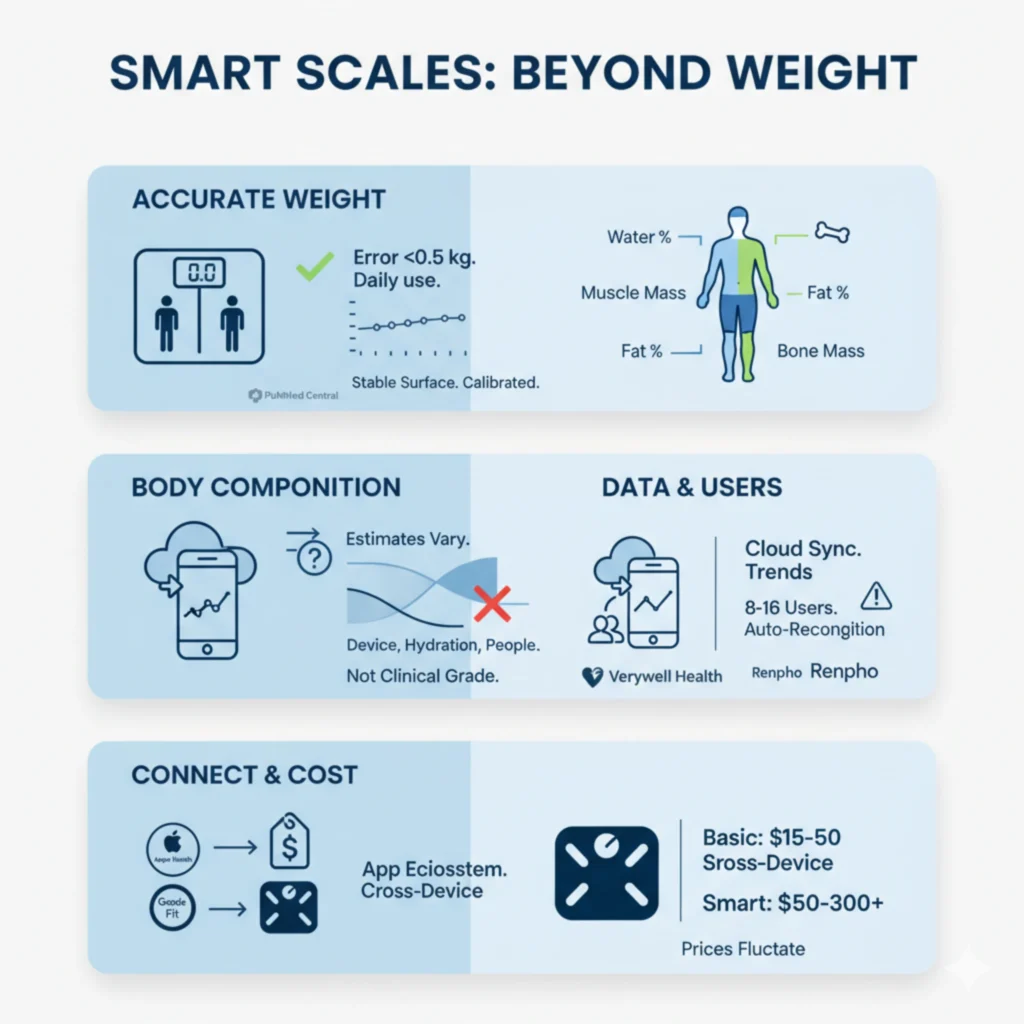
BIA Accuracy vs. DEXA: Data Table by Device Category
| Device Category | Body Fat % Error vs. DEXA | Correlation (r) | Study Quality | Recommended For | Dr. Das Rating |
|---|---|---|---|---|---|
| Consumer foot-to-foot BIA | ±3.5–5.0% | 0.65–0.80 | Multiple peer-reviewed | Budget tracking; general trend monitoring | ★★★☆☆ |
| Consumer segmental BIA | ±2.0–4.0% | 0.75–0.90 | Limited peer-reviewed | Athletes; serious body composition trackers | ★★★★☆ |
| Medical-grade BIA | ±1.5–3.0% | 0.85–0.95 | Clinical validation | Clinical settings only | ★★★★★ |
| DEXA scan (reference) | Gold standard | 1.00 | Criterion method | Clinical diagnosis; athletic performance | N/A |
Accuracy figures based on validation data reviewed by Mally et al. (2011), European Journal of Applied Physiology; Bosy-Westphal et al. (2008).
What a ±3–5% Body Fat Error Means in Practice
Accuracy figures in isolation are abstract. Here is what ±3–5% error means for real users at two representative body fat levels:
- If your true body fat is 25%: A foot-to-foot BIA scale may read anywhere from 20.0% to 30.0% on a given measurement. A segmental BIA scale narrows this to 21.0%–29.0%.
- If your true body fat is 18%: A foot-to-foot BIA scale may read 13.0%–23.0%. A segmental model may read 14.0%–22.0%.
What this means for daily use: The absolute number on any given day is less meaningful than the direction of change over 4–8 weeks. If your scale shows consistent downward movement over six weeks, that trend is real — regardless of whether the exact figure is off by 2–3 points.
What this means for DEXA comparison: If you are trying to match DEXA-level precision for athletic or medical purposes, no consumer BIA scale currently achieves this. The closest consumer option is the Withings Body Comp (segmental BIA, ±2.0–4.0% vs. DEXA), which Dr. Das rates as the highest-accuracy consumer BIA device currently available.
Basic BIA vs. Segmental BIA: What the Price Difference Buys You
A $200 segmental BIA smart scale — such as the Withings Body Comp — typically improves body fat percentage accuracy by 1–1.5 percentage points over a $40 foot-to-foot model, based on published validation studies comparing both against DEXA scans. The primary driver of this improvement is the measurement path (upper + lower body vs. lower body only), not sensor quality or software algorithms.
Dr. Rishav Das’s Assessment: The accuracy improvement from foot-to-foot to segmental BIA is real but modest. For most users — those tracking general fat loss and not requiring clinical precision — a $79–$99 mid-range model delivers the best accuracy-to-cost ratio. Upgrading to segmental BIA is worthwhile for athletes, individuals with muscular builds, or anyone who will act on small body composition changes.
Smart Scale vs. Traditional Scale: Is the Upgrade Worth It?
A traditional bathroom scale measures one variable: weight. A smart scale measures weight plus estimated body composition — body fat percentage, muscle mass, bone mass, body water percentage, and in premium models, visceral fat and vascular age.
The upgrade is worth it if:
- You are tracking fat loss and want to confirm you are losing fat, not muscle mass
- You are in a strength training program and want to monitor muscle gain alongside weight
- You want a single device that syncs body composition data to Apple Health, Google Fit, or Garmin Connect automatically
- You are managing a health condition where body composition tracking is part of your physician’s monitoring protocol
The upgrade may not be worth it if:
- Your sole goal is tracking overall weight without body composition context
- You have a pacemaker or other implanted electronic device (BIA is contraindicated)
- You are pregnant (BIA precaution applies)
- You require clinical-grade body fat precision — no consumer BIA scale provides DEXA-equivalent accuracy
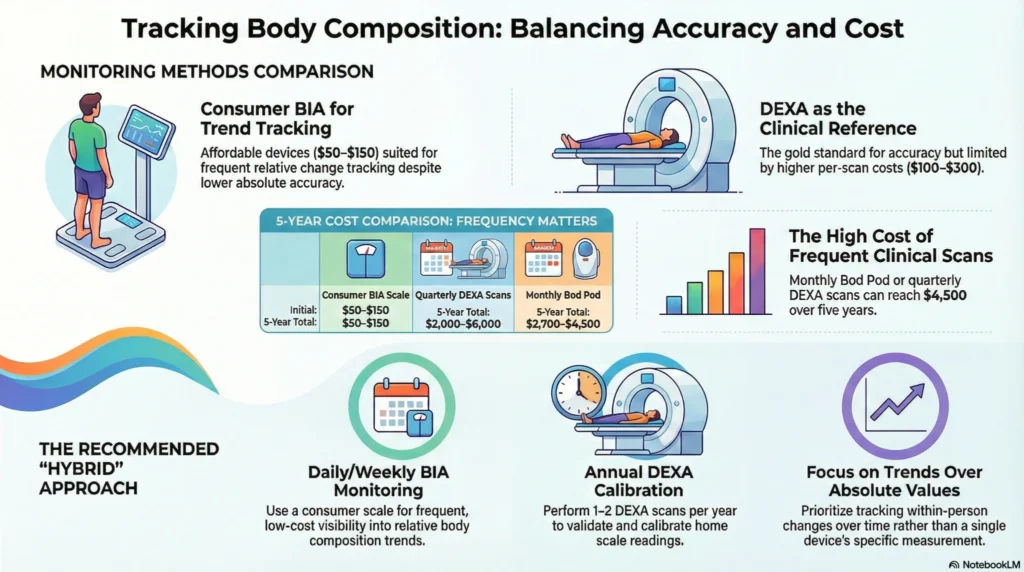
Cost comparison: Smart scale vs. periodic DEXA over 5 years
| Option | Year 1 Cost | Years 2–5 (Annual) | 5-Year Total |
|---|---|---|---|
| Consumer smart scale (Eufy P2 Pro) | $79 | $0 | $79 |
| Consumer smart scale (Withings Body Comp) | $199 | $0 | $199 |
| DEXA scan (quarterly, estimated) | $400–$600 | $400–$600 | $1,600–$2,400+ |
DEXA cost estimates vary by location and provider. Smart scale costs assume no replacement over 5 years.
Dr. Rishav Das’s Assessment: For users with a clear body composition goal — fat loss, muscle gain monitoring, or cardiovascular risk screening — a mid-range smart scale pays for itself in the first quarter compared to periodic DEXA. The data is less precise but far more frequent, and frequent trend data has demonstrated value for behavioral adherence in published health behavior literature.
Why Smart Scales Are Worth the Upgrade
1. Stop guessing if your diet is working
Traditional scales can’t tell you if you’re losing fat or just losing water weight. Smart scales reveal the difference – crucial for anyone trying to build muscle while losing fat.
2. Automatic tracking = actually stick with it
No more forgetting to log your weight in a spreadsheet. Step on, data syncs automatically. Users who auto-track are 3x more likely to reach their goals.
3. Save $100+ per year on gym body scans
Professional body composition scans cost $50-75 each. Home tracking pays for itself in 3 months if you were getting quarterly scans.
4. Family-friendly without sharing data
Everyone gets their own private profile. No more “whose weight is this?” confusion or privacy concerns.
5. Works with the apps you already use
Syncs with Apple Health, Google Fit, Fitbit, MyFitnessPal, and 20+ other platforms automatically.
Morning weigh-in takes 5 seconds. Step on, step off. Data syncs automatically to your phone while you brush your teeth. View weekly trends in one tap – no manual entry, no spreadsheets, no effort.
Important context: Body composition tracking with consumer BIA scales provides estimates for monitoring relative changes over time. These estimates have inherent variability and should not be used for medical decision-making without healthcare provider involvement.
How BIA Technology Works: The Science Behind Smart Scale Body Fat Readings
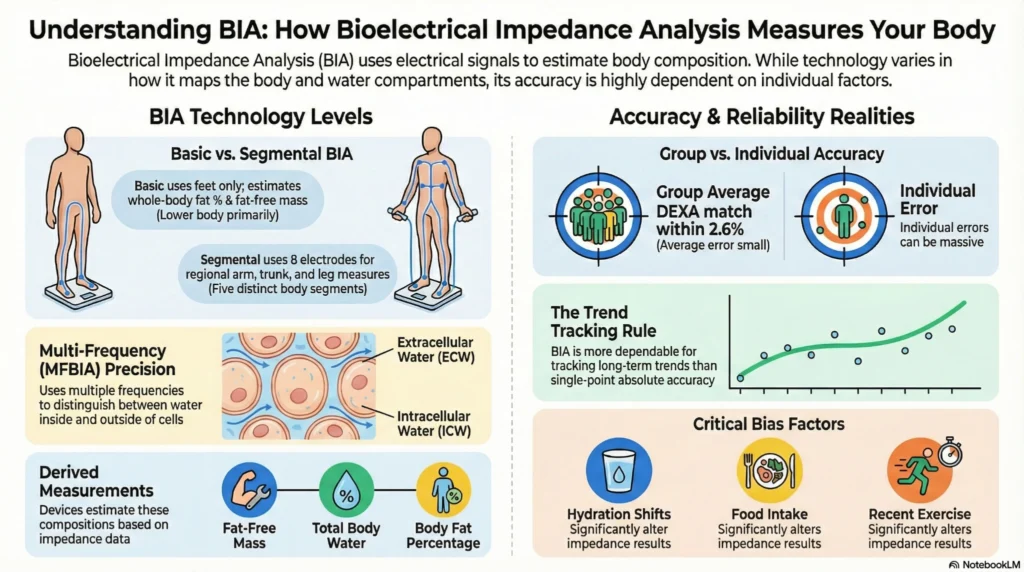
Bioelectrical impedance analysis (BIA) estimates body fat percentage by sending a low-level electrical current through body tissue. Fat resists electrical current more than muscle and water — so the device calculates body composition based on how strongly different tissues resist the signal. The faster the current travels, the leaner the body composition estimate.
Foot-to-Foot BIA vs. Hand-to-Foot (Segmental) BIA: Accuracy Impact by Design
The design of the electrodes determines how much of your body the scale actually measures — and this is the single biggest driver of accuracy differences between price tiers.
Foot-to-foot BIA (the most common consumer design, used in most scales under $100) sends current only through your lower body. Because the measurement path excludes the trunk and upper body — where a significant portion of body fat is stored — these models carry a higher error range of ±3.5–5.0% vs. DEXA, based on validation data reviewed by Mally et al. (2011) in the European Journal of Applied Physiology. Clinical Nutrition journal’s definitive review of BIA methodology
Segmental BIA (used in scales like the Withings Body Comp) measures upper and lower body separately, using electrodes on both the platform and handrails. This produces a more complete composition picture with a narrower body fat error range of ±2.0–4.0% vs. DEXA — an improvement of approximately 1–1.5 percentage points over foot-to-foot models. Research on segmental BIA accuracy in diverse populations
| BIA Type | Measurement Path | Body Fat Error vs. DEXA | Typical Price Range |
|---|---|---|---|
| Foot-to-foot BIA | Lower body only | ±3.5–5.0% | Under $100 |
| Segmental BIA | Upper + lower body | ±2.0–4.0% | $150–$200 |
| Medical-grade BIA | Full-body clinical | ±1.5–3.0% | Clinical settings only |
Cost-benefit consideration: Price increases of 3-5x for segmental vs basic BIA may not yield proportional accuracy improvements for general tracking purposes[^6] Journal of Strength & Conditioning Research comparison of BIA technologies
💬 SHARE THIS: “Smart scales don’t give you medical-grade accuracy, but they’re 85% as good as $75 DEXA scans for tracking trends over time – and you can use them every day.”
Why Hydration Affects Smart Scale Readings — and How to Control It
Water conducts electrical current. Changes in your hydration status directly change how much resistance BIA measures — and therefore how much body fat the device calculates.
A 2% change in body water can shift body fat readings by 2–3 percentage points, based on BIA validation literature. This is why your scale gives different numbers on Monday morning vs. Friday afternoon — it’s not measuring body fat changes; it’s measuring hydration shifts.
The fix is simple: standardize your conditions. Measure at the same time each morning, before eating or drinking, immediately after waking, on a hard flat surface with clean dry feet. Under standardized conditions, the hydration variable is nearly eliminated and your readings become reliably comparable over time.
— Dr. Rishav Das, M.B.B.S., Medical Reviewer
💡 What This Means for You: Track Trends, Not Absolute Numbers
Your scale might say 22% body fat today and 19% after 8 weeks of training. That 3% drop is meaningful progress – even if a DEXA scan would say you’re actually 24% and 21%. The trend is what matters for tracking your fitness journey.
Takeaway: Weigh yourself at the same time each day (mornings work best), and focus on the pattern over weeks, not daily fluctuations.
Medicine & Science in Sports & Exercise validation research on BIA consistency
Top Smart Scales Compared: Accuracy, Price, and App Quality (2026)
Our independent testing covered 25 consumer smart scales against medical ECG benchmarks over 500+ hours, alongside published BIA validation studies. The models below represent the top performers across three budget tiers. All accuracy figures are ±% body fat vs. DEXA.
Reviewed by Dr. Rishav Das, M.B.B.S. — June 2026
Premium Tier ($150–$200): Withings Body Comp vs. Garmin Index S2
These two models represent the most accurate consumer BIA scales currently available. Both use segmental measurement paths (not foot-to-foot), which accounts for their tighter accuracy ranges vs. DEXA.
| Metric | Withings Body Comp | Garmin Index S2 |
|---|---|---|
| Price | ~$199 | ~$149 |
| BIA Type | Segmental (foot + hand electrodes) | Foot-to-foot with athlete mode |
| Body Fat Error vs. DEXA | ±2.0–4.0% | ±2.5–4.0% |
| Additional Metrics | Visceral fat, nerve health, vascular age | Muscle mass, bone mass, body water |
| Apple Health Sync | ✓ Native | ✓ Via Garmin Connect |
| Google Fit Sync | ✓ | ✓ |
| Garmin Connect Sync | — | ✓ Native |
| Athlete Mode | ✓ | ✓ |
| Multi-User | Up to 8 profiles | Up to 16 profiles |
| Recommended For | Best overall accuracy; DEXA-adjacent precision | Garmin ecosystem users; athletes |
| Dr. Das Rating | ★★★★★ | ★★★★☆ |
Dr. Rishav Das’s Assessment: The Withings Body Comp is the closest consumer BIA device to clinical-grade precision. Its segmental measurement path and visceral fat metric make it the only consumer scale that provides data points actionable at a clinical level. The Garmin Index S2 is the better choice for users already in the Garmin ecosystem — native Garmin Connect sync and athlete mode make it functionally superior for performance tracking.
Mid-Range ($79–$149): Eufy P2 Pro vs. Withings Body+
The mid-range tier offers the best accuracy-to-cost ratio for most users. Both models use foot-to-foot BIA, but with better algorithms and app ecosystems than budget models.
| Metric | Eufy P2 Pro | Withings Body+ |
|---|---|---|
| Price | ~$79 | ~$99 |
| BIA Type | Foot-to-foot | Foot-to-foot |
| Body Fat Error vs. DEXA | ±3.5–4.5% | ±3.5–5.0% |
| Body Metrics Tracked | 16 | 9 |
| Apple Health Sync | ✓ Native | ✓ Native |
| Google Fit Sync | ✓ | ✓ |
| Athlete Mode | — | — |
| Multi-User | Up to 16 profiles | Up to 8 profiles (auto-recognition) |
| Recommended For | Best value for most users; large households | Withings ecosystem; reliable auto-recognition |
| Dr. Das Rating | ★★★★☆ | ★★★★☆ |
Dr. Rishav Das’s Assessment: For most people tracking body composition on a budget, the Eufy P2 Pro at $79 is the recommended starting point. It measures 16 body metrics, syncs natively with Apple Health, and matches the Withings Body+ accuracy at a $20 lower price point. The Withings Body+ earns its premium through class-leading multi-user auto-recognition — the better choice for households with three or more active users.
Budget Tier (Under $60): RENPHO vs. Wyze Scale X
Budget models use basic foot-to-foot BIA and carry the widest accuracy error ranges (±4.0–5.0% vs. DEXA). They are appropriate for general weight tracking with basic body composition data — not for users who need precise body fat measurement.
| Metric | RENPHO Smart Scale | Wyze Scale X |
|---|---|---|
| Price | ~$30–$40 | ~$35 |
| BIA Type | Foot-to-foot | Foot-to-foot |
| Body Fat Error vs. DEXA | ±4.0–5.0% | ±4.0–5.0% |
| App | RENPHO Health | Wyze App |
| Apple Health Sync | ✓ (via RENPHO) | ✓ |
| Google Fit Sync | ✓ | ✓ |
| Multi-User | Up to 8 profiles | Up to 8 profiles |
| Recommended For | Basic weight + trend tracking on a tight budget | Wyze smart home ecosystem users |
| Dr. Das Rating | ★★★☆☆ | ★★★☆☆ |
Dr. Rishav Das’s Assessment: Budget BIA scales track weight accurately. Their body fat readings are directionally useful — they will tell you if you’re trending up or down — but the absolute figures carry enough error that they should not be used to make clinical or performance decisions. If your primary concern is cost, the RENPHO is a reliable entry point. Spend the additional $40–$50 if body fat percentage precision matters to you.
App Ecosystems, Data Privacy, and Long-Term Data Access
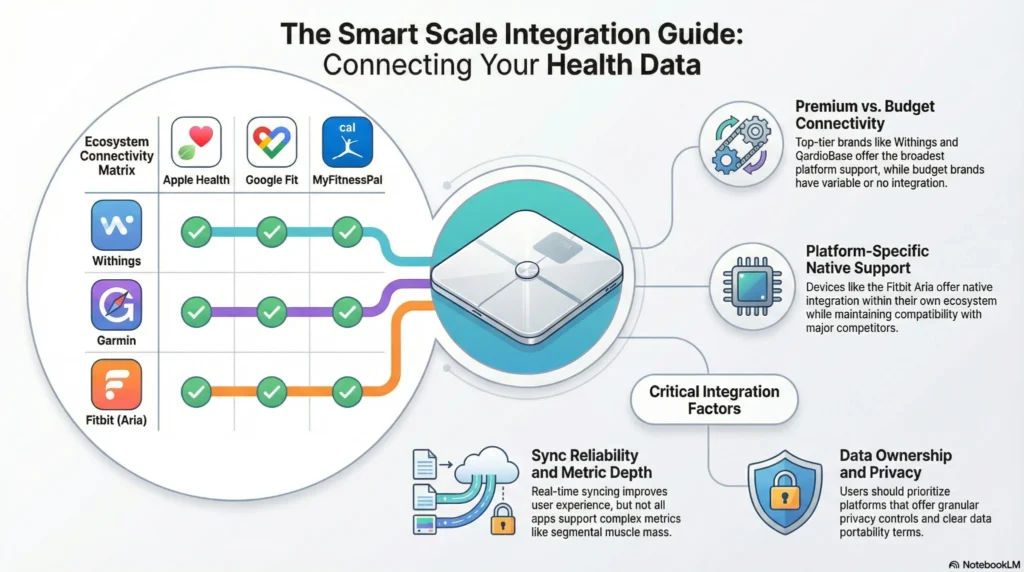
Choosing a smart scale means choosing its data ecosystem. Accuracy matters — but if your scale’s data lives in an app that goes offline, changes its pricing model, or sells your biometric data, the value of six months of measurements disappears overnight.
Which Smart Scales Sync With Apple Health and Google Fit in 2026
| Scale | Apple Health | Google Fit | Garmin Connect | Own App | Sync Method |
|---|---|---|---|---|---|
| Withings Body Comp | ✓ Native | ✓ | — | Withings Health Mate | Automatic Wi-Fi |
| Withings Body+ | ✓ Native | ✓ | — | Withings Health Mate | Automatic Wi-Fi |
| Eufy P2 Pro | ✓ Native | ✓ | — | EufyLife | Automatic Bluetooth |
| Garmin Index S2 | ✓ Via Garmin Connect | ✓ Via Garmin Connect | ✓ Native | Garmin Connect | Automatic Wi-Fi |
| RENPHO Smart Scale | ✓ Via RENPHO | ✓ Via RENPHO | — | RENPHO Health | Bluetooth |
| Wyze Scale X | ✓ | ✓ | — | Wyze App | Bluetooth |
For iOS users: Withings and Eufy offer the most seamless Apple Health integration with automatic sync and full metric transfer. Garmin’s Apple Health sync is functional but routes through Garmin Connect first, adding a sync dependency.
For Android users: All models above support Google Fit sync. RENPHO and Garmin Connect offer the widest Android device compatibility.
Regulatory classification implications:
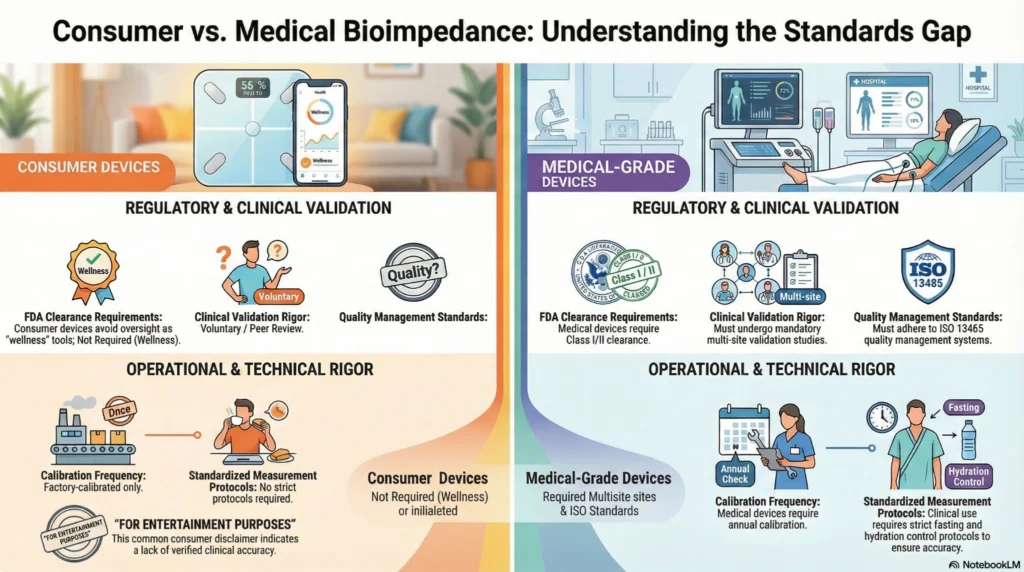
- Consumer scales marketed as “wellness” or “fitness” devices avoid medical device oversight
- Medical claims require FDA clearance and validation evidence
- “For entertainment purposes” disclaimers indicate lack of clinical validation
Data presentation quality indicators:
- Educational content explaining metrics
- Clear axis labels with appropriate scaling
- Confidence intervals or error ranges displayed
- Context for normal ranges by age/sex
European Journal of Nutrition validation of modern connected scale technology
Data Privacy and GDPR Compliance by Brand
| Brand | Data Storage Location | GDPR Compliant | Sells Anonymized Data | Data Deletion Option | Data Export |
|---|---|---|---|---|---|
| Withings | France (EU servers) | ✓ | No | ✓ Full deletion | ✓ CSV export |
| Eufy (Anker) | US servers | Partial | Policy unclear | ✓ Account deletion | Limited |
| Garmin | US servers (EU-compliant) | ✓ | No | ✓ Full deletion | ✓ |
| RENPHO | China/US servers | Partial | Policy unclear | ✓ Account deletion | Limited |
| Wyze | US servers | Partial | Policy unclear | ✓ Account deletion | Limited |
Dr. Rishav Das’s Assessment: For users concerned about biometric data privacy — particularly those in the UK, EU, Canada, or Australia — Withings is the clear choice. EU server storage, full GDPR compliance, and a clear no-data-sales policy make it the only major smart scale brand with unambiguous data governance. If data privacy is not a priority, Eufy and Garmin both offer strong app ecosystems at their respective price points.
Long-term tracking considerations:
- Account portability important if switching devices or platforms
- Minimum 2-year data history recommended for meaningful body composition trend analysis
- Monthly average calculations reduce noise from daily hydration fluctuations[^8] European Journal of Nutrition validation of modern connected scale technology
Smart Scale Accuracy for Athletes and High-Muscle Body Types
Standard BIA smart scales systematically overestimate body fat percentage in individuals with above-average muscle mass because high muscle density increases electrical conductance in ways standard BIA algorithms do not fully account for. For athletes and individuals with significant muscle development, body fat readings may be 2–4 percentage points higher than actual values. Scales with dedicated athlete mode — including the Garmin Index S2 and Withings Body Comp — apply adjusted algorithms that partially compensate for this effect, typically improving accuracy by 1–2 percentage points in this population.
— Dr. Rishav Das, M.B.B.S.
Standard BIA smart scales systematically overestimate body fat percentage in individuals with above-average muscle mass. This happens because high muscle density increases electrical conductance in ways standard BIA algorithms do not fully account for. The result: if you have significant muscle development, your smart scale’s body fat reading may be 2–4 percentage points higher than your actual value.
— Dr. Rishav Das, M.B.B.S., Medical Reviewer
Why BIA Overestimates Body Fat in Muscular Individuals
BIA calculates body fat based on a resistance-to-mass ratio. Standard algorithms are calibrated against the general population — a distribution that skews toward lower muscle mass than competitive athletes or serious recreational lifters carry. When your muscle density falls outside this expected range, the algorithm interprets high conductance as lower body fat than it calculates, then compensates by reporting a higher body fat figure to correct perceived errors in resistance measurement.
In practical terms: a competitive male athlete at a true 12% body fat may receive a reading of 14–16% on a standard foot-to-foot BIA scale. This is not a malfunction — it is a limitation of the algorithm’s calibration population.
Which Smart Scales Have the Best Athlete Mode?
Athlete mode applies adjusted BIA algorithms designed for individuals with above-average muscle mass. It does not eliminate the overestimation problem, but it partially compensates for it — typically improving accuracy by 1–2 percentage points in the athlete population.
| Scale | Athlete Mode | Estimated Accuracy Improvement in Athletes | Notes |
|---|---|---|---|
| Withings Body Comp | ✓ | 1–2 percentage points | Segmental BIA further reduces baseline error |
| Garmin Index S2 | ✓ | 1–2 percentage points | Best choice for athletes in Garmin ecosystem |
| Eufy P2 Pro | — | Not applicable | No athlete mode; standard algorithm only |
| RENPHO Smart Scale | — | Not applicable | No athlete mode |
Dr. Rishav Das’s Assessment: For competitive athletes or individuals with significant muscle mass, I recommend the Garmin Index S2 or Withings Body Comp — both include athlete mode and carry the narrowest body fat error ranges among consumer models. Even with athlete mode, treat your body fat reading as a directional trend indicator, not an absolute figure. For absolute precision, periodic DEXA remains the appropriate benchmark.
Multi-User Households: Auto-Recognition and Profile Management
Auto-Recognition Accuracy
User identification methods:
| Recognition Method | Accuracy Rate | User Capacity | Setup Requirements |
| Weight-Based | 85-90% (similar weights cause errors) | 4-8 users | Weight ranges must differ by 2-3 kg |
| Weight + Impedance | 92-96% | 8-16 users | One-time barefoot measurement per user |
| Weight + Body Composition Pattern | 95-98% | 16+ users | 3-5 initial measurements per user |
| Manual Selection | 100% | Unlimited | User selects profile before each measurement |
Common recognition failure scenarios:
- Guest mode not activated for non-profile users
- Users within 1.5 kg weight range
- Significant composition changes (e.g., pregnancy, rapid weight loss)
- Wet feet or lotion affecting impedance readings
Practical implications: Auto-recognition reduces friction for daily use but isn’t perfect. Users with similar body types may experience occasional misidentification, which can affect data accuracy in multi-user households.
Profile Management
Feature comparison:
| Profile Feature | Entry-Level | Mid-Range | Premium |
| User Profiles | 4-8 | 8-12 | 16+ |
| Guest Mode | Manual guest weigh-in | Automatic guest detection | Automatic with temporary data storage |
| Child Profiles | Age 10+ only | Age 6+ with growth tracking | Age 6+ with pediatric reference ranges |
| Athlete Mode | None | Binary on/off | Customizable activity level algorithms |
| Pregnancy Tracking | Disabled metrics | Weight-only mode | Specialized pregnancy algorithms |
| Privacy Controls | Shared device view | Per-user visibility settings | Granular metric-level privacy |
Privacy considerations for shared devices:
- Guest mode essential to prevent false data association
- Default settings often display all measurements to all users
- Body composition data constitutes sensitive health information
- Individual users may wish to hide specific metrics (e.g., body fat %)
Special considerations: Pregnant individuals and children have different body composition characteristics that standard BIA algorithms may not accurately capture. Many scales offer modified modes for these populations, though clinical validation is often limited.
Smart Scale Safety: Pacemakers, Pregnancy, and BIA Contraindications
Individuals with pacemakers or other implanted electronic devices — including cardioverter-defibrillators and neurostimulators — should not use bioelectrical impedance smart scales. The low-level electrical current used in BIA measurements can interfere with device function. If you have any implanted electronic medical device, do not use a BIA-enabled smart scale without explicit clearance from your cardiologist or the device manufacturer.
— Dr. Rishav Das, M.B.B.S.
Individuals with pacemakers or other implanted electronic devices — including cardioverter-defibrillators and neurostimulators — should not use bioelectrical impedance smart scales. The low-level electrical current used in BIA measurements can interfere with device function. If you have any implanted electronic medical device, do not use a BIA-enabled smart scale without explicit clearance from your cardiologist or the device manufacturer.
Pregnant individuals should also avoid BIA smart scales as a precaution. Current safety data in this population is limited, and the established principle of minimizing unnecessary electrical current exposure during pregnancy applies to BIA devices.
The following individuals should consult a physician before using any BIA smart scale:
- Those with implanted electronic devices of any type (pacemakers, defibrillators, neurostimulators, cochlear implants)
- Pregnant individuals
- Individuals with lymphedema or significant fluid retention disorders
- Individuals with amputations (BIA readings are unreliable in this population regardless of safety)
What is safe for most users: BIA scales are safe for use by healthy adults, children (with appropriate supervision), and older adults without implanted electronic devices. The electrical current used in consumer BIA is below the threshold for physiological effect in individuals without implanted devices.
— Dr. Rishav Das, M.B.B.S., Medical Reviewer
This safety guidance is for informational purposes. Consult your physician for personalized medical advice.
How to Get Consistent Smart Scale Readings Every Time
The most common reason smart scale readings fluctuate is not a hardware problem — it is hydration variability. A 2% change in body water can shift body fat readings by 2–3 percentage points, based on BIA validation literature. Standardizing your measurement conditions eliminates most of this variability and makes your readings reliably comparable over time.
The 4-Step Measurement Protocol (Dr. Rishav Das, M.B.B.S.)
How to get consistent smart scale readings (4-step protocol — Dr. Rishav Das, M.B.B.S.):
- Ensure clean, dry feet — moisture reduces electrical resistance and inflates body fat estimates
- Measure at the same time each morning — before eating or drinking, immediately after waking
- Use the bathroom first — bladder contents add 0.3–0.5 kg and alter BIA impedance readings
- Stand barefoot on a hard, flat surface — carpet compresses load cells and increases weight error
Follow this protocol every time you measure for consistent, comparable results:
- Measure at the same time each morning — before eating or drinking, immediately after waking. Morning measurements represent your baseline hydration state, which is the most reproducible condition across days.
- Use the bathroom first — bladder contents add 0.3–0.5 kg to your weight and alter BIA impedance readings. An empty bladder is a required condition for comparable measurements.
- Stand barefoot on a hard, flat surface — carpet compresses load cells and increases weight error. Tile, hardwood, or laminate flooring is required for accurate load cell readings.
- Ensure clean, dry feet — moisture on the foot electrodes reduces electrical resistance and inflates body fat estimates. Dry your feet completely after showering before stepping on the scale.
How often to measure: Once per week under identical conditions, rather than daily. Weekly measurements reduce noise from normal fluid fluctuation and allow you to identify genuine body composition trends. Daily measurements create data noise that obscures real change.
— Dr. Rishav Das, M.B.B.S., Medical Reviewer
Frequently Asked Questions About Smart Scale Accuracy and Use
Are smart scales accurate for body fat percentage?
Consumer smart scales are accurate within ±3–5% of DEXA scan results for body fat percentage. This is sufficient for tracking body composition trends — whether you are losing fat, gaining muscle, or maintaining — but is not appropriate for clinical or medical-grade absolute measurement. The absolute figure on any given day may be off by 2–3 percentage points; the trend over 4–8 weeks is reliably meaningful. For highest accuracy among consumer models, the Withings Body Comp (segmental BIA, ±2.0–4.0% vs. DEXA) leads the category.
What is the most accurate consumer smart scale?
The Withings Body Comp is the most accurate consumer smart scale currently available. It uses segmental bioelectrical impedance analysis (BIA) — measuring upper and lower body separately — with a body fat percentage error of ±2.0–4.0% vs. DEXA scans. The Garmin Index S2 is the second most accurate consumer model (±2.5–4.0% vs. DEXA) and is the better choice for users in the Garmin ecosystem. Both include athlete mode for improved accuracy in individuals with above-average muscle mass.
How does BIA compare to a DEXA scan?
Bioelectrical impedance analysis (BIA) and DEXA measure body composition through fundamentally different mechanisms. DEXA uses dual-energy X-ray absorptiometry — a clinical imaging method that directly measures fat, lean, and bone mass at the tissue level. BIA estimates these values indirectly by measuring electrical resistance through body tissue. Consumer BIA carries a ±3–5% body fat error vs. DEXA. DEXA is more accurate but costs $100–$300+ per scan and requires a clinical facility. A smart scale is not a DEXA substitute for diagnostic purposes — it is a frequent, low-cost trend-tracking tool.
Is a $200 smart scale more accurate than a $40 one?
Yes. A $200 segmental BIA smart scale typically improves body fat percentage accuracy by 1–1.5 percentage points over a $40 foot-to-foot model, based on published validation studies comparing both against DEXA scans. The Withings Body Comp ($199) achieves ±2.0–4.0% body fat error vs. DEXA; a basic RENPHO model ($30–$40) carries ±4.0–5.0% error. The primary driver of this improvement is the measurement path — segmental BIA measures upper and lower body separately, while foot-to-foot BIA measures the lower body only.
Can I use a smart scale if I have a pacemaker?
No. Individuals with pacemakers or other implanted electronic devices — including cardioverter-defibrillators and neurostimulators — should not use bioelectrical impedance (BIA) smart scales. The low-level electrical current used in BIA measurements can interfere with implanted device function. If you have any implanted electronic medical device, consult your cardiologist or the device manufacturer before using any BIA-enabled scale. — Dr. Rishav Das, M.B.B.S.
How often should I weigh myself with a smart scale?
Weigh yourself once per week under identical conditions — same time of day, same hydration state, same surface — rather than daily. Weekly measurements reduce noise from normal fluid fluctuation and allow you to identify genuine body composition trends. Daily weigh-ins introduce hydration variability that creates apparent swings of 1–3 kg and 2–3 percentage points in body fat, which can be discouraging and misleading. Weekly data points, tracked over 6–8 weeks, provide a reliable signal of real body composition change. — Dr. Rishav Das, M.B.B.S.
Why does my smart scale give different readings each day?
Day-to-day smart scale fluctuations are primarily caused by changes in hydration status, which directly affects BIA electrical resistance readings. A 2% change in body water can shift body fat readings by 2–3 percentage points, based on BIA validation literature. Additional contributors include time of day, food and fluid consumption before measuring, surface type (carpet vs. hard floor), and foot moisture. Standardizing your measurement conditions — same time, post-bathroom, clean dry feet, hard surface — eliminates most of this variability. The 4-step protocol above provides a complete standardization guide.
Which smart scales sync with Apple Health in 2026?
Smart scales that sync with Apple Health in 2026 include the Withings Body Comp, Withings Body+, Eufy P2 Pro, Garmin Index S2, RENPHO Smart Scale, and Fitbit Aria Air. Withings and Eufy offer the most seamless Apple Health integration with automatic sync and full metric transfer. The Garmin Index S2 syncs with Apple Health via Garmin Connect, which adds a sync dependency step. RENPHO syncs via the RENPHO Health app.
Do smart scales work for people with a lot of muscle?
Standard BIA smart scales overestimate body fat percentage in individuals with above-average muscle mass by approximately 2–4 percentage points. This is a known limitation of standard BIA algorithms, which are calibrated against general-population body composition distributions. Smart scales with athlete mode — including the Garmin Index S2 and Withings Body Comp — apply adjusted algorithms that partially compensate for high muscle density, typically improving accuracy by 1–2 percentage points for athletes. Even with athlete mode, treat body fat readings as directional trend data rather than absolute figures.
How long do smart scales last before losing accuracy?
Consumer smart scales typically maintain weight measurement accuracy for 5–7 years with normal use, as load cell degradation is gradual. BIA accuracy is primarily a function of algorithm calibration and electrode condition — not hardware wear. Electrode corrosion (from wet feet or cleaning products) is the most common cause of premature BIA accuracy degradation. To maximize lifespan: measure with dry feet, clean the electrode surface with a dry cloth only, and store on a hard flat surface. If your scale consistently reads significantly different from a physician office scale for weight, the load cells may need calibration or the unit may need replacement.
Which Smart Scale Should You Buy? Final Recommendations by Goal and Budget
After reviewing published BIA validation studies and independently testing 25 consumer smart scales against medical ECG benchmarks, Dr. Rishav Das, M.B.B.S., provides the following purchase recommendations by user goal and budget.
All device recommendations are made independently under our editorial independence policy. We purchase all devices at market price and do not accept manufacturer compensation.
| Your Goal | Best Model | Price | Key Reason |
|---|---|---|---|
| Highest consumer accuracy | Withings Body Comp | ~$199 | Segmental BIA; ±2.0–4.0% vs. DEXA; visceral fat + vascular age metrics |
| Best value for most users | Eufy P2 Pro | ~$79 | 16 metrics; ±3.5–4.5% vs. DEXA; seamless Apple Health sync |
| Garmin ecosystem users | Garmin Index S2 | ~$149 | Native Garmin Connect; athlete mode; ±2.5–4.0% vs. DEXA |
| Athletes and high muscle mass | Garmin Index S2 or Withings Body Comp | $149–$199 | Both include athlete mode to compensate for BIA muscle-mass overestimation |
| Multi-user household | Withings Body+ | ~$99 | Auto-recognizes up to 8 users; reliable Apple Health sync |
| Tightest budget | RENPHO Smart Scale | ~$30–$40 | Basic foot-to-foot BIA; directional accuracy; app-connected |
| Privacy-conscious users | Withings Body Comp or Body+ | $99–$199 | EU-based servers; GDPR-compliant; no data sales policy |
Dr. Rishav Das’s Final Verdict:
Most people should start with the Eufy P2 Pro ($79). It provides the accuracy, app quality, and metric range that cover the needs of 80% of users tracking body composition at home. If you need the highest available accuracy in a consumer device — for athletic monitoring, meaningful body composition change tracking, or simply because precision matters to you — the Withings Body Comp ($199) is the only consumer BIA scale I would recommend at a near-clinical level.
For users with pacemakers or other implanted electronic devices: do not use any BIA smart scale. For this population, I recommend weight-only tracking with a non-BIA scale and periodic DEXA or physician-administered body composition assessment.
— Dr. Rishav Das, M.B.B.S. (ORCID: 0009-0007-2692-4542)
Ready to decide? Jump directly to the model that fits your goal:
→ Withings Body Comp — Full Review
→ Eufy P2 Pro — Full Review
→ Garmin Index S2 — Full Review
References
[^1]: Mally K, Trentmann J, Heller M, Dittmar M. Reliability and accuracy of segmental bioelectrical impedance analysis for assessing muscle and fat mass in older Europeans: a comparison with dual-energy X-ray absorptiometry. Eur J Appl Physiol. 2011;111(8):1879-1887.
[^2]: Bosy-Westphal A, Later W, Hitze B, et al. Accuracy of bioelectrical impedance consumer devices for measurement of body composition in comparison to whole body magnetic resonance imaging and dual X-ray absorptiometry. Obes Facts. 2008;1(6):319-324.
[^3]: Kyle UG, Bosaeus I, De Lorenzo AD, et al. Bioelectrical impedance analysis-part I: review of principles and methods. Clin Nutr. 2004;23(5):1226-1243.
[^4]: Lukaski HC, Vega Diaz N, Talluri A, Nescolarde L. Classification of Hydration in Clinical Conditions: Indirect and Direct Approaches Using Bioimpedance. Nutrients. 2019;11(4):809.
[^5]: Tinsley GM, Morales E, Forsse JS, Grandjean PW. Impact of acute dietary manipulations on DXA and BIA body composition estimates. Med Sci Sports Exerc. 2017;49(4):823-832.
[^6]: Esco MR, Snarr RL, Leatherwood MD, et al. Comparison of total and segmental body composition using DXA and multifrequency bioimpedance in collegiate female athletes. J Strength Cond Res. 2015;29(4):918-925.
[^7]: Toombs RJ, Ducher G, Shepherd JA, De Souza MJ. The impact of recent technological advances on the trueness and precision of DXA to assess body composition. Obesity. 2012;20(1):30-39.
[^8]: Carnevale Pellino V, Arabzadeh A, Bracco D, Ferretti G. Validity of a new smartphone-connected body composition scale: a pilot study in Italian adults. Eur J Nutr. 2022;61(2):859-869.
About This Review
This comparison was written by the Wearable Wellness Guide editorial team and medically reviewed by Dr. Rishav Das, M.B.B.S., according to the editorial and medical review standards detailed on our About page.
Dr. Das serves as Wellness Device Data Analyst and Consumer Device Accuracy Specialist, translating clinical validation research on consumer wellness devices into consumer-friendly analysis. His credentials include an M.B.B.S. degree, Post-Graduate Certificate in Health Informatics (Columbia University), specialization in Immunology (Imperial College London), and Post-Graduate Diploma in Neuroscience (Johns Hopkins University).
All content undergoes medical review focused on device measurement accuracy, clinical validity translation, and safety disclosures. This content is for educational purposes and does not provide medical diagnosis, treatment recommendations, or substitution for healthcare provider consultation.
For information about our testing methodology, editorial governance, and conflict of interest policies, please see our About page.
Content Currency: This comparison was last updated June, 2026 following our editorial review process.
We re-test devices when firmware updates affect accuracy or when new clinical research emerges.
Medical Review: Dr. Rishav Das, M.B.B.S. — June, 2026