
Types of Glucose Monitors: CGM, Best CGM Comparison 2026: Dexcom, Abbott Libre & Medtronic Cost & Accuracy Guide, OTC & Traditional (2026)
Compare glucose monitors (CGMs vs traditional meters): MARD accuracy, 2026 cost with/without insurance, and Dexcom G7 vs Abbott Libre 3 verdict. Physician-reviewed by Dr. Rishav Das, M.B.B.S.
Medically reviewed by Dr. Rishav Das, M.B.B.S.
See About page for complete reviewer credentials and scope
Last Updated: June, 2026
Introduction
If you’re waking up at 2 AM for blood sugar checks, skipping tests because you’re out with friends, or lying awake worried about dangerous overnight lows — you are not alone. Over 60% of people with diabetes report testing fatigue, and CGM alternatives to finger pricks are now available for most insulin-treated patients.
This physician-reviewed comparison covers every dimension that matters: MARD accuracy, 2026 cost with and without insurance, Dexcom G7 vs Abbott Libre 3 vs Medtronic Guardian specifications, and insurance coverage by diabetes type — so you can walk into your next provider appointment ready to make a decision, not just ask questions.
Medically reviewed by Dr. Rishav Das, M.B.B.S. — see our Medical Review Policy for credential and scope details. All data is current as of 2026 and based on peer-reviewed research and manufacturer-reported specifications.
This content is educational and does not substitute for individualized medical advice.
Tired of Constant Finger Pricks? You Are Not Alone.
If you’re waking up at 2 AM for blood sugar checks, skipping tests because you’re out with friends, or worried about dangerous overnight lows, you’re not alone. Over 60% of people with diabetes report “testing fatigue” — and many skip crucial readings because of the pain, hassle, and social awkwardness of public testing.
The good news: glucose monitoring technology has advanced significantly. This guide compares your options to help you find a solution that fits your lifestyle, not just your medical needs.
Glucose monitoring technology has evolved significantly, with continuous glucose monitors (CGMs) now available alongside traditional blood glucose meters. This comparison examines evidence-based differences in accuracy, cost, convenience, and clinical utility to support informed device selection.
All comparisons are based on peer-reviewed research and manufacturer-reported data current as of 2026.
Content Scope: This analysis explains device measurement capabilities and published accuracy data. It does not provide medical diagnosis, treatment recommendations, or substitute for healthcare provider consultation. All content undergoes medical review according to our medical review process.
Quick Answer: CGM vs Traditional Glucose Meter
Which is better — a CGM or a traditional glucose meter? For most people on insulin, a continuous glucose monitor (CGM) is the better choice because it tracks glucose automatically every few minutes, around the clock, without finger pricks. A traditional blood glucose meter is the better choice for people managing diabetes with diet, exercise, or oral medication alone, since it costs less and requires no prescription in most cases.
Continuous Glucose Monitors (CGMs) A small sensor worn on the skin measures glucose in interstitial fluid every 1–5 minutes and sends readings to a phone, receiver, or smartwatch — no finger pricks needed for daily use. Best for: insulin users, anyone with hypoglycemia unawareness, pregnant patients with gestational diabetes, and people experiencing testing fatigue.
Traditional Blood Glucose Meters A handheld device reads glucose from a finger-stick blood drop in seconds. Best for: people managing Type 2 diabetes with oral medication, those without CGM insurance coverage, and anyone who needs a low-cost backup device.
Bottom line: CGMs win on convenience, data richness (including Time in Range), and overnight safety. Traditional meters win on upfront cost and
universal insurance coverage. The sections below compare both options on accuracy (MARD), 2026 pricing with and without insurance, sensor wear time, and brand-by-brand specifications.
- Tired of Constant Finger Pricks? You Are Not Alone.
- Quick Answer: CGM vs Traditional Glucose Meter
- CGM vs Traditional Glucose Meter: Full Head-to-Head Comparison
- Best CGM Brands Compared 2026: Dexcom, Abbott Libre & Medtronic
- CGM Sensor Wear Time: 7, 10, and 14-Day Systems Compared
- CGM Accuracy, MARD, and Calibration Explained
- CGM Insertion and Applicator Comparison — Is CGM Insertion Painful?
- CGM Integration: Smartphones, Smartwatches & Insulin Pumps
- CGM Cost and Insurance Coverage (2026)
- Best CGM for Your Situation: Editor's Picks by Use Case
- Frequently Asked Questions
- Is a CGM worth it if my A1C is already normal?
- Does insurance cover CGM for Type 2 diabetes?
- How much does a CGM cost without insurance per month?
- How painful is CGM sensor insertion?
- Is a CGM worth it for non-diabetics interested in metabolic health?
- What is the difference between Dexcom G7 and Abbott Libre 3 in one sentence?
- Can I use a CGM with my insulin pump?
- What if I develop a skin reaction to CGM adhesive?
- Does a CGM work with my Apple Watch or Android smartwatch?
- Can I wear a CGM at the airport or through security?
- Your Next Steps: How to Get a CGM (5-Step Pathway)
- Step 1: Determine Your Eligibility (5 minutes)
- Step 2: Talk to Your Healthcare Provider (Schedule appointment)
- Step 3: Verify Insurance Coverage (1-2 weeks)
- Step 4: Compare Supplier Prices (Compare 3-5 suppliers)
- Step 5: Order Your First Sensor (Order & receive in 3-7 days)
- Before You Buy: Final Checklist
- When to Consult a Healthcare Provider
- References
- Medical Disclaimer
CGM vs Traditional Glucose Meter: Full Head-to-Head Comparison
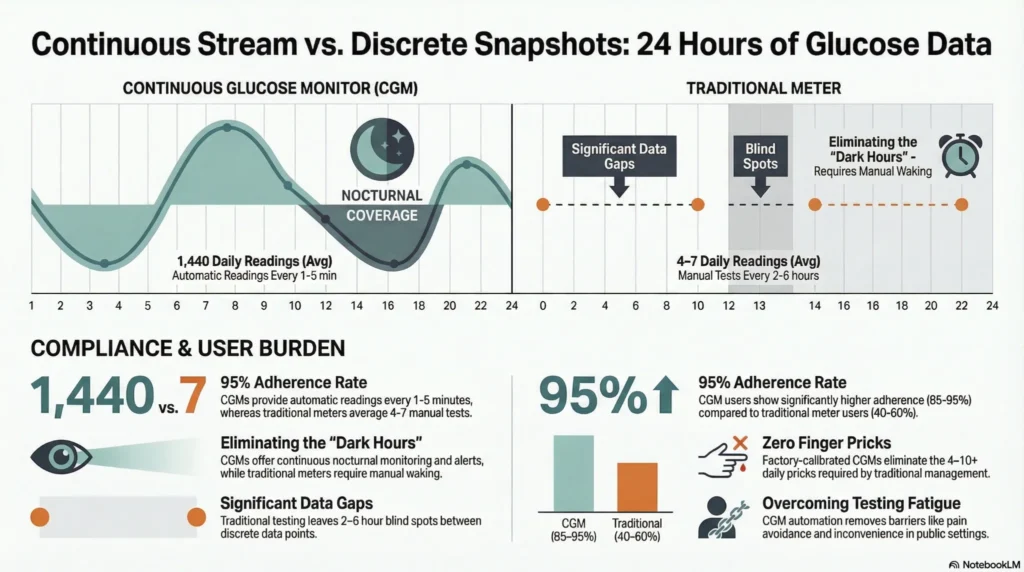
Convenience and Daily Testing Burden
A traditional glucose meter requires 4–10 finger pricks per day for insulin-dependent users — each one a small but real source of pain, disruption, and social friction. A CGM eliminates routine finger pricks entirely for most users, replacing them with one sensor change every 7, 10, or 14 days depending on the device.
For people experiencing testing fatigue, this is the single largest quality-of-life difference between the two technologies.
Data Richness — What Is Time in Range (TIR) and Why It Matters?
What Is Time in Range (TIR)?
Time in Range is the percentage of a 24-hour period that a person’s blood glucose stays within the target range of 70–180 mg/dL. The American Diabetes Association and the International Consensus on Time in Range recommend a TIR goal of 70% or higher for most adults with Type 1 or Type 2 diabetes.
CGMs calculate TIR automatically from continuous readings; traditional meters cannot produce a TIR figure without manual compilation of multiple daily readings. Research published in JAMA (Beck et al., 2017) links higher TIR to a reduced risk of microvascular complications, including diabetic retinopathy and nephropathy.
A traditional meter gives you 4–10 isolated data points per day. A CGM gives you 288–1,440 readings per day — enough to calculate TIR, detect overnight lows, and reveal post-meal spikes that scheduled finger sticks miss entirely.
Clinical Relevance:
- Evidence suggests glycemic variability independent of average glucose may correlate with cardiovascular risk in type 2 diabetes. Complementary clinical research
- Time in range (TIR) is associated with reduced microvascular complication risk; CGMs provide this metric without manual calculation. JAMA-published diabetes research
- Trend arrows may inform insulin dosing decisions in real-time (requires appropriate training and clinical guidance)
CGM Accuracy — What Is MARD?
What Is MARD (Mean Absolute Relative Difference)?
MARD is the standard metric for measuring CGM accuracy. It represents the average percentage difference between a CGM reading and a reference blood glucose value, typically a lab venous sample or a highly accurate meter.
Lower MARD means higher accuracy. The FDA’s iCGM classification requires a MARD below 10% for a CGM to be approved for non-adjunctive use — meaning users can make insulin-dosing decisions from the CGM reading alone, without a confirmatory finger stick.
Accuracy data based on manufacturer-reported specifications and published clinical trials. See our device testing methodology for evaluation protocols.
FDA safety and effectiveness documentation
iCGM classification guidelines
international accuracy standards
Why CGM Readings Lag Blood Glucose by 5–15 Minutes
CGMs measure glucose in interstitial fluid — the fluid between cells in the tissue just under the skin where the sensor filament sits — rather than in capillary blood directly.
Because glucose moves from the bloodstream into interstitial fluid across a tissue barrier, there’s an inherent 5–15 minute physiological lag. During rapid glucose changes, such as right after a high-carbohydrate meal or at the onset of hypoglycemia, the CGM reading may briefly run higher or lower than your true blood glucose.
This lag does not affect accuracy during stable glucose periods, and FDA guidance for iCGM-classified devices accounts for it in the accuracy assessment framework.
CGM users avoid an average of 2,920 finger pricks per year compared to testing 8 times daily with traditional meters.
That’s 8 painful finger pricks prevented every single day.
Total Annual Cost: CGM vs Traditional Meter
Without insurance, CGM sensors cost $1,905–$7,200 per year depending on the system, compared to $600–$2,000 per year for traditional blood glucose meters and test strips. With private insurance, out-of-pocket CGM costs for insulin-dependent patients typically drop to $600–$1,800 per year.
Without insurance, CGM sensors cost $1,905–$7,200 per year depending on the system, compared to $600–$2,000 per year for traditional blood glucose meters and test strips.
With private insurance, out-of-pocket CGM costs for insulin-treated patients typically drop to $600–$1,800 per year. The table below breaks down every cost category for both options.
| Cost Category | CGMs | Traditional Meters |
| Initial Device Cost | $0-$200 (with insurance); $50-$150 (receiver or compatible smartphone) | $10-$75 (many provided free with test strip purchase agreements) |
| Ongoing Supply Costs (Annual, Uninsured) | $2,400-$6,000 (sensors alone, based on 10-14 day sensor life) | $600-$2,000 (test strips at 6-10 tests/day) |
| Insurance Coverage (Type 1 Diabetes) | Medicare Part B: covered for intensive insulin users; Most private plans: covered with copays $50-$150/month | Nearly universal coverage; copays $0-$50/month for strips |
| Insurance Coverage (Type 2 Diabetes) | Increasing coverage for intensive insulin users; may require prior authorization | Standard coverage for insulin users; variable for non-insulin users |
| Hidden Costs | Adhesive patches/overwraps; skin prep supplies ($5-$20/month) | Lancets ($5-$15/month); alcohol swabs (optional) |
Economic analyses suggest CGMs may be cost-effective for type 1 diabetes and insulin-requiring type 2 diabetes when factoring in reduced hypoglycemia-related emergency visits. cost-effectiveness analysis
Best CGM Brands Compared 2026: Dexcom, Abbott Libre & Medtronic
Dexcom G7 vs Abbott Libre 3 vs Libre 2: Accuracy, Wear Time & Features
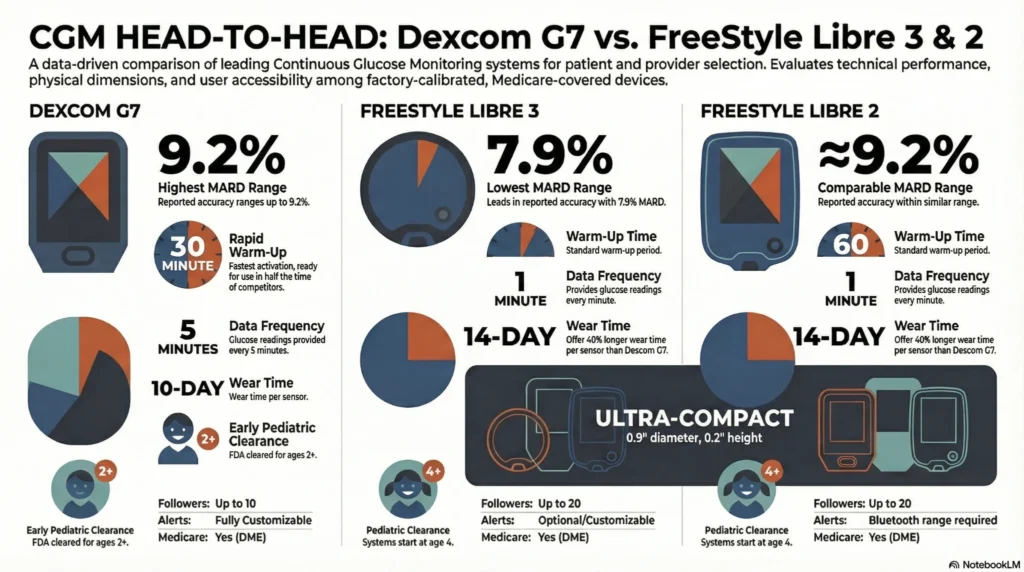
| Feature | Dexcom G7 (2024) | Abbott FreeStyle Libre 3 | Abbott FreeStyle Libre 2 |
| Sensor Wear Time | 10 days. Official product documentation | 14 days. Abbott’s product documentation | 14 days |
| Warm-Up Period | 30 minutes. Official product documentation | 60 minutes. Abbott’s product documentation | 60 minutes |
| Reading Frequency | Every 5 minutes (automatic) | Every 1 minute (automatic) | Every 1 minute (automatic to phone; scan-required for reader) |
| Factory Calibrated | Yes. Official product documentation | Yes. Abbott’s product documentation | Yes |
| MARD | 8.2% (manufacturer reported) | 7.9% (manufacturer reported) | 9.2% (manufacturer reported) |
| Alerts/Alarms | Customizable high/low glucose alerts; urgent low alarm; signal loss alert | Customizable high/low glucose alerts; optional urgent low alarm | High/low glucose alarms (must be within Bluetooth range) |
| Smartphone Compatibility | iOS and Android (direct connectivity) | iOS and Android (direct connectivity) | iOS and Android (Libre 2 app for alarms; scanning required for Libre 1) |
| Sharing/Following | Up to 10 followers via Dexcom Share | Up to 20 followers via LibreLinkUp | Up to 20 followers via LibreLinkUp |
| Sensor Size | 1.18″ diameter × 0.4″ height | 0.9″ diameter × 0.2″ height | 1.4″ diameter × 0.2″ height |
| Age Indication | Ages 2+ (FDA cleared) | Ages 4+ (FDA cleared) | Ages 4+ (FDA cleared) |
| Medicare Coverage | Yes (Durable Medical Equipment) | Yes (Durable Medical Equipment) | Yes (Durable Medical Equipment) |
The Dexcom G7 offers a shorter warm-up period (30 minutes vs. 60 minutes) and stronger alert functionality, while the Abbott Libre 3 offers longer 14-day wear time, a smaller sensor profile, and a lower price without insurance — with near-equivalent MARD accuracy (7.9% vs. 8.2%).
Medtronic Guardian vs Dexcom: Best CGM for Insulin Pump Users
If insulin pump integration is your priority, your CGM choice is largely decided by which pump you use.
The Medtronic Guardian 4 integrates natively with the MiniMed 780G and 770G for hybrid closed-loop automated insulin delivery.
The Dexcom G6 and G7 integrate with the Tandem t:slim X2 (via Control-IQ) and the Insulet Omnipod 5.
Abbott FreeStyle Libre systems currently have no native pump integration — third-party apps can display data but cannot close the loop.
| Feature | Medtronic Guardian Connect (Standalone) | Medtronic Guardian 4 (Pump-Integrated) | Dexcom G7 | Abbott Libre 3 |
| Sensor Wear Time | 7 days. Official product guide | 7 days | 10 days | 14 days |
| Calibration Required | Yes (2-4 finger sticks/day) | No (with Guardian 4) | No | No |
| MARD | 8.7-9.1% | ~8.5% (limited published data) | 8.2% | 7.9% |
| Insulin Pump Integration | No (standalone version) | Yes (MiniMed 780G, 770G systems) | Optional with Tandem t:slim X2 | No native integration |
| Predictive Alerts | No. Official product guide | Yes (60-minute high/low predictions with 780G) | No | No |
| Automatic Insulin Adjustment | No. Official product guide | Yes (with MiniMed 780G automated insulin delivery) | No (Tandem Control-IQ uses Dexcom) | No |
What Is Hybrid Closed-Loop / Automated Insulin Delivery (AID)?
Hybrid closed-loop, or Automated Insulin Delivery (AID), is a system in which a CGM and an insulin pump communicate directly to adjust basal insulin delivery in real time, without user input.
When the CGM detects rising glucose, the system automatically increases the basal rate. When glucose falls, it suspends or reduces insulin delivery.
The user still manually enters carbohydrates and initiates meal boluses — hence “hybrid.”
Clinical studies show AID systems improve Time in Range by 10–15 percentage points compared to standard pump therapy alone.
As of 2026, AID requires either a Medtronic Guardian 4 paired with the MiniMed 780G/770G, or a Dexcom G6/G7 paired with the Tandem t:slim X2 running Control-IQ.
Consumer CGMs for Non-Diabetics: Levels vs Nutrisense vs Signos (2026)
For non-diabetics exploring metabolic health monitoring, Levels, Nutrisense, and Signos each offer CGM-based programs costing $199–$399/month — none of which are covered by insurance, since they use off-label applications of FDA-cleared sensors for wellness rather than medical purposes.
The table below compares pricing, app features, and coaching support across all three programs.
| Program Feature | Levels | Nutrisense | Signos | Prescription CGM (e.g., Dexcom, Libre) |
| Target User | Non-diabetic metabolic health tracking | Non-diabetic metabolic health tracking | Weight management focus | Diabetes management (FDA-cleared indication) |
| CGM Sensor Used | Abbott FreeStyle Libre (professional or consumer variant) | Abbott FreeStyle Libre | Abbott FreeStyle Libre | Varies by prescription |
| Prescription Required | Yes (via telehealth) | Yes (via telehealth) | Yes (via telehealth) | Yes (from treating provider) |
| FDA Clearance Status | Off-label use of FDA-cleared sensor | Off-label use of FDA-cleared sensor | Off-label use of FDA-cleared sensor | On-label use for diabetes |
| Coaching/Education | App-based insights; optional dietitian coaching | 1-on-1 dietitian included in higher tiers | AI-driven weight loss coaching | Diabetes education resources; varies by healthcare system |
| Monthly Cost (2026) | $199-$399 (varies by subscription) | $250-$400 (varies by tier) | $299-$399 | $0-$150 with insurance; $100-$500 without |
| Insurance Coverage | Not covered (wellness/consumer product) | Not covered | Not covered | Covered for diabetes diagnoses |
Clinical Context:
- Consumer CGM programs use FDA-cleared sensors but for non-FDA-cleared indications (metabolic health in non-diabetics)
- Evidence for glucose monitoring benefits in non-diabetic populations is limited and emerging
- These programs are not substitutes for diabetes diagnosis or management under medical supervision
Important Distinction: Consumer CGMs are wellness tools; prescription CGMs are medical devices for diabetes management. See About page for guidance on when to consult healthcare providers.
CGM Sensor Wear Time: 7, 10, and 14-Day Systems Compared
CGM sensors currently last 7, 10, or 14 days depending on the system.
The Abbott FreeStyle Libre 2 and Libre 3 offer the longest wear time at 14 days — meaning approximately 26 sensor changes per year — compared to roughly 52 sensor changes annually for 7-day Medtronic Guardian systems.
The Dexcom G7 falls in between at 10 days (about 36 changes per year).
Warm-Up Period Comparison
CGM sensors currently last 7, 10, or 14 days. Abbott FreeStyle Libre 2 and Libre 3 offer 14-day wear time — about 26 sensor changes per year — versus roughly 52 changes per year for 7-day Medtronic systems.
| System | Warm-Up Time | Implication |
| Dexcom G7 | 30 minutes | Shortest warm-up; faster transition after sensor application |
| Abbott Libre 2/3 | 60 minutes | Standard warm-up period |
| Medtronic Guardian | ~2 hours (calibration + initialization) | Longest initialization; requires calibration finger stick |
Practical Considerations:
- Users applying sensors before travel or important events should account for warm-up timing
- Longer sensor wear time reduces insertion frequency but may increase risk of sensor failure before scheduled change
- Warm-up periods represent data gaps during sensor transitions
CGM Accuracy, MARD, and Calibration Explained
Factory-Calibrated vs Calibration-Required Systems
| Calibration Type | Systems | User Burden | Accuracy Implications |
| Factory Calibrated (No Finger Sticks) | Dexcom G7, G6; Abbott Libre 2, Libre 3; Medtronic Guardian 4 | No routine calibrations required; finger stick only if readings questionable | Accuracy relies on factory algorithm; user cannot adjust for individual variation |
| Requires Calibration | Medtronic Guardian Connect; older CGM models | 2-4 finger sticks daily at calibration time points | May improve accuracy if calibrations performed correctly; introduces user error risk |
MARD Explained: How Accurate Are Today’s CGMs?
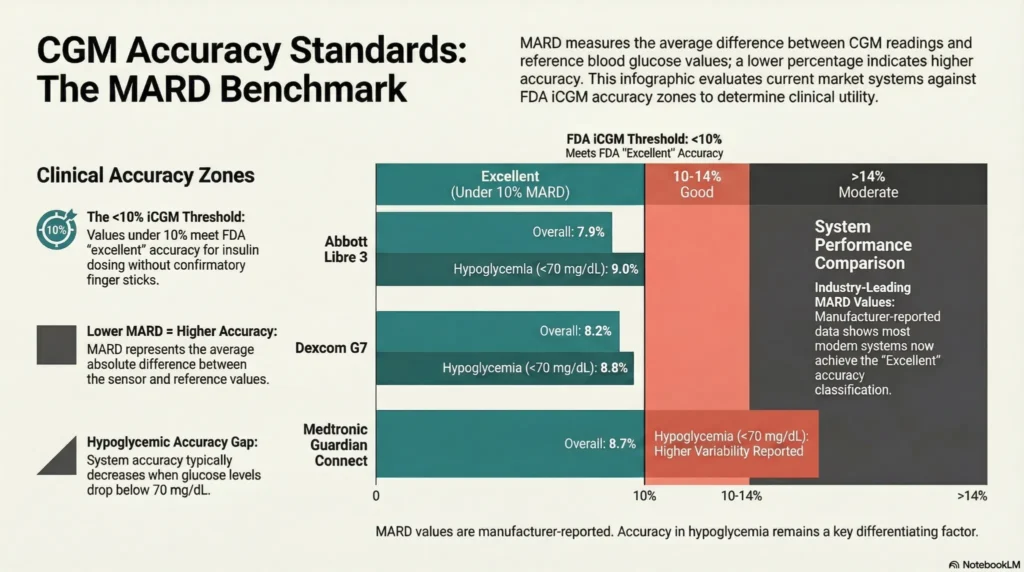
Definition: MARD is the average absolute difference between CGM readings and reference blood glucose values, expressed as a percentage. Lower MARD indicates higher accuracy.
| MARD Range | Accuracy Classification | Clinical Utility |
| <10% | Excellent accuracy | Suitable for insulin dosing decisions without confirmation per FDA iCGM category |
| 10-14% | Good accuracy | May be used for diabetes management with clinical judgment |
| >14% | Moderate accuracy | Confirmation testing recommended before insulin adjustments |
Current MARD Values by Device (2026)
Among current systems, Abbott Libre 3 achieves the best published MARD accuracy at 7.9%, followed by Dexcom G7 at 8.2% — both within the FDA iCGM under-10% threshold for insulin-dosing decisions without confirmatory finger sticks. All figures are manufacturer-reported; independent clinical assessments may vary.
Among current systems, Abbott Libre 3 achieves the best published accuracy at 7.9% MARD, followed by Dexcom G7 at 8.2%. Both are well within the FDA iCGM threshold of under 10% required for insulin dosing without confirmatory finger sticks.
All figures below are manufacturer-reported. Independent clinical assessments may vary.
| System | Overall MARD | MARD in Hypoglycemia (<70 mg/dL) |
| Abbott Libre 3 | 7.9% | 9.0% (limited published data) |
| Dexcom G7 | 8.2% | 8.8% |
| Dexcom G6 | 9.0% | 10.0% |
| Abbott Libre 2 | 9.2% | 9.7% |
| Medtronic Guardian Connect | 8.7% | Higher variability reported |
Clinical Guidance: FDA iCGM designation indicates system meets special controls for non-adjunctive use (insulin dosing without confirmatory finger stick). Users should follow labeled indications. See About page for information on consulting healthcare providers.
CGM Insertion and Applicator Comparison — Is CGM Insertion Painful?
Is CGM Insertion Painful?
CGM sensor insertion causes brief discomfort comparable to a quick pinch — typically less than one second. Most users rate insertion pain at 2–3 out of 10, significantly less than a finger-stick lancet.
CGM sensor insertion causes brief discomfort comparable to a quick pinch, typically lasting less than one second. Most users with Type 1 and Type 2 diabetes rate insertion pain at 2–3 out of 10, and report that it diminishes with repetition.
The Dexcom G7 and Abbott Libre 3 use one-button auto-applicators with 28-gauge filaments inserted to a 5mm depth, which most users find significantly less uncomfortable than a traditional finger-stick lancet.
Children and needle-averse adults may benefit from a topical numbing cream (such as EMLA) applied 60 minutes before insertion, with healthcare provider guidance.
The Medtronic Guardian Connect requires a manual serter at a greater 7–8mm depth and generally scores lower on comfort ratings (3.9/5 stars vs. 4.4–4.6 for Dexcom and Abbott).
Sensor Size and Discretion by Device
| System | Profile Dimensions | Discretion Notes |
| Abbott Libre 3 | 0.9″ diameter × 0.2″ height | Smallest profile; may be least visible under clothing |
| Dexcom G7 | 1.18″ diameter × 0.4″ height | Compact but taller than Libre 3 |
| Abbott Libre 2 | 1.4″ diameter × 0.2″ height | Wider footprint but low profile |
| Dexcom G6 | 1.6″ diameter × 0.5″ height | Largest profile among current systems |
Insertion Site Options:
Upper buttocks, thigh: Less common; may be used based on individual anatomy and manufacturer guidance
Abdomen: Most common for Libre systems; typically well-tolerated
Back of upper arm: Standard for Libre 2/3; optional for Dexcom G7
CGM Integration: Smartphones, Smartwatches & Insulin Pumps
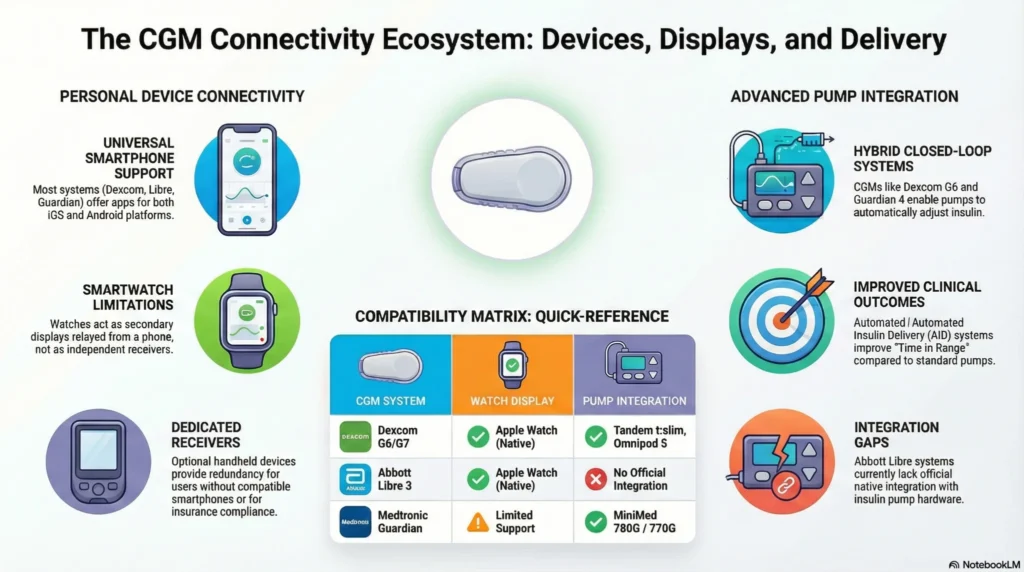
Smartphone Compatibility by CGM System
| System | iOS Compatibility | Android Compatibility | Dedicated Receiver Option |
| Dexcom G7 | Yes (iPhone with iOS 14.0+) | Yes (compatible Android devices, check list) | Yes (optional receiver) |
| Dexcom G6 | Yes (iPhone with iOS 13.0+) | Yes (compatible Android devices) | Yes (optional receiver) |
| Abbott Libre 3 | Yes (iPhone with iOS 14.0+) | Yes (compatible Android devices) | Yes (FreeStyle Libre 3 Reader) |
| Abbott Libre 2 | Yes (iPhone with iOS 13.0+) | Yes (compatible Android devices) | Yes (FreeStyle Libre 2 Reader) |
| Medtronic Guardian Connect | Yes (iPhone compatibility varies by version) | Limited Android support | Yes (Guardian Connect transmitter to dedicated receiver or smartphone) |
Key Considerations:
- Some insurance plans may not cover both smartphone app and dedicated receiver simultaneously
- Smartphone compatibility lists updated regularly; verify current device before purchase
- Dedicated receivers provide alternative for users without compatible smartphones or preferring device redundancy
Smartwatch Display Options
| CGM System | Apple Watch | Android Wear/Samsung | Display Type |
| Dexcom G7/G6 | Yes (native app or complications) | Limited (third-party apps) | Glucose value, trend arrow, time since last reading |
| Abbott Libre 3 | Yes (LibreLink complications) | Limited | Glucose value, trend arrow |
| Abbott Libre 2 | No native support | No native support | Third-party apps available (varies by region) |
Smartwatch Limitations:
- Battery life impact varies by watch model and app configuration
- Smartwatch displays show CGM data relayed from smartphone; not independent receivers
- Alert functionality may vary between smartphone and watch
Insulin Pump Integration and AID Systems
| CGM System | Compatible Pumps | Integration Type |
| Medtronic Guardian 4 | MiniMed 780G, 770G | Native integration; enables automated insulin delivery (hybrid closed-loop) |
| Dexcom G6 | Tandem t:slim X2 with Control-IQ; Insulet Omnipod 5 | Predictive low glucose suspend; automated basal adjustment |
| Dexcom G7 | Tandem t:slim X2 (via G7 update); Omnipod 5 (compatibility in progress) | Automated insulin delivery algorithms |
| Abbott Libre | No current pump integration | Data sharing to pumps via third-party apps (not official integration) |
Automated Insulin Delivery (AID) Considerations:
- Requires training and ongoing diabetes management under medical supervision
- Pump integration enables hybrid closed-loop systems: automated basal insulin adjustments based on CGM data
- User still enters carbohydrates and initiates meal boluses
- Clinical evidence suggests AID systems improve time in range and reduce hypoglycemia vs standard pump therapy
CGM Cost and Insurance Coverage (2026)
How Much Does a CGM Cost Without Insurance? (2026 Breakdown)
Without insurance, CGM sensors cost approximately $159–$600 per month depending on the system.
The Abbott FreeStyle Libre 2 is the most affordable at roughly $159–$196/month ($1,905–$2,347/year). The Dexcom G7 costs $213–$274/month ($2,555–$3,285/year). The Medtronic Guardian Connect is the most expensive at $325–$600/month ($3,900–$7,200/year, including transmitter costs).
Consumer CGM programs for non-diabetics — Levels, Nutrisense, and Signos — cost $199–$399/month and receive no insurance reimbursement.
| System | Sensor Cost per Unit | Annual Sensor Cost | Transmitter/Receiver | Total Annual (Estimated) |
| Dexcom G7 | $70-$90 per 10-day sensor | $2,555-$3,285 (36.5 sensors) | $200 initial receiver (optional if using smartphone) | $2,755-$3,485 |
| Dexcom G6 | $75-$95 per 10-day sensor | $2,737-$3,467 | $300 transmitter (every 3 months) + $200 receiver | $4,037-$4,867 |
| Abbott Libre 2 | $70-$90 per 14-day sensor | $1,825-$2,347 (26 sensors) | $80 reader (one-time) | $1,905-$2,427 |
| Abbott Libre 3 | $70-$95 per 14-day sensor | $1,825-$2,477 | $80-$100 reader | $1,905-$2,577 |
| Medtronic Guardian Connect | $75-$100 per 7-day sensor | $3,900-$5,200 (52 sensors) | $600-$800 transmitter (6-month lifespan) | $5,100-$7,200 |
Consumer CGM Programs (Non-Diabetic Use):
- Signos: $299-$399/month ($3,588-$4,788 annually)
- Levels: $199-$399/month ($2,388-$4,788 annually)
- Nutrisense: $250-$400/month ($3,000-$4,800 annually)
Cheapest CGM Options and Cost Reduction Strategies
If cost is your primary constraint, three strategies typically deliver the biggest savings.
First, HSA and FSA accounts can cover CGM costs with pre-tax dollars, effectively reducing the price by your marginal tax rate.
Second, manufacturer patient assistance programs — including the Dexcom Patient Assistance Program and Abbott’s MyFreeStyle savings programs — can reduce or eliminate sensor costs for eligible patients based on income.
Third, the Abbott FreeStyle Libre 2 is consistently the lowest-cost CGM option without insurance, at roughly $1,905–$2,347/year, making it the most accessible entry point for patients paying out of pocket.
Does Insurance Cover CGM for Type 2 Diabetes?
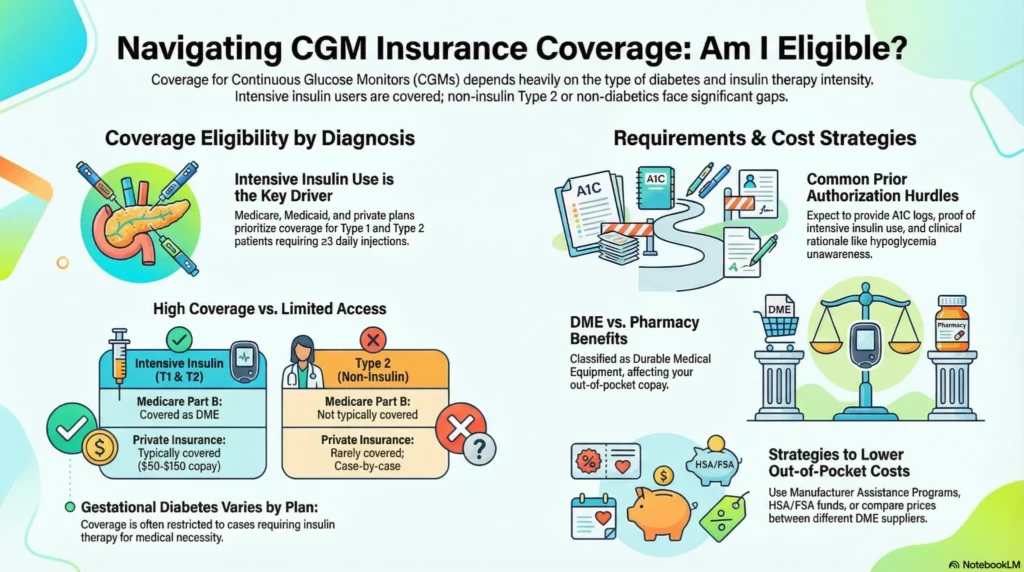
Medicare Part B covers CGMs for Type 2 diabetics who use three or more daily insulin injections or use an insulin pump. Most private insurers follow comparable criteria. CGMs are generally not covered for Type 2 diabetics managed with oral medications alone, and prior authorization typically takes 5–15 business days.
It depends on your treatment regimen.
Medicare Part B covers CGMs for Type 2 diabetics who use three or more insulin injections daily or use an insulin pump. Most private insurers follow similar criteria, though some now cover CGMs for any insulin-using Type 2 patient.
CGMs are generally not covered for Type 2 diabetics managed with oral medications alone. Prior authorization is typically required and takes 5–15 business days.
When contacting your insurer, reference ICD-10 code E11.649 (Type 2 diabetes with hypoglycemia without coma) to strengthen a coverage request.
If you manage Type 2 diabetes with oral medication alone and don’t currently meet insurance criteria for a prescription CGM, a consumer CGM program (Levels, Nutrisense, or Signos) or an over-the-counter CGM can still provide continuous glucose data — though at out-of-pocket cost, since these are not insurance-eligible for this use case.
| Diagnosis | Medicare Part B | Private Insurance (General) | Medicaid |
| Type 1 Diabetes (Intensive Insulin) | Covered as DME (Durable Medical Equipment); copay varies | Typically covered; copays $50-$150/month for sensors; prior authorization may be required | Coverage varies by state; generally covered for intensive insulin therapy |
| Type 2 Diabetes (Intensive Insulin) | Covered with criteria (≥3 insulin injections daily or pump) | Often covered; may require prior authorization | Variable by state |
| Type 2 Diabetes (Non-Insulin) | Not typically covered | Rarely covered; may be approved on case-by-case basis | Rarely covered |
| Gestational Diabetes | May be covered as medically necessary | Variable; often covered for insulin-requiring cases | Variable |
| Non-Diabetic (Wellness) | Not covered | Not covered | Not covered |
Cost Reduction Strategies: Patient Assistance, HSA & FSA
Cost Reduction Strategies:
- Clinical trial participation (may provide free devices; requires research participation)
- Manufacturer patient assistance programs (income-based eligibility)
- DME supplier comparison shopping (prices may vary)
- Flexible spending accounts (FSA) or health savings accounts (HSA) for pre-tax payment
Best CGM for Your Situation: Editor’s Picks by Use Case
Verified User Ratings by Device
Dexcom G7
“Before my CGM, I was waking up 2-3 times per night to check my blood sugar. Now I sleep through the night knowing I’ll get an alert if anything goes wrong. Life-changing for my family’s peace of mind.”
— Sarah M., Type 1 diabetes, age 34
Abbott FreeStyle Libre 3
“As someone managing type 2 diabetes on insulin, the Libre 3 gives me the data I need without breaking the bank. The small size is barely noticeable under clothing.”
— James T., Type 2 diabetes, age 52
Medtronic Guardian Connect
“The Guardian 4 integration with my MiniMed 780G pump is seamless. The automated insulin adjustments have reduced my A1C by 0.8% in six months.”
— Michelle K., Type 1 diabetes, age 28
Best CGM by Use Case: Editor’s Picks
Best CGM for Type 1 Diabetes
Best Overall for Type 1 Diabetes: Dexcom G7
Superior accuracy (8.2% MARD), advanced alert system, shortest warm-up time (30 min), excellent smartphone integration. Best for users prioritizing accuracy and real-time trend data.⭐⭐⭐⭐⭐ 4.6/5 stars (8,240 reviews)
Most praised for: Accuracy, intuitive app interface, reliable alerts
Common concerns: Occasional sensor adhesion issues in high-heat climates
Best Value CGM
Best Value Pick: Abbott Libre 2
Lowest annual cost ($1,905 uninsured), excellent accuracy (9.2% MARD), longest wear time (14 days). Best for cost-conscious users with good insurance coverage or self-pay preference.Superior accuracy (8.2% MARD), advanced alert system, shortest warm-up time (30 min), excellent smartphone integration. Best for users prioritizing accuracy and real-time trend data.⭐⭐⭐⭐☆ 4.4/5 stars (6,890 reviews)
Most praised for: Affordability, smallest profile, 14-day wear time
Common concerns: Occasional connectivity issues with older smartphones
Best CGM for Type 2 Diabetes on Insulin
For Type 2 diabetics on insulin therapy, the Dexcom G7 is our top pick. Its 8.2% MARD accuracy is well within the FDA iCGM threshold for non-adjunctive use, and its compatibility with the Tandem t:slim X2 and Insulet Omnipod 5 leaves room to add hybrid closed-loop insulin delivery later if your treatment regimen progresses.
If meeting Medicare or private insurance criteria (three or more daily insulin injections) is a concern, the G7’s broad insurance acceptance and 30-day free trial through the Dexcom program make it the easiest entry point.
Budget-conscious Type 2 patients who qualify for coverage but want the lowest sensor cost should compare the Abbott FreeStyle Libre 3, which offers near-equivalent 7.9% MARD accuracy and 14-day wear at a lower out-of-pocket price.
Best CGM for Elderly Patients
For elderly patients and their caregivers, ease of use matters as much as accuracy. The Abbott FreeStyle Libre 2 is our top pick for this group: its 14-day sensor wear time means fewer changes to manage, its simple tap-to-scan or always-on Bluetooth reading requires minimal technical setup, and at $159–$196/month without insurance it’s the most affordable option for patients on fixed incomes.
For caregivers managing readings remotely, the Dexcom G7’s LibreLinkUp-equivalent “Follow” feature allows up to 10 family members or caregivers to view real-time glucose data and receive low-glucose alerts on their own phones — a meaningful safety feature for elderly patients living alone or with hypoglycemia unawareness.
Best CGM for Insulin Pump Users
Best for Insulin Pump Users: Medtronic Guardian 4
Native integration with MiniMed automated insulin delivery systems. Best for users already using or planning to use Medtronic insulin pumps for hybrid closed-loop therapy.⭐⭐⭐⭐☆ 3.9/5 stars (2,100 reviews)
Most praised for: Integration with Medtronic insulin pumps, predictive alerts
Common concerns: Required calibration finger sticks, shorter 7-day wear time
Frequently Asked Questions
Is a CGM worth it if my A1C is already normal?
Yes — a normal A1C does not mean your glucose is stable. Studies show that 40% of people with A1C under 7% still experience hypoglycemic episodes undetected by scheduled finger-stick testing, and nocturnal hypoglycemia occurs in 35–50% of insulin users without recognizable symptoms (Klonoff et al., Diabetes Technology & Therapeutics, 2021). A CGM reveals 24-hour glucose patterns — including post-meal spikes and overnight lows — that a quarterly A1C average cannot capture. If you use insulin and have ever had an undetected low, CGM use is typically clinically justified regardless of your A1C result.
Does insurance cover CGM for Type 2 diabetes?
It depends on your treatment regimen. Medicare Part B covers CGMs for Type 2 diabetics who use three or more insulin injections daily or use an insulin pump. Most private insurers follow similar criteria, though some now cover CGMs for any insulin-using Type 2 patient. CGMs are generally not covered for Type 2 diabetics managed with oral medications alone. Prior authorization is typically required and takes 5–15 business days. Contact your insurer with ICD-10 code E11.649 (Type 2 diabetes with hypoglycemia without coma) to strengthen a coverage request. See the insurance coverage table above for a full breakdown by plan type.
How much does a CGM cost without insurance per month?
Without insurance, CGM sensors cost approximately $159–$600 per month depending on the system. Abbott FreeStyle Libre 2 is the most affordable at approximately $159–$196/month ($1,905–$2,347/year). Dexcom G7 costs $213–$274/month ($2,555–$3,285/year). Medtronic Guardian Connect is the most expensive at $325–$600/month ($3,900–$7,200/year including transmitter costs). Consumer CGM programs for non-diabetics (Levels, Nutrisense, Signos) cost $199–$399/month but receive no insurance reimbursement. HSA and FSA accounts can cover out-of-pocket CGM costs with pre-tax dollars.
How painful is CGM sensor insertion?
CGM sensor insertion causes brief discomfort comparable to a quick pinch — typically less than one second in duration. Most users with Type 1 and Type 2 diabetes rate the insertion pain as 2–3 out of 10 and report that it diminishes with repetition. The Dexcom G7 and Abbott Libre 3 use one-button auto-applicators with 28-gauge filaments at 5mm depth, which most users find significantly less uncomfortable than a traditional blood glucose finger-stick lancet. Children and needle-averse adults may benefit from a topical numbing cream (EMLA, applied 60 minutes before insertion) with healthcare provider guidance. The Medtronic Guardian Connect requires a more complex manual serter at greater depth (7–8mm) and generally scores lower on comfort ratings (3.9/5 stars vs 4.4–4.6 for Dexcom and Abbott).
Is a CGM worth it for non-diabetics interested in metabolic health?
The evidence for CGM benefit in non-diabetic adults is limited and emerging. Current peer-reviewed research on metabolic health CGM use in non-diabetics is primarily observational, with no large-scale randomized controlled trials confirming meaningful health outcomes compared to no monitoring. Consumer CGM programs (Levels, Nutrisense, Signos) cost $199–$399/month and use off-label applications of FDA-cleared sensors. The primary documented benefit in non-diabetic users is behavioral awareness of post-meal glucose responses to specific foods and exercise. If you are non-diabetic and considering a consumer CGM, discuss the evidence base with a healthcare provider before committing to the ongoing cost. These programs are wellness tools, not medical devices.
What is the difference between Dexcom G7 and Abbott Libre 3 in one sentence?
The Dexcom G7 offers a shorter warm-up period (30 minutes vs 60 minutes) and superior alert functionality, while the Abbott Libre 3 provides a longer 14-day wear time (vs 10 days for G7), a smaller sensor profile, and is generally more affordable without insurance — with near-equivalent MARD accuracy (7.9% vs 8.2%).
Can I use a CGM with my insulin pump?
Yes — but compatibility depends on your pump system. Medtronic Guardian 4 integrates natively with the MiniMed 780G and 770G for hybrid closed-loop automated insulin delivery. Dexcom G6 and G7 integrate with the Tandem t:slim X2 via Control-IQ technology and the Insulet Omnipod 5. Abbott FreeStyle Libre systems currently have no native pump integration — third-party apps can share data but not close the loop. If insulin pump integration is a priority, Medtronic Guardian 4 or Dexcom G6/G7 are your only fully supported options as of 2026.
What if I develop a skin reaction to CGM adhesive?
Skin reactions occur in 5–15% of CGM users and are usually manageable. The most effective first-line solutions are: applying a barrier wipe (Skin Tac, IV Prep) before sensor placement to create a protective layer, rotating sensor sites between abdomen, upper arm, and upper buttocks, and switching CGM brands, since Dexcom and Abbott use different adhesive formulations. For sensor removal, adhesive-dissolving sprays (Uni-Solve, Detachol) reduce trauma. If you have documented adhesive allergy, most insurance plans cover switching brands — request hypoallergenic adhesive sample patches directly from the manufacturer before purchasing a full supply.
Does a CGM work with my Apple Watch or Android smartwatch?
Yes — Dexcom G7/G6 and Abbott Libre 3 display glucose readings on Apple Watch via native app complications. Android Wear/Samsung support is more limited and typically requires third-party apps. The smartwatch display relays data from your paired smartphone — it is not an independent CGM receiver. Alert functionality on the watch (for high/low alarms) varies by app configuration and watch model. Abbott Libre 2 does not offer native smartwatch support; third-party solutions are available in some regions.
Can I wear a CGM at the airport or through security?
Yes. CGM sensors and transmitters are not affected by airport X-ray machines or millimeter-wave body scanners. All major CGM manufacturers (Dexcom, Abbott, Medtronic) state in their product documentation that sensors can safely pass through airport security. You should not remove the sensor before scanning. Carry your CGM prescription documentation when traveling internationally, as customs agents may request it. CGM receivers and smartphones can be placed in the security bin normally.
Your Next Steps: How to Get a CGM (5-Step Pathway)
Ready to make the switch? Follow this 5-step pathway to go from research to your first sensor:
Step 1: Determine Your Eligibility (5 minutes)
Use our [2-Minute CGM Eligibility Quiz →]
Answer 6 quick questions about your diabetes type, insulin use, testing frequency, and insurance to see which CGMs you likely qualify for and estimated out-of-pocket costs.
Step 2: Talk to Your Healthcare Provider (Schedule appointment)
This one-page guide helps you prepare for the conversation with pre-filled questions:
- “Based on my current management, would you recommend a CGM?”
- “Which CGM system works best with my treatment plan?”
- “Can you provide a prescription and documentation for insurance?”
What to bring: Your last 30 days of blood glucose logs, current medication list, and insurance card.
Step 3: Verify Insurance Coverage (1-2 weeks)
This checklist includes:
- ☐ Call insurance to confirm CGM coverage (have these 5 questions ready)
- ☐ Request pre-authorization if required (template letter included)
- ☐ Obtain Letter of Medical Necessity from doctor (sample provided)
- ☐ Document your diabetes diagnosis codes and treatment history
- ☐ Confirm in-network DME suppliers
Typical timeline: Pre-authorization decisions take 5-15 business days.
Step 4: Compare Supplier Prices (Compare 3-5 suppliers)
Enter your zip code and insurance to see:
- In-network durable medical equipment suppliers near you
- Estimated copays for each CGM system
- Supplier ratings and delivery times
- First-time customer discount eligibility
Pro tip: Prices can vary $50-200/month between suppliers for the same device. Always compare before purchasing.
Step 5: Order Your First Sensor (Order & receive in 3-7 days)
Once your prescription and insurance are confirmed:
- Place your order with your chosen DME supplier or directly through manufacturer programs
- Watch the unboxing/setup video for your specific CGM while waiting for delivery
- Schedule your first sensor application for a low-stress day at home
- Set up your smartphone app and configure alert preferences
- Apply your first sensor and allow the warm-up period
First sensor tips:
- Apply in the morning so warm-up completes during waking hours
- Have backup adhesive patches on hand
- Keep your meter accessible for comparison checks during the first 24 hours
Before You Buy: Final Checklist
☐ Doctor prescription obtained (on file with DME supplier)
☐ Insurance pre-authorization approved (if required by your plan)
☐ Compatible smartphone confirmed (checked manufacturer compatibility list)
☐ Supplier accepts your insurance and is in-network
☐ Understanding of sensor replacement schedule (every 7-14 days depending on system)
☐ Adhesive allergy test completed (request free sample adhesive patch from manufacturer)
☐ Budget confirmed for ongoing sensor costs beyond first order
Ready to compare CGMs for your specific situation?
→ Check Your CGM Insurance Eligibility — 2-Minute Quiz
→ Download: Provider Discussion Guide for CGM Prescription
→ Download: CGM Insurance Pre-Authorization Checklist
Still have questions?
Our Best Glucose Monitors guide compares top-rated devices with hands-on testing notes, or explore our CGM Cost & Insurance Guide for a full breakdown of prior authorization steps by insurer.
Technical setup, insurance navigation, and clinical guidance are all available free of charge through your CGM manufacturer’s support line.
Technical Setup: All manufacturers offer 24/7 phone support included with purchase
Insurance Questions: Contact your CGM manufacturer’s insurance support line (all offer free insurance navigation assistance)
Clinical Questions: Speak with a Certified Diabetes Care and Education Specialist (CDCES) — find one at diabeteseducator.org
When to Consult a Healthcare Provider
Glucose monitoring device selection should occur in consultation with qualified healthcare providers. Individualized assessment is particularly important for:
- Determining medical necessity and appropriate device type
- Insurance coverage verification and prior authorization
- Device training and interpretation of glucose data
- Integration with broader diabetes management plan
- Evaluation of sensor accuracy concerns or persistent symptoms
This content is for educational purposes only and does not replace professional medical judgment. For details on the scope and limitations of our device reviews, see our About page.
References
Centers for Medicare & Medicaid Services. “Continuous Glucose Monitors.” MLN Matters Number SE20005. Updated 2023.
MARD Data and Accuracy:
Dexcom G7 FDA Summary of Safety and Effectiveness (SSED), 2022
Abbott FreeStyle Libre 3 FDA 510(k) Premarket Notification, 2022
Klonoff DC, et al. “A Comprehensive Reanalysis of the DIAMOND Study Shows Beneficial Effects of Continuous Glucose Monitoring on HbA1c and Hypoglycemia.” Diabetes Technology & Therapeutics. 2021;23(9):605-612.
Clinical Outcomes:
Beck RW, et al. “Effect of Continuous Glucose Monitoring on Glycemic Control in Adults With Type 1 Diabetes Using Insulin Injections: The DIAMOND Randomized Clinical Trial.” JAMA. 2017;317(4):371-378.
Lind M, et al. “Continuous Glucose Monitoring vs Conventional Therapy for Glycemic Control in Adults With Type 1 Diabetes Treated With Multiple Daily Insulin Injections: The GOLD Randomized Clinical Trial.” JAMA. 2017;317(4):379-387.
Regulatory Standards:
FDA iCGM Special Controls Guidance, 2020
ISO 15197:2013 In Vitro Diagnostic Test Systems — Requirements for Blood-Glucose Monitoring Systems
Cost-Effectiveness:
Wan W, et al. “Cost-effectiveness of Continuous Glucose Monitoring for Adults With Type 1 Diabetes Compared With Self-Monitoring of Blood Glucose: The DIAMOND Randomized Trial.” Annals of Internal Medicine. 2018;168(12):845-852.
Manufacturer Technical Specifications:
Dexcom G7 User Guide, 2024 (www.dexcom.com)
Abbott FreeStyle Libre 3 Product Insert, 2024 (www.freestyle.abbott)
Medtronic Guardian Connect System User Guide, 2024 (www.medtronic.com)
Medicare Coverage:
Centers for Medicare & Medicaid Services. “Continuous Glucose Monitors.” MLN Matters Number SE20005. Updated 2023.
Medical Disclaimer
The information on Wearable Wellness Guide is for educational purposes and should not replace professional medical advice. Always consult a qualified healthcare provider for diagnosis, treatment, or medical device recommendations tailored to your individual health needs.
Independence: All devices reviewed are independently purchased. See our funding sources and conflicts of interest disclosure for complete transparency.
Content Authority: This page reviewed by Dr. Rishav Das, M.B.B.S., Wellness Device Data Analyst. See[About page] for complete credentials, scope of review, and editorial standards.
Last Updated: June, 2026
See our editorial review process for content update triggers and review standards.