
Stress Tracker Comparison: Smart Ring vs Smartwatch vs Biofeedback (2026 Guide)
Smart ring or smartwatch for stress tracking? Stress tracker comparison by HRV accuracy, subscription fees, and app quality across leading devices — physician reviewed.
Medically reviewed by Dr. Rishav Das, M.B.B.S. — Wellness Device Data Analyst | Consumer Device Accuracy Specialist
See our full credentials, qualifications, and scope of medical review authority.
Last Updated: June, 2026
Quick Answer — Stress Tracker Comparison
Smart rings (particularly Oura Ring Gen 3) generally outperform smartwatches for overnight sleep HRV accuracy, due to stronger finger-based PPG signal quality. For daytime stress monitoring, real-time notifications, and activity tracking, smartwatches (Apple Watch, Garmin) offer broader functionality. Chest straps with ECG-based sensors remain the most accurate option for active HRV measurement but are the least practical for continuous wear. Among major platforms, Garmin is the only mainstream brand requiring no ongoing subscription. No consumer wearable is a medical device and none can diagnose stress, anxiety, or any health condition.
When comparing stress trackers, the choice isn’t simply brand or price — it’s form factor, sensor type, and what you actually need the device to tell you. Smart rings, smartwatches, and dedicated biofeedback devices each serve different use cases, and selecting the wrong category can mean spending $200–$500 on hardware that doesn’t address your actual goal.
This physician-reviewed comparison covers everything that matters: HRV measurement accuracy, sensor type tradeoffs (optical ring vs. wrist-mounted vs. ECG chest strap), subscription cost transparency, battery life, app quality, and the evidence for stress reduction — not just stress tracking. All comparisons are grounded in peer-reviewed research and reviewed by Dr. Rishav Das, M.B.B.S.
No device on this page is a medical tool, and no score it generates is a clinical diagnosis. What these devices provide — when chosen correctly — is consistent, directional data about how your body responds to and recovers from daily demands.
Use this page to answer:
- Is a smart ring or smartwatch better for sleep HRV tracking?
- Which platforms require an ongoing subscription — and how much?
- Does wearable stress tracking actually help reduce stress, or only measure it?
- What counts as a “good” HRV score on your device?
Common reasons people look for a stress tracker:
- “I feel stressed consistently but can’t identify when or why it’s worst”
- “I’m sleeping enough hours but waking up exhausted — and I don’t know why”
- “I want objective data to share with my doctor or therapist”
- “I’ve tried meditation apps but have no way to know if they’re working”
This comparison is written for adults actively researching wearable devices to support stress management — whether you’re new to biometrics or comparing upgrades. No clinical background required. ↑ For foundational context on how stress is measured physiologically, visit our Stress & Wellness Tracking Hub →
People use stress trackers for one reason: to feel more in control of how their body responds to daily demands — and to recover better overnight. The right device depends entirely on which part of that goal matters most to you.
Quick Decision Table: Stress Tracker Comparison by Use Case
Not sure where to start? Answer one question: what matters most to you right now?
| Goal | Top Pick |
|---|---|
| Best overall for sleep stress recovery | Oura Ring Gen 3 |
| Best smartwatch for stress + fitness combined | Garmin Venu 3 |
| Best budget pick under $200 | Fitbit Charge 6 |
| Best for active HRV biofeedback | HeartMath Inner Balance |
| Best ecosystem integration (iPhone users) | Apple Watch Series 9 |
- Comparing price tiers before committing → jump to Price vs Value
- Prioritizing overnight sleep recovery → jump to Smart Ring vs Smartwatch
- Want active stress coaching during the day → jump to Passive Monitoring vs Active Biofeedback
People use stress trackers for one reason: to feel more in control of how their body responds to daily demands — and to recover better overnight. The right device depends entirely on which part of that goal matters most to you.
→ Still undecided? See the “Find Your Match” section before the FAQs.
- Quick Decision Table: Stress Tracker Comparison by Use Case
- What Is a Stress Tracker — And How Does It Differ From a Fitness Tracker?
- Smart Ring (Oura, Samsung) vs Smartwatch for Stress Tracking (Apple Watch, Garmin): Which Should You Buy?
- What Is a Good HRV Score? (Quick Reference for Wearable Users)
- Passive Monitoring vs. Active Biofeedback: Which Approach Actually Reduces Stress?
- HRV Measurement Methods: Optical Sensors vs. Chest Straps
- App Experience and Guided Stress Insights
- Stress Tracker Pricing and Subscription Costs: What You Actually Pay
- How to Choose Based on Your Goal
- Frequently Asked Questions About Stress Trackers
- When to Consult a Healthcare Provider
- References
What Is a Stress Tracker — And How Does It Differ From a Fitness Tracker?
TL;DR: If stress recovery, sleep quality, and HRV trending are your primary goals, a stress-focused device is worth the additional cost. If you want steps, workouts, and basic sleep data with stress as a secondary feature, a general fitness tracker is sufficient — and often cheaper.
Wellness devices marketed for stress management differ from standard fitness trackers in both hardware design and software intent. Understanding those differences helps consumers align a device to their actual wellness goals.
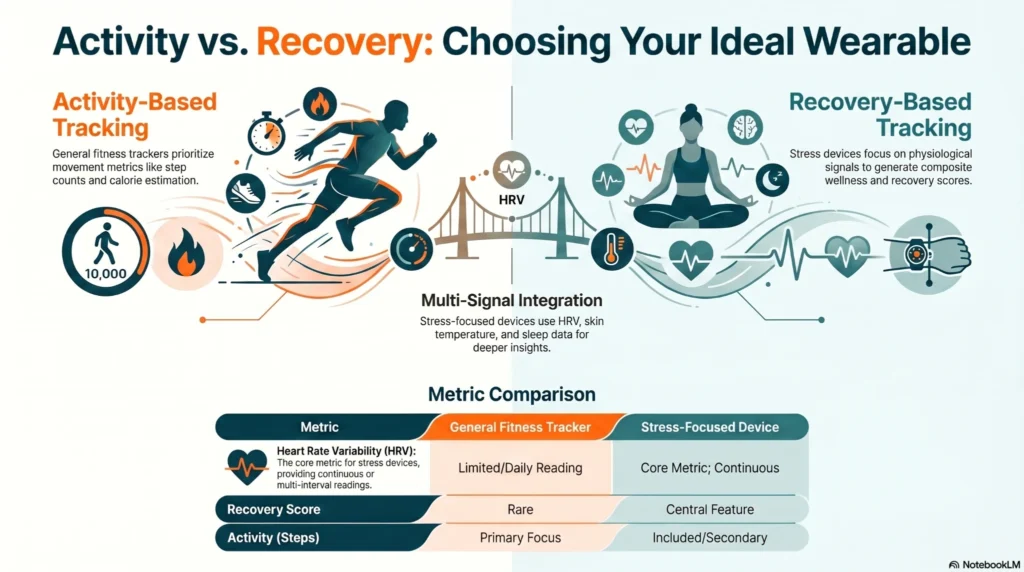
Metric Differences: Stress Trackers vs. General Fitness Trackers
| Metric | General Fitness Tracker | Stress-Focused Wellness Device |
| Steps / Distance | ✅ Primary focus | ✅ Often included, secondary |
| Calorie Estimation | ✅ Core feature | ⚠️ Variable; not always prioritized |
| Heart Rate (resting) | ✅ Standard | ✅ Standard |
| Heart Rate Variability (HRV) | ⚠️ Limited; often single daily reading | ✅ Core metric; continuous or multi-interval |
| Skin Conductance (EDA) | ❌ Rarely included | ⚠️ Offered by select devices (e.g., Fitbit Sense) |
| Blood Oxygen (SpO₂) | ⚠️ Occasional spot-check | ⚠️ Variable |
| Skin Temperature | ⚠️ Limited | ⚠️ Offered by select wearables (e.g., Oura, Fitbit) |
| Stress Score / Index | ⚠️ Basic or absent | ✅ Primary output; multi-signal algorithm |
| Breathing Rate | ⚠️ Estimated | ✅ More commonly tracked |
| Sleep Stage Analysis | ⚠️ Basic (light/deep/REM estimates) | ✅ More granular; stress-recovery integration |
| Recovery Score | ❌ Rare | ✅ Common; central to daily recommendations |
Key Takeaway: Stress-focused devices tend to integrate multiple physiological signals — particularly HRV, skin temperature, and sleep data — to generate composite wellness or recovery scores. General fitness trackers prioritize activity-based outputs.
📌 Editorial Note: Claims about specific device capabilities (e.g., EDA, continuous HRV) should be verified against current manufacturer specifications and independent sensor accuracy assessments prior to publication.
Algorithm Sophistication: How Devices Process Raw Stress Data
The value of any wearable metric depends significantly on how raw sensor data is processed and interpreted. Stress-focused devices feed multiple simultaneous data streams — HRV, EDA, skin temperature, and accelerometer data — into composite models that can distinguish low-grade chronic stress from acute physical exertion. General fitness trackers typically rely on heart rate elevation alone as a stress proxy, which generates significantly more false positives during exercise, caffeine intake, and posture changes.
| Algorithm Dimension | General Fitness Tracker | Stress-Focused Device |
| Data Inputs | Primarily accelerometer + optical HR | Multi-sensor fusion (HR, HRV, EDA, temperature, SpO₂, movement) |
| Stress Inference Method | Simple HR elevation thresholds | Multivariate models incorporating HRV, EDA, and context |
| Personalization | Minimal baseline adjustment | Adaptive baselines based on individual historical data |
| Longitudinal Pattern Recognition | ⚠️ Limited | ✅ More common; trend analysis over weeks or months |
| Algorithmic Transparency | ⚠️ Rarely disclosed | ⚠️ Rarely disclosed; proprietary in most cases |
| Peer-reviewed Validation | ⚠️ Variable; limited for consumer devices | ⚠️ Variable; some devices have published accuracy studies |
Evidence Note: A review published in npj Digital Medicine found that consumer wearable accuracy for HRV and stress inference varies widely across devices and conditions, and that algorithmic transparency remains a major gap across the industry.¹ Independent validation studies are limited for most consumer-grade products.
Wellness Features Comparison
Stress-focused devices typically include wellness features that general fitness trackers either omit or provide only in basic form. Recovery recommendations, mindfulness reminders, and stress alerts all depend on the multi-signal algorithms that distinguish these devices from standard activity trackers.
| Feature | General Fitness Tracker | Stress-Focused Device |
| Guided Breathing Exercises | ⚠️ Sometimes (basic) | ✅ Common; often customizable |
| Stress Alerts / Notifications | ❌ Rare | ✅ More common |
| Recovery Recommendations | ❌ Rare | ✅ Often linked to daily readiness scores |
| Mindfulness Reminders | ⚠️ Limited | ✅ More integrated |
| Sleep Coaching | ⚠️ Basic | ✅ Often a primary feature |
| Integration with Mental Health Apps | ⚠️ Variable | ⚠️ Variable |
| Clinician Data Export | ❌ Rare | ⚠️ Offered by some platforms (e.g., Garmin Health, Apple Health Records) |
Smart Ring (Oura, Samsung) vs Smartwatch for Stress Tracking (Apple Watch, Garmin): Which Should You Buy?
TL;DR: For most people whose priority is overnight sleep stress recovery, smart rings outperform smartwatches — the comfort, battery, and signal accuracy advantages compound over time. If daytime notifications, exercise tracking, and app breadth matter as much as sleep data, a smartwatch is the stronger all-around device. The Oura Ring Gen 3 is the current sleep-recovery benchmark; the Samsung Galaxy Ring is the emerging challenger.
Smart rings (e.g., Oura Ring, Samsung Galaxy Ring) and smartwatches (e.g., Apple Watch, Garmin Venu, Fitbit) represent two distinct form factors, each with trade-offs relevant to stress monitoring.
Form factor affects sensor placement, comfort, and measurement continuity. The comparison below covers four key dimensions.
Comfort and Wearability
| Dimension | Smart Ring | Smartwatch |
| Weight | Very low (2–6g typical) | Moderate (30–60g typical) |
| Sleep Wearability | ✅ High; minimal disruption | ⚠️ Variable; some users remove overnight |
| Daytime Comfort | ✅ Unobtrusive | ⚠️ Varies; may cause wrist fatigue or skin irritation with extended wear |
| Skin Contact Area | Finger (high vascularity) | Wrist (variable; motion artifact–prone) |
| Exercise Wearability | ⚠️ Limited; incompatible with gloves or grip sports | ✅ Designed for exercise tracking |
| Shower / Water Resistance | ✅ Typically waterproof | ✅ Typically waterproof (varies by model) |
| Sizing | Fixed ring size; cannot be adjusted | Adjustable strap |
Metric Accuracy: How Sensor Placement Affects HRV Data
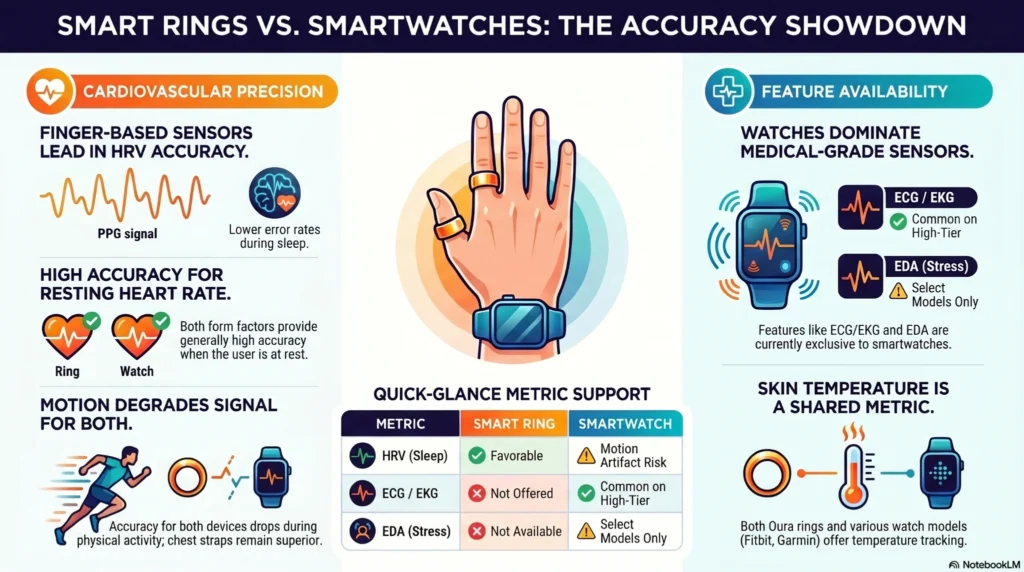
Smart rings generally produce more accurate HRV readings during sleep than smartwatches. The reason is sensor placement: a finger-based PPG sensor captures a stronger, cleaner pulse signal from the digital arteries than a wrist-mounted sensor, which is more susceptible to motion artifact and loose contact during sleep. The accuracy gap between ring and watch narrows substantially during the day, and chest straps with ECG-based R-R interval capture remain the most accurate consumer option for active HRV measurement — at the cost of comfort and continuous-wear viability.
| Metric | Smart Ring | Smartwatch |
| Resting HR Accuracy | ✅ Generally high at rest | ✅ Generally high at rest |
| HRV Accuracy (resting/sleep) | ✅ Favorable; finger arteries provide stronger PPG signal | ⚠️ Wrist signal more susceptible to motion artifact |
| HRV Accuracy (active/daytime) | ⚠️ Movement may affect accuracy | ⚠️ Similarly affected; chest strap superior for active HRV |
| ECG / Single-lead EKG | ❌ Not currently offered in most rings | ✅ Offered by Apple Watch, Samsung Galaxy Watch |
| EDA (Electrodermal Activity) | ❌ Not available via ring form factor | ⚠️ Available on select models (Fitbit Sense series) |
| SpO₂ | ⚠️ Available on some rings | ✅ Common on mid- to high-tier models |
| Skin Temperature | ✅ Offered on Oura Gen 3+ | ✅ Offered on Fitbit, some Garmin models |
Evidence Note: A 2022 study in Sensors found that finger-based PPG sensors produced HRV estimates with lower mean absolute error compared to wrist-based sensors during sleep, though both showed degraded accuracy during physical activity.²
Battery Life and Wear Gap Risk
Battery life affects how consistently a device can capture data — particularly during sleep and multi-day recovery tracking.
| Device Type | Typical Battery Life | Charging Method | Wear Gap Risk |
| Smart Ring | 4–7 days (varies by model) | Proprietary cradle | Low; short charge time |
| Entry Smartwatch | 1–2 days | Magnetic/proprietary | Moderate; overnight charging common |
| Mid-tier Smartwatch | 3–5 days | Magnetic/proprietary | Low to moderate |
| Premium GPS Smartwatch | 7–14 days (GPS off) | Proprietary | Low |
| Hybrid Watch (analog hands) | Weeks to months (low-power sensors) | Battery replacement | Very low |
Note: Battery life claims from manufacturers typically reflect optimal conditions. Real-world battery performance may be lower depending on features enabled (e.g., continuous HR, GPS, always-on display).
Discretion, Aesthetics, and Everyday Usability
| Dimension | Smart Ring | Smartwatch |
| Workplace Discretion | ✅ Minimal visual presence | ⚠️ Visible; may draw attention |
| Notification Display | ❌ No screen | ✅ Core function |
| Fashion Versatility | ✅ Jewelry-like appearance | ⚠️ Style-dependent |
| Social / Medical Stigma | ✅ None; indistinguishable from jewelry | ⚠️ Health monitoring device appearance may be noticeable |
| Formal Occasion Compatibility | ✅ High | ⚠️ Moderate |
Does Skin Tone Affect Wearable Stress Tracker Accuracy?
Optical (PPG) sensors used by smart rings and smartwatches work by emitting light into the skin and detecting the reflected signal from blood vessels. Because melanin — the pigment responsible for skin tone — absorbs a portion of the emitted light, higher melanin concentrations can reduce the strength of the sensor’s return signal.
What the evidence shows for SpO₂ versus HRV:
The most well-documented accuracy concern relates to pulse oximetry (SpO₂ measurement) — published research, including studies conducted during the COVID-19 pandemic, documented overestimation of blood oxygen saturation in patients with darker skin tones on consumer pulse oximeters. Wearable devices with SpO₂ sensors carry a similar theoretical risk.
For HRV specifically, the picture is more nuanced. HRV is derived from the timing of detected pulse peaks (the intervals between beats) rather than from the absolute amplitude of the optical signal. This means that even a weaker signal — as long as the peaks remain detectable — can still produce valid HRV data. The practical accuracy impact on HRV from skin tone alone is considered more limited than for SpO₂, though it may not be negligible under high-motion or low-contact conditions.
Form factor difference: Smart rings placed on the finger benefit from higher vascularity compared to the wrist, which may partially offset PPG signal attenuation in users with darker skin tones — though device-specific validation data on this point is limited.
What Is a Good HRV Score? (Quick Reference for Wearable Users)
Heart rate variability is not a single standardized measurement — it is expressed differently across devices, and what counts as “normal” depends heavily on age, fitness level, sex, and individual physiology. This section provides orientation for buyers comparing devices or interpreting their first weeks of data.
How HRV Is Expressed Across Popular Wearable Platforms
Most wearables do not display raw HRV values. They either report a proprietary wellness score derived from HRV and other signals, or they report a standardized HRV metric (most commonly RMSSD — the root mean square of successive RR interval differences) in milliseconds. Understanding which your device uses matters before comparing numbers across platforms or with published research.
| Device / Platform | HRV Metric Displayed | Scale | Notes |
|---|---|---|---|
| Oura Ring | RMSSD (ms) | Raw milliseconds | Reported as part of Readiness Score; 30-day rolling baseline shown |
| Garmin | RMSSD (ms) | Raw milliseconds | Overnight HRV status; displayed as average with range |
| Whoop | RMSSD (ms) | Raw milliseconds | Morning HRV measurement; 30-day rolling baseline integral to Recovery Score |
| Apple Watch | SDNN (ms) | Raw milliseconds | Reported in the Health app; average and range over time |
| Fitbit | Heart Rate Variability score | Raw RMSSD (ms) or interpreted score (varies by device) | Reported in Sleep section |
| HeartMath Inner Balance | Coherence ratio | 0–16 scale (session-level) | Measures real-time HRV coherence during biofeedback sessions, not a baseline metric |
Key point: RMSSD and SDNN are not directly comparable. An RMSSD of 50 ms is not equivalent to an SDNN of 50 ms.
Why Your Personal Baseline Matters More Than Population Norms
A reading that looks low in isolation may be entirely normal for one person’s physiology and concerning for another’s. Your device’s rolling baseline — typically calculated over 30 days by platforms like Oura, Garmin, and Whoop — is the number that matters for practical day-to-day decisions, not a comparison to general population data.
What a significantly below-baseline reading typically indicates:
- Physiological stress or recovery debt from prior-day exertion
- Illness onset (HRV often drops before symptoms appear)
- Poor sleep quality or insufficient sleep duration
- Alcohol consumption within 12–24 hours
- High cumulative emotional or occupational stress load
No single data point should be treated as definitive. The utility of HRV tracking comes from pattern recognition across weeks and months, not from any individual morning reading.
Passive Monitoring vs. Active Biofeedback: Which Approach Actually Reduces Stress?
If you’re wondering whether a stress tracker will actually help you feel less stressed — this section answers that directly.
Wellness devices differ not only in what they measure, but in whether they ask the user to actively engage. Passive monitoring runs continuously in the background; active biofeedback requires real-time user participation.
User Engagement and Friction
| Dimension | Passive Monitoring | Active Biofeedback |
| User Effort Required | Minimal (wear and check app periodically) | Moderate to high (timed sessions) |
| Session Frequency | Continuous or scheduled background | On-demand or scheduled |
| Data Accumulation | Long-term trends; day, week, month views | Session-level; short-duration windows |
| Notification Interruption | ⚠️ Stress alerts may interrupt tasks | ⚠️ Session scheduling requires intentional time |
| Engagement Sustainability | ✅ Low friction; easier to maintain | ⚠️ May decline over time without habit formation |
| Insight Depth | ✅ Rich longitudinal patterns | ✅ Detailed in-session physiological response |
Effectiveness for Stress Reduction: What the Evidence Shows
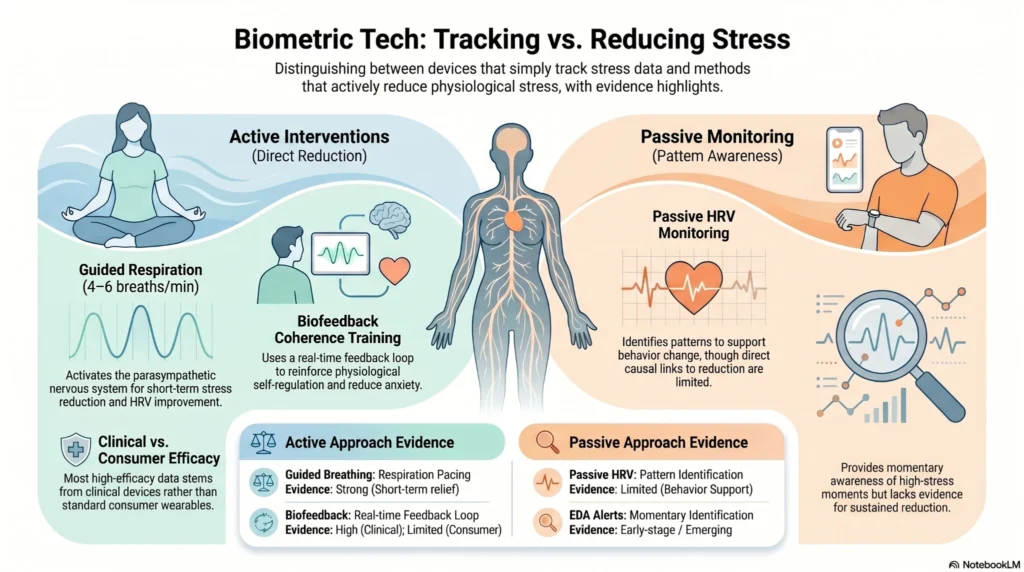
Important distinction: Tracking stress and reducing stress are not equivalent functions. Device effectiveness depends heavily on how the user acts on the data provided.
| Approach | Mechanism | Evidence Summary |
| Passive HRV Monitoring | Identifies patterns; promotes self-awareness | Evidence suggests awareness of physiological stress patterns may support behavior change, though direct causal links to stress reduction are limited in consumer device studies.³ |
| Guided Breathing (device-prompted) | Slow-paced respiration activates parasympathetic nervous system | Evidence supports slow, paced breathing (4–6 breaths/min) for short-term HRV improvement and subjective stress reduction.⁴ |
| Biofeedback (HRV-based coherence training) | Real-time feedback loop reinforces physiological self-regulation | Clinical biofeedback has demonstrated efficacy for stress and anxiety reduction; consumer device approximations have more limited evidence.⁵ |
| EDA-based stress alerts | Alerts user to high-stress moments for intervention | Early-stage evidence; EDA alerts may support momentary awareness but effectiveness for sustained reduction is not well established in consumer contexts. |
Caution: Most efficacy data comes from clinical-grade biofeedback devices. Evidence for consumer wearables should be interpreted with appropriate caution.
Learning Curve and Setup Complexity
| Dimension | Passive Monitoring | Active Biofeedback |
| Setup Complexity | Low | Low to moderate |
| Interpretation Learning Curve | Moderate (understanding HRV baselines, trends) | Moderate (understanding coherence ratios, breath timing) |
| Time to First Useful Insight | Days to weeks (baseline establishment) | Immediate (session feedback) |
| Coaching / Guidance Needed | Low | Moderate; app guidance or practitioner support beneficial |
| Risk of Misinterpretation | ⚠️ Moderate; HRV fluctuation is normal and context-dependent | ⚠️ Low to moderate |
HRV Measurement Methods: Optical Sensors vs. Chest Straps
Heart rate variability (HRV) is a key physiological marker associated with autonomic nervous system function and is used across most stress-oriented wellness devices. However, measurement methods vary significantly and affect data reliability.
Optical PPG vs. ECG Chest Strap — Accuracy Tradeoffs
| Dimension | Optical PPG (Wrist / Finger) | Chest Strap (ECG-based) |
| Sensor Technology | Photoplethysmography (light absorption) | Electrical signal (electrocardiogram) |
| Signal Type | Pulse wave (indirect) | R-R interval (direct) |
| Accuracy at Rest | ✅ Generally acceptable for trend monitoring | ✅ High; considered reference standard for consumer use |
| Accuracy During Exercise | ⚠️ Significantly reduced; motion artifact | ✅ More stable |
| Comfort for Sleep | ✅ High (especially ring) | ❌ Low; strap may be disruptive |
| Cost | ✅ Included in device | ⚠️ Additional accessory; $50–$150 range |
| Use Case Fit | General daily trend monitoring, sleep HRV | Athletic training, clinical-grade short-term readings |
| Consumer Products | Oura Ring, Apple Watch, Fitbit, Garmin | Polar H10, Garmin HRM-Pro, Wahoo TICKR X |
Evidence Note: A systematic review in the International Journal of Sports Physiology and Performance found that optical wrist-based HRV measurement shows acceptable agreement with ECG under controlled, low-motion conditions, but accuracy degrades substantially during movement.⁶ Chest straps using R-R interval capture remain the consumer-accessible reference standard for HRV measurement.
Nighttime vs. Daytime HRV: Which Measurement Type Is More Useful?
| Dimension | Nighttime HRV (Sleep-based) | Daytime HRV (Spot-check / Continuous) |
| Motion Artifact | ✅ Low; minimal movement | ⚠️ Higher; activity-dependent |
| Signal Stability | ✅ More consistent | ⚠️ Variable |
| Physiological Relevance | Reflects overnight autonomic recovery; integrates effects of prior day’s stress, sleep quality, and illness | Reflects acute stress response, reactivity to specific events or tasks |
| HRV Metric Used | RMSSD, SDNN (whole-night or segmented) | RMSSD (short-term), coherence ratio |
| Actionability | Informs next-day readiness and recovery state | Supports in-the-moment intervention (breathing, breaks) |
| Primary Devices | Oura Ring, Garmin (sleep HRV) | Apple Watch (Breathe), Garmin (stress tracking), HeartMath Inner Balance |
| Evidence Quality | ✅ Better studied; more consistent signal | ⚠️ More variable; context-dependent interpretation |
Factors That Affect HRV Accuracy on Any Device
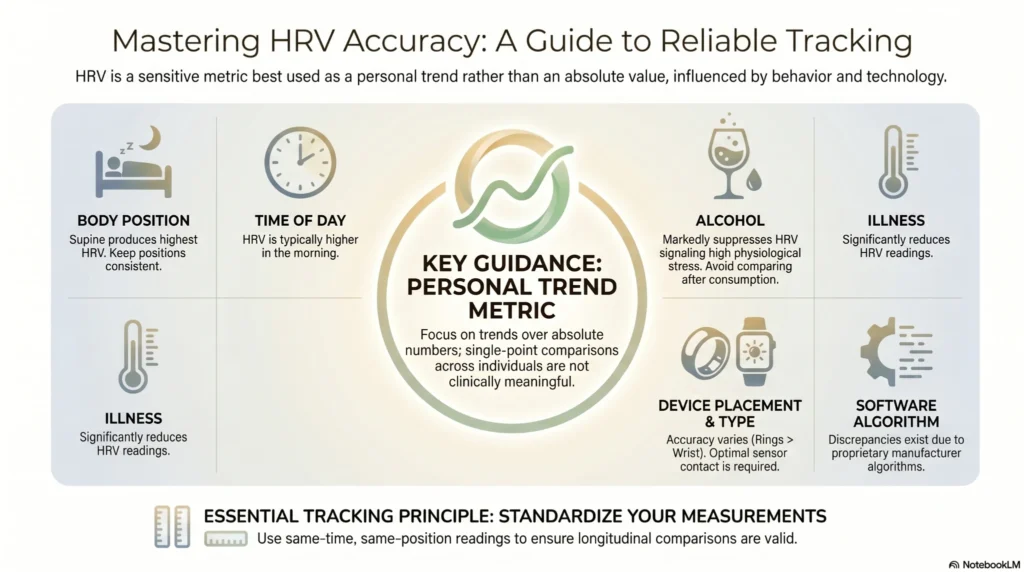
| Factor | Impact on HRV Accuracy | Practical Implication |
| Body Position | Significant; supine produces highest HRV | Comparisons should be made in consistent positions |
| Time of Day | Morning HRV typically higher than evening | Use same-time measurements for longitudinal comparisons |
| Alcohol Consumption | Suppresses HRV markedly | Disclose in tracker if applicable; avoid same-night comparisons |
| Illness / Infection | Reduces HRV before and during illness | Anomalously low readings may signal physiological stress |
| Menstrual Cycle Phase | HRV varies across cycle phases in individuals who menstruate | Baseline tracking should account for cyclical variation |
| Caffeine | May affect short-term HRV; evidence mixed | Standardize intake timing when tracking trends |
| Device Placement | Ring > Wrist for resting PPG accuracy | Optimal sensor contact required for valid readings |
| Software Algorithm | Proprietary processing varies by manufacturer | Cross-device HRV comparisons may not be valid |
Key Guidance: HRV is most useful as a personal trend metric rather than an absolute number. Single-point comparisons across individuals or devices are generally not clinically meaningful. Accuracy claims on this site are evaluated against our published testing methodology and evidence standards.
A note for first-time buyers: No consumer wearable is a medical device — and that’s fine. For tracking personal trends across weeks and months, the accuracy of leading devices is more than sufficient. The goal is directional insight, not diagnostic precision. A consistent pattern in your own data matters far more than any single reading.
App Experience and Guided Stress Insights
Hardware capability is only part of the wellness device equation. The companion app determines how effectively raw data is translated into actionable insight.
Data Visualization: What a Good Stress App Should Show
| Visualization Element | What to Look For | Red Flags |
| HRV Trend Display | 30-, 60-, 90-day rolling charts with personal baseline overlay | Daily-only view with no trend context |
| Sleep Architecture | Stage breakdown (light, deep, REM) with HRV by stage | Binary sleep/wake only |
| Stress Timeline | Hourly or intraday stress mapping with labeled events | Single daily stress number with no temporal detail |
| Recovery Score Components | Transparent weighting of contributing metrics | Single score with no component breakdown |
| Baseline Personalization | Adaptive rolling baseline, not static population averages | No baseline disclosure |
| Data Export | CSV, PDF, or health platform integration (Apple Health, Google Fit) | No export capability |
| Historical Comparison | Week-over-week or month-over-month trend views | 7-day cap on data access |
Actionable Insights vs. Raw Data Display
Tracking data becomes wellness-relevant only when it informs decisions or behavior. Evaluate whether an app moves beyond data display toward guided action.
| Insight Type | Description | Example |
| Daily Readiness Guidance | Recommends activity intensity based on recovery score | “Your HRV is below your baseline — consider light activity today” |
| Stress Pattern Identification | Highlights recurring high-stress periods or triggers | “Your stress typically peaks Tuesday and Thursday afternoons” |
| Sleep Hygiene Recommendations | Data-driven prompts aligned to sleep timing and quality | “Your deep sleep decreases when you go to bed after midnight” |
| Personalized Baselines | Shows deviation from your own norm, not population averages | “Your HRV today is 15% below your 30-day average” |
| Correlation Surfacing | Links lifestyle behaviors to wellness metrics | “On nights you logged alcohol, your HRV was 18% lower on average” |
| Goal Progress Tracking | Maps metric trends toward user-defined wellness goals | Readiness score trend over 8-week stress management program |
Note: The clinical validity of AI-generated lifestyle correlations in consumer apps has not been systematically evaluated in peer-reviewed literature as of this writing. These insights are best treated as hypothesis-generating rather than diagnostically conclusive.
Guided Breathing and Meditation Integration
| Feature | Basic Integration | Advanced Integration |
| Guided Breathing | Fixed 4-7-8 or box breathing timer | Biofeedback-adjusted pace based on real-time HRV |
| Session Duration Options | Fixed (e.g., 5 minutes only) | Customizable (1–30 min) |
| Post-Session Feedback | None or simple “Done” confirmation | HRV before/after comparison, coherence score |
| Meditation Library | None | Curated or third-party library (e.g., Headspace, Calm integration) |
| Physiological Validation | None | Shows HRV or stress score change attributable to session |
| Scheduling / Reminders | Manual only | Adaptive; prompts at detected high-stress periods |
Devices with notable breathing/meditation integration:
- Garmin (Body Battery + Breathwork app): Guides structured breathing; Body Battery integrates session recovery.
- Apple Watch (Mindfulness app): Breath sessions with haptic pacing; limited physiological feedback.
- HeartMath Inner Balance: Dedicated HRV coherence biofeedback; requires separate sensor; most physiologically integrated consumer option.
- Fitbit Premium: Guided mindfulness sessions; EDA-integrated stress detection on Sense series.
Stress Tracker Pricing and Subscription Costs: What You Actually Pay
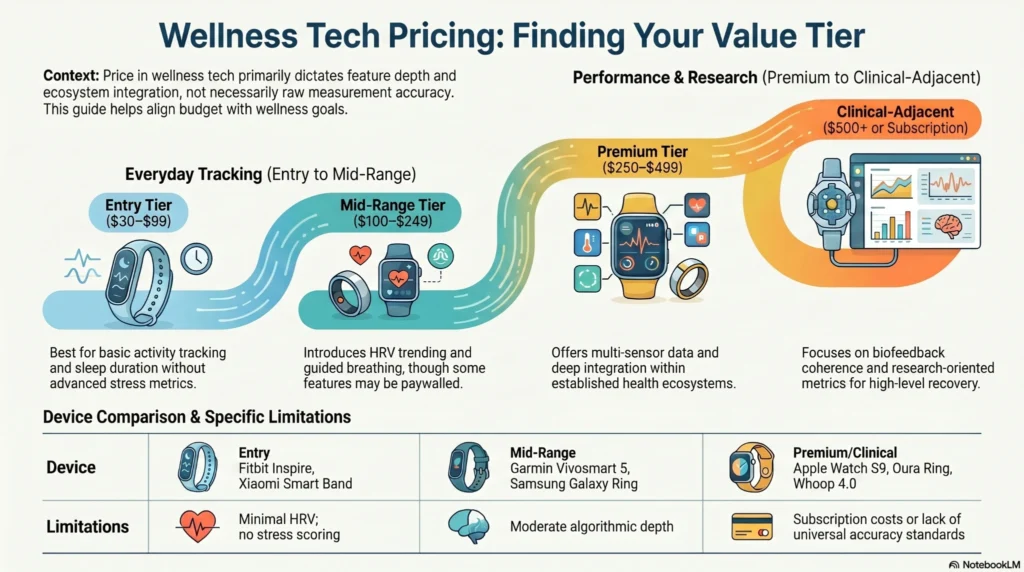
Device price does not reliably predict measurement accuracy or wellness outcome relevance. This section provides a structured breakdown of cost tiers and what users may reasonably expect at each level.
Device Price Tiers and What to Expect
| Price Tier | Typical Range (USD) | Representative Devices | Primary Strengths | Primary Limitations |
| Entry | $30–$99 | Fitbit Inspire, Xiaomi Smart Band | Step tracking, basic HR, sleep duration | Minimal HRV; no stress scoring; basic app |
| Mid-Range | $100–$249 | Fitbit Charge 6, Garmin Vivosmart 5, Samsung Galaxy Ring | HRV trending, stress scores, SpO₂, guided breathing | Moderate algorithmic depth; some features paywalled |
| Premium | $250–$499 | Apple Watch Series 9, Oura Ring Gen 3, Garmin Venu 3 | Comprehensive multi-sensor data, strong app platforms, health ecosystem integration | No universal standard for HRV accuracy; subscription required for some platforms |
| Clinical-Adjacent / Subscription | $500+ or subscription model | Whoop 4.0 (subscription), HeartMath Inner Balance + app | Research-oriented recovery metrics, biofeedback coherence training, some published accuracy studies | Subscription costs; still consumer-grade; not a medical device |
Subscription Costs by Platform — The Real Annual Cost of Each Stress Tracker
Among the major stress tracking platforms, Garmin is the only mainstream option with no required subscription — all core features including HRV trending and sleep scoring are included in the hardware purchase. At the other end, Whoop charges approximately $239 per year on the annual plan and bundles hardware into the subscription with no upfront hardware cost, making it the highest ongoing annual cost of any mainstream stress tracker. Oura Ring requires a subscription (~$5.99/month, approximately $72 annually) after a 6-month free trial period. Fitbit Premium is optional, unlocking advanced stress analysis features not available in the free tier.
| Device | Hardware Cost | Subscription Required | Annual Subscription Cost |
|---|---|---|---|
| Oura Ring Gen 3 | ~$299–$349 | ✅ Yes (after 6-month trial) | ~$71.88 ($5.99/mo) |
| Whoop 4.0 | $0 (included in subscription) | ✅ Yes | ~$239/year (12-month plan) |
| Fitbit Charge 6 | ~$159 | ⚠️ Premium optional | ~$79.99/year |
| Apple Watch Series 9 | ~$399+ | ⚠️ Fitness+ optional | ~$79.99/year |
| Garmin Devices | $150–$500 | ❌ No subscription required | $0 |
| HeartMath Inner Balance | ~$129 (sensor) | ⚠️ App free; Pro features vary | Variable |
📌 Editorial Note: Device pricing is subject to change. All prices should be verified against current retail listings prior to publication and should not be treated as endorsements or guaranteed accurate.
For a goal-based decision framework, see → How to Choose Based on Your Goal (above)
How to Choose Based on Your Goal
Decision Framework by Use Case
Rather than starting with price or brand, identify your primary use case:
| If your priority is… | Start here |
|---|---|
| Overnight sleep recovery and morning readiness | Smart ring (Oura Gen 3) or sleep-first smartwatch (Garmin) |
| Daytime stress pattern identification | Apple Watch + Mindfulness, or Garmin with Body Battery |
| Active biofeedback and HRV coherence training | HeartMath Inner Balance (requires separate sensor) |
| Budget under $200 with HRV trending | Fitbit Charge 6 or Samsung Galaxy Ring |
| Clinician-shareable data or health platform integration | Apple Watch (Apple Health Records) or Garmin Health |
Use-case examples:
- Someone already working with a therapist or coach: prioritize a device with data export capability (CSV or Apple Health) so insights can be shared in sessions.
- Remote worker whose stress spikes during afternoon calls: daytime HRV spot-checks on a Garmin or Apple Watch will surface patterns that overnight-only tracking misses.
- Parent with fragmented sleep: a smart ring’s passive overnight tracking requires no conscious effort — no buttons, no sessions, just wear it.
Value Assessment Framework
Rather than equating price with quality, prospective buyers may benefit from evaluating:
- Primary use case: Sleep recovery tracking vs. daytime stress monitoring vs. active biofeedback vs. athletic HRV tracking.
- Data access needs: Is historical trend data available without a subscription?
- App depth: Does the platform provide actionable insight, or primarily data display?
- Device longevity: Ring sizing changes, battery degradation, and hardware generation cycles affect long-term value.
- Ecosystem fit: Integration with existing health apps (Apple Health, Google Fit, MyFitnessPal) may reduce friction.
Find Your Match: One-Question Device Selector
Answer one question: what do you most want to improve?
- I want to sleep better and wake up more recovered → Oura Ring Gen 3 or Garmin sleep-focused models. Prioritize sleep HRV, recovery score, and overnight passive tracking.
- I want to understand and reduce daytime stress → Apple Watch Series 9 (Mindfulness app) or Garmin Venu 3 (Body Battery + stress timeline). Look for intraday stress mapping.
- I want real-time feedback to practice calming myself → HeartMath Inner Balance. It is the only consumer-accessible device built specifically around HRV coherence biofeedback.
- I have a $150 budget and want to start somewhere → Fitbit Charge 6. Provides HRV trending, stress scores, SpO₂, and guided breathing without a required subscription.
Frequently Asked Questions About Stress Trackers
Is a smart ring or smartwatch more accurate for HRV tracking?
Smart rings generally produce more accurate HRV readings during sleep than smartwatches. Finger-based PPG sensors capture a stronger, cleaner pulse signal than wrist-mounted sensors, which are more susceptible to motion artifact during sleep. The accuracy gap narrows during the day, and chest straps using ECG-based R-R interval measurement remain the most accurate consumer option for active HRV.
What is the difference between a stress tracker and a fitness tracker?
Stress-focused wearables and general fitness trackers differ primarily in which physiological signals they prioritize. Fitness trackers center on activity outputs — steps, calories, and basic heart rate. Stress-focused devices collect multiple simultaneous signals — HRV, skin temperature, and, on select devices, electrodermal activity — and feed these into algorithms designed to detect physiological recovery load rather than just physical activity.
Do I need a subscription for Oura Ring or Whoop?
Oura Ring includes a 6-month free membership trial; after that, a subscription of approximately $5.99 per month (~$72 per year) is required. Whoop is entirely subscription-based at approximately $239 per year on the annual plan, with hardware bundled into the cost. Garmin devices require no subscription at all. Fitbit Premium is optional at approximately $79.99 per year.
Can a wearable diagnose stress or anxiety?
No. Consumer wearables are not medical devices and cannot diagnose stress disorders, anxiety, or any clinical condition. They measure physiological correlates associated with stress responses, but a device cannot distinguish between causes such as physical exertion, illness, poor sleep, or emotional stress. If you are experiencing persistent stress, anxiety, or related symptoms, please consult a qualified healthcare provider.
I’m not technical — will I understand the data on my stress tracker?
Most mid-range and premium devices are designed to surface plain-language scores (readiness, stress, sleep quality) without requiring any understanding of raw metrics. If simplicity is a priority, look for apps with a single daily score (Oura’s Readiness Score, Garmin’s Body Battery) rather than platforms that present raw HRV numbers as the primary output.
When to Consult a Healthcare Provider
If you are experiencing persistent stress, anxiety, sleep difficulties, or related symptoms, the information provided on this educational page is not a substitute for professional medical or psychological evaluation. Please consult a qualified healthcare provider. This content is produced under the editorial standards described on our About page.
References
- Bent B, Goldstein BA, Kibbe WA, Dunn JP. Investigating sources of inaccuracy in wearable optical heart rate sensors. npj Digital Medicine. 2020;3(1):18. https://doi.org/10.1038/s41746-020-0226-6
- Altini M, Kinnunen H. The promise of sleep: A multi-sensor approach for accurate sleep stage detection using the Oura ring. Sensors. 2021;21(13):4302. https://doi.org/10.3390/s21134302
- Gillinov S, Etiwy M, Wang R, et al. Variable accuracy of wearable heart rate monitors during aerobic exercise. Medicine & Science in Sports & Exercise. 2017;49(8):1697–1703. https://doi.org/10.1249/mss.0000000000001284
- Zaccaro A, Piarulli A, Laurino M, et al. How breath-control can change your life: A systematic review on psycho-physiological correlates of slow breathing. Frontiers in Human Neuroscience. 2018;12:353. https://doi.org/10.3389/fnhum.2018.00353
- Gevirtz R. The promise of heart rate variability biofeedback: Evidence-based applications. Biofeedback. 2013;41(3):110–120. https://doi.org/10.5298/1081-5937-41.3.01
- Plews DJ, Scott B, Altini M, et al. Comparison of heart-rate-variability recording with smartphone photoplethysmography, Polar H7 chest strap, and electrocardiography. International Journal of Sports Physiology and Performance. 2017;12(10):1324–1328. https://doi.org/10.1123/ijspp.2016-0668
Medical Review Statement: This content has been reviewed according to the medical and editorial standards outlined on our About page. Review conducted by Dr. Rishav Das, M.B.B.S.
See our conflict of interest and funding disclosures
⚠️ Informational Content Only This page is educational and does not constitute medical advice, diagnosis, or treatment. Consumer wellness devices are not medical devices and are not validated for clinical diagnosis. If you are experiencing persistent stress, anxiety, or related symptoms, please consult a qualified healthcare provider. See our full Medical Disclaimer.
Page last updated: June, 2026
Medical review: Dr. Rishav Das, M.B.B.S. — June, 2026
See our About page for full editorial standards, conflict of interest disclosures, and medical review governance.