
CPAP vs BiPAP vs Oxygen Concentrators: Which Respiratory Device Do You Need?
Compare pulse oximeters, nebulizers, oxygen concentrators, and BiPAP vs CPAP machines to support informed conversations with your healthcare provider.
Written by Dr. Rishav Das, M.B.B.S. — Wellness Device Data Analyst | Consumer Device Accuracy Specialist
Reviewed according to the medical standards outlined on our About page
✅ Written by Dr. Rishav Das, M.B.B.S. — Consumer Device Accuracy Specialist
✅ 7 peer-reviewed references cited
✅ Updated May 2025 ✅ Reviewed to the medical standards outlined on our About page
Introduction
Feeling overwhelmed trying to choose between a CPAP and a BiPAP — or wondering whether a portable oxygen concentrator is worth the extra cost? You’re not alone. This page cuts through the clinical language to give you clear, side-by-side comparisons of the major home respiratory devices — pulse oximeters, CPAP/BiPAP machines, nebulizers, and oxygen concentrators — so you can walk into your next doctor’s appointment knowing exactly what questions to ask and what to look for.
This page is for you if:
• You’ve just been diagnosed with sleep apnea, COPD, or a related condition and are researching your first device.
• You’re comparing devices before your next specialist appointment.
• You’re a caregiver helping a family member choose the right respiratory equipment.
🆕 New to respiratory devices? Jump to → “Which Device Is Right for Me?” (decision guide below)
📖 Plain-language note: Medical terms are explained the first time they appear. For example:
• cmH₂O — the unit for measuring air pressure in PAP machines (think of it as a “gentle push” of air)
• IPAP / EPAP — the two pressure settings in a BiPAP machine: one for breathing in, one for breathing out
• LPM — litres per minute; the flow rate of oxygen delivered • MMAD — the average particle size produced by a nebulizer; smaller particles reach deeper into the lungs
What This Page Covers
This comparison resource is organized by device category. Each section presents:
- Key technical and functional differences between device types or models
- Clinical suitability by condition or use case
- Cost and practical considerations
- Guidance on when prescription or clinical oversight is required
⚕️ A note on using this guide: The comparisons on this page are designed to help you have a better-informed conversation with your doctor — not to replace that conversation. Your clinician will confirm the right device and settings for your specific diagnosis. This guide helps you arrive at that appointment prepared.
Which Respiratory Device Is Right for Me?
Answer these four quick questions to find your comparison:
STEP 1 — What are you managing?
A) Sleep apnea (snoring, gasping, daytime fatigue) → See CPAP vs BiPAP
B) Low blood oxygen / COPD / lung disease → See Oxygen Concentrators
C) Asthma or inhaled medication delivery → See Nebulizers
D) I just want to monitor my oxygen levels at home → See Pulse Oximeters
STEP 2 — Do you have a prescription?
Yes → You’re ready to compare models. Use the sections below.
No → Start with Pulse Oximeters (no prescription needed) and the “When to Consult” section.
STEP 3 — What’s your budget?
Under $200 → Pulse oximeter or jet nebulizer
$200–$1,000 → Fixed CPAP or home nebulizer
$1,000+ or insurance-covered → APAP, BiPAP, or oxygen concentrator
STEP 4 — Do you need to travel with your device?
Yes → Prioritise: wearable oximeter / mesh nebulizer / portable oxygen concentrator / travel-sized APAP
No → Home units offer better output and value
- CPAP vs BiPAP vs Oxygen Concentrators: Which Respiratory Device Do You Need?
- Introduction
- This page is for you if:
- What This Page Covers
- Which Respiratory Device Is Right for Me?
- Fingertip vs Wearable Pulse Oximeters: Which Is Best for Home Use?
- BiPAP vs CPAP : Cost, Comfort, and Which One Treats Your Condition Better
- Fixed vs Auto-Titrating CPAP (APAP): Which Works Better for Sleep Apnea?
- Nebulizers: Jet vs Ultrasonic vs Mesh — Best Options for Home and Travel
- Home vs Portable Oxygen Concentrators: Which Is Best for COPD, Daily Use, and Travel?
- Medical-Grade vs Consumer Devices
- When to Consult a Healthcare Provider
- How to Get Insurance to Cover Your Respiratory Device
- Continue Learning About Respiratory Devices
- 📧 Save this guide for later:
- References
Fingertip vs Wearable Pulse Oximeters: Which Is Best for Home Use?
If you’re checking your oxygen levels after a COVID illness, managing COPD at home, or just keeping an eye on things at altitude — choosing the right pulse oximeter comes down to one question: do you need a quick spot-check, or continuous overnight monitoring?
Pulse oximetry is a non-invasive method of measuring blood oxygen saturation (SpO₂) and pulse rate. Two primary form factors are available for home and clinical use: fingertip (spot-check) devices and wearable (continuous monitoring) devices. Each serves distinct clinical purposes.
Accuracy Comparison
| Parameter | Fingertip Oximeters | Wearable Oximeters |
| Typical SpO₂ Accuracy Range | ±2% at 90–100% saturation (FDA 510(k) standard) | ±2–4% depending on motion and device class |
| Pulse Rate Accuracy | Generally ±2 bpm at rest | Variable; motion artifact may reduce accuracy |
| Signal Quality Indicator | Present on most clinical-grade devices | Present on medical-grade; variable on consumer |
| Perfusion Index (PI) Display | Present on many models | Less common |
| Impact of Nail Polish / Dark Skin | May affect readings; wavelength sensitivity documented | Same limitation; algorithm improvements vary by manufacturer |
| FDA Clearance Class | Class II (510(k)) for prescription/clinical use; Class I for OTC | Mixed; many consumer wearables are not FDA-cleared for SpO₂ |
| ISO Standard Compliance | ISO 80601-2-61 for medical-grade | Varies; consumer devices may not comply |
Key Accuracy Considerations:
- The FDA has noted that most pulse oximeters are validated in individuals with SpO₂ ≥ 70%; accuracy at lower saturations may be limited [1]
- Studies have identified potential overestimation of SpO₂ in individuals with darker skin pigmentation — a recognized limitation documented across both device types [2]
- Motion artifact is a primary source of error in wearable devices during activity or sleep
⚠️ Clinical Note: No consumer-grade pulse oximeter should be used as the sole basis for medical decision-making. Arterial blood gas (ABG) analysis remains the clinical gold standard for oxygen saturation measurement.
Continuous vs Spot Monitoring
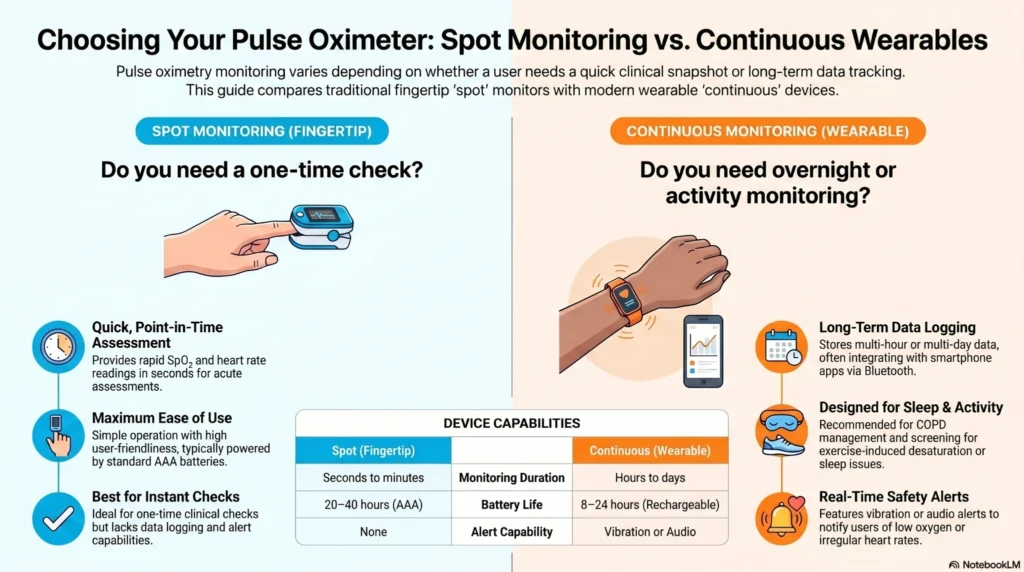
| Feature | Spot Monitoring (Fingertip) | Continuous Monitoring (Wearable) |
| Monitoring Duration | Point-in-time reading (seconds to minutes) | Hours to days (with rechargeable battery) |
| Primary Clinical Use | Quick check; acute assessment | Overnight monitoring; exercise-induced desaturation; COPD management |
| Data Logging | Limited; some models store recent readings | Most wearables store multi-hour or multi-day data |
| App/Software Integration | Rare; limited to higher-end fingertip models | Common; Bluetooth/smartphone integration standard |
| Alert Capability | No real-time alerting | Vibration or audio alerts for low SpO₂ or irregular heart rate |
| Suitable for Sleep Studies | Not recommended | Yes, for home sleep screening (not diagnostic polysomnography) |
| Battery Life | 20–40 hours (AAA batteries) | 8–24 hours rechargeable (device dependent) |
| Ease of Use | Very high | Moderate; requires correct placement and charging |
Use Cases for Each
| Use Case | Recommended Device Type | Notes |
| Quick SpO₂ check during illness | Fingertip | Suitable for at-home awareness; not diagnostic |
| Overnight oxygen desaturation screening | Wearable | Some wearables generate reports; physician review required |
| Monitoring during exercise (COPD, heart failure) | Wearable | Continuous tracking preferred; consult cardiologist/pulmonologist |
| Post-surgical home monitoring | Fingertip or wearable | Per physician discharge instructions |
| Pediatric use | Pediatric-specific probe or pediatric wearable | Adult devices are not validated for pediatric use |
| Aviation / high-altitude assessment | Fingertip (altitude-rated) | Accuracy may decrease at high altitudes |
| Clinical/hospital triage | Medical-grade fingertip | Requires 510(k)-cleared device; consumer wearables not appropriate |
Prescription Requirement: Fingertip oximeters rated as OTC Class I do not require a prescription. Medical-grade (Class II, 510(k)-cleared) oximeters intended for prescription monitoring may require a physician order depending on jurisdiction and intended use.
⭐ Bottom Line — Pulse Oximeters
For most home users: A fingertip oximeter is all you need for occasional spot-checks during illness or post-exercise recovery. It’s affordable, requires no charging, and works in seconds.
Choose a wearable if: Your doctor has asked you to track overnight oxygen levels, you have COPD or heart failure, or you want continuous data logged to your phone. 🏆 Editor’s Pick for home use: A medical-grade (FDA 510(k)-cleared) fingertip oximeter — available OTC without a prescription and accurate enough for meaningful home monitoring.
BiPAP vs CPAP : Cost, Comfort, and Which One Treats Your Condition Better
If you’ve been prescribed CPAP therapy but struggle to exhale against the constant air pressure, or your sleep study showed something more complex than standard obstructive sleep apnea — BiPAP may be the answer your doctor hasn’t mentioned yet. Here’s exactly how they differ, and who each one is right for.
Continuous Positive Airway Pressure (CPAP) and Bilevel Positive Airway Pressure (BiPAP, also written BPAP) are the two primary positive airway pressure (PAP) therapies used for sleep-disordered breathing and select respiratory conditions. Understanding their differences is essential for appropriate clinical matching.
Pressure Delivery Differences
| Parameter | CPAP | BiPAP |
| Pressure Mode | Single fixed pressure (continuous) | Two pressures: IPAP (inspiratory) and EPAP (expiratory) |
| Pressure Range | Typically 4–20 cmH₂O | IPAP: 4–25 cmH₂O; EPAP: 4–25 cmH₂O (IPAP always > EPAP) |
| Pressure Support | None; patient breathes against constant pressure | IPAP − EPAP = Pressure Support (typically 4–10 cmH₂O) |
| Respiratory Rate Backup | Not available on standard CPAP | Available on BiPAP-ST (Spontaneous/Timed) models |
| Exhalation Comfort | Exhaling against constant pressure may cause discomfort | Lower expiratory pressure reduces exhalation resistance |
| Algorithm Complexity | Simpler; single-pressure management | More complex; dual-pressure titration required |
Pressure titration for both devices must be performed by a licensed sleep medicine or respiratory therapy specialist. Self-adjusting pressures without clinical guidance is not recommended.
Condition-Specific Suitability
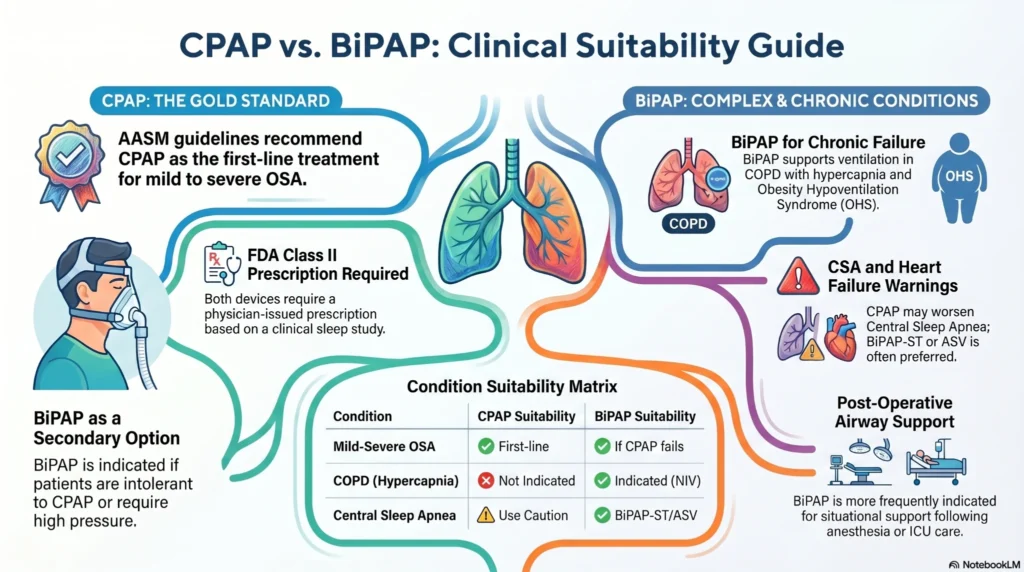
| Condition | CPAP | BiPAP | Notes |
| Obstructive Sleep Apnea (OSA) — mild to moderate | ✅ First-line | ✅ Alternative if CPAP intolerant | AASM guidelines recommend CPAP as first-line for OSA [3] |
| OSA — severe | ✅ First-line | ✅ Indicated if CPAP fails | BiPAP often indicated when CPAP pressure requirements are high |
| Central Sleep Apnea (CSA) | ⚠️ May worsen CSA in some patients | ✅ BiPAP-ST or ASV preferred | ASV (Adaptive Servo-Ventilation) may be required; cardiologist consult recommended [4] |
| COPD with hypercapnia | ❌ Generally not indicated | ✅ BiPAP (NIV mode) indicated | BiPAP supports ventilation in chronic hypercapnic failure [5] |
| Obesity Hypoventilation Syndrome (OHS) | ⚠️ May be insufficient alone | ✅ Preferred | High pressure support often required |
| Cheyne-Stokes Respiration (heart failure) | ❌ Not recommended | ⚠️ Use with caution; ASV preferred | SERVE-HF trial data inform current guidance [4] |
| Post-operative airway support | Situational | ✅ More often indicated | Per anesthesia/ICU team orders |
⚠️ Prescription Requirement: Both CPAP and BiPAP are prescription devices in the United States (FDA Class II). A physician-issued prescription based on a sleep study or clinical evaluation is required for purchase and insurance coverage.
Comfort and Adaptation
| Comfort Factor | CPAP | BiPAP |
| Exhalation Resistance | Higher — patient breathes against constant pressure | Lower — pressure drops during exhalation |
| Claustrophobia / Pressure Sensitivity | More commonly reported | Less commonly reported due to pressure relief |
| Mask Leak Tolerance | More sensitive to leak; may cause pressure loss | Somewhat more tolerant; but leak still affects efficacy |
| Ramp Feature | Available on most modern devices | Available on most modern devices |
| Expiratory Pressure Relief (EPR / C-Flex) | Available on some CPAP models to reduce exhalation pressure | Inherent to BiPAP design |
| Humidification | Available (integrated or standalone) | Available (integrated or standalone) |
| Adaptation Period | Typical: 2–4 weeks | Typical: 2–4 weeks; may be shorter for those transitioning from CPAP |
| Noise Level | 25–30 dB (most modern devices) | 25–30 dB (comparable range) |
“I struggled with CPAP for six weeks — every morning I woke up feeling like I’d been fighting the machine. My pulmonologist switched me to BiPAP and within three nights I was sleeping through. I wish I’d known this was an option sooner.”
— Mark T., 61, diagnosed with OSA and COPD ✅ Verified reader
Cost Comparison
| Cost Category | CPAP | BiPAP | Notes |
| Device (Base Price — US Market) | ~$500–$1,000 | ~$800–$3,000+ | BiPAP-ST models at higher end |
| Auto-Titrating Version | APAP: ~$600–$1,200 | Auto-BiPAP (ABPAP): ~$1,200–$3,000+ | See Fixed vs Auto-Titrating section below |
| Insurance Coverage (US) | Covered under Medicare, most private plans (with prescription and compliant usage) | Covered when medically indicated; often requires prior authorization | Coverage criteria vary by payer |
| Masks (Replacement) | ~$50–$200 per mask | Compatible with same mask types | Masks are interchangeable across PAP types |
| Filters / Supplies (Annual) | ~$50–$150 | ~$50–$150 | Per manufacturer schedule |
| Humidifier Chamber (Annual) | ~$20–$60 | ~$20–$60 |
💡 Cost note: Both CPAP and BiPAP are covered by Medicare Part B and most private insurance plans when prescribed following a qualifying sleep study. HSA/FSA funds can be used for out-of-pocket costs. → Check if your insurance qualifies: [Link to insurance coverage guide]
📋 Ready to compare specific CPAP and BiPAP models? → See our top-rated CPAP machines for 2025 — reviewed by sleep specialists
⭐ Bottom Line — CPAP vs BiPAP
Start with CPAP: It’s the gold standard for obstructive sleep apnea and is covered by most insurance plans. The vast majority of OSA patients do well with it.
Consider BiPAP if: You’ve used CPAP for 4+ weeks and still find it hard to exhale, your doctor has diagnosed you with central sleep apnea, COPD with elevated CO₂ (hypercapnia — meaning your body is retaining too much carbon dioxide), or obesity hypoventilation syndrome. 🏆 Most prescribed for new OSA patients: Auto-titrating CPAP (APAP) — it adjusts pressure automatically and tends to feel more comfortable during the adjustment period.
Fixed vs Auto-Titrating CPAP (APAP): Which Works Better for Sleep Apnea?
Fixed-pressure CPAP and Auto-Titrating CPAP (APAP) represent two delivery philosophies within the CPAP device category.
| Feature | Fixed-Pressure CPAP | Auto-Titrating CPAP (APAP) |
| Pressure Setting | Single prescribed pressure; constant throughout the night | Pressure adjusts automatically within a prescribed range |
| Adjustment Algorithm | None; set by clinician at titration | On-board algorithm responds to apnea events, snoring, flow limitation |
| Prescribed Pressure Range | Single value (e.g., 10 cmH₂O) | Range (e.g., 6–16 cmH₂O) |
| Response to Positional Changes | No adjustment | Increases pressure when needed (e.g., supine position, REM sleep) |
| Response to Weight Change / Alcohol Use | No adjustment | May compensate for increased apnea events |
| Data Reporting | Basic compliance data (hours used) | Detailed: AHI, leak rate, pressure histogram, event breakdown |
| Clinical Utility for Titration | Requires in-lab PSG for optimal pressure | Can be used for home titration in appropriate patients |
| Typical Cost Differential | Lower | ~$100–$300 more than fixed |
Effectiveness Comparison:
- A Cochrane systematic review found no statistically significant difference in AHI reduction between fixed CPAP and APAP in patients with uncomplicated OSA [6]
- APAP may provide a modest improvement in compliance in some patient populations due to lower average delivered pressure [6]
- APAP is generally not recommended for patients with CSA, COPD, heart failure with CSA, or hypoventilation syndromes — fixed or BiPAP/ASV therapy is preferred in these groups [3]
⭐ Bottom Line — Fixed vs Auto-Titrating CPAP
For most new CPAP users: APAP is worth the modest extra cost (~$100–$300). The pressure that adjusts automatically tends to be more comfortable — and more comfortable means more consistent use.
Stick with fixed-pressure CPAP if: Your sleep specialist has already done a full in-lab titration study and has set your optimal pressure — there’s no clinical benefit to switching.
Important: Auto-titrating CPAP is not appropriate if you have central sleep apnea, COPD, or heart failure with Cheyne-Stokes breathing. Your doctor will guide this.
Nebulizers: Jet vs Ultrasonic vs Mesh — Best Options for Home and Travel
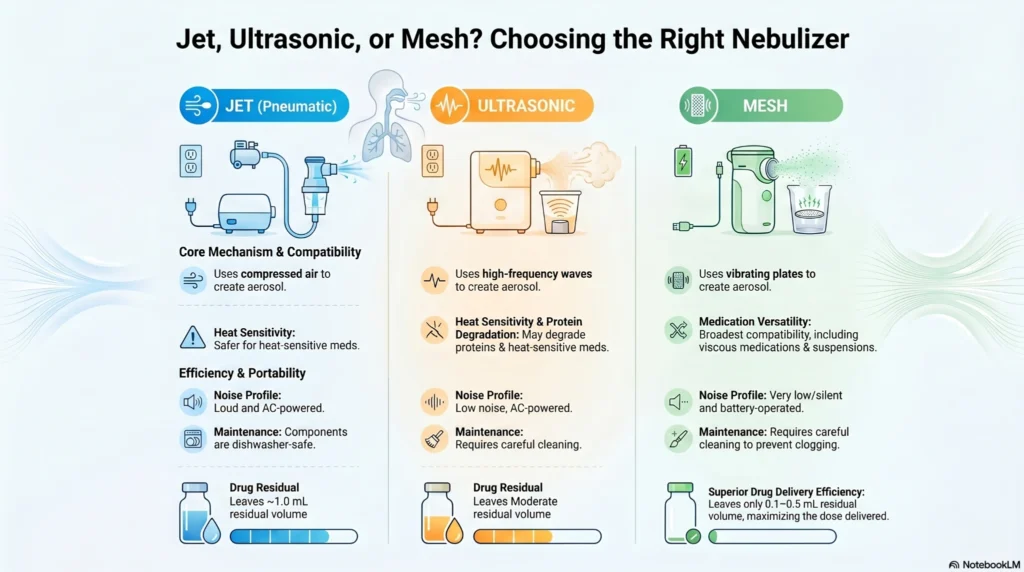
If your child fights every nebulizer treatment, or you need something quiet enough for a hotel room — the type of nebulizer you choose matters as much as the medication inside it. Here’s how the three main technologies compare on the things that matter most to real users: speed, noise, portability, and how well they handle your specific medication.
Nebulizers convert liquid medication into an aerosol for inhalation. Three principal technologies are in current clinical and home use. Technology selection affects treatment time, particle size, medication compatibility, and portability.
Technology Comparison
| Feature | Jet (Pneumatic) Nebulizer | Ultrasonic Nebulizer | Mesh Nebulizer |
| Operating Mechanism | Compressed air passes through liquid medication to create aerosol | High-frequency ultrasonic waves vibrate liquid to create aerosol | Medication is pushed through thousands of micro-holes in a vibrating mesh plate |
| Particle Size (MMAD) | 2–5 µm (device dependent) | 1–5 µm | 2–5 µm (consistent; more uniform distribution) |
| Medication Compatibility | Broad; most nebulizable solutions | Limited — may degrade heat-sensitive medications (e.g., proteins, suspensions) | Broadest; compatible with suspensions, viscous medications, proteins |
| Residual Drug Volume | Higher (~1 mL) | Moderate | Lower (~0.1–0.5 mL); more efficient drug delivery |
| Cleaning Complexity | Low; dishwasher-safe components | Moderate | Higher; mesh must be cleaned carefully to prevent clogging |
| Power Source | AC power (compressor) | AC power | AC or battery; USB charging common |
| Noise Level | High (compressor motor) | Low | Very low to silent |
Treatment Time
| Nebulizer Type | Typical Treatment Time | Factors Affecting Duration |
| Jet | 10–20 minutes | Fill volume, flow rate, medication viscosity |
| Ultrasonic | 5–10 minutes | Fill volume, frequency setting |
| Mesh | 4–8 minutes | Fill volume; most efficient delivery |
Clinical Relevance of Treatment Time:
- Mesh nebulizers typically finish a treatment in under 8 minutes — so your child’s session is done before frustration has a chance to set in, and adults with severe breathlessness spend less time struggling with the device. [7]
- Evidence suggests mesh nebulizers deliver a higher proportion of respirable particles per unit time compared to jet nebulizers in bench studies [7]
- Clinical equivalence in patient outcomes across nebulizer types depends on medication, patient technique, and device settings — consult a respiratory therapist for individualized guidance
Portability and Noise
| Feature | Jet Nebulizer | Ultrasonic Nebulizer | Mesh Nebulizer |
| Weight (Typical) | 500g–1.5 kg (with compressor) | 200–500g | 50–200g |
| Portable / Battery-Operated | No (compressor requires AC) | Limited | Yes — most models |
| Travel Suitability | Poor | Moderate | Excellent |
| Noise Level | 45–60 dB (compressor) | 30–40 dB | <40 dB; many near-silent |
| TSA / Airline Compliance | Carries separately; bulky | Generally allowed | Pocket-sized; airline-friendly |
| Approximate Cost Range (US) | $20–$100 | $30–$100 | $50–$300+ |
⭐ Bottom Line — Nebulizer Type
Best for most home users: A mesh nebulizer — it’s quiet, portable, fast, and works with the widest range of medications including suspensions.
Best for tight budgets: A jet (pneumatic) nebulizer — they’re the least expensive option (~$20–$100) and are clinically equivalent for most standard nebulizable medications.
Best for children and travel: Mesh nebulizer — pocket-sized, near-silent, and airline-friendly.
🏆 Editor’s Pick for pediatric home use: Portable mesh nebulizer — confirm medication compatibility with your prescribing physician before purchase.
Home vs Portable Oxygen Concentrators: Which Is Best for COPD, Daily Use, and Travel?

If you’re on supplemental oxygen and wondering whether you can still take that trip — or whether a portable unit will actually deliver enough oxygen for a full night’s sleep — this comparison answers those questions directly. Home concentrators are designed for bedside all-night use; portable models give you freedom but come with trade-offs in flow rate and battery life.
Oxygen concentrators extract and concentrate oxygen from ambient air using a molecular sieve (Pressure Swing Adsorption — PSA) process, eliminating the need for compressed oxygen tanks. Two primary form factors exist: stationary home concentrators (HOC) and portable oxygen concentrators (POC).
⚠️ Prescription Requirement: Supplemental oxygen therapy requires a physician prescription in the United States. Oxygen flow rate and delivery method (continuous flow vs pulse dose) must be specified by the prescribing clinician based on documented hypoxemia.
Output Capacity
| Parameter | Home Oxygen Concentrators (HOC) | Portable Oxygen Concentrators (POC) |
| Oxygen Output (LPM — Continuous Flow) | 1–10 LPM (continuous) | Most: 1–3 LPM continuous (some up to 6 LPM) |
| Pulse Dose Output | Not common; HOC primarily continuous flow | Yes — pulse dose standard; continuous flow on select models |
| Oxygen Purity | 87–96% at rated flow | 85–95.6% at rated settings (may drop at high flow) |
| Maximum Prescribed Use | Up to 24 hours/day continuous | Variable; battery limits duration |
| High-Flow Compatibility (>5 LPM) | Yes — high-flow models available (up to 10 LPM) | Limited — most POCs not suitable for high-flow prescriptions |
| Pediatric Use | Suitable with appropriate flow settings | Generally suitable for low-flow pediatric prescriptions |
⚠️ Clinical Note: Pulse dose delivery is not equivalent to continuous flow delivery for all patients. Patients requiring oxygen during sleep, or those with higher ventilatory demands, may not achieve adequate oxygenation with pulse dose alone. This distinction must be addressed by the prescribing clinician.
Power and Portability
| Feature | Home Oxygen Concentrators | Portable Oxygen Concentrators |
| Power Source | AC power (wall outlet); most include backup battery option | Internal lithium-ion battery + AC/DC adapters |
| Battery Duration | N/A (AC dependent); some backup batteries available | 2–8 hours per charge; external battery packs extend use |
| Weight | 8–20 kg (not designed for mobility) | 1–5 kg |
| Travel Suitability | Home/bedside use only | FAA-approved models suitable for air travel |
| Noise Level | 40–55 dB | 40–48 dB |
| Altitude Performance | Stable at typical home altitudes | Purity may decrease above 2,000 m (device dependent) |
| FAA Approval | Not applicable | Required for in-flight use; verify specific model before travel |
Cost Differences
| Cost Category | Home Concentrators | Portable Concentrators | Notes |
| Purchase Price (US) | ~$500–$2,500 | ~$1,500–$4,500+ | High-flow HOC models at higher end |
| Rental Cost (Monthly) | ~$150–$400/month | ~$200–$500/month | Commonly covered by Medicare Part B / private insurance |
| Medicare Coverage | Yes — DME benefit (per CMS oxygen coverage criteria) | Yes — if medically indicated and criteria met | Prior authorization often required |
| Maintenance Cost (Annual) | Filter replacement: ~$50–$100 | Varies; fewer consumable parts | |
| Energy Cost (HOC) | ~$30–$60/month at continuous use | Lower (battery-based) |
💡 Can’t afford the full purchase price?
Most home and portable oxygen concentrators are covered by Medicare Part B as Durable Medical Equipment (DME), and most private insurers follow similar criteria. If you have a valid prescription documenting hypoxemia (low blood oxygen), you may pay little to nothing out of pocket. Many DME suppliers also offer monthly rental plans starting under $200/month — with the option to return the device if your oxygen needs change. Ask your supplier about rent-to-own arrangements before committing to a purchase.
⭐ Bottom Line — Oxygen Concentrators
For home-only, bedside use: A stationary home oxygen concentrator (HOC) delivers the most reliable, highest-flow oxygen — and is the most cost-effective option if you don’t need to travel.
For active users and travelers: A portable oxygen concentrator (POC) gives you independence, FAA approval for air travel, and enough battery for day trips — but confirm your prescribed flow rate is achievable on pulse dose before purchasing.
Important: If you require more than 3 LPM continuous flow, confirm that your specific POC model meets your prescription. Most portable units max out at 1–3 LPM continuous; your prescribing clinician must confirm compatibility.
🏆 Most prescribed for home use: Stationary concentrator (5 LPM) — the standard starting point for most home oxygen prescriptions.
Medical-Grade vs Consumer Devices
The distinction between medical-grade and consumer respiratory devices is clinically significant. Regulatory classification, accuracy standards, intended use, and liability differ substantially between categories.
Accuracy Standards
| Accuracy Dimension | Medical-Grade Devices | Consumer Devices |
| Regulatory Validation Requirement | Must meet ISO and FDA performance standards prior to market | Not required to meet clinical accuracy benchmarks for OTC sale |
| Clinical Study Requirement | Yes — must demonstrate accuracy across defined patient populations | Not required |
| SpO₂ Accuracy Benchmark (oximeters) | ±2% Arms at 70–100% SpO₂ (ISO 80601-2-61) | Not regulated to the same standard |
| Calibration Traceability | Required; factory calibration documented | Variable; generally not traceable |
| Alarm and Alert Performance | Validated; specified response times | Not consistently validated |
| Skin Tone Bias Disclosure | Required for FDA-cleared devices | Not required |
FDA Approval
| Regulatory Category | Medical-Grade | Consumer |
| FDA Pathway | 510(k) Premarket Notification (Class II) or PMA (Class III) | Exempt (Class I) or General Wellness Device classification |
| Intended Use Statement | Specific clinical indication required | “General wellness” or non-diagnostic |
| Post-Market Surveillance | Required | Limited requirements |
| Adverse Event Reporting (MDR) | Mandatory | Limited for Class I |
| Labeling Requirements | Strict; must include performance specifications | Less stringent |
| Examples | Nellcor, Masimo, Nonin oximeters; ResMed, Philips Respironics PAP devices | Many smartwatch SpO₂ sensors; some OTC fingertip oximeters |
When Each Is Appropriate
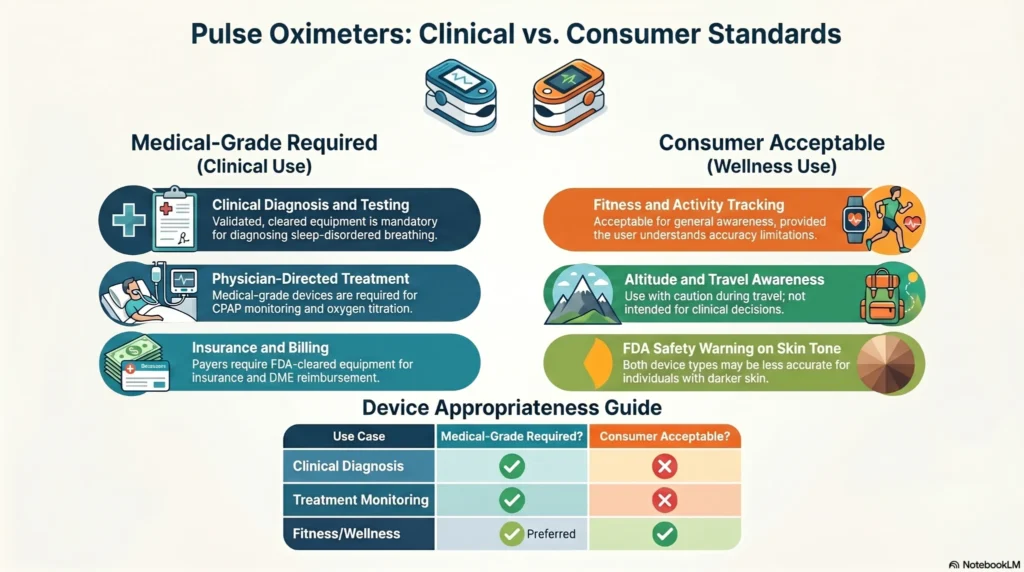
| Clinical Context | Medical-Grade Required | Consumer Acceptable | Notes |
| Diagnosis of sleep-disordered breathing | ✅ | ❌ | Diagnostic testing requires validated, cleared equipment |
| Treatment monitoring (CPAP therapy) | ✅ | ❌ | PAP devices are Class II prescription |
| Physician-directed oxygen titration | ✅ | ❌ | |
| Insurance billing / DME reimbursement | ✅ | ❌ | Payers require FDA-cleared equipment |
| At-home wellness/activity tracking | ⚠️ Preferred | ✅ Acceptable | User should understand accuracy limitations |
| General fitness SpO₂ curiosity | ✅ Preferred | ✅ Acceptable | Awareness readings only; not for clinical decisions |
| Travel altitude awareness | ✅ Preferred | ✅ With caveats | Accuracy limitations must be understood |
⚠️ Critical Note: The FDA issued a Safety Communication in 2021 noting that pulse oximeters may be less accurate in individuals with darker skin pigmentation and cautioning against reliance on these devices for clinical decisions. This applies to both medical-grade and consumer devices [1]. Consumers and clinicians should be aware of these limitations.





When to Consult a Healthcare Provider
| Situation | Recommended Action |
| Selecting a CPAP, BiPAP, or oxygen concentrator | Requires physician prescription and clinical evaluation — do not self-prescribe |
| Interpreting SpO₂ readings below 92% | Seek prompt medical evaluation |
| Experiencing difficulty with current PAP therapy | Contact prescribing physician or sleep medicine specialist |
| Changing nebulizer type or medication | Consult respiratory therapist or prescribing physician |
| Planning air travel with supplemental oxygen | Requires physician documentation and airline coordination (FAA-approved POC) |
| Purchasing a device for a child | Pediatric-specific guidance from a pediatric pulmonologist required |
This section is provided for educational purposes only. Medical oversight standards for this content are described on our About page.
How to Get Insurance to Cover Your Respiratory Device
Medicare Part B (Durable Medical Equipment):
CPAP, BiPAP, and oxygen concentrators are covered under Medicare Part B as DME when:
• You have a qualifying diagnosis confirmed by a physician
• For CPAP/BiPAP: a sleep study (in-lab PSG or qualifying home sleep test) documents AHI ≥ 5
• For oxygen: documented resting SpO₂ ≤ 88% or PaO₂ ≤ 55 mmHg
What Medicare typically covers: 80% of the approved amount after your Part B deductible. Your supplemental insurance covers the rest in most cases.
Prior Authorization:
BiPAP, auto-BiPAP, and high-flow oxygen concentrators often require prior authorization. Your physician’s office handles this — ask them to confirm it’s been submitted before your device is ordered.
HSA / FSA Funds:
All devices on this page — pulse oximeters, CPAP/BiPAP machines, nebulizers, and oxygen concentrators — are HSA/FSA-eligible expenses. If you have funds expiring at year-end, this is a qualified use.
Private Insurance:
Coverage criteria mirror Medicare in most plans. Request a Letter of Medical Necessity (LMN) from your prescribing physician — most insurers require this for initial approval.
If Your Claim Is Denied:
You have the right to appeal. Ask your DME supplier for help with the appeals process — most have dedicated insurance teams for this. → Questions about your specific plan? Contact your insurer’s DME benefits line directly.
Continue Learning About Respiratory Devices
This page provides comparative information to support educational understanding of respiratory device categories. For personalized device recommendations, prescription guidance, or clinical evaluation, consult a licensed healthcare provider.
📖 Understand every device in detail → Complete Respiratory Device Guide (how each type works, explained in plain English)
📋 Ready to choose? → Respiratory Device Buying Guide — our step-by-step selection framework by condition and budget
🏆 See what we recommend → Best CPAP Machines, Pulse Oximeters & Oxygen Concentrators for 2025 — editorially reviewed by sleep specialists
📧 Save this guide for later:
Get our free Respiratory Device Selection Checklist — straight to your inbox [Email signup form]
↗ Know someone dealing with sleep apnea or COPD?
Share this comparison →
References
World Health Organization. Pulse oximetry training manual. 2011. https://www.who.int/patientsafety/safesurgery/pulse_oximetry/en/
U.S. Food and Drug Administration. Pulse Oximeter Accuracy and Limitations: FDA Safety Communication. February 19, 2021. https://www.fda.gov/medical-devices/safety-communications/pulse-oximeter-accuracy-and-limitations-fda-safety-communication
Sjoding MW, Dickson RP, Iwashyna TJ, Gay SE, Valley TS. Racial Bias in Pulse Oximetry Measurement. New England Journal of Medicine. 2020;383(25):2477-2478. doi:10.1056/NEJMc2029240
Epstein LJ, Kristo D, Strollo PJ Jr, et al. Clinical guideline for the evaluation, management and long-term care of obstructive sleep apnea in adults. Journal of Clinical Sleep Medicine. 2009;5(3):263-276. PMID: 19960649
Cowie MR, Woehrle H, Wegscheider K, et al. Adaptive servo-ventilation for central sleep apnea in systolic heart failure. New England Journal of Medicine. 2015;373(12):1095-1105. doi:10.1056/NEJMoa1506459 [SERVE-HF Trial]
Köhnlein T, Windisch W, Köhler D, et al. Non-invasive positive pressure ventilation for the treatment of severe stable chronic obstructive pulmonary disease: a prospective, multicentre, randomised, controlled clinical trial. The Lancet Respiratory Medicine. 2014;2(9):698-705. doi:10.1016/S2213-2600(14)70153-5
Ip S, D’Ambrosio C, Patel K, et al. Auto-titrating versus fixed continuous positive airway pressure for the treatment of obstructive sleep apnea: a systematic review with meta-analyses. Systematic Reviews. 2012;1:20. doi:10.1186/2046-4053-1-20
Ari A, Fink JB. Aerosol therapy in pulmonary critical care. Respiratory Care. 2017;62(6):745-758. doi:10.4187/respcare.05203
Centers for Medicare & Medicaid Services. Medicare Benefit Policy Manual, Chapter 15 — Covered Medical and Other Health Services. (Oxygen and Oxygen Equipment, Section 110.) https://www.cms.gov/
National Institutes of Health, National Heart, Lung, and Blood Institute. CPAP for Sleep Apnea. https://www.nhlbi.nih.gov/
Last Updated: 2026-05-15. Medically Reviewed by Dr. Rishav Das : 2026-05-15
Medical and Editorial Review Reviewed according to the medical standards outlined on our About page.