
Find Respiratory Devices That Meet Your Needs
Learn how to buy oximeter, CPAP, and nebulizer equipment. Evaluate clinical features , insurance coverage , and ongoing maintenance costs in our guide.
Written by Dr. Rishav Das, M.B.B.S. — see About page for full credentials
Reviewed according to the medical standards outlined on our About page
Introduction
Whether you’ve just received a diagnosis, are helping a loved one manage a condition, or are simply trying to understand which device is right for your situation — this guide is written for you. We’ll help you compare respiratory devices clearly, understand your insurance options, and buy with confidence rather than confusion.
Already know what you need? See Our Best-Rated Respiratory Device Recommendations for 2026→
⚠️ When to Consult a Healthcare Provider
All device information on this page is reviewed by a licensed physician and updated annually to reflect current clinical guidelines and FDA guidance
This page is educational and does not constitute medical advice. Devices such as CPAP machines and oxygen concentrators require a prescription issued by a licensed clinician. If you are uncertain which device category is appropriate for your situation, consult your physician, pulmonologist, or sleep specialist before purchasing. See our About page for the medical oversight standards that govern this content.
Who This Guide Is For
Whether you’re a patient newly diagnosed with sleep apnea or COPD, a caregiver helping a parent or partner manage a respiratory condition, or a general health enthusiast researching pulse oximeters — this guide walks you through every device category in plain English. All devices covered are available in the United States.
- Find Respiratory Devices That Meet Your Needs
- Introduction
- Who This Guide Is For
- Assess Your Respiratory Monitoring Needs
- Best Pulse Oximeters for Home Use: How to Choose (2026)
- How to Buy a CPAP Machine: Features, Costs & Insurance (2026)
- Best Nebulizers for Home Use: How to Choose by Condition (2026)
- Best Home Oxygen Concentrators: Buying Guide for COPD & Medicare Patients
- Where to Buy and What to Avoid
- Maintenance and Replacement Costs
- Most Common Respiratory Device Buying Mistakes
- MISTAKE 1: "Buying a consumer pulse oximeter for clinical monitoring"
- MISTAKE 2: "Buying a CPAP without proper titration"
- MISTAKE 3: "Ordering from a seller that doesn't require a prescription"
- MISTAKE 4: "Skipping mask fitting and accepting the first option"
- MISTAKE 5: "Assuming insurance will cover the full cost automatically"
- MISTAKE 6: "Buying a mesh nebulizer without checking medication compatibility"
- MISTAKE 7: "Using a portable oxygen concentrator during sleep without physician clearance"
- References
Navigating respiratory devices can feel overwhelming — especially if you’ve just received a diagnosis or are helping a loved one. You might be unsure whether you need a prescription, worried about cost, or just trying to figure out which device actually applies to your situation. You’re not alone, and this guide cuts through the confusion. Use the decision trees below as a starting point — not a clinical verdict.
Assess Your Respiratory Monitoring Needs
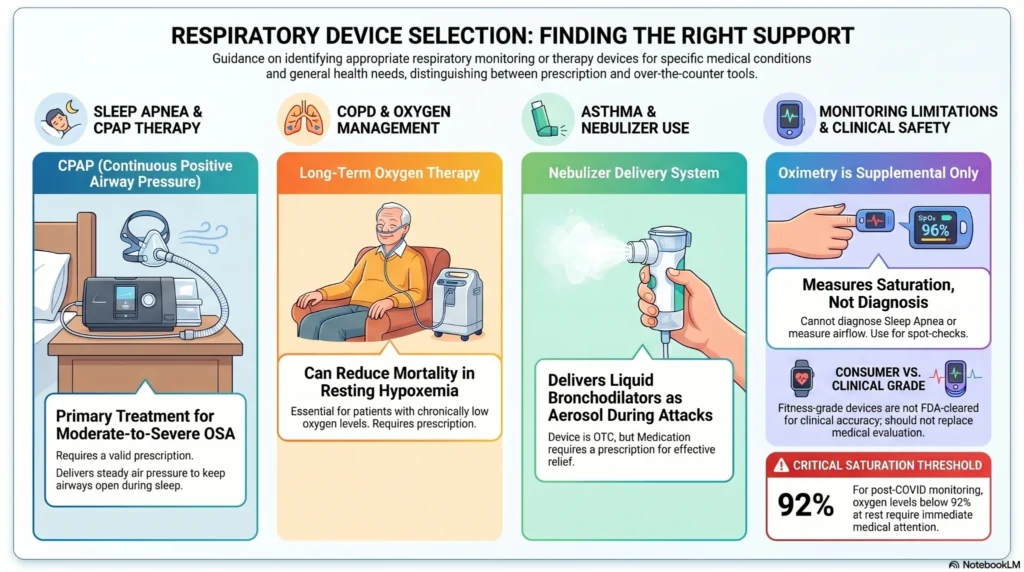
Use the decision trees below to identify which device category is most likely relevant to your situation. These are educational starting points — not clinical recommendations.
At a Glance: Which Device Do You Need?
| Device | Prescription Required | OTC Available | Avg. Cost Range | Primary Use Case | Insurance Coverage |
|---|---|---|---|---|---|
| Pulse Oximeter | No | Yes | $10–$150 | SpO₂ monitoring (COPD, asthma, post-COVID, fitness) | Generally not covered for OTC purchase |
| CPAP / BiPAP / APAP | Yes | No | $500–$1,500+ | Obstructive sleep apnea treatment | Medicare & most plans cover (with compliance) |
| Nebulizer | No (device); Yes (medication) | Yes (device) | $40–$500 | Inhaled medication delivery (asthma, COPD, CF) | Some plans cover; confirm with insurer |
| Oxygen Concentrator | Yes | No | $500–$4,000 | Supplemental oxygen therapy (COPD, pulmonary fibrosis) | Medicare Part B covers with qualifying criteria |
All cost ranges are approximate USD out-of-pocket estimates. Insurance coverage varies by plan and diagnosis. See each device section for full coverage details.
For Sleep Apnea
| Assessment Question | If Yes → Consider | If No → Consider |
| Have you received a formal sleep apnea diagnosis? | CPAP or BiPAP machine (prescription required) | Speak with a sleep specialist before purchasing |
| Has a sleep study been completed? | Proceed with CPAP prescription process | Home sleep test or in-lab polysomnography first |
| Are you experiencing daytime sleepiness, loud snoring, or witnessed apneas? | Discuss screening with your physician | General health oximetry monitoring |
| Do you already use a CPAP but need a replacement? | Review current prescription; confirm settings before replacing | Contact prescribing physician for updated titration |
Key considerations for sleep apnea device selection:
- CPAP therapy is considered a first-line treatment for moderate-to-severe obstructive sleep apnea (OSA) [American Academy of Sleep Medicine, 2023]
- A valid prescription is legally required in most jurisdictions to purchase a CPAP machine
- Auto-adjusting CPAP (APAP) may be appropriate for patients with varying pressure needs — confirm with your physician
- Pulse oximetry monitoring is sometimes used as a supplementary tool to track nocturnal oxygen desaturation, but does not diagnose OSA [U.S. Food and Drug Administration, 2022]
For COPD Management
| Device Type | Typical Use in COPD | Requires Prescription? |
| Pulse Oximeter | SpO₂ monitoring; early detection of exacerbations | No (OTC for personal monitoring) |
| Portable Oxygen Concentrator | Long-term oxygen therapy (LTOT) when SpO₂ ≤ 88% on room air | Yes |
| Home Oxygen Concentrator | Stationary supplemental oxygen at home | Yes |
| Nebulizer | Delivery of bronchodilators (e.g., albuterol, ipratropium) | Device is OTC; medication requires prescription |
Evidence note: Evidence suggests that long-term oxygen therapy (LTOT) may reduce mortality in COPD patients with resting hypoxemia [Nocturnal Oxygen Therapy Trial Group, 1980; MRC Working Party, 1981]. Initiation of LTOT is guided by physician assessment of arterial blood gas values and clinical history — not solely by pulse oximeter readings.
For Asthma Monitoring
| Clinical Scenario | Recommended Device | Clinical Rationale |
| Acute symptom monitoring during attacks | Pulse oximeter | Tracks oxygen saturation during bronchospasm episodes |
| Nebulized medication delivery (e.g., albuterol) | Mesh or jet nebulizer | Converts liquid medication to inhalable aerosol |
| Exercise-induced bronchoconstriction monitoring | Pulse oximeter | May assist in identifying SpO₂ changes during exertion |
| Severe or poorly controlled asthma | Consult physician — combined monitoring may be indicated | Not suitable for self-management without clinical guidance |
Note: Pulse oximeters measure oxygen saturation (SpO₂) but do not measure airflow obstruction, peak flow, or spirometry values. They are supplementary tools in asthma management, not primary monitoring instruments [Global Initiative for Asthma (GINA), 2023].
For General Health Tracking
| Use Case | Appropriate Device | Important Caveat |
| Post-COVID recovery monitoring | Pulse oximeter | SpO₂ < 92% at rest warrants medical attention [WHO, 2022] |
| High-altitude travel | Pulse oximeter | Monitor for altitude-related hypoxemia; seek medical care if symptomatic |
| Athletic performance tracking | Pulse oximeter (activity-grade) | Consumer fitness devices are not FDA-cleared for clinical accuracy; interpret with caution |
| General wellness (no known condition) | Consumer-grade pulse oximeter | Not intended for diagnostic purposes; not a substitute for clinical evaluation |
Best Pulse Oximeters for Home Use: How to Choose (2026)
If you’re monitoring SpO₂ at home — whether you’re managing COPD, recovering from COVID, or tracking oxygen during sleep — choosing the right pulse oximeter could help you catch a dangerous drop in oxygen levels before it becomes an emergency. Not all pulse oximeters are equally accurate, particularly across different skin tones. This section explains exactly what to look for
Quick Reference: For clinical/physician-ordered monitoring → prioritise 510(k) clearance and skin-tone validation. For home monitoring → prioritise 510(k) clearance and display readability. For travel/occasional use → prioritise battery life and compact size.”
FDA Approval and Accuracy
Understanding regulatory status is a foundational step in pulse oximeter selection. The FDA distinguishes between two categories:
| Category | FDA Status | Accuracy Standard | Appropriate Use |
| Prescription / Clinical-Grade | 510(k) cleared or De Novo authorized | ±2–3% RMSD across diverse skin tones (FDA 2024 guidance) | Clinical settings; physician-ordered monitoring |
| OTC / Consumer-Grade | May carry 510(k) clearance or be uncleared | Variable; may not be validated across all skin tones | General wellness; non-diagnostic personal use |
| Smartwatch / Wearable SpO₂ | Generally not FDA-cleared for SpO₂ accuracy | Not held to clinical accuracy standards | Trend monitoring only; not for clinical decisions |
Critical accuracy considerations:
- The FDA issued a Safety Communication (2021) and subsequent 2024 proposed rule noting that pulse oximeter accuracy may be affected by skin pigmentation, poor perfusion, nail polish, and motion artifact [FDA, 2021; 2024]
- Clinically meaningful SpO₂ readings require devices validated on subjects with varied skin tones — check the manufacturer’s clinical validation documentation
- Accuracy tolerance: devices within ±2% RMSD of arterial blood gas measurements are generally accepted for clinical use [ISO 80601-2-61:2017]
- Do not rely on consumer-grade devices for clinical decision-making without physician guidance
What to verify before purchasing:
- [ ] 510(k) clearance number (searchable on FDA database)
- [ ] Clinical validation studies available from manufacturer
- [ ] Accuracy data across diverse skin tones
- [ ] Intended use statement on labeling
Display Quality
| Display Feature | Why It Matters | Recommended Minimum |
| SpO₂ readout size | Readability for users with low vision or in low-light settings | Large, high-contrast digital display |
| Pulse rate display | Secondary monitoring of heart rate; may indicate poor perfusion | Simultaneous display with SpO₂ preferred |
| Plethysmograph (waveform) | Indicates signal quality and pulse strength | Useful for confirming reading validity |
| Screen rotation | Accommodates different finger positions and orientations | 4-way or 2-way rotation preferred |
| Brightness / backlighting | Nighttime or low-light readability | Adjustable backlight recommended |
| Alarm / alert indicators | Notifies users when SpO₂ or pulse rate falls outside set thresholds | Available on clinical-grade models; rare in consumer devices |
Battery and Durability
| Specification | Clinical / Frequent Use | Occasional / Travel Use |
| Battery type | Rechargeable (USB-C preferred) or AA alkaline | AA batteries acceptable |
| Battery life | 20+ hours continuous use | 8–12 hours sufficient |
| Auto-shutoff | Preferred (preserves battery) | Preferred |
| Housing material | Medical-grade plastic; drop-resistant | Standard ABS plastic |
| IP rating (dust/water) | IPX2 or higher preferred | Not typically required |
| Operating temperature range | 5°C–40°C (confirm for clinical environments) | Standard consumer ranges |
Price Ranges
| Tier | Approximate Price Range (USD) | Typical Characteristics | Appropriate For |
| Budget / Entry-Level | $10–$25 | Basic SpO₂ + PR display; no FDA clearance verified; limited accuracy data | Occasional wellness use only; not for clinical decisions |
| Mid-Range OTC | $25–$60 | Often 510(k)-cleared; validated accuracy; plethysmograph display | Regular home monitoring; physician-recommended use |
| Clinical / Professional-Grade | $60–$150+ | High accuracy across skin tones; data logging; connectivity; durable housing | Home health care; post-surgical monitoring; physician recommendation |
| Wrist / Wearable SpO₂ | $50–$350 | Continuous monitoring; not FDA-cleared for SpO₂ clinical accuracy | Trend tracking; fitness; not clinical use |
⚠️ Price is not a reliable indicator of accuracy. Always verify 510(k) clearance status independently of price tier.
Insurance Coverage for Pulse Oximeters
Pulse oximeters purchased over the counter are generally not covered by health insurance or Medicare for routine personal monitoring. However, if your physician orders a pulse oximeter as part of a documented home monitoring program (for example, after a hospitalization for COPD or heart failure), some plans may cover it as durable medical equipment (DME). Check with your insurer and request an order from your physician if coverage is a concern. For clinical-grade devices prescribed for physician-ordered monitoring, Medicare may cover with a qualifying diagnosis and documentation
Our Top Pick: Best Pulse Oximeter for Home Monitoring
Look for an FDA 510(k)-cleared fingertip pulse oximeter validated across diverse skin tones, with a clear digital display, plethysmograph waveform, and a minimum of 510(k) clearance documentation you can verify on the FDA database. Under $60 for most home monitoring needs. → See our full pulse oximeter recommendations
How to Buy a CPAP Machine: Features, Costs & Insurance (2026)
Effective CPAP therapy has been shown to reduce daytime sleepiness, lower blood pressure, and significantly improve quality of life for patients with obstructive sleep apnea — but only when the right device is properly fitted and used consistently. The sections below walk you through every part of that process: getting your prescription, choosing the right machine and mask, understanding insurance coverage, and maintaining your equipment.
⚠️ Prescription Required. CPAP, BiPAP, and APAP machines are FDA Class II medical devices. A valid prescription from a licensed clinician is required to legally purchase these devices in the United States [FDA Device Classification, 21 CFR 868.5965].
Getting a Prescription and Sleep Study
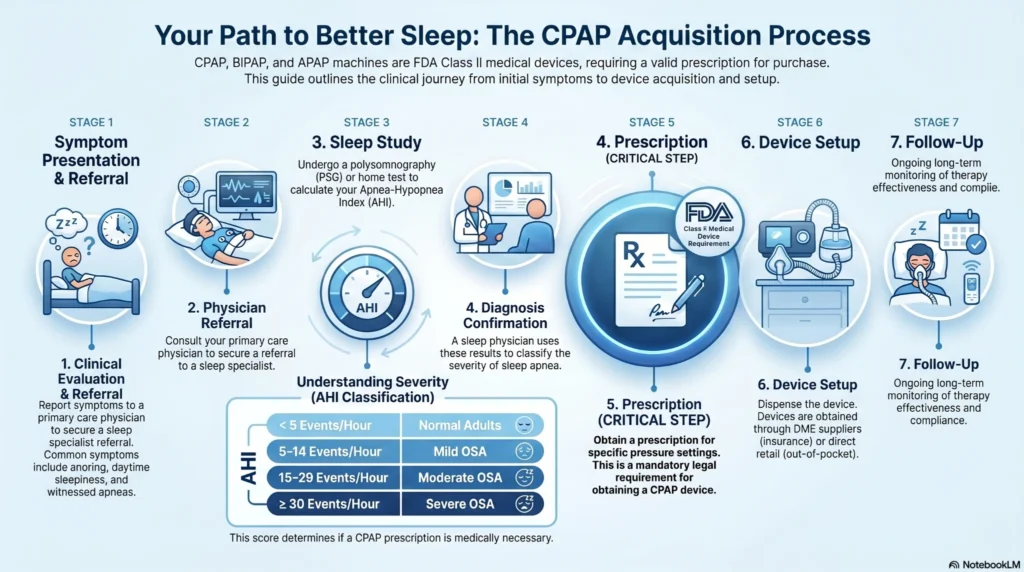
Step-by-step overview of the CPAP prescription process:
| Step | Description | Who Is Involved |
| 1. Symptom evaluation | Report symptoms (snoring, daytime sleepiness, witnessed apneas) | Primary care physician |
| 2. Referral | Referral to sleep specialist or order for sleep study | PCP or pulmonologist |
| 3. Sleep study | In-lab polysomnography (PSG) or home sleep apnea test (HSAT) | Sleep specialist; accredited sleep lab |
| 4. Diagnosis | Apnea-Hypopnea Index (AHI) calculated; severity classified | Sleep physician |
| 5. Prescription issued | Pressure setting(s) prescribed based on titration study or APAP algorithm | Prescribing physician |
| 6. Device dispensed | Obtained through DME supplier (insurance-covered) or direct retail (out-of-pocket) | DME provider or retailer |
| 7. Follow-up | Compliance and efficacy monitoring (often via device data) | Sleep specialist or PCP |
AHI Classification (for reference):
| AHI (Events/Hour) | Severity Classification |
| < 5 | Normal (adults) |
| 5–14 | Mild OSA |
| 15–29 | Moderate OSA |
| ≥ 30 | Severe OSA |
Source: American Academy of Sleep Medicine (AASM) Scoring Manual, 2023
Buying on Behalf of a Parent or Partner?
If you’re helping a loved one navigate their CPAP prescription, bring the following to their DME appointment: a copy of the sleep study results, the written prescription with prescribed pressure settings, and your insurance card. Ask the DME supplier specifically about the mask exchange program — most offer at least one swap if the first mask doesn’t fit comfortably.
Machine Features to Consider
| Feature | Description | Clinical Relevance |
| CPAP (Fixed Pressure) | Delivers one constant pressure throughout the night | Suitable when prescribed pressure is stable and well-tolerated |
| APAP (Auto-Adjusting) | Automatically adjusts pressure within a set range | May improve comfort; suitable for patients with positional or REM-related variation |
| BiPAP (Bilevel) | Separate pressures for inhalation (IPAP) and exhalation (EPAP) | Often used for complex sleep apnea, COPD, or patients intolerant of standard CPAP |
| Travel mode / voltage | Universal voltage (100–240V); compact design | Important for international travel |
| Ramp feature | Gradually increases to prescribed pressure at sleep onset | May improve early-treatment comfort |
| Expiratory pressure relief (EPR/C-Flex) | Reduces pressure slightly during exhalation | Associated with improved comfort in some patients [Pépin et al., 2009] |
| Quiet operation | Sound levels typically 25–30 dB | Relevant for light sleepers and bed partners |
| Altitude adjustment | Automatic or manual compensation for altitude changes | Required for use above ~8,000 ft |
Mask Types and Fitting
Mask selection significantly affects CPAP therapy adherence. The right mask depends on breathing pattern, facial anatomy, and personal preference.
| Mask Type | Description | Best For | Potential Drawbacks |
| Nasal Pillow | Small cushions that seal at nostrils | Side sleepers; users with facial hair; low-pressure prescriptions | May not seal well at high pressures; not suitable for mouth breathers |
| Nasal Mask | Covers nose from bridge to upper lip | Active sleepers; users who prefer minimal facial coverage | Mouth leakage if mouth breathing occurs |
| Full Face Mask | Covers both nose and mouth | Mouth breathers; higher-pressure prescriptions; nasal congestion | Bulkier; greater potential for leaks; may feel claustrophobic |
| Hybrid / Oral Mask | Oral cushion with nasal pillows | Mouth breathers intolerant of full face mask | Less common; fitting requires specialist guidance |
Fitting checklist:
- [ ] Mask fits without gaps at seal points
- [ ] No pressure marks or skin irritation after a 15-minute trial
- [ ] Headgear adjusted to recommended tension (snug, not tight)
- [ ] Compatible with prescribed machine interface (check connector size)
- [ ] Size confirmed via manufacturer sizing guide or DME fitting session
Watch: How a CPAP titration study works and what to expect at your DME appointment.
[Embed a short YouTube explainer video here — e.g., search ‘CPAP setup explained for beginners’ and embed a reputable, unbranded explainer. Alternatively, link with anchor text: “Watch: How to choose and set up your first CPAP machine (YouTube, ~5 min) →”]
Humidification Options
| Humidification Type | Description | Recommended When |
| No humidifier | No moisture added to airflow | Mild therapy; humid climates; some patient preferences |
| Passover humidifier | Water chamber warms and moistens air passively | General use; reduces nasal dryness and irritation |
| Heated humidifier (integrated) | Actively heats water to increase humidity output | Dry climates; patients with nasal symptoms; cold environments |
| Heated tube (climate control) | Warms the air delivery tube to prevent condensation (“rainout”) | Cold bedroom environments; higher humidity settings |
Note: Evidence suggests that heated humidification may improve CPAP adherence in patients experiencing upper airway dryness [Mador et al., 2005]. Humidifier use is typically individualized based on patient comfort.
Data Tracking and Connectivity
Modern CPAP machines collect therapy data that may be used by clinicians to assess compliance and efficacy.
| Data Feature | Description | Clinical Use |
| AHI reporting | Device-estimated apnea-hypopnea events per hour | Compliance monitoring; therapy adjustment |
| Leak rate | Measurement of unintentional mask leakage | Mask fit assessment |
| Usage hours | Nightly and average therapy duration | Insurance compliance documentation |
| SD card / USB export | Local data download for manual review | Shared with physician or DME supplier |
| Wireless / Cellular connectivity | Automatic data upload to cloud platform | Remote monitoring by care team |
| Patient app access | User-facing summaries of nightly data | Self-monitoring; behavior reinforcement |
Insurance documentation note: Many payers require documented CPAP compliance — typically ≥4 hours/night on ≥70% of nights in a consecutive 30-day period — to authorize continued equipment coverage [CMS Coverage Policy, 2023]. Confirm requirements with your insurer.
Insurance Coverage
One of the biggest frustrations CPAP patients face is being surprised by out-of-pocket costs after assuming insurance would cover everything. Here’s how coverage actually works — and how to make sure you qualify. With the right documentation, Medicare Part B may cover up to 80% of your CPAP cost after the deductible. Private insurance plans vary, but most cover CPAP as durable medical equipment (DME) when you meet qualifying criteria
| Step | Description | Key Consideration |
| Verify coverage | Contact insurer to confirm CPAP is covered under DME benefit | Required documentation: prescription + sleep study results |
| Prior authorization | Many plans require pre-approval before equipment is dispensed | Timeline: typically 5–15 business days |
| In-network DME supplier | Use an in-network supplier to maximize coverage | Out-of-network suppliers may result in higher out-of-pocket costs |
| Rent-to-own model | Many insurers cover CPAP as a rental for 10–13 months before ownership | Ownership typically transfers after compliance period is met |
| Resupply coverage | Most plans cover replacement supplies (masks, filters, tubing) on a schedule | Keep records of supply orders; over-ordering may violate coverage terms |
| Medicare (Part B) | Covers CPAP rental and supplies with 20% coinsurance after deductible | Requires in-person evaluation + sleep study; strict compliance documentation |
Common insurance documentation requirements:
- [ ] Written prescription specifying device type and pressure settings
- [ ] Qualifying sleep study results (AHI ≥ 5 typically; varies by payer)
- [ ] Letter of medical necessity (LMN) from prescribing physician
- [ ] Compliance data reports (after initial rental period)
Our Top Pick: How to Approach Your First CPAP Purchase
For most newly diagnosed patients, your physician and DME supplier will guide the machine selection — the prescription determines your pressure settings, and the DME will fit your mask.
Your job is to come prepared: know your AHI severity, ask about APAP if you want pressure flexibility, and always request a mask fitting session before accepting the first option. → See our reviewed CPAP machine recommendations for 2026
Best Nebulizers for Home Use: How to Choose by Condition (2026)
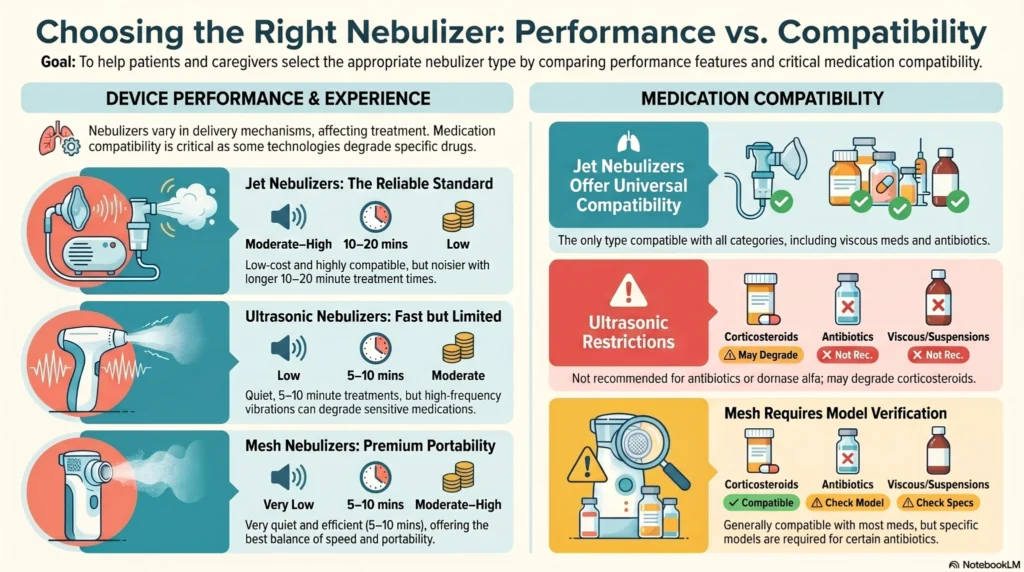
Whether you’re looking for the best nebulizer for COPD, asthma, or cystic fibrosis management — or need a portable nebulizer for travel — the type you choose directly affects treatment time, medication compatibility, and long-term adherence.
Nebulizer type overview:
| Type | Mechanism | Typical Treatment Time | Relative Noise | Relative Cost |
| Jet (Compressor) | Compressed air atomizes liquid medication | 10–20 minutes | Moderate–High | Low |
| Ultrasonic | High-frequency vibration creates aerosol | 5–10 minutes | Low | Moderate |
| Mesh | Liquid passes through a vibrating mesh membrane | 5–10 minutes | Very Low | Moderate–High |
Medication Compatibility
Not all nebulizers are compatible with all inhaled medications. Confirm compatibility before purchase.
| Medication Category | Jet Nebulizer | Ultrasonic Nebulizer | Mesh Nebulizer |
| Saline solutions | ✓ Compatible | ✓ Compatible | ✓ Compatible |
| Short-acting bronchodilators (e.g., albuterol) | ✓ Compatible | ✓ Compatible | ✓ Compatible |
| Long-acting bronchodilators | ✓ Compatible | Check manufacturer | ✓ Compatible (verify) |
| Corticosteroids (e.g., budesonide) | ✓ Compatible | ⚠ May degrade medication | ✓ Compatible |
| Antibiotics (e.g., tobramycin, colistin) | ✓ Compatible | ⚠ Not recommended | ✓ Compatible (some models) |
| Dornase alfa | ✓ Compatible | ✗ Not recommended | ✓ Compatible (specific models) |
| Viscous / suspension medications | ✓ Compatible | ✗ Not recommended | ⚠ Check manufacturer specs |
⚠️ Always confirm medication compatibility with the nebulizer manufacturer and your prescribing clinician before use. Some medications can damage mesh membranes or lose efficacy when exposed to ultrasonic vibration.
Key questions to ask your pharmacist or physician:
- [ ] Is this specific medication approved for use with my nebulizer model?
- [ ] Does the medication require a specific particle size (MMAD) for optimal lung deposition?
- [ ] Should the nebulizer cup be kept at room temperature or refrigerated?
Portability Needs
| Use Scenario | Recommended Type | Key Features to Prioritize |
| Home-only use | Tabletop jet (compressor) nebulizer | Durability; large medication cup; low cost |
| Travel (occasional) | Compact mesh nebulizer | Battery operation; USB charging; TSA-compliant size |
| Daily on-the-go use (e.g., cystic fibrosis) | Portable mesh nebulizer | Long battery life; silent operation; rapid treatment |
| Pediatric use (home) | Standard jet or quiet mesh | Child-friendly design; distraction-compatible operation |
| Emergency / acute exacerbation | Tabletop jet with AC power | Fast nebulization; compatible with rescue medications |
Portability feature checklist:
- [ ] Battery-operated or USB-rechargeable option
- [ ] Weight and dimensions suitable for travel bag or carry-on
- [ ] Treatment time compatible with mobile use
- [ ] Carrying case or protective pouch included
- [ ] FAA / airline approval for in-flight use (for air travel needs)
Treatment Time Requirements
Treatment time is a meaningful factor in long-term adherence, particularly for patients requiring multiple daily treatments.
| Clinical Context | Typical Treatment Frequency | Preferred Nebulizer Speed | Rationale |
| Acute bronchospasm | As needed (intermittent) | Any type | Speed less critical for occasional use |
| Mild persistent asthma | 1–2× daily (controller medication) | Mesh or ultrasonic preferred | Faster treatment supports adherence |
| Moderate–severe COPD | 2–4× daily | Mesh nebulizer preferred | Minimizes time burden across multiple daily treatments |
| Cystic fibrosis (complex regimen) | 2–4 treatments/day; multiple medications | High-performance portable mesh | Treatment time directly affects quality of life |
| Pediatric (young children) | 2–3× daily typical | Fastest available with medication compatibility | Minimizes patient distress and cooperation challenges |
Insurance Coverage for Nebulizers
Nebulizer devices are generally covered by Medicare Part B and most private insurance plans as durable medical equipment (DME) when prescribed by a physician for a qualifying condition such as asthma, COPD, or cystic fibrosis.
The device itself is typically covered; inhaled medications require a separate prescription and pharmacy benefit. To qualify: obtain a written prescription specifying the device type and diagnosis, use an in-network DME supplier, and confirm your plan’s DME coverage tier.
Replacement parts (medication cups, mouthpieces, tubing, filters) are also covered on a schedule by most plans — ask your DME supplier for the resupply timeline
Our Top Pick: Best Nebulizer by Use Case”
For home-only use: a tabletop jet (compressor) nebulizer is the most cost-effective choice — durable, compatible with most medications, and typically covered by insurance. For travel or daily on-the-go use: a portable mesh nebulizer offers quiet, fast treatment with USB charging.
Always confirm medication compatibility with your physician before purchasing a mesh model. → See our reviewed nebulizer recommendations
Best Home Oxygen Concentrators: Buying Guide for COPD & Medicare Patients
⚠️ Prescription Required. Oxygen concentrators are FDA Class II medical devices and require a physician prescription in the United States. Purchase, rental, and insurance reimbursement all require documented medical necessity [FDA, 21 CFR 868.5860].
Prescription Requirements
| Requirement | Details |
| Qualifying SpO₂ criteria (typical) | SpO₂ ≤ 88% on room air at rest, or ≤ 89% during exertion or sleep (Medicare criteria) |
| Documentation required | Arterial blood gas (ABG) or pulse oximetry results; certificate of medical necessity (CMN) |
| Prescribing clinician | Must be a licensed physician (MD or DO); some states allow NP/PA with supervision |
| Qualifying diagnoses | COPD, pulmonary fibrosis, heart failure with hypoxemia, severe asthma (with documented hypoxemia), others |
| Medicare (Part B) | Covers home oxygen therapy as DME; monthly rental model; specific qualification criteria apply [CMS Local Coverage Determination L33797] |
| Requalification | Some payers require periodic retesting to confirm ongoing medical necessity |
Steps to obtain a prescription:
- Physician documents qualifying SpO₂ levels (resting, exertional, and/or nocturnal)
- Physician completes Certificate of Medical Necessity (CMS-484 for Medicare)
- DME supplier is selected (in-network preferred for insurance coverage)
- Equipment delivered, fitted, and patient educated on use and safety
- Follow-up monitoring scheduled
Managing Oxygen Therapy for a Loved One?
If you’re coordinating home oxygen therapy on behalf of a family member, here’s what to bring to the DME appointment: the physician’s Certificate of Medical Necessity (CMS-484 for Medicare), a copy of the qualifying SpO₂ test results, and your insurance information.
Ask the DME supplier specifically about backup oxygen planning and what to do in a power outage — this is required for safe home oxygen management.
Flow Rate Needs
Flow rate (liters per minute, LPM) must match the prescribed oxygen requirement. Prescriptions specify flow rate based on clinical assessment.
| Flow Rate | Typical Clinical Context | Device Category |
| 1–2 LPM | Mild resting hypoxemia; ambulatory oxygen | Portable concentrator or home unit |
| 2–3 LPM | Moderate COPD with exertional desaturation | Home concentrator; portable for activity |
| 3–5 LPM | Significant resting or exertional hypoxemia | Home concentrator (most cover up to 5 LPM continuously) |
| 6–10 LPM | Severe hypoxemia; post-operative needs | High-flow home concentrator or dual-unit setup |
| > 10 LPM | ICU-level need; acute respiratory failure | Hospital-grade equipment only; not a home device |
Continuous vs. pulse dose:
| Delivery Mode | Description | Appropriate For |
| Continuous flow | Constant oxygen delivery regardless of breathing pattern | Sleep; mouth breathing; higher flow needs |
| Pulse dose / demand | Delivers oxygen only on inhalation (triggered by breath) | Active, ambulatory patients; battery conservation |
⚠️ Pulse-dose concentrators are generally not appropriate for sleep use without physician clearance, as breathing rate and pattern during sleep may not reliably trigger adequate oxygen delivery [American Association for Respiratory Care, 2022].
Portability Considerations
| Category | Home (Stationary) Concentrator | Portable Oxygen Concentrator (POC) |
| Weight | 15–55 lbs (varies by model) | 3–10 lbs |
| Power source | AC power (wall outlet) | AC, DC (car adapter), battery |
| Maximum flow rate | Up to 10 LPM continuously | 1–3 LPM continuous; higher in pulse dose mode |
| Intended use | In-home stationary therapy | Travel; ambulatory use; short trips |
| FAA approval | Not applicable | Must be FAA-approved for in-flight use (check model list) |
| Noise level | 40–50 dB | 40–45 dB (varies by model) |
| Typical cost | $500–$3,000 (purchase) | $1,500–$4,000 (purchase) |
Portability checklist:
- [ ] Prescription specifies continuous or pulse-dose delivery
- [ ] Prescribed flow rate is achievable by portable unit
- [ ] Battery duration sufficient for intended activity duration
- [ ] FAA approval confirmed if air travel is anticipated (verify against current FAA list)
- [ ] Weight and carrying method compatible with patient’s mobility
Power and Battery
| Power Consideration | Home Concentrator | Portable Concentrator |
| Primary power source | 110/120V AC (standard outlet) | Internal rechargeable battery + AC/DC adapter |
| Power consumption | 150–600W (varies by flow rate) | 60–200W |
| Battery duration (typical) | N/A — AC-only operation | 2–8 hours per charge (flow rate dependent) |
| Battery replacement | N/A | Replacement batteries available; cost $100–$500 |
| Extended power outage risk | High — no backup function | Lower — battery provides temporary use |
| Backup planning | Discuss backup oxygen supply with DME provider | Carry spare battery or AC adapter when traveling |
| Altitude sensitivity | Some units compensate automatically | Confirm altitude performance with manufacturer |
Power outage safety note: Patients dependent on home oxygen concentrators should register with their local utility company as a medical priority customer and establish a backup plan with their DME provider. Consult your care team regarding emergency oxygen planning.
Next Steps: Buying or Renting an Oxygen Concentrator
Oxygen concentrators require a prescription and are almost always obtained through a DME supplier — not purchased directly online. Your DME supplier will handle Medicare or insurance billing, deliver and set up the equipment, and schedule follow-up maintenance.
Your most important action: confirm your DME supplier is ACHC- or Joint Commission-accredited and is in-network with your insurance plan. → See our guidance on choosing a DME supplier
Where to Buy and What to Avoid
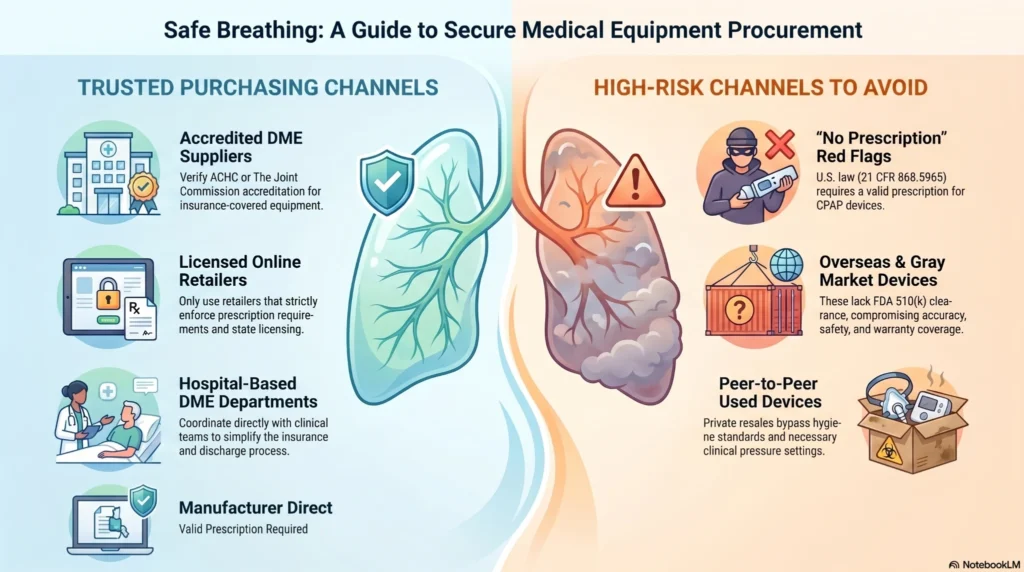
The Cost of Getting It Wrong
Buying from an unlicensed seller, purchasing a CPAP without proper titration, or using an unvalidated pulse oximeter can have serious consequences: incorrect pressure settings can worsen sleep apnea rather than treat it; inaccurate pulse oximeters can mask dangerous oxygen drops; and purchasing from a seller that doesn’t verify your prescription means your insurance will not reimburse the cost. The sections below identify which purchasing channels are safe — and which to avoid.
Recommended purchasing channels:
| Channel | Best For | Verification Steps |
| DME (Durable Medical Equipment) supplier | CPAP, oxygen concentrators, nebulizers — insurance-covered | Confirm ACHC or The Joint Commission accreditation; verify in-network status |
| Licensed online retailers | CPAP machines and accessories | Confirm prescription requirement enforced; check state licensing |
| Hospital or clinic-based DME departments | Post-discharge equipment needs | Coordinated with clinical team; often simplifies insurance process |
| Pharmacy (retail) | Nebulizers, pulse oximeters, replacement supplies | Verify product-specific FDA clearance status |
| Manufacturer direct | Some CPAP and oxygen equipment | Confirm valid prescription is required; verify return policy |
Channels and practices to approach with caution:
| Risk Factor | Description | Why It Matters |
| Unlicensed online sellers | No prescription verification; may sell counterfeit or unapproved devices | FDA safety risk; insurance will not reimburse |
| Overseas / gray market devices | Not subject to U.S. FDA oversight; may lack 510(k) clearance | Accuracy, safety, and warranty not guaranteed |
| Used / refurbished CPAP machines (peer-to-peer) | Private resale bypasses prescription requirement | May be set to previous user’s pressure; hygiene concerns; no warranty |
| “No prescription required” CPAP claims | U.S. law requires a valid prescription [21 CFR 868.5965] | May indicate non-compliant seller; insurance invalid |
| Unverified pulse oximeters (non-FDA-cleared) | Accuracy claims unvalidated | May provide false readings; dangerous for clinical monitoring |
Patient communities like the r/CPAP forum and the COPD Foundation patient network are valuable resources for real-world device feedback — particularly on mask fit and long-term CPAP adherence. Our recommendations are consistent with the most frequently cited community insights: mask fit matters more than machine brand, and compliance data tracking is essential for insurance coverage continuity.
What to verify before any purchase:
- [ ] FDA 510(k) clearance or De Novo authorization (search FDA 510(k) database)
- [ ] Seller requires valid prescription where legally required
- [ ] Manufacturer’s warranty applicable to U.S. purchasers
- [ ] Return/exchange policy for items that do not fit or function as expected
- [ ] Compatibility with current prescription settings (CPAP, oxygen)
Maintenance and Replacement Costs
Ongoing maintenance costs are an important and often underestimated component of total device ownership. The tables below reflect general industry and manufacturer guidelines; individual product requirements may vary.
Pulse Oximeter — Maintenance Summary:
| Item | Replacement Frequency | Approximate Cost |
| Probe / sensor cover | Per manufacturer recommendation | $5–$20 (if replaceable) |
| Batteries (if non-rechargeable) | As needed | $2–$10/set |
| Device replacement | 2–5 years typical lifespan | $25–$150 (repeat purchase) |
| Calibration | Not typically user-serviceable; replace device if accuracy is suspected | — |
CPAP Machine — Maintenance Schedule:
| Component | Recommended Replacement Interval | Approximate OOP Cost* |
| Disposable filter | Weekly to monthly (varies by model) | $2–$5 each |
| Non-disposable filter | Every 6 months | $5–$15 each |
| Mask cushion / nasal pillow | Every 1–3 months | $15–$40 each |
| Mask frame | Every 6 months | $20–$60 |
| Headgear | Every 6 months | $15–$30 |
| Tubing (standard) | Every 3 months | $10–$20 |
| Heated tubing | Every 3 months | $20–$40 |
| Humidifier water chamber | Every 6 months | $15–$40 |
| Machine replacement | Every 3–5 years | $500–$1,500+ |
OOP = out-of-pocket costs if not covered by insurance. Most insurers cover CPAP resupply on a schedule. Confirm with your plan.
Download the Free First-Time CPAP Buyer Checklist (PDF)
Get a one-page printable checklist covering your sleep study prep, prescription documentation, DME appointment, mask fitting, insurance paperwork, and first-week setup. Sent directly to your inbox
Nebulizer — Maintenance Schedule:
| Component | Recommended Replacement Interval | Approximate Cost |
| Medication cup / reservoir | Every 6 months | $10–$25 |
| Mouthpiece or mask | Every 6 months | $5–$15 |
| Tubing | Every 6 months | $5–$15 |
| Filter (jet compressors) | Every 6 months | $3–$10 |
| Mesh membrane (mesh nebulizers) | Every 6–12 months | $20–$60 |
| Compressor / device replacement | Every 3–5 years | $40–$200 (jet); $150–$500 (mesh) |
Cleaning frequency: Nebulizer components in contact with medication should be cleaned after each use per manufacturer instructions and standard infection control guidelines [CDC, 2023]. Failure to clean components may result in medication contamination and increased infection risk.
Oxygen Concentrator — Maintenance Overview:
| Maintenance Item | Frequency | Notes |
| External filter cleaning | Weekly | Rinse or wipe; allow to fully dry |
| Bacterial filter replacement | Per manufacturer (typically every 1–2 years) | Some models user-replaceable |
| Nasal cannula replacement | Every 2–4 weeks | Can be covered by DME supplier/insurance |
| Tubing replacement | Every 3–6 months | Check for kinks, cracks, or yellowing |
| Annual service / check-up | Yearly | Some DME providers include as part of rental |
| Battery replacement (POC) | Every 1–3 years (varies by use) | $100–$500 per battery pack |
| Sieve bed replacement | Every 3–5 years | Typically performed by DME technician; cost varies |
| Device replacement | Per DME provider schedule | Under insurance rental: equipment replaced per policy |
Most Common Respiratory Device Buying Mistakes
MISTAKE 1: “Buying a consumer pulse oximeter for clinical monitoring”
Consumer devices (including many smartwatch sensors) are not FDA-cleared for clinical accuracy and may give false readings across certain skin tones. If your physician has ordered SpO₂ monitoring, ask specifically for a 510(k)-cleared device.
MISTAKE 2: “Buying a CPAP without proper titration”
A CPAP machine set to the wrong pressure can be ineffective or even harmful. Never purchase a CPAP without a valid prescription that specifies your pressure settings — and never use a used machine set to a previous owner’s pressure.
MISTAKE 3: “Ordering from a seller that doesn’t require a prescription”
Any online retailer selling CPAP machines without verifying your prescription is operating outside U.S. law [21 CFR 868.5965]. These devices will not be covered by insurance and may not be the device your physician prescribed.
MISTAKE 4: “Skipping mask fitting and accepting the first option”
Mask fit is the #1 factor in CPAP adherence. A poorly fitted mask causes leaks, skin irritation, and often leads to abandoning therapy entirely. Always request a fitting session, and ask about the exchange policy before committing.
MISTAKE 5: “Assuming insurance will cover the full cost automatically”
Coverage requires documentation (prescription, sleep study results, Letter of Medical Necessity), in-network supplier selection, and ongoing compliance reporting for CPAP. Skipping any step can result in denied claims and unexpected bills.
MISTAKE 6: “Buying a mesh nebulizer without checking medication compatibility”
Ultrasonic vibration in mesh nebulizers can degrade certain medications (particularly corticosteroids and some antibiotics). Always confirm compatibility with your prescribing physician and the device manufacturer before purchasing
MISTAKE 7: “Using a portable oxygen concentrator during sleep without physician clearance”
Pulse-dose concentrators may not deliver adequate oxygen during sleep, when breathing rate and pattern change. Confirm with your physician whether continuous-flow delivery is required for overnight use.
References
- American Academy of Sleep Medicine (AASM). International Classification of Sleep Disorders, 3rd Edition (ICSD-3), Text Revision. 2023.
- U.S. Food and Drug Administration. Pulse Oximeters — Safety Communication. 2021. https://www.fda.gov/medical-devices/safety-communications/pulse-oximeter-accuracy-and-limitations-fda-safety-communication
- U.S. Food and Drug Administration. Proposed Rule: Performance Standards for Pulse Oximeters. February 2024. https://www.fda.gov
- Nocturnal Oxygen Therapy Trial Group. “Continuous or nocturnal oxygen therapy in hypoxemic chronic obstructive lung disease.” Annals of Internal Medicine. 1980;93(3):391–398.
- Medical Research Council Working Party. “Long-term domiciliary oxygen therapy in chronic hypoxic cor pulmonale complicating chronic bronchitis and emphysema.” Lancet. 1981;1(8222):681–686.
- Global Initiative for Asthma (GINA). Global Strategy for Asthma Management and Prevention. 2023. https://ginasthma.org
- World Health Organization (WHO). COVID-19: Clinical Management. 2022. https://www.who.int
- ISO 80601-2-61:2017. Medical electrical equipment — Particular requirements for basic safety and essential performance of pulse oximeter equipment. International Organization for Standardization.
- Pépin JL, Muir JF, Gentina T, et al. “Pressure reduction during exhalation in sleep apnea patients: a randomized crossover trial.” Chest. 2009;135(3):702–709.
- Mador MJ, Krauza M, Pervez A, et al. “Effect of heated humidification on compliance and quality of life in patients with sleep apnea using nasal continuous positive airway pressure.” Chest. 2005;128(4):2151–2158.
- Centers for Medicare & Medicaid Services (CMS). Local Coverage Determination (LCD): Oxygen and Oxygen Equipment (L33797). Current revision. https://www.cms.gov
- American Association for Respiratory Care (AARC). Clinical Practice Guideline: Oxygen Therapy for Adults in the Acute Care Facility. 2022. https://www.aarc.org
- Centers for Disease Control and Prevention (CDC). Guideline for Disinfection and Sterilization in Healthcare Facilities. 2023. https://www.cdc.gov
- U.S. Food and Drug Administration. Code of Federal Regulations, Title 21, Part 868 — Anesthesiology Devices. https://www.ecfr.gov/current/title-21/chapter-I/subchapter-H/part-868
The information on this page is for educational purposes and should not replace professional medical advice. Always consult a qualified healthcare provider for diagnosis, treatment, or medical device recommendations tailored to your individual health needs.
Page last reviewed by: Dr. Rishav Das, M.B.B.S [Date: 2026-05-15] — see About page for full credentials and scope of review authority.