
Respiratory Device Guide: How to Choose the Right CPAP, Oxygen Concentrator, or Pulse Oximeter
Explore our guide on respiratory devices, including the pulse oximeter and CPAP. Learn how they work and match categories to common conditions.
Written by: Dr. Rishav Das, M.B.B.S. — see About page for credentials
Reviewed according to the medical standards outlined on our About page.
Choose Respiratory Devices That Support You
Respiratory devices span a wide range of functions — from monitoring blood oxygen saturation to delivering therapy for chronic conditions. This guide organizes those devices by category, explains how each type works, and outlines condition-specific considerations to help readers have more informed conversations with their healthcare providers.
⚠️ Important: This page is for educational purposes only. No content on this page constitutes medical advice, a diagnosis, or a treatment recommendation. All device selection, prescription, and use decisions should be made in consultation with a licensed healthcare provider. See our About page for the medical oversight standards governing this content.
Who This Guide Is For
This guide is written for adults recently diagnosed with a respiratory condition, caregivers helping a family member choose equipment, and anyone whose doctor has mentioned CPAP, supplemental oxygen, or a nebulizer — but who wants to understand what those words actually mean before their next appointment.
Jump to your situation:
🫁 I manage asthma or COPD → Respiratory Treatment Devices
🛌 I was just diagnosed with sleep apnea → Sleep Apnea Therapy Devices
💨 My doctor mentioned supplemental oxygen → Oxygen Therapy Devices
📊 I want to monitor my oxygen at home → Oxygen Monitoring Devices
📋 Free resource: [Questions to Ask Your Doctor Before Starting CPAP or Oxygen Therapy →] A printable checklist of 8 questions to bring to your next appointment — covering device options, prescription requirements, insurance coverage, and mask fitting. [Download the checklist — no sign-up required] (or) [Get it by email →]
When to Consult a Healthcare Provider
The following situations warrant direct consultation with a licensed healthcare provider. This list is illustrative, not exhaustive.
| Situation | Action |
| SpO₂ consistently below 95% at rest | Consult provider promptly |
| SpO₂ below 90% | Seek prompt medical evaluation |
| New or worsening shortness of breath | Consult provider |
| Suspicion of sleep apnea (witnessed apneas, excessive daytime sleepiness) | Seek referral for sleep evaluation |
| Considering supplemental oxygen without a prescription | Consult provider before use |
| COPD or asthma symptoms worsening despite current therapy | Consult provider |
| Uncertainty about which device is appropriate | Consult provider |
This page is produced under the medical oversight standards described on our About page.
What This Guide Covers
| What This Guide Covers | Purpose |
| Oxygen monitoring devices | Tracking blood oxygen saturation (SpO₂) |
| Sleep apnea therapy devices | Supporting airway patency during sleep |
| Oxygen therapy devices | Delivering supplemental oxygen |
| Respiratory treatment devices | Assisting with airway clearance and lung assessment |
| Device mechanisms | How key technologies function |
| Condition-specific considerations | Matching device categories to common conditions |
- Respiratory Device Guide: How to Choose the Right CPAP, Oxygen Concentrator, or Pulse Oximeter
Oxygen Monitoring Devices
Oxygen monitoring devices measure blood oxygen saturation (SpO₂) — the percentage of hemoglobin in arterial blood that is bound to oxygen. SpO₂ is a key indicator of respiratory and circulatory function. Normal SpO₂ in healthy adults is generally considered to be 95–100%, though clinical thresholds vary by condition and provider guidance. [1, 2]
Pulse Oximeters (Fingertip, Wearable)
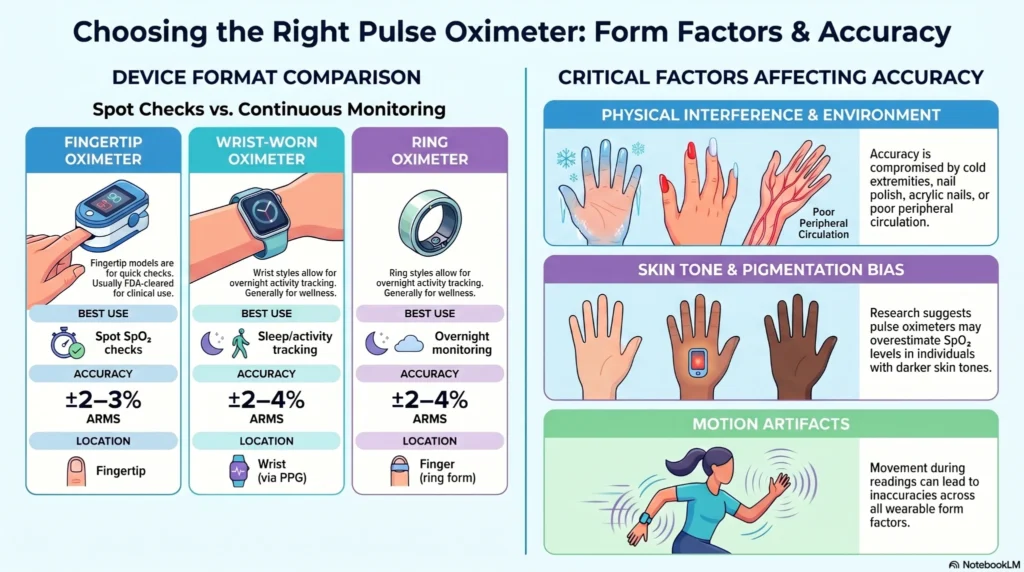
Pulse oximeters use photoplethysmography (PPG) — a light-based method that reads your pulse by shining light through your skin — to non-invasively estimate SpO₂ by measuring differential absorption of red and infrared light through perfused tissue. [3]
Device Format Comparison
| Feature | Fingertip Oximeter | Wrist-Worn Oximeter | Ring Oximeter |
| Sensor location | Fingertip | Wrist (via PPG) | Finger (ring form) |
| Continuous monitoring | No (spot check) | Yes | Yes |
| Intended use | Spot SpO₂ checks | Sleep/activity tracking | Overnight or activity monitoring |
| FDA clearance (typical) | Many have 510(k) clearance | Varies by model | Varies by model |
| Prescription required | No (OTC) | No (OTC) | No (OTC) |
| Clinical accuracy standard | ±2–3% ARMS | ±2–4% ARMS (varies) | ±2–4% ARMS (varies) |
| Common limitations | Motion artifact, nail polish, poor perfusion | Wrist positioning, motion | Ring fit, motion |
| Skin tone accuracy note | Performance may vary in darker skin tones [4] | Performance may vary [4] | Performance may vary [4] |
Key Limitations to Note
- SpO₂ readings may be inaccurate with cold extremities, poor peripheral circulation, nail polish, or acrylic nails. [3]
- Evidence suggests that pulse oximeters may overestimate SpO₂ in people with darker skin pigmentation — this is an area of active research and regulatory review. [4, 5]
- Wearable form factors are generally intended for general wellness tracking, not clinical monitoring, unless otherwise cleared by the FDA.
- Spot-check devices are not a substitute for continuous clinical monitoring in high-acuity settings.
Continuous SpO₂ Monitors
Continuous SpO₂ monitoring devices provide real-time, ongoing oxygen saturation data — as opposed to periodic spot checks. These are used in both clinical environments and, increasingly, in home-based care settings for specific conditions.
Continuous SpO₂ Monitor Characteristics
| Characteristic | Details |
| Signal type | Real-time PPG-based SpO₂ |
| Data output | Continuous numerical readout; trend recording |
| Alarm capability | Threshold-based alerts (e.g., SpO₂ <90%) |
| Primary clinical use | ICU, post-operative monitoring, sleep studies |
| Home-use applications | COPD monitoring, nocturnal hypoxemia assessment |
| Prescription status | May require prescription for medical-grade devices |
| Data connectivity | Bluetooth, cloud upload, EHR integration (clinical models) |
Considerations
- Clinical continuous monitors carry higher accuracy requirements than consumer wearables.
- Home continuous monitors may be used under physician guidance for conditions such as COPD, heart failure, or sleep-disordered breathing.
- Recording duration varies by device — relevant for overnight or extended monitoring protocols.
Medical-Grade vs Consumer Pulse Oximeters: Accuracy, FDA Clearance, and When It Matters
A meaningful distinction exists between FDA-cleared medical-grade pulse oximeters and consumer wellness devices.
Clinical vs Consumer Oximeter Comparison
| Attribute | Clinical / Medical-Grade | Consumer / Wellness |
| FDA pathway | 510(k) clearance (Class II medical device) | Often not FDA-cleared; may be Class I exempt |
| Accuracy standard | ±2% ARMS (FDA guidance: 70–100% SpO₂ range) | Variable; often ±2–4% or unspecified |
| Intended use | Diagnostic support; clinical monitoring | General wellness tracking |
| Data validation | Clinical trials across diverse skin tones required | Not required |
| Insurance coverage | May be covered with prescription | Generally not covered |
| Cost range | Higher ($50–$300+ for consumer-clinical; higher for hospital-grade) | Lower ($20–$80 typical) |
| Examples of use settings | Hospital, clinic, physician-supervised home monitoring | Personal health tracking, fitness, sleep apps |
⚠️ Regulatory Note: The FDA has issued guidance documents on pulse oximeter accuracy and limitations, particularly regarding performance in individuals with dark skin pigmentation. Readers should consult the FDA website or their healthcare provider for current guidance. [5]
Sleep Apnea Therapy Devices
If you’ve been told you stop breathing during sleep — or you wake up exhausted no matter how long you rest — PAP therapy is likely what your doctor will recommend next. Here’s what each type does, and why your prescription might specify one over another.
Sleep apnea is a condition characterized by repeated partial or complete obstruction of the upper airway during sleep, resulting in disrupted breathing and intermittent hypoxemia. [6] Positive airway pressure (PAP) therapy is the most widely studied first-line treatment for moderate-to-severe obstructive sleep apnea (OSA). [7]
⚠️ All PAP therapy devices referenced in this section require a prescription in the United States. Device settings must be prescribed and configured by a licensed healthcare provider.
PAP Device Category Overview
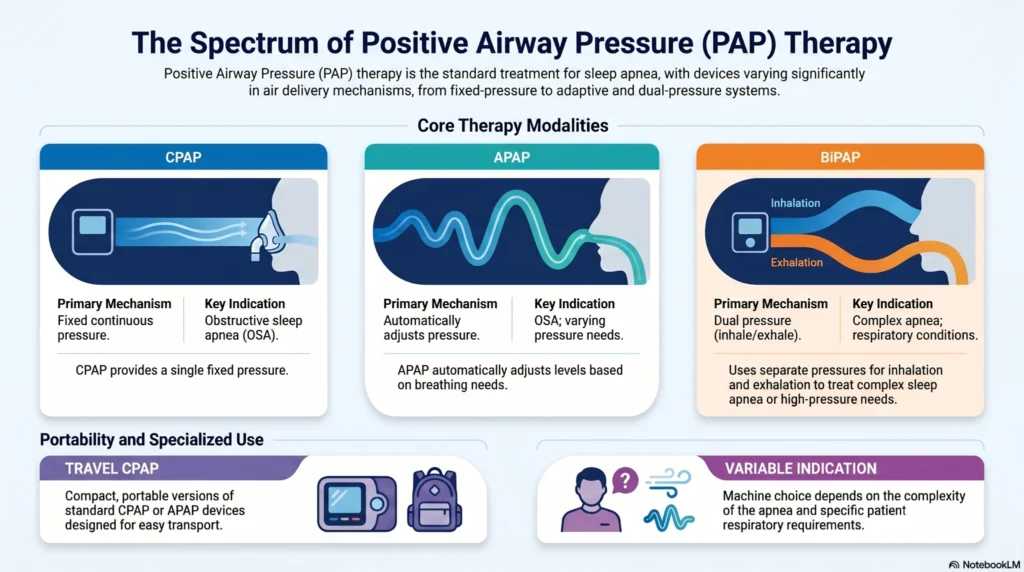
| Device Type | Primary Mechanism | Key Indication |
| CPAP | Fixed continuous pressure | Obstructive sleep apnea (OSA) |
| BiPAP/BPAP | Dual pressure (inhale/exhale) | OSA with high pressure needs; complex sleep apnea; some respiratory conditions |
| APAP/Auto-CPAP | Automatically adjusts pressure | OSA; varying pressure needs |
| Travel CPAP | Compact CPAP or APAP | OSA; travel and portability needs |
CPAP Machines
Continuous positive airway pressure (CPAP) machines deliver a single, fixed pressure level throughout the breathing cycle. This constant airflow acts as a pneumatic splint, preventing airway collapse during sleep. [7]
CPAP Machine Key Features
| Feature | Details |
| Pressure delivery | Fixed, prescribed pressure (typically 4–20 cm H₂O) |
| Prescription required | Yes |
| Humidity support | Most include integrated or compatible heated humidifier |
| Data recording | Most current models record AHI, leak rate, usage hours |
| Connectivity | Many models offer Bluetooth/cellular data upload to provider |
| Mask compatibility | Full face, nasal, nasal pillow masks (sold separately) |
| Average daily use recommendation | ≥4 hours/night for insurance compliance (varies by plan) |
| Evidence base | Extensive; established first-line therapy for moderate-to-severe OSA [7] |
| Typical cost & coverage | Without insurance: $500–$1,500. Medicare Part B and most private insurers cover CPAP with a qualifying sleep study. Out-of-pocket cost with coverage: typically $0–$150 after deductible. Prior authorization is commonly required — confirm with your plan before ordering. |
📋 What consistent CPAP use is associated with: Research shows that regular CPAP use in people with moderate-to-severe OSA is associated with reduced daytime sleepiness, improved mood and cognitive function, lower blood pressure, and a reduced risk of cardiovascular events. These outcomes depend on consistent nightly use — typically defined as 4 or more hours per night. [7, 8]
Common CPAP Concerns — and What Actually Helps
- Mask leak or discomfort is the most common reason people stop using CPAP — but it’s almost always fixable. Most DME suppliers offer mask exchanges within 30 days, and switching from a full-face mask to a nasal pillow mask resolves discomfort for many users. Ask your supplier about a trial period before committing to one style.
- Aerophagia (air swallowing) can cause bloating or discomfort. Lowering pressure or switching to APAP often helps — discuss this symptom with your prescribing provider rather than stopping therapy.
- Pressure-related discomfort at the fixed setting is common in the first weeks. Many providers now prescribe APAP for initial therapy because it adjusts automatically as your needs change.
- Claustrophobia with a full-face mask typically resolves with a nasal or nasal pillow mask alternative. Many people who initially struggle with CPAP adapt successfully after a mask change. [8]
💬 Many CPAP users share mask-fitting tips and first-night experiences in online communities like Reddit’s r/SleepApnea. While peer advice can be reassuring, always confirm device or setting changes with your prescribing provider.
→ Ready to compare specific CPAP models? See our Best CPAP Machines guide for model-by-model comparisons, or use the checklist below to prepare for your provider conversation.
CPAP vs BiPAP: When Bilevel Therapy Is Prescribed
Bilevel positive airway pressure (BiPAP/BPAP) devices deliver two distinct pressure levels: a higher inspiratory positive airway pressure (IPAP) and a lower expiratory positive airway pressure (EPAP). This differentiation may reduce the work of breathing on exhalation compared to fixed CPAP. [9]
BiPAP Key Specifications
| Attribute | Details |
| Pressure levels | IPAP (inspiration) and EPAP (expiration), set independently |
| Pressure range | Typically 4–25 cm H₂O (IPAP); lower EPAP |
| Prescription required | Yes |
| Primary indications | OSA with high pressure requirements; central sleep apnea; COPD with hypercapnia; neuromuscular conditions |
| Backup rate option | Some models include timed backup breath delivery (BiPAP-ST) |
| Cost comparison vs CPAP | Generally higher |
| Insurance coverage | May require documentation of CPAP trial failure or specific diagnosis |
When BiPAP May Be Considered
- Patient unable to tolerate CPAP exhalation pressure.
- Prescribing clinician determines CPAP insufficient for achieving adequate therapy.
- Presence of central or complex sleep apnea components.
- Specific comorbidities (e.g., COPD, OHS) where bilevel support is clinically indicated.
⚠️ BiPAP device selection and settings are determined exclusively by a prescribing clinician based on diagnostic data (e.g., polysomnography (an overnight sleep study that records breathing, oxygen levels, and brain activity results).
APAP Machines: How Auto-CPAP Works and Who It’s For
Auto-titrating PAP (APAP or AutoCPAP) machines automatically adjust delivered pressure within a prescribed range in response to detected breathing events, flow limitation, or snoring signals. [10]
APAP vs Fixed CPAP Comparison
| Attribute | Fixed CPAP | APAP |
| Pressure delivery | Single fixed level | Variable, within prescribed range |
| Algorithm response | None | Real-time adjustment to breathing events |
| Prescription required | Yes | Yes |
| Suitable for | Stable OSA with known pressure needs | Varying pressure needs; initial titration support |
| Data reporting | Usage, leak, AHI | Usage, leak, AHI, pressure distribution |
| Evidence base | Extensive | Well-established; comparable efficacy to CPAP in many OSA patients [10] |
| Common use case | Long-term OSA therapy | Post-titration therapy; variable severity OSA |
Travel CPAP Options
Travel CPAP devices are compact, lightweight versions of standard CPAP or APAP machines designed for portability. They are intended to maintain therapy continuity during travel.
Travel CPAP Characteristics
| Feature | Standard CPAP | Travel CPAP |
| Weight | ~1–3 lbs (450–1,360 g) | ~0.5–1 lb (225–450 g) typical |
| Size | Desktop unit | Compact; fits carry-on or small bag |
| Power input | AC (standard outlet) | AC + DC; many support 12V, USB-C, or battery packs |
| FAA carry-on status | Generally exempt from carry-on size limits as medical device | Same |
| Humidifier | Integrated heated humidifier standard | Often optional or waterless humidifier |
| Data recording | Standard | Varies; some models limited |
| Pressure range | Full range | Full range (device dependent) |
| Prescription required | Yes | Yes |
📝 Note: Travelers using PAP therapy should carry their prescription documentation and device power adapter information. Airlines generally classify CPAP devices as medical equipment exempt from standard carry-on restrictions, though policies vary. [11]
Oxygen Therapy Devices
Being told you need supplemental oxygen can feel alarming — but for many people with COPD, pulmonary fibrosis, or heart failure, it’s what allows them to stay active, sleep better, and avoid hospitalizations. This section explains the device types your provider may prescribe and what distinguishes them.
Oxygen therapy devices deliver supplemental oxygen to individuals whose arterial oxygen levels fall below clinically acceptable thresholds. Supplemental oxygen is indicated for conditions including COPD with hypoxemia, pulmonary fibrosis, heart failure, and other conditions causing chronic hypoxemia. [12]
⚠️ Prescription Requirement: Supplemental oxygen is a prescription medical treatment in the United States. Use without medical supervision is not recommended and may be harmful in some clinical contexts. [12]
Home vs Portable Oxygen Concentrators: Key Differences for COPD and Chronic Hypoxemia
Oxygen concentrators generate concentrated oxygen from ambient air by filtering out nitrogen using pressure swing adsorption (PSA) technology — a filtering process that pulls concentrated oxygen out of ordinary room air. They do not require oxygen tank refills. [13]
Home vs Portable Oxygen Concentrator Comparison
| Attribute | Home Oxygen Concentrator (HOC) | Portable Oxygen Concentrator (POC) |
| Oxygen delivery | Continuous flow | Continuous flow or pulse dose (device dependent) |
| Oxygen output | Typically 1–10 LPM | Typically 1–6 LPM (continuous); pulse dose settings vary |
| Power source | AC power only | AC, DC (car), and battery |
| Weight | 15–55 lbs (6.8–25 kg) | 2–10 lbs (0.9–4.5 kg) |
| Portability | Stationary; wheeled for in-home movement | Designed for travel and mobility |
| FAA approval | Not applicable | FAA-approved models available for air travel |
| Noise level | Moderate (30–55 dB typical) | Lower (varies) |
| Maintenance | Filter cleaning; regular service | Filter cleaning; battery maintenance |
| Prescription required | Yes | Yes |
| Typical cost & coverage | HOC: $500–$1,500 to purchase; often provided as rental by DME supplier. Medicare Part B covers home oxygen equipment (including concentrators) with a qualifying SpO₂ threshold and Certificate of Medical Necessity. Most private insurers follow similar criteria. [15] | POC: $1,500–$3,500. |
Pulse Dose vs Continuous Flow
| Delivery Mode | How It Works | Consideration |
| Continuous flow | Constant oxygen stream regardless of breath timing | Required for higher flow rates; sleep use; some clinical indications |
| Pulse dose (demand) | Oxygen delivered only on inhalation detection | More battery-efficient; may not be suitable for all patients or sleep use |
⚠️ Pulse dose delivery is not universally appropriate. Clinical guidance on whether continuous flow or pulse dose is suitable for a specific patient is determined by the prescribing provider. [13]
Oxygen Tanks vs Concentrators: Which Is Right for Your Situation?
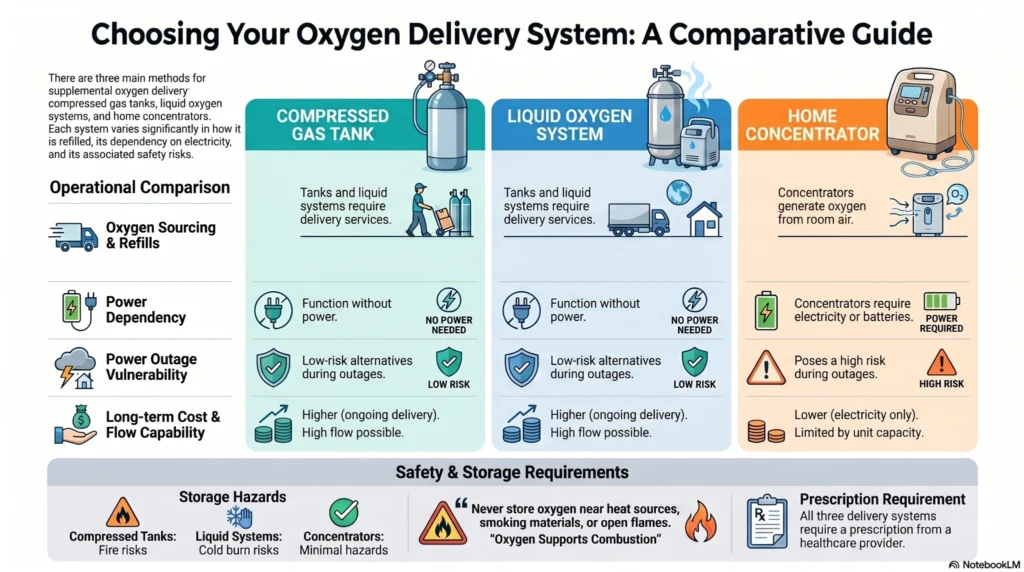
Compressed gas oxygen tanks (cylinders) and liquid oxygen systems represent an alternative to concentrators for supplemental oxygen delivery.
Oxygen Tank vs Concentrator Comparison
| Attribute | Compressed Gas Tank | Liquid Oxygen System | Home Concentrator |
| Oxygen source | Pre-filled compressed gas | Liquid oxygen (cryogenic) | Generated from room air |
| Refill required | Yes (delivery service) | Yes (delivery service) | No |
| Flow capability | High flow possible | High flow possible | Limited by unit capacity |
| Portability | Small cylinders portable; large tanks stationary | Portable unit filled from reservoir | Stationary (HOC) or portable (POC) |
| Power dependency | None | None (reservoir) | Yes (electrical outlet or battery) |
| Power outage risk | Low (no power needed) | Low | High (concentrator stops) |
| Long-term cost | Higher (ongoing delivery) | Higher (ongoing delivery) | Lower (electricity only) |
| Storage safety | Requires secure, ventilated storage; fire risk | Requires secure, ventilated storage; cold burn risk | Minimal storage hazard |
| Prescription required | Yes | Yes | Yes |
⚠️ Safety Note: Compressed oxygen supports combustion. Users should follow all safety guidelines regarding storage near heat sources, smoking, and open flames. These guidelines are typically provided by the prescribing provider and oxygen supplier. [14]
Prescription Requirements
Supplemental oxygen is classified as a prescription medical device in the United States and most countries with regulated healthcare systems.
Prescription Process Overview
| Step | Details |
| 1. Clinical evaluation | Healthcare provider assesses symptoms and orders diagnostic testing |
| 2. Diagnostic testing | Arterial blood gas (ABG) or pulse oximetry under qualifying conditions |
| 3. Qualifying thresholds | SpO₂ ≤88% at rest, on exertion, or during sleep (Medicare criteria; clinical criteria may vary) [15] |
| 4. Prescription issuance | Provider issues Certificate of Medical Necessity (CMN) or equivalent |
| 5. Supplier sourcing | Durable medical equipment (DME) supplier provides device per prescription |
| 6. Insurance coverage | Medicare Part B and most insurers cover oxygen therapy with qualifying documentation [15] |
| 7. Follow-up | Provider re-evaluates oxygen need at intervals per clinical protocol |
⚠️ Prescribing thresholds and insurance coverage criteria vary. Readers should consult their healthcare provider and insurance plan for specific requirements.
→ Comparing home oxygen options? See our Best Oxygen Concentrators guide for product-level comparisons, or ask your DME supplier which models your insurer approves.
Respiratory Treatment Devices
If you or a family member has asthma, COPD, or cystic fibrosis, you may already be using one of these devices — or your doctor may have recommended one recently. This section explains how nebulizers, peak flow meters, and spirometers work and why each one matters for managing your condition at home.
Respiratory treatment devices support airway management, medication delivery, and lung function measurement. They are used across conditions including asthma, COPD, cystic fibrosis, and other pulmonary disorders.
Types of Nebulizers for Home Use: Jet, Ultrasonic, and Mesh Compared
Nebulizers convert liquid medication into a fine aerosol mist that can be inhaled directly into the airways and lungs. They are commonly used to deliver bronchodilators, corticosteroids, antibiotics, and mucolytics. [16]
Nebulizer Type Comparison
| Type | Mechanism | Key Characteristics | Common Use |
| Jet (pneumatic) nebulizer | Compressed air breaks liquid into aerosol | Reliable; lower cost; requires compressed air source | Home and clinical use; standard asthma/COPD |
| Ultrasonic nebulizer | High-frequency vibration atomizes liquid | Quieter; faster treatment; may heat medication | Home use; some medications incompatible |
| Mesh nebulizer | Liquid passes through vibrating mesh plate | Compact; battery-capable; efficient; portable | Travel; pediatric use; efficient medication delivery |
Nebulizer Use Considerations
| Consideration | Details |
| Prescription | Nebulizers are typically OTC devices; nebulized medications require prescription |
| Cleaning protocol | Regular disinfection required to prevent bacterial contamination [16] |
| Medication compatibility | Not all medications are compatible with all nebulizer types |
| Treatment time | Jet: 10–15 min; Ultrasonic: faster; Mesh: 5–10 min (varies) |
| Mask vs mouthpiece | Mouthpiece preferred for most adults; masks used for young children or those unable to use mouthpiece |
Peak Flow Meters
A peak flow meter measures peak expiratory flow rate (PEFR) — the maximum speed at which a person can exhale after taking a full breath. PEFR is used primarily in asthma management to assess airway obstruction and monitor treatment response. [17]
Peak Flow Meter Summary
| Attribute | Details |
| Measurement | Peak expiratory flow rate (L/min) |
| Primary use | Asthma monitoring; response to bronchodilator therapy |
| Device types | Mechanical (standard); electronic (digital readout) |
| Prescription required | No (OTC) |
| Reference values | Compared to personal best or predicted normal values by age, sex, and height [17] |
| Frequency of use | As directed by prescribing provider; often daily in moderate-to-severe asthma |
| Zone system | Green (≥80% of personal best), Yellow (50–79%), Red (<50%) — zones defined by provider [17] |
| Limitations | Effort-dependent; results vary with technique and cooperation |
Spirometers
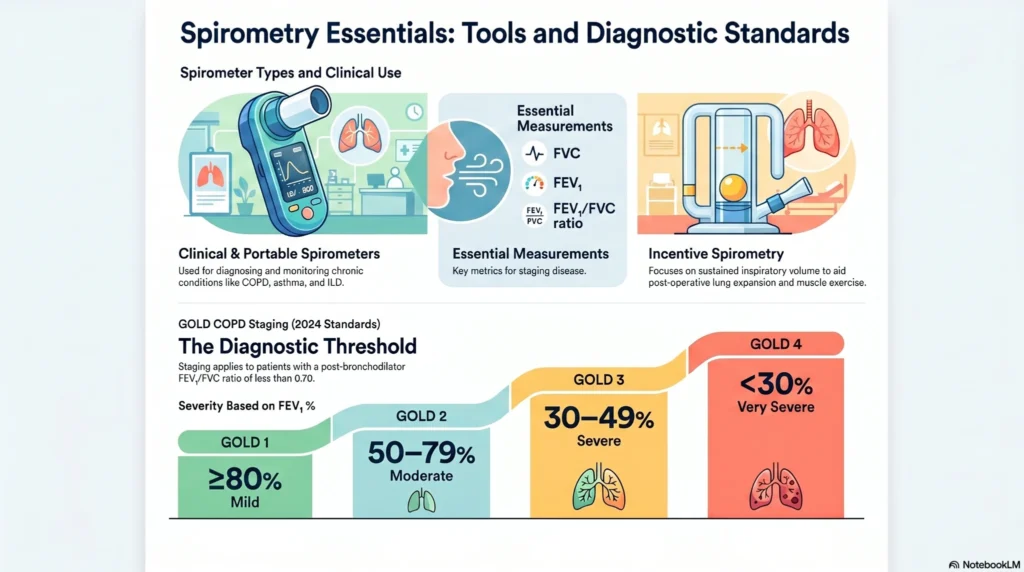
A spirometer measures multiple lung function parameters, including forced vital capacity (FVC), forced expiratory volume in one second (FEV₁), and the FEV₁/FVC ratio — key values in diagnosing and staging obstructive and restrictive lung diseases. [18]
Spirometer Types and Context
| Type | Setting | Key Measurements | Use |
| Clinical spirometer | Physician office, pulmonary function lab | FVC, FEV₁, FEV₁/FVC, flow-volume loop, MVV | Diagnosis and staging of COPD, asthma, ILD |
| Handheld / portable spirometer | Home or point-of-care | FVC, FEV₁, FEV₁/FVC | Monitoring; telemedicine integration |
| Incentive spirometer | Post-operative/hospital | Sustained inspiratory volume | Respiratory muscle exercise; post-surgical lung expansion |
Spirometry Diagnostic Reference (GOLD COPD Staging)
| GOLD Stage | FEV₁ % Predicted (post-bronchodilator, FEV₁/FVC <0.70) | Severity |
| GOLD 1 | ≥80% | Mild |
| GOLD 2 | 50–79% | Moderate |
| GOLD 3 | 30–49% | Severe |
| GOLD 4 | <30% | Very Severe |
Source: Global Initiative for Chronic Obstructive Lung Disease (GOLD) 2024 Report [19]
⚠️ Spirometry results must be interpreted by a qualified clinician in the context of clinical history, symptoms, and other diagnostic findings. The table above is for educational reference only.
How Each Device Works
This section provides brief, mechanism-focused explanations of how each major device category functions. These descriptions are intended to support user understanding, not to substitute for clinical instruction.
Device Mechanism Summary Table
| Device | Core Technology | Measurement or Output |
| Fingertip pulse oximeter | Photoplethysmography (PPG): red/infrared light absorption ratio through fingertip | SpO₂ (%), pulse rate (bpm) |
| Wearable SpO₂ monitor | PPG sensor at wrist, ring, or earlobe; continuous signal processing | SpO₂ trends, heart rate, HRV |
| CPAP machine | Motor-driven blower generates fixed positive airway pressure via tubing and mask | Delivered pressure (cm H₂O); usage and AHI data |
| BiPAP/BPAP device | Dual-level pressure cycling: higher IPAP on inhalation, lower EPAP on exhalation | IPAP/EPAP pressures; usage data |
| APAP machine | Algorithm monitors airflow, detects events (apneas, hypopneas, flow limitation), adjusts pressure in real time | Pressure range; AHI; pressure distribution |
| Home oxygen concentrator | Pressure swing adsorption (PSA): nitrogen selectively removed from room air using zeolite molecular sieve | Oxygen-enriched output (typically 87–96% O₂ purity at prescribed LPM) |
| Portable oxygen concentrator | Same PSA principle as HOC; pulse dose or continuous flow; battery-powered option | SpO₂ support at prescribed LPM |
| Jet nebulizer | Compressed air entrains liquid medication; Bernoulli effect creates aerosol droplets | Aerosolized medication droplets (~1–5 µm for lung deposition) |
| Mesh nebulizer | Piezoelectric actuator vibrates mesh plate; liquid forced through mesh holes creates fine droplets | Small, consistent aerosol droplets; efficient medication delivery |
| Peak flow meter | Mechanical vane or electronic sensor measures maximum forced expiratory airflow | PEFR in liters per minute (L/min) |
| Spirometer | Measures volume and flow of air moved during controlled breathing maneuvers | FVC, FEV₁, FEV₁/FVC ratio, flow-volume loop |
Choosing for Your Condition
⚠️ The guidance in this section is educational and categorical. It does not constitute a recommendation for any individual. Device selection and prescription must be determined by a licensed healthcare provider based on a complete clinical evaluation.
Condition-Based Device Consideration Overview
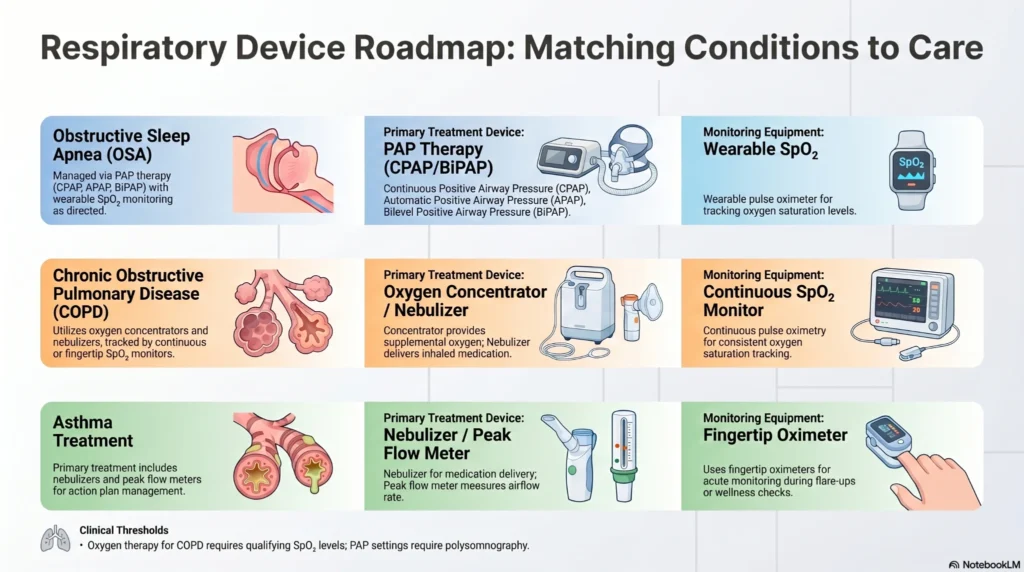
| Condition | Primary Device Category | Monitoring Device | Notes |
| Obstructive sleep apnea | PAP therapy (CPAP, APAP, BiPAP) | Wearable SpO₂ (as directed) | Device type and settings prescribed after polysomnography (an overnight sleep study that records breathing, oxygen levels, and brain activity) |
| COPD | Oxygen concentrator (if hypoxemic); nebulizer; spirometer for monitoring | Continuous SpO₂ monitor or fingertip oximeter | Oxygen therapy requires qualifying SpO₂ thresholds |
| Asthma | Nebulizer; peak flow meter | Fingertip oximeter (acute monitoring) | Peak flow meters central to action plan management |
| General monitoring | Fingertip pulse oximeter | Same | Appropriate for periodic wellness checks; not diagnostic |
For Sleep Apnea
| Consideration | Details |
| Diagnosis pathway | Sleep study (in-lab polysomnography or home sleep test) required for OSA diagnosis |
| First-line device | CPAP is the most widely studied first-line PAP therapy for moderate-to-severe OSA [7] |
| When APAP may be considered | When fixed pressure titration study is not completed; varying pressure needs |
| When BiPAP may be considered | High pressure requirements; CPAP intolerance; central or complex sleep apnea; specific comorbidities |
| Travel considerations | Travel CPAP maintains therapy continuity; same prescription applies |
| SpO₂ monitoring | May be used adjunctively to assess therapy effectiveness; not a substitute for PAP therapy |
| Mask selection | Full face, nasal, or nasal pillow; selected based on breathing pattern, comfort, and provider guidance |
📋 Free resource: [Questions to Ask Your Doctor Before Starting CPAP or Oxygen Therapy →] A printable checklist of 8 questions to bring to your next appointment — covering device options, prescription requirements, insurance coverage, and mask fitting. [Download the checklist — no sign-up required] (or) [Get it by email →]
For COPD
| Consideration | Details |
| Oxygen therapy | Indicated when resting SpO₂ ≤88% or with qualifying exertional or nocturnal hypoxemia [15] |
| Concentrator type | Home concentrator for primary use; portable concentrator for mobility |
| Pulse dose vs continuous | Determined by prescribing provider based on SpO₂ response to each delivery mode |
| Nebulizer use | Commonly used to deliver bronchodilators (e.g., albuterol, ipratropium) and other inhaled medications [16] |
| Spirometry monitoring | Used periodically to assess disease progression and treatment response [18, 19] |
| SpO₂ monitoring | Ongoing monitoring at home may support early identification of exacerbations; guidance from provider recommended |
| BiPAP consideration | BiPAP may be prescribed for COPD with hypercapnic respiratory failure in specific clinical contexts [9] |
For Asthma
| Consideration | Details |
| Peak flow meter | Central tool in asthma action plans; daily monitoring in moderate-to-severe asthma [17] |
| Nebulizer use | Delivers bronchodilators during acute episodes; used when MDI/spacer is insufficient or not tolerated [16] |
| Spirometry | Periodic spirometry supports diagnosis, classification, and monitoring of asthma control [18] |
| SpO₂ monitoring | Fingertip oximetry may be used during acute episodes to guide care-seeking decisions — thresholds defined by provider |
| CPAP/BiPAP | Not a standard asthma therapy; may be used in specific acute or comorbid scenarios under clinical direction |
For General Monitoring
| Consideration | Details |
| Device type | Fingertip pulse oximeter (OTC) is appropriate for periodic SpO₂ spot checks |
| Accuracy considerations | Choose an FDA-cleared device; be aware of accuracy limitations in darker skin tones [4, 5] |
| Appropriate use | Wellness tracking; identifying significant changes in SpO₂ to prompt provider consultation |
| Not appropriate for | Diagnosing conditions; replacing clinical monitoring; managing active respiratory illness without provider guidance |
| When to consult a provider | SpO₂ readings consistently below 95%; rapid decline; symptoms of dyspnea, chest pain, or confusion |





Insurance & Coverage Guide
Device costs vary widely, and insurance coverage is one of the most common reasons people delay or abandon treatment. The following outlines typical coverage criteria for the most commonly prescribed respiratory devices.
⚠️ Coverage criteria, authorization requirements, and out-of-pocket costs vary by plan, state, and individual clinical documentation. Always confirm with your insurance plan and prescribing provider before purchasing or renting a device.
CPAP / APAP / BiPAP Medicare Part B covers PAP therapy for OSA when prescribed following a qualifying sleep study (in-lab polysomnography or home sleep test) and when the patient demonstrates compliance — typically defined as use for ≥4 hours/night on ≥70% of nights during a 30-day period. Most private insurers apply similar criteria. Prior authorization is commonly required. Out-of-pocket costs with coverage are typically $0–$150 after deductible (20% of Medicare-approved amount). Devices may be rented or purchased depending on the supplier and plan.
Home Oxygen Therapy Medicare Part B (and most private insurers) cover home oxygen equipment — including concentrators, tanks, and portable units — when a qualifying SpO₂ threshold is met (typically ≤88% at rest, on exertion, or during sleep) and when a Certificate of Medical Necessity (CMN) is issued by the prescribing provider. Coverage is reviewed periodically; re-evaluation by your provider is required. [15]
Nebulizers The nebulizer device itself is typically covered under Medicare Part B as durable medical equipment when prescribed. Medications delivered via nebulizer require a separate prescription and may be covered under Medicare Part D or the equivalent prescription benefit under private plans.
Pulse Oximeters Standard OTC fingertip pulse oximeters are generally not covered by insurance. Medical-grade continuous monitoring devices prescribed for clinical monitoring may be covered under DME benefits with appropriate documentation.
📋 Before your appointment, ask your provider:
- What are my out-of-pocket costs after insurance?
- Do I need prior authorization for this device?
- Will you issue a Certificate of Medical Necessity?
- Does my plan cover rental or purchase — and which is better for my situation?
References
- World Health Organization. Pulse Oximetry Training Manual. Geneva: WHO Press; 2011. Available at: https://www.who.int/patientsafety/safesurgery/pulse_oximetry/en/
- Jubran A. Pulse oximetry. Critical Care. 2015;19(1):272. doi:10.1186/s13054-015-0984-8
- Nitzan M, Romem A, Koppel R. Pulse oximetry: fundamentals and technology update. Medical Devices (Auckland, NZ). 2014;7:231–239. doi:10.2147/MDER.S47319
- Sjoding MW, Dickson RP, Iwashyna TJ, Gay SE, Valley TS. Racial bias in pulse oximetry measurement. New England Journal of Medicine. 2020;383(25):2477–2478. doi:10.1056/NEJMc2029240
- U.S. Food and Drug Administration. Pulse Oximeters: Recommendations for Patients and Caregivers. Updated 2024. Available at: https://www.fda.gov/medical-devices/safety-communications/pulse-oximeters-recommendations-patients-and-caregivers
- American Academy of Sleep Medicine. International Classification of Sleep Disorders. 3rd ed. (ICSD-3). Darien, IL: AASM; 2014.
- Epstein LJ, Kristo D, Strollo PJ, et al. Clinical guideline for the evaluation, management and long-term care of obstructive sleep apnea in adults. Journal of Clinical Sleep Medicine. 2009;5(3):263–276.
- Weaver TE, Grunstein RR. Adherence to continuous positive airway pressure therapy: the challenge to effective treatment. Proceedings of the American Thoracic Society. 2008;5(2):173–178. doi:10.1513/pats.200708-119MG
- Masa JF, Mokhlesi B, Benítez I, et al. Long-term clinical effectiveness of continuous positive airway pressure therapy versus non-invasive ventilation therapy in patients with obesity hypoventilation syndrome: a multicentre, open-label, randomised controlled trial. The Lancet. 2019;393(10182):1721–1732. doi:10.1016/S0140-6736(18)32978-7
- Ayas NT, Patel SR, Malhotra A, et al. Auto-titrating versus standard continuous positive airway pressure for the treatment of obstructive sleep apnea: results of a meta-analysis. Sleep. 2004;27(2):249–253. doi:10.1093/sleep/27.2.249
- Federal Aviation Administration. Portable Oxygen Concentrators. Available at: https://www.faa.gov/passengers/fly_safe/portable_oxygen
- Global Initiative for Chronic Obstructive Lung Disease (GOLD). Global Strategy for the Diagnosis, Management, and Prevention of COPD. 2024 Report. Available at: https://goldcopd.org
- Hardinge M, Annandale J, Bourne S, et al. British Thoracic Society guidelines for home oxygen use in adults. Thorax. 2015;70(Suppl 1):i1–i43. doi:10.1136/thoraxjnl-2015-206865
- National Fire Protection Association (NFPA). Home Oxygen Safety. Available at: https://www.nfpa.org
- Centers for Medicare & Medicaid Services. Local Coverage Determination (LCD): Home Oxygen (L33797). Available at: https://www.cms.gov
- Dolovich MB, Ahrens RC, Hess DR, et al. Device selection and outcomes of aerosol therapy: evidence-based guidelines. Chest. 2005;127(1):335–371. doi:10.1378/chest.127.1.335
- National Heart, Lung, and Blood Institute. Expert Panel Report 3: Guidelines for the Diagnosis and Management of Asthma. NIH Publication No. 08-4051. Bethesda, MD: NHLBI; 2007.
- Miller MR, Hankinson J, Brusasco V, et al. Standardisation of spirometry. European Respiratory Journal. 2005;26(2):319–338. doi:10.1183/09031936.05.00034805
- Global Initiative for Chronic Obstructive Lung Disease (GOLD). GOLD 2024 Pocket Guide to COPD Diagnosis, Management, and Prevention. Available at: https://goldcopd.org
Written by Dr. Rishav Das, M.B.B.S. — see About page for credentials
Reviewed according to the medical standards outlined on our About page
Last Review: 2026-15-05